Last updated: November 20, 2026
Quick answer: most businesses should choose occurrence coverage if they want fewer timing traps; claims-made coverage can work better only when they can manage a retroactive date, reporting windows, and an extended reporting period. This article explains how to choose a claims-made or occurrence form for your business, and it uses the exact policy timing that matters: when the loss happens, when the claim is made, and how long the claim can surface later. For many businesses, an occurrence policy is easier to live with; a claims-made policy can fit better when the insured wants tighter control over reporting terms and can keep those terms steady.
Key takeaways
- The real choice is about timing: when the injury or damage happens, and when the claim is first made.
- An occurrence policy is simpler for long-tail risk because the loss date drives coverage.
- A claims-made policy puts more weight on reporting windows, the retroactive date, and continuity.
- Businesses that expect a long gap between the event and the claim should be careful with claims-made forms.
- This is general information. For a specific policy, use a lawyer or broker who can review the exact wording.
What is the real choice here?
The real choice is whether your business wants coverage tied mainly to the date of the event or to the date the claim is first made and reported. That is the core difference between an occurrence policy and a claims-made policy, and it changes how a business should think about old incidents, new claims, and policy changes.
An occurrence form usually fits when the business wants the simplest story: if the injury or damage happened during the policy period, the claim can still land later and the policy form is still the one that matters. A claims-made form puts more weight on the claim being made during the policy term, with the retroactive date and reporting rules shaping the rest.
For example, a consulting firm, a contractor, and a retailer can all need liability coverage, but the timing of their risk can look very different. That is why business insurance basics matter before a buyer picks a form. A single answer is wrong for everyone.
How does an occurrence policy work?
An occurrence policy works best when the business wants the cleanest fit for losses that can surface long after the work or event is over. The trigger is the occurrence itself, so the key question is whether the bodily injury, property damage, or other covered event happened during that policy period.
That matters because some claims show up late. A customer injury, a completed-job dispute, or property damage may not be reported until well after the policy year ends. With an occurrence form, the old policy can still be the one that responds if the event happened during its term.
The drawback is less about the trigger and more about the long tail of old exposures. A business can keep the right policy paperwork for years and still need to track which occurrence form was in force on the loss date. If recordkeeping is weak, the simplicity of the form can be lost in the file cabinet.
This form is usually a strong fit for businesses that want fewer moving parts in the reporting process and that value coverage tied to the event date. It is a weaker fit when the business expects to rewrite or replace coverage often and wants the policy structure to make that easier.
How does a claims-made policy work?
A claims-made policy works best when the business can control timing, track a retroactive date, and keep the reporting rules tight. The claim has to be made during the policy period, and the policy language usually turns on when the claim is first reported and whether the loss falls after the retroactive date.
That makes this form more exacting. A business cannot just ask, “Did the incident happen while I was insured?” It also has to ask whether the claim came in during the right period and whether the act, error, or injury is old enough to fit under the retroactive date. If those pieces do not line up, the policy can leave a gap.
The upside is that this structure can match businesses that keep close insurance controls and want the form to mirror their reporting habits. Professional firms and operations with defined reporting systems often find this form workable because they know when claims are likely to be reported and can maintain continuity.
The downside is just as plain: claims-made coverage punishes sloppiness. Miss the reporting window, lose track of the retroactive date, or let coverage lapse without understanding the extended reporting period, and a business may face a gap at exactly the wrong time. For a company with poor administrative discipline, that is a real risk.
What changes the answer most?
The answer changes most when the business has a long delay between the event and the claim, or when the policy history is likely to change. A claims-made policy is more sensitive to timing, while an occurrence policy is more forgiving on when the claim arrives.
| Criteria | Claims-made policy | Occurrence policy | Winner for this condition |
|---|---|---|---|
| Trigger | Claim must be made in the covered period, with reporting tied to the policy terms | Event must happen during the policy period | Occurrence, for late claims |
| Retroactive date | Usually matters | Usually not part of the core trigger | Occurrence, for simpler history |
| Reporting requirement | Central to coverage | Less central than the event date | Occurrence, for easy administration |
| Extended reporting period | Often relevant | Usually not the main feature | Claims-made, if continuity is managed |
| Late-discovered harm | More sensitive | Better suited | Occurrence |
| Policy changes over time | Can create gaps if mishandled | Easier to compare year to year | Occurrence |
| Administrative burden | Higher | Lower | Occurrence |
| Need for tight dating rules | Strong fit | Weaker fit | Claims-made |
| Long-tail risk | More delicate | Better aligned | Occurrence |
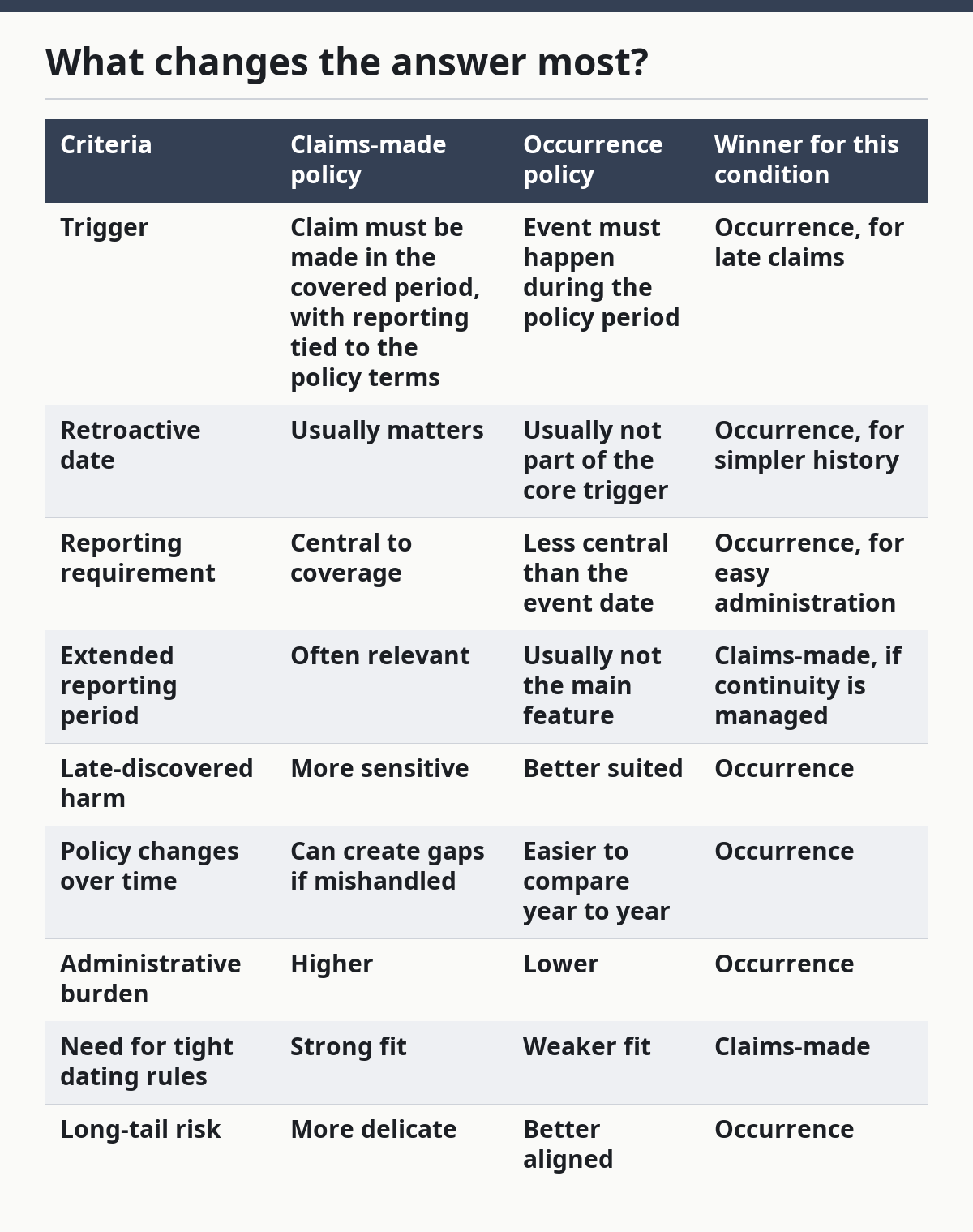
The table points to a plain pattern: occurrence coverage is the safer default for businesses that want fewer timing traps. Claims-made can still be the right answer, but only if the business is set up to respect the retroactive date and reporting windows.
Two sources explain the timing issue in general terms. The Insurance Information Institute discusses the claims-made and occurrence distinction, and the National Association of Insurance Commissioners publishes consumer material on commercial insurance. Those are good starting points before a lawyer or broker reviews the actual policy form.
Which form fits a claims-made policy?
A claims-made policy fits best when the business has steady insurance management and a real reason to care about how claims are reported. That usually means a company with a known retroactive date, a habit of reviewing policy language at renewal, and a need to keep the reporting rules aligned with its operations.
This form can work well for businesses where claims are likely to be noticed and reported in a controlled way. A professional practice, a service firm, or another business with regular administrative review may handle the timing rules without trouble. The extended reporting period can also be part of the plan, but only if the business understands what it does and does not do.
The weakness is obvious: this is not a casual form. A business that forgets dates, changes carriers without checking the old exposure, or assumes old incidents will stay covered without reading the reporting rules is asking for trouble. The retroactive date is not decorative. It is one of the main boundaries of the policy.
A claims-made form is not the right pick for a business that wants to place coverage once and think less about timing after that. It is also not the right pick if the business has a pattern of changing insurers without careful review of the policy dates. A professional liability insurance review can help here because that line often uses claims-made wording.
Which form fits an occurrence policy?
An occurrence policy fits best when the business wants the policy form to follow the event date and reduce the number of moving parts. That makes it a strong choice for businesses that value predictability, especially when a claim may not appear until months or years after the actual incident.
The chief advantage is that the policy period is anchored to when the damage or injury happened. That can be easier to explain, easier to file, and easier to match to older records. A business does not need to track a claims-made reporting deadline in the same way, and the retroactive date is not part of the core decision.
The drawback is that the business still has to know which occurrence form was in force when the event happened. That means old policy records matter. If the company has many policy years and poor filing habits, even an occurrence form can become hard to use when a claim finally arrives.
This form is usually the better fit for businesses that want the clearest coverage story and the least timing risk. It is a weaker fit only when a business has a strong administrative reason to prefer the claims-made structure and can manage it carefully. A general liability policy often uses occurrence wording, which is why many buyers find it easier to follow.
What are the exception scenarios?
The overall recommendation flips in a few narrow situations. A claims-made policy can be the better fit if the business has a stable claims process, a clear retroactive date, and a real need for the reporting structure to match its operations.
For example, a business that expects claims to be reported quickly and systematically may accept the tighter structure of claims-made coverage. A business that has already built its insurance program around a claims-made form may also be better off staying with that design than changing the structure without a full review. Where the policy wording and reporting process are tightly managed, the claims-made form can be the cleaner administrative choice.
The occurrence form can also be the wrong answer if the business is looking for a structure that depends on careful dating and strict reporting control. In that case, the simpler trigger may not fit the business model even if it feels easier at first glance.
These exceptions do not change the basic rule. They just show that the better form is the one that matches the business’s loss timing, filing discipline, and willingness to manage dates. A general rule is helpful; the policy form still has to fit the actual risk.
What should a business choose?
Choose an occurrence policy if the business wants the simpler default, expects claims to surface late, or does not want the retroactive date and reporting rules to drive the decision. Choose a claims-made policy if the business can manage the timing rules, wants the policy structure to follow reporting dates, and has a clear plan for the retroactive date and extended reporting period. If the business cannot keep policy dates straight, neither form is a good fit.
That is the cleanest answer for most businesses. Occurrence is the safer fit for fewer timing traps. Claims-made is the more technical fit for businesses that can live inside the timing rules and keep them under control.
Which policy form is better for my business?
The better form is the one that matches how claims arise in your business and how carefully your records are kept. If claims may appear long after the work or event, occurrence usually fits better because the loss date drives coverage. If your business can manage a retroactive date, reporting rules, and an extended reporting period, claims-made may fit better.
What is the difference between claims-made and occurrence coverage?
The difference is the trigger. An occurrence policy responds to an event that happens during the policy period, while a claims-made policy responds to a claim made during the policy period, subject to the retroactive date and reporting terms. That timing difference is what makes one form easier for some businesses and riskier for others.
When does each policy form make sense?
Occurrence makes sense when the business wants simpler timing and expects claims to arrive late. Claims-made makes sense when the business can control reporting dates and wants a form that is built around claim timing. The right choice depends on how losses happen and how strong the business is at tracking policy dates and coverage changes.
Drafted with AI; not yet reviewed by a person.