Last updated: November 20, 2026
Policy Language and Endorsements Explained
Quick answer: one endorsement can change a business liability policy’s coverage. Policy language and endorsements are the fastest way to see what a commercial policy really covers, and the topic of Policy Language and Endorsements: The Complete Guide: related questions starts with the base form, then every endorsement that changes limits, definitions, exclusions, or defense duty.
People who read commercial liability forms for work start with the declarations page, then move straight to exclusions and endorsements. That order helps because a single change can affect an aggregate limit or a defense obligation without changing the policy title at all, as consumer guidance from the NAIC and contract-form resources from IRMI both stress.
Key takeaways
- The main policy tells you the default rules; endorsements change those rules.
- An endorsement can raise, narrow, or replace coverage terms, so it matters as much as the base form.
- Aggregate limits are easy to misunderstand because they cap the insurer’s total payment for the policy period, not just one claim.
- The most useful reading order is declarations page, insuring agreement, definitions, exclusions, conditions, then endorsements.
- A policy can look generous on paper and still leave a gap if an endorsement cuts back a definition or adds a limit subcap.
What does policy language actually control?
Policy language controls what the insurer agrees to pay, when it must defend, and what it can deny. In a business liability policy, that language usually sits in the insuring agreement, definitions, exclusions, conditions, and limit section, and the words in those parts can matter more than the policy name on the front page.
The declarations page gives the broad numbers, such as the per-occurrence limit and the general aggregate limit. The body of the policy explains what counts as an occurrence, what counts as property damage or bodily injury, and when the insurer’s duty to defend starts or ends. If a term is defined in one section and used again in another, the definition controls unless an endorsement replaces it.
So this is where a lot of people go wrong. They look at the declarations page, see a large number, and assume that number applies to every loss. It does not. A policy with a $1 million general aggregate limit can still run out if several claims hit the same policy period, the same insured, or the same product hazard, depending on the form wording.
Because that limit can be used by more than one claim, the practical rule is simple: the base policy sets the starting point, but it does not tell the whole story. If the policy has form numbers like ISO CG 00 01 or similar commercial general liability wording, the fine print decides what the limit really means.
What changes when an endorsement is added?
An endorsement changes the policy by modifying, adding to, or replacing part of the original wording. Sometimes it is broad and obvious, such as a limit change. Sometimes it is narrow, such as adding one scheduled additional insured or excluding one type of work.
That is why endorsements are not “extra paperwork.” They are part of the contract. If an endorsement says “this endorsement changes the policy,” then the endorsement wins over the older language where they conflict. That is true even when the base form still looks unchanged on the page.
A common mistake is treating all endorsements as helpful, but some narrow coverage. For a real-world check, review the wording with a licensed insurance professional or legal counsel if the endorsement affects a contract or a large loss. A waiver of subrogation endorsement, for example, may help with a contract requirement, while an additional insured endorsement may help with a client deal. But an endorsement can also reduce coverage, add a sublimit, or narrow a definition so much that the protection you thought you had is no longer there, which is why IRMI and insurer guidance both recommend reading the exact form.
Here is the cleanest way to think about it: the base policy is the default contract, and the endorsement is a targeted edit. A few words in an endorsement can change the result of a claim as much as a full page of base-form language.
How do aggregate limits work in business liability policies?
An aggregate limit is the maximum amount the insurer will pay for covered losses during the policy period, and that is different from the limit for one claim. In many business liability policies, the declarations page shows both the per-occurrence limit and the general aggregate limit, and the policy language explains when each one applies.
This matters because several smaller claims can use up the aggregate limit before the policy year ends. That can leave the insured paying the rest of any later covered claim out of pocket unless another limit applies.
The wording also matters for what counts against the aggregate. Some policies have separate aggregates for products-completed operations, premises, or specific hazards. Other policies use endorsements to create a separate aggregate or to move one exposure into a different bucket. If the endorsement changes the limit structure, the declarations page alone will not tell you the full story.
A good reading habit is to ask three questions every time: what is the per-occurrence limit, what is the aggregate limit, and does any endorsement create a different cap for a specific risk? That is the shortest path to spotting a coverage shortfall before a claim arrives.
Base policy vs. endorsement: what is the real difference?
The base policy sets the standard rules, while the endorsement changes those rules for a specific condition, class of risk, or insured. The base form is the starting contract, and the endorsement is the edit that can win over it.
| Criteria | Base policy | Endorsement | Winner for this condition |
|---|---|---|---|
| Default effect | Sets the original coverage terms | Alters or replaces a term | Base policy for general reading |
| Legal weight | Controls unless changed | Controls where it conflicts | Endorsement when there is a conflict |
| Scope | Broad, policy-wide | Narrow or targeted | Base policy for broad rules |
| Limit impact | Often states the main limits | Can add a sublimit or separate aggregate | Endorsement when limits change |
| Clarity for claims | Gives the starting framework | Explains special exceptions or additions | Base policy for first review |
| Risk of hidden change | Lower if read alone | Higher because it can quietly narrow coverage | Endorsement review |
| Use in contracts | Standard insurance wording | Used to satisfy contract demands | Endorsement for contract-specific terms |
| Renewal impact | Often stable | Can change year to year | Endorsement if you need current details |
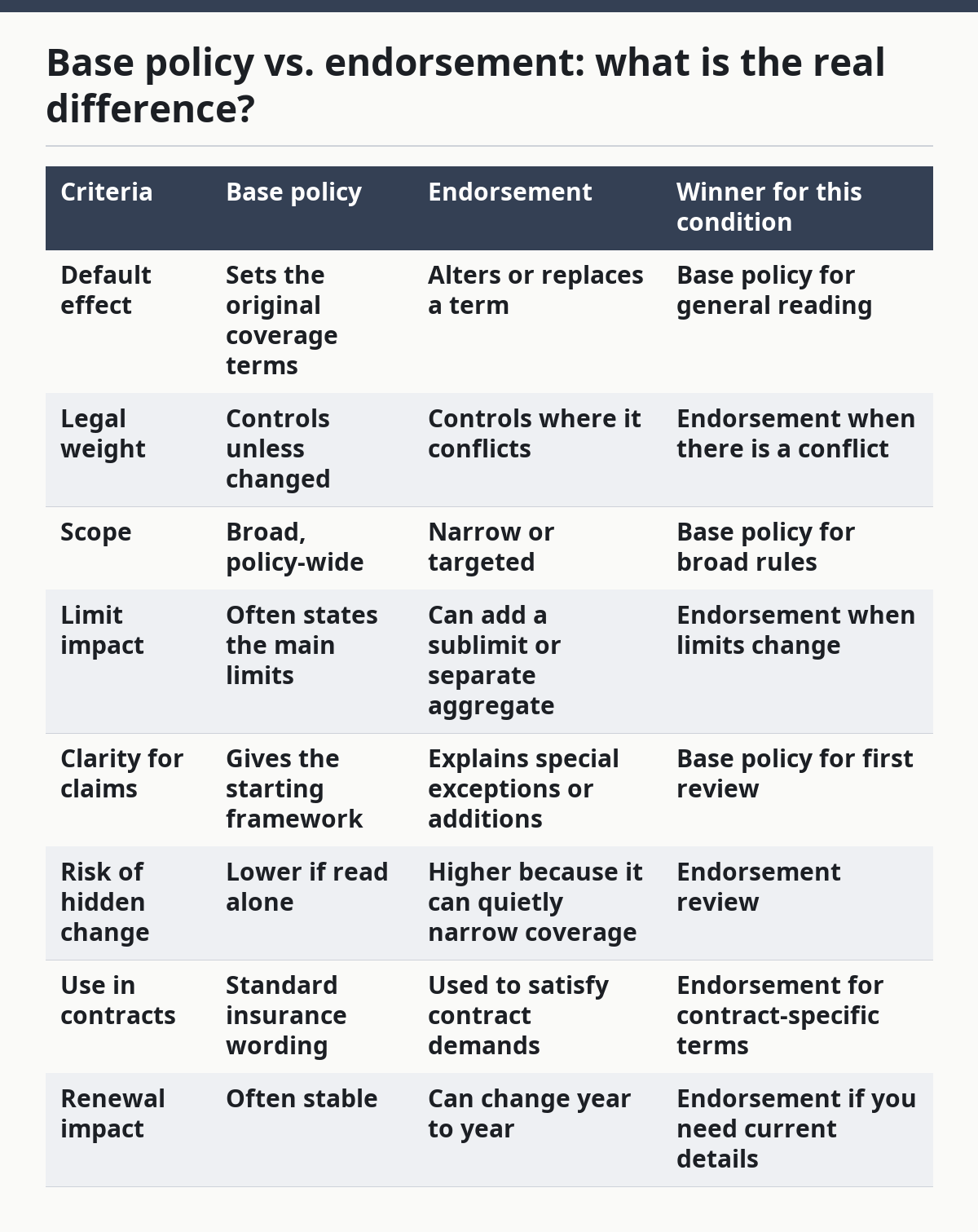
So the practical winner is the endorsement whenever it changes a limit, exclusion, or insured status. The base policy wins only as the default background rule. If you stop at the declarations page, you are reading half the contract and guessing at the rest.
Which endorsements matter most on a liability policy?
The endorsements that matter most are the ones that change limits, who is insured, what counts as covered work, or how defense costs are handled. In business liability forms, that usually means additional insured endorsements, waiver of subrogation endorsements, primary and noncontributory wording, and any endorsement that creates a separate aggregate or sublimit.
Additional insured language matters because it can expand protection to a customer, landlord, or general contractor. That can help the policyholder satisfy a contract, but it can also create pressure on the policy’s aggregate limit if the endorsement broadens the number of people who can make a claim under the same policy period.
Waiver of subrogation wording matters because it can affect the insurer’s right to recover from a responsible party. Primary and noncontributory wording matters because it can shift the order of payment between policies. A separate aggregate matters because it can carve one class of losses away from the general aggregate, which changes how fast the main limit gets used up.
However, the drawback is that these endorsements can be written so tightly that the result is narrower than it looks. A scheduled endorsement may protect only one named location, one contract, or one operation. If the insured assumes the wording applies everywhere, the policy can fail at the exact point where the claim starts.
When do endorsements create a gap?
An endorsement creates a gap when it narrows the policy more than the reader expects. That often happens when the endorsement changes a definition, adds a class exclusion, or introduces a sublimit that is lower than the main aggregate.
A gap can also appear when two endorsements point in different directions. One endorsement may add coverage for a vendor, while another cuts back coverage for the same kind of work. If you do not read both together, you can end up with a coverage map that looks better than the actual contract.
This is the point where the details matter most. An endorsement that says “for this endorsement only” can override the base form for a single provision. An endorsement that says “does not apply to” can remove coverage entirely for a specific loss type. Even a one-line change in the definitions section can alter the meaning of the whole policy.
Because of that, read endorsements as a chain, not as separate snippets. The order matters, the wording matters, and the dates matter. If an endorsement list is long, the risk is not that the policy is incomplete; the risk is that it is complete in a way the insured did not expect.
What should you check before renewal?
You should check the declarations page, every endorsement, and every limit change before renewal because renewal is where small wording changes hide. A policy that looked stable last year can shift on the new term without any dramatic change in the title page.
Start with the aggregate limit and per-occurrence limit. Then look for any new endorsement that changes an insured, a location, a hazard, or a defense condition. If a renewal replaces one endorsement with another, that swap can matter as much as a premium change, because the legal effect may be different even when the policy number looks familiar.
So the best check is mechanical, not emotional. Compare the current form and endorsements to the prior term line by line. If the current policy has a different ISO form number, a new schedule, or a new limitation, consult a licensed insurance professional or legal counsel and treat that as a coverage event, not just paperwork. A small edit can decide a large claim.
What should you ask if the wording is unclear?
You should ask what changed, what the change does to the limit, and which endorsement controls if there is a conflict. Those three questions are the fastest way to clear up most policy disputes before they turn into a claim fight.
If a term is undefined, ask where it is defined elsewhere in the policy package. If the policy uses a schedule, ask whether the schedule overrides the base form for that item. If the aggregate limit appears in one place and a sublimit appears in another, ask whether both apply or whether one replaces the other.
In particular, this is also the right moment to bring in outside help from a licensed insurance professional or legal counsel if the policy wording affects a contract or a large loss exposure. Policy language is contractual language, and the wrong reading of one endorsement can change the result of a claim.
What are the edge cases that change the answer?
The answer changes when the endorsement creates a separate aggregate, when a schedule names only one location or one project, when defense costs erode limits, or when an additional insured endorsement is narrower than the contract requires. In those cases, the “main” limit on the declarations page may not tell you what the claim will actually use up.
A separate aggregate can flip the analysis because it may protect one exposure without touching the general aggregate. A defense-within-limits policy can also change the math, because defense costs may reduce the amount left for indemnity. And if the policy uses project-specific or location-specific wording, the coverage you thought applied broadly may apply to only one site or one job.
Likewise, those cases are the reason a careful reader never stops at the title of the endorsement. The title may sound helpful, but the body of the endorsement decides the real effect.
FAQ
What is the difference between an endorsement and a rider?
An endorsement changes the policy contract, and “rider” is often used in the same way in casual speech. In commercial liability insurance, the endorsement is the more precise term, and it is usually the word that appears on the form itself.
Can an endorsement reduce coverage?
Yes. An endorsement can narrow a definition, add an exclusion, or create a lower sublimit. A form that looks like an upgrade on the label can still cut back coverage in the text, so the wording matters more than the title.
Does the aggregate limit apply to every claim?
Usually the aggregate limit caps covered losses during the policy period, but the exact rule depends on the form and any endorsements. Some claims may fall under a separate aggregate or a different limit bucket, so the declarations page alone is not enough.
What is the first page I should read?
The declarations page is the first page to check, because it shows the main limits and forms. The next pages are the endorsements, since they often change the meaning of those limits more than the base form does.
Why do endorsements matter so much on business liability insurance?
Endorsements matter because they can change who is covered, what is covered, and how much the insurer will pay. A single endorsement can affect an aggregate limit, a defense duty, or an exclusion, which is why they deserve the same attention as the main policy wording.
Drafted with AI; not yet reviewed by a person.