Last updated: November 20, 2026
Quick Answer: Liability exposure at a business event can involve 3 parties at once — the host, a vendor, and a sponsor — and it often rises during setup, teardown, alcohol service, and crowd movement. Business events create liability exposure when a host, vendor, or sponsor can be blamed for injury, property damage, or a contract dispute tied to the event. The risk is often higher at temporary venues, during setup and teardown, when alcohol is served, and when crowd control slips. Rules vary by jurisdiction, so this is general information and not legal advice; a qualified lawyer should be consulted for any specific event.
Key takeaways
- Liability at a business event is usually shared, not single-source. The host, vendors, and sponsors can each face different claims from the same incident.
- The riskiest moments are often outside the main program. Setup, teardown, delivery, alcohol service, and guest movement often create the strongest exposure.
- A temporary venue can shift responsibility in ways that surprise people, especially when the site is not built for the size or use of the event.
- Vendor contracts matter because indemnity language can move losses from one party to another, even when the vendor did not directly cause the harm.
- Sponsors can face exposure when their branding, staffing, or promotional role makes them look involved in event operations, not just marketing.
Who is exposed at a business event?
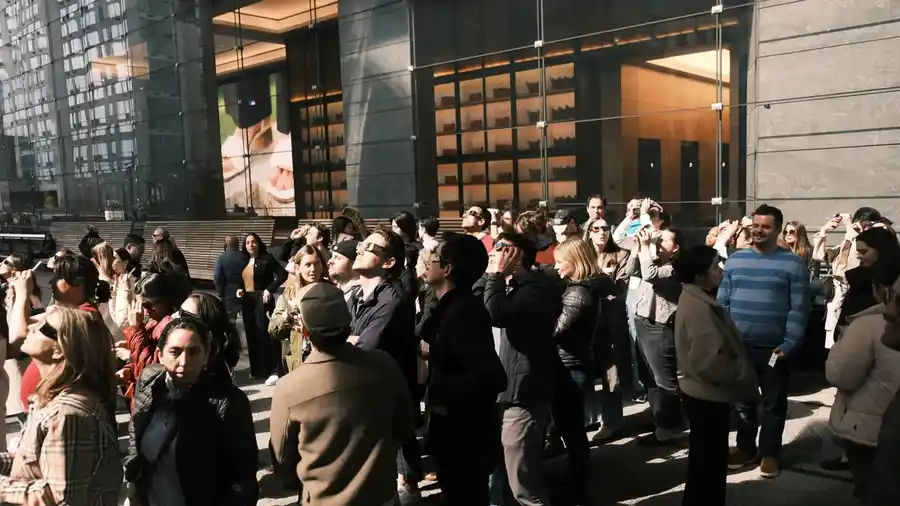
Business event liability exposure falls on the party that had control, created the risk, or agreed to bear it, and that can be the host, a vendor, a sponsor, or all three at once. A simple example is a reception held in a temporary venue where a guest slips near an unmarked cable: the host may face a claim for poor planning, the AV vendor for unsafe placement, and the sponsor if its staff helped run the room.
The legal theory changes by jurisdiction, but the practical pattern is the same. Claims often turn on negligence, premises control, contract promises, and who had the last clear chance to fix the problem. A host may control invitations and site selection, a vendor may control equipment or staffing, and a sponsor may control branded activities, giveaways, or hospitality space.
The term premises liability means a claim based on unsafe property conditions. At a business event, that can include a wet floor, a blocked exit, or a loading dock that was never meant for guest traffic. A temporary venue makes this more complicated because the space may be safe for storage or construction but not for a 300-person reception.
This page is for readers who need to understand event liability exposure as a risk-sharing problem, not as an insurance product page. It is not for someone who needs advice on a live dispute, a claim letter, or a contract fight already in motion.
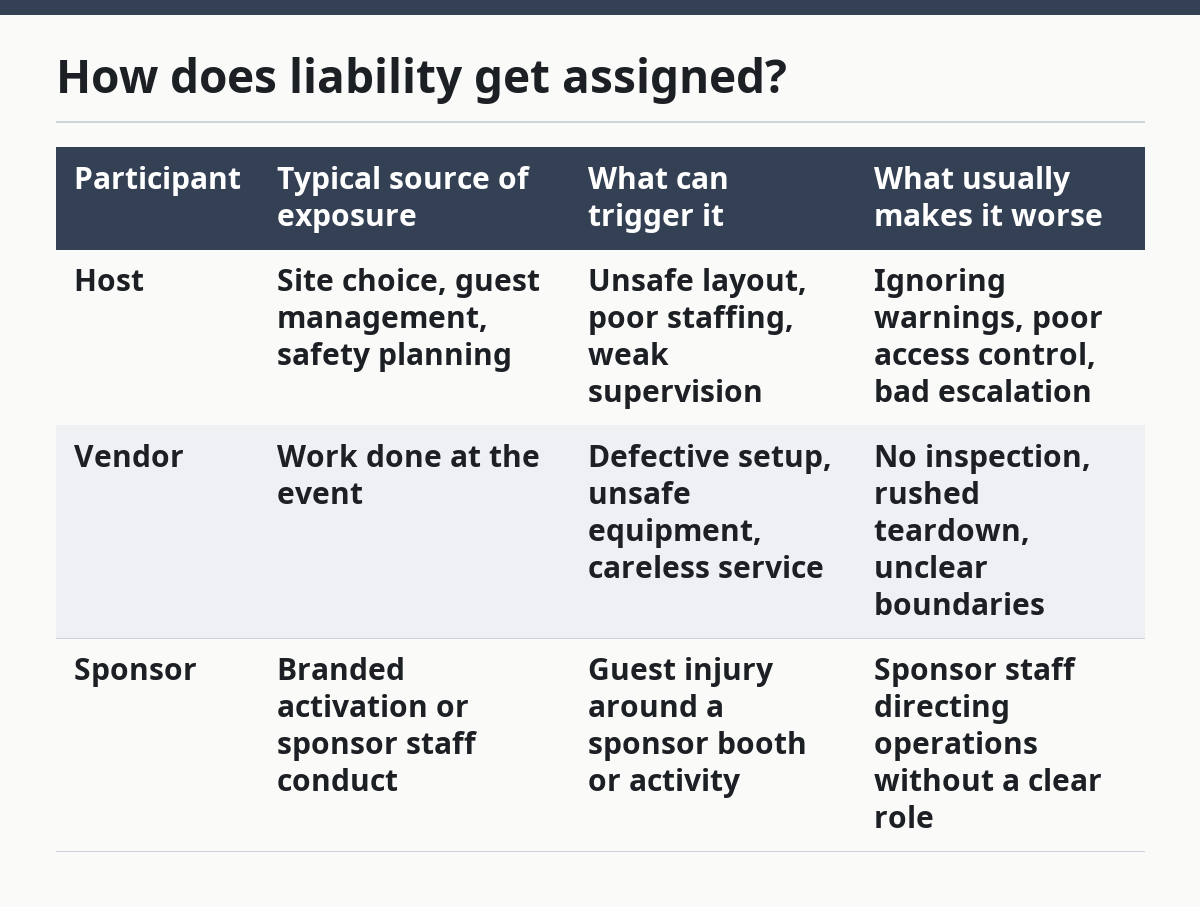
How does liability get assigned?
Liability gets assigned by looking at control, fault, and contract terms, then matching each person’s role to the harm that happened. In practice, that means the same incident can produce more than one claim path.
| Participant | Typical source of exposure | What can trigger it | What usually makes it worse |
|---|---|---|---|
| Host | Site choice, guest management, safety planning | Unsafe layout, poor staffing, weak supervision | Ignoring warnings, poor access control, bad escalation |
| Vendor | Work done at the event | Defective setup, unsafe equipment, careless service | No inspection, rushed teardown, unclear boundaries |
| Sponsor | Branded activation or sponsor staff conduct | Guest injury around a sponsor booth or activity | Sponsor staff directing operations without a clear role |
A vendor indemnity clause is a contract term that requires one party to cover certain losses or claims from another party. In plain language, it can move the bill from the host to the vendor, or the other way around, if the wording is broad enough and the law allows it. The problem is that many people sign these clauses without checking who is actually responsible for setup, supervision, cleanup, and third-party damage.
The sponsor’s risk is often misunderstood. A sponsor is not always just a name on a banner; if the sponsor runs a lounge, hands out samples, or staffs a registration desk, that role can look operational. Once that happens, the sponsor may be pulled into the claim even if it did not own the venue or plan the full event.
What happens at temporary venues?
Temporary venues create extra exposure because the space is assembled for the event and may depend on temporary fixtures, rented equipment, and short-term access routes. That changes everything from lighting to exits to the way people move through the room.
A temporary venue may be a tent, ballroom conversion, trade show hall, warehouse, parking structure, or outdoor site with portable flooring. These spaces often need additional checks for egress, fire lanes, barricades, signage, and load-bearing limits. If the room was built for 150 people and 400 show up, the hazard is no longer theoretical.
The host usually has the widest planning duty, but vendors can create their own exposure inside the same space. A decorator can block an exit, a caterer can leave a spill, and an AV team can run cables across a walkway. The temporary venue operator may also have its own duties, especially if it controls the site or provided the structure.
The most common mistake is assuming the venue contract solves the risk problem. A contract can allocate loss after an incident, but it does not stop the incident. If the room needs a 10-foot clearance for a stage and a service cart narrows it to 3 feet, the contract language does nothing for the guest who trips.
For event safety basics, OSHA’s walking-working surfaces guidance is a useful starting point, and NFPA 101 covers means of egress for occupied spaces (OSHA, NFPA 101).
What exposures do vendors create?
Vendors create exposure when their work changes the physical space, serves the public, or puts people in direct contact with goods, food, equipment, or power. The more a vendor touches the guest experience, the more claim paths open up.
Here is the practical sequence that should be checked before the event begins:
- Map the work area. Mark every setup zone, guest path, and delivery route on a site plan at room scale, then verify that no route crosses a fire exit or loading lane. A problem is any path that depends on people “just knowing” where to go.
- Match each vendor to a task list. Write down who handles power, rigging, food, alcohol, cleanup, and crowd flow, with one named contact per task. A problem is two vendors assuming the other one owns the same task.
- Check the contract for indemnity and hold-harmless language. Confirm whether the clause covers injury, property damage, defense costs, or only direct losses. A problem is language that shifts broad losses without limits while leaving the performance duties vague.
- Inspect physical hazards before doors open. Look for cords, wet surfaces, unstable props, sharp edges, unsecured signage, and blocked exits during the last 30 minutes before guests arrive, and consult a qualified safety professional or event attorney if the layout is complex. OSHA and NFPA guidance are useful reference points for walking surfaces and exits (OSHA, NFPA 101). A problem is any hazard that only exists once the event is live.
- Set supervision rules for high-risk work. Require direct oversight for rigs, cooking, alcohol service, and heavy deliveries, and define who can stop work. A problem is letting a crew work unsupervised during a rush.
- Control teardown timing. Separate guest departure from equipment removal whenever possible, and keep a clear path for carts and trucks. A problem is tearing down while guests are still in the same corridor.
- Document handoffs. Use a written sign-off when one party hands the space, equipment, or cash desk to another. A problem is a missing record of who had control when damage started.
That process does not make liability disappear, but it makes the exposure easier to sort out. It also helps when the same accident touches more than one vendor, which is common at multi-day conferences or trade events.
Because fast turnarounds create confusion, a vendor is often in a weaker position when it works quickly and without documentation. A rushed stage build, a late food delivery, or a last-minute cable run can create a clean sequence of blame after the fact. Slower setup, clearer handoff notes, and a hard stop for hazards that cannot be fixed before opening are usually the better risk controls.
How does alcohol service change the risk?
Alcohol service changes the risk because it can turn an ordinary guest injury into a conduct question about intoxication, supervision, and service control. A reception with open drinks is not the same as a trade show with coffee and soft drinks.
The exposure can sit with the host, the caterer, the bar operator, or a sponsor if the sponsor controls the hospitality area. The problem is not just the drink itself. It is the mix of crowd density, late hours, limited lighting, and guests moving through a temporary venue after service begins.
This is also where people make the mistake of thinking one contract clause settles everything. Alcohol-related claims often depend on who served, who supervised the area, and who had the power to cut service or remove a hazard. In many events, that power is split across more than one party.
I am not going into liquor coverage here, because that belongs on a separate page. The liability point is simpler: if alcohol is part of the event, the host and the service vendor need a clear line on who controls service, who watches the room, and who steps in when a guest should not be served.
Why does crowd control matter so much?
Crowd control matters because many event claims start when a guest flow turns into a crush, a bottleneck, or a blocked path. A lobby can be safe at 20 people and unsafe at 200, especially if a check-in table, sponsor booth, or photo wall narrows movement.
The host usually bears the broadest planning risk, but crowd control can expose anyone who helped shape the flow. A sponsor may create a line with a giveaway. A vendor may stage equipment where traffic should move. A venue operator may place barriers that look orderly but trap guests near an exit.
The practical test is simple: if the room depends on “people will probably stay calm,” the plan is weak. Real crowd control uses spacing, signage, staffing, and a clear lane for emergency access. If those pieces are missing, the claim will often focus on poor planning rather than a single act.
The consequence of weak crowd control is not limited to slips and trips. It can also affect evacuation, security, and the ability to respond to a medical event. Once the guest flow goes wrong, more than one party may be accused of failing to see the problem early enough.
When should a host, vendor, or sponsor stop and get legal help?
A host, vendor, or sponsor should stop and get legal help when the event plan depends on borrowed language, vague roles, or a risk that no one has clearly accepted in writing. That is especially true if the event uses a temporary venue, alcohol service, crowd-sensitive attractions, or several vendors working in the same footprint.
The contract uses broad indemnity language: it may shift defense costs and losses in ways that are hard to unwind later — get counsel to review the clause before signing. A 1-page signature sheet is not enough if the event is large or the role is unclear.
No one can say who controls a hazard zone: unclear control can turn one incident into three claims — define the controlling party in writing before setup starts. This matters around stages, kitchens, loading docks, and sponsor activations.
The site is temporary or converted for the day: temporary spaces often need separate safety checks — bring in qualified legal and site review before opening. A warehouse, tent, or parking structure is not a standard office floor.
Alcohol is served and the service rules are informal: intoxication claims can spread quickly between host and vendor — use a clear service plan and get legal review of the event structure. A casual “just keep an eye on things” approach is weak.
The event involves heavy equipment, rigging, or power distribution: these are high-consequence tasks — do not improvise roles or assume the venue covers it. A single loose cable can become a premises claim and a contract claim at the same time.
Someone is already injured or threatening a claim: the problem has moved from planning to response — stop debating fault in real time and get counsel. Statements made at the scene can affect the record later.
What mistakes do people actually make?
People usually make the same few mistakes, and each one makes the loss harder to sort out. The wrong move is rarely dramatic; it is usually a small omission that turns into a larger claim.
Therefore, they assume the host is always the only responsible party. That is wrong because vendors and sponsors can create their own operational exposure. The better alternative is a role map that names who controls each area.
Next, they treat a venue contract as a safety plan. That fails because a contract allocates risk after an incident, while safety planning tries to prevent the incident. The better alternative is a written site walkthrough and a last-minute hazard check.
Then, they let vendor boundaries blur during setup and teardown. That often leads to disputes about who caused the damage and who had the duty to stop work. The better alternative is a handoff record at each change of control.
Likewise, they ignore sponsor involvement once branding starts. A sponsor that hosts a booth, hands out items, or manages a lounge may no longer look like a passive advertiser. The better alternative is to treat sponsor operations as a live risk zone, not a logo placement.
Finally, they leave alcohol and crowd flow to general event staff without a clear escalation rule. That can leave no one with authority to slow service or redirect movement. The better alternative is a named decision-maker for the room.
How should a reader think about the risk mix?
A reader should think about business event liability exposure as a shared risk map, not a single policy question. The host usually owns the broad structure, vendors own their work, and sponsors can pick up exposure when they act like operators instead of advertisers.
Because of that, the general guide to commercial liability coverage by risk scenario fits best here, because it helps frame the event as a set of separate exposures rather than one lumped-together risk. That matters when the same accident can trigger different claims against different parties.
The honest trade-off is that tighter control costs more time and more paperwork. A 20-minute walkthrough, a few written handoffs, and a clear role chart can feel slow before the event starts. It is still cheaper than trying to sort out control after a guest injury, property loss, or contract dispute.
FAQ
Who is responsible at a business event?
Responsibility is usually shared, and it depends on who controlled the hazard, who created it, and what the contract says. A host may face the broadest planning exposure, while a vendor may be responsible for the work it performed, and a sponsor may be exposed if it took part in operations rather than just marketing.
What exposures do vendors create?
Vendors create exposure when their setup, service, or teardown changes the physical risk at the event. Common examples include cables across walkways, food-service spills, equipment placement, or unclear handoffs during teardown. The risk rises when the vendor controls a task but the contract does not clearly define that task.
How does a sponsor’s risk differ from a host’s?
A sponsor’s risk is usually narrower than a host’s, but it can grow fast if the sponsor becomes operational. A sponsor that merely buys visibility is in a different position from one that runs a lounge, staffs a booth, or directs guests. Once the sponsor acts like part of the event team, its exposure can look much closer to the host’s.
Drafted with AI; not yet reviewed by a person.