Last updated: November 20, 2026
Quick Answer: To use How to Use a Certificate of Insurance Without Mistaking It for Coverage, check 3 items—the policy number, expiration date, and any additional insured wording—before you rely on the page. A certificate of insurance is evidence that a policy may exist, not the policy itself, so use it as a check on names, dates, and policy references, not as proof that coverage will pay. If you are a certificate holder, or you are sending one to a third party, verify the document against the actual policy and any additional insured wording before you rely on it; when the stakes are contract rights or payment, consult a qualified insurance professional or lawyer. For a standard form reference, see ACORD, which publishes the widely used ACORD 25 certificate form.
Key takeaways
- A certificate can show that insurance was reported on a specific date, but it does not rewrite the policy.
- The three fields that matter most are the policy reference, the expiration date, and any additional insured wording.
- If the certificate conflicts with the policy language, the policy controls.
- Treat the certificate as a snapshot, not a promise, and get professional advice if the issue affects rights or payment.
- When the question is about payment, defense, or legal rights, the policy and endorsements matter more than the certificate.
Who should use a certificate this way?
Anyone who receives or requests a certificate of insurance should use it this way when they need to know what the page does, and does not, tell them. It assumes you already have the certificate in hand, usually on an ACORD 25 form or a similar insurance certificate, and you know the policy number, expiration date, and named insured shown on the page.
This is information, not financial advice. If your decision affects contract rights, loss payment, or a dispute over coverage, a qualified adviser should review your specific situation because insurance rules and contract terms vary by country and change over time.
A certificate of insurance is useful when you need a quick record for a job file, a vendor file, or a lease packet. It is not the place to decide whether a claim will be covered. That answer sits in the policy form, the endorsements, and the contract language behind the certificate; see also policy declarations and endorsements.
How do you use a certificate of insurance correctly?
You use a certificate of insurance correctly by checking it against the policy details it points to and by treating any gap as a warning sign. The certificate is a summary sheet, not a coverage grant, so the job is to verify identity, dates, and wording before you depend on it. For a plain-English overview, compare it with your certificate of insurance guide and the additional insured language in the policy.
- Read the policy reference number first: Match the policy number on the certificate to the policy file or the insurer’s record, and make sure the listed carrier name matches too; if the number is missing or does not line up, the certificate may be stale or wrong.
- Check the expiration date next: Confirm the policy term shown on the certificate has not ended, and note whether the date is current on the day you are reviewing it; if the date has passed, the certificate no longer tells you that the policy is in force.
- Verify the named insured exactly: Compare the named insured on the certificate with the legal entity in the contract, because a trade name alone can hide the wrong business; if the legal name is different, the certificate may not support the deal you think it does.
- Look for additional insured wording: Find the section that mentions additional insured status and check whether it is stated as a formal endorsement or only listed as a note; if there is no endorsement reference, the certificate may not create the protection you expected.
- Confirm the certificate holder is only the recipient: Treat the certificate holder line as a mailing or notice line, not as proof of rights under the policy; if the holder line is the only place your name appears, that does not tell you coverage has been extended to you.
- Compare the certificate to the contract requirement: Read the insurance clause in the contract and check whether the certificate actually matches the limits, dates, and wording the contract asks for; if the contract asks for something broader, the certificate alone does not close the gap.
- Check for exclusions or special notes: Review any remarks, limitations, or blanket statements that point to exceptions, because a short note can change how the page should be read; if the note is vague, consult a qualified professional and treat it as incomplete evidence rather than comfort.
- Save the certificate with the date received: Keep the certificate and the date it arrived in the same file so you can show what was known at that time; if you cannot prove when you got it, the document is weaker as a record.
The point is not to hunt for perfection. The point is to avoid treating a one-page summary as if it were a 20-page policy package, and that is why a lawyer or broker may need to review a disputed file. A certificate can help you sort files in under 5 minutes; it cannot answer every coverage question. For more on the policy side, see policy terms and claims handling.
What can a certificate of insurance prove?
A certificate of insurance can prove that someone presented insurance information on a specific date, with specific policy identifiers and an expiration date. It can also show that a certificate holder was named on the page and that additional insured wording may have been requested or noted.
It cannot prove that every promise in a contract is backed by the policy. It also cannot prove that a claim will be paid, that a defense will be provided, or that a policy term will survive a later dispute. That is why the policy reference matters so much: it is the bridge from the summary sheet to the actual contract. The certificate is evidence; the policy is the control document.
Here is the easiest way to think about the document set:
| Document | What it does | What it does not do |
|---|---|---|
| Certificate of insurance | Summarizes coverage facts on a date | Rewrite policy terms |
| Policy | States the actual insurance terms | Tell every third party what they want to hear |
| Endorsement | Changes or adds policy wording | Replace the rest of the policy |
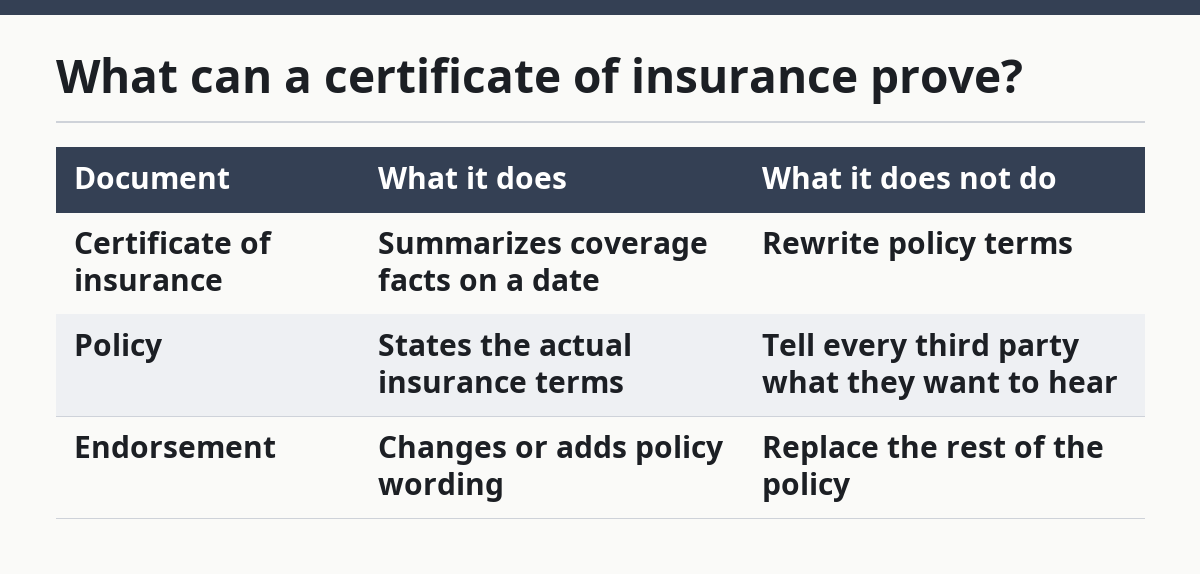
That table matters because many disputes start with someone reading the certificate as if it were the policy. It is not. The certificate is a record of what was shown, while the policy and endorsements are the documents that control the coverage terms. The NAIC explains that insurance information should be read in context, and the policy language controls.
What should you check before you rely on it?
You should check the expiration date, the policy reference, and the additional insured wording before you rely on a certificate. Those three items tell you whether the document is current, connected to a real policy, and tied to the rights you think it creates.
The expiration date is often the clearest warning sign, but it is not the only one. If a certificate shows a policy that ended on a prior date, the page may still be useful as history, but it is not a current proof of coverage. The policy reference tells you which contract to look up if you need to verify details, and the additional insured wording tells you whether the page is only noting a request or pointing to an actual endorsement.
A certificate holder should also look for consistency. If the named insured, carrier, policy number, and dates do not fit together, the document needs follow-up before it is used in a file, a lease packet, or a contract checklist. A mismatch of even one field can mean the wrong policy was attached, so compare it with the declarations page before you act.
When should you stop relying on the certificate?
You should stop relying on the certificate whenever the document and the contract do not line up, because the certificate does not fix the mismatch. In those cases, the right next step is to obtain the underlying policy or ask a qualified adviser to review the contract and insurance language.
The expiration date has passed: The page may be outdated — do not treat it as current proof of insurance.
The policy number does not match the contract file: The certificate may refer to a different policy — verify the underlying policy before using it.
The named insured is a different legal entity: The certificate may cover the wrong business — ask for the actual policy declaration page or related endorsement.
Additional insured wording is missing or vague: The certificate may not grant the status you expected — check the endorsement language, not the summary line.
The certificate holder line is the only place your name appears: That is often only a receipt or notice line — do not assume rights from that field alone.
The contract asks for a specific coverage term not shown on the page: The certificate is incomplete for that purpose — use the policy documents that set the real terms.
A certificate is a useful checkpoint, not a cure. If the issue is about loss payment, defense, or legal rights, the risk of reading the page too loosely is that you may assume protection that is not there. In a dispute, ask counsel or your broker to compare the certificate with the policy before you rely on it.
What mistakes do people make with certificates of insurance?
People usually make the same few mistakes, and each one has a simple consequence. The fix is to move from the summary page back to the policy documents instead of trusting the page by itself.
-
Treating the certificate as the contract. The consequence is false confidence about coverage. The correct alternative is to check the policy and endorsements that sit behind the certificate.
-
Ignoring the expiration date. The consequence is relying on an old record. The correct alternative is to confirm the date is still current at the time you use it.
-
Assuming the certificate holder has coverage rights. The consequence is believing a receipt line creates protection. The correct alternative is to look for actual policy wording or an endorsement.
-
Reading a note as if it were an endorsement. The consequence is overreading a summary remark. The correct alternative is to verify the policy reference and supporting endorsement language.
-
Missing a legal name mismatch. The consequence is working from the wrong entity. The correct alternative is to match the named insured exactly to the contract party.
-
Using one certificate for every purpose. The consequence is treating a 1-page summary like a full policy file. The correct alternative is to get the specific policy language that answers the exact question.
These mistakes are common because certificates are designed to be brief. A brief form is useful only when the reader remembers that it leaves out most of the contract. For related reading, see certificate tracking and vendor insurance requirements.
When does the standard reading not apply?
The standard reading needs extra care when the certificate is being used for a contract that depends on exact wording, such as additional insured status, waiver language, or a specific policy term. In those cases, a 1-page certificate is not enough by itself.
It also needs more care when the certificate is old, when the carrier name is unfamiliar, or when the policy reference appears inconsistent across documents. If the same file contains different dates or different insured names, do not guess which one is right.
Another edge case is when the certificate uses broad wording that sounds reassuring but does not point to a real endorsement. That is where many people slip: the page appears to say something useful, but the actual policy language may be narrower. The safer move is to verify the endorsement before relying on the summary, and to get a professional review if the contract is high-value or time-sensitive.
Why do people ask for a certificate of insurance?
People ask for a certificate of insurance because they want proof that insurance exists without waiting to read a full policy. The page is fast to review, easy to file, and gives them a policy reference, an expiration date, and a place to check whether additional insured wording appears.
That convenience is exactly why it gets misused. A certificate is a useful administrative document, but it is not a substitute for the policy itself. If the question is about what rights exist under the policy, the certificate is only the starting point.
What can a certificate prove?
A certificate can prove that insurance information was issued or presented for a particular policy on a particular date. It can also show the policy reference, expiration date, and whether additional insured wording was noted. It does not prove that the policy will respond to a claim in the way a reader expects.
What cannot be learned from a certificate?
You cannot learn the full policy terms from a certificate. You also cannot tell from the page alone whether exclusions, endorsements, or contract language limit coverage, because those details live in the policy package. If that question matters, the certificate is only a clue, not the answer.
Why do people ask for a certificate of insurance?
People ask for a certificate of insurance because they want a quick record before they sign a contract, open a file, or allow work to begin. The form helps them see current dates and policy references without reading the full policy packet first. That convenience is helpful, but it should never be treated as the final word on coverage.
Drafted with AI; not yet reviewed by a person.