Last updated: November 20, 2026
Commercial general liability policy setup and placement means matching the policy form, limits, endorsements, and carrier to the real risks in the business and the contracts it signs. Quick Answer: a CGL policy can run out in 12 months if the aggregate is too low, even when the premium looked attractive. If the coverage is set up wrong, the claim may land outside the policy even when the business thought it was protected. This is general information, not legal advice, and a qualified lawyer should be consulted on any specific matter because rules vary by jurisdiction. For background on CGL basics, see the Insurance Information Institute and the IRMI glossary.
Key takeaways
- The right CGL setup usually starts with the business’s contracts, operations, and locations, not with the cheapest premium.
- “Placement” is about more than buying a policy; it is about who is insured, what work is covered, where the work happens, and which endorsements change the deal.
- Aggregate limits matter because one claim can drain the policy and leave little or nothing for the rest of the policy term.
- Certificates of insurance are not the policy. A certificate can help prove coverage exists, but it does not change the policy form.
- If the business signs contracts, works on other people’s premises, or hires subcontractors, the policy needs closer review before binding.
What does a commercial general liability policy cover?
A commercial general liability policy covers the basic third-party claims that arise from a business’s operations, subject to the policy language and jurisdiction. In plain terms, that usually means bodily injury, property damage, and some personal and advertising injury claims.
The common mistake is to treat CGL as a catch-all. It is not, so a lawyer or broker should review the fit before binding. It usually does not replace workers’ compensation, professional liability, cyber coverage, auto coverage, or property insurance. If the business sells advice, designs, software, or a professional service, the CGL may leave a gap because those losses often sit in a different policy form. The Insurance Information Institute notes that CGL is designed for third-party claims, not every business loss.
Placement starts with the exposure, not the label on the policy. A retail tenant, a contractor, a manufacturer, and a consultant all need different attention even though they may all buy “general liability.” The same policy name can hide very different endorsements, exclusions, and completed operations terms.
For businesses that care about aggregate limit on business liability insurance, the key issue is how fast claims can eat through the total available limit. One slip-and-fall, one fire claim, or one product claim can use up a large share of the annual aggregate if the policy is thinly structured. That is why a cheap policy can be expensive later.
A useful first screen is simple:
- If the business only has office work and no customer foot traffic, the setup may be straightforward.
- If the business has a storefront, jobsite, delivery work, or subcontractors, the setup gets more complex.
- If the business signs contracts with indemnity, additional insured, or waiver language, the placement needs review before binding.
Quick check: if the business only wants “basic liability,” it may still need endorsements, contract review, and a closer look at the aggregate limit.
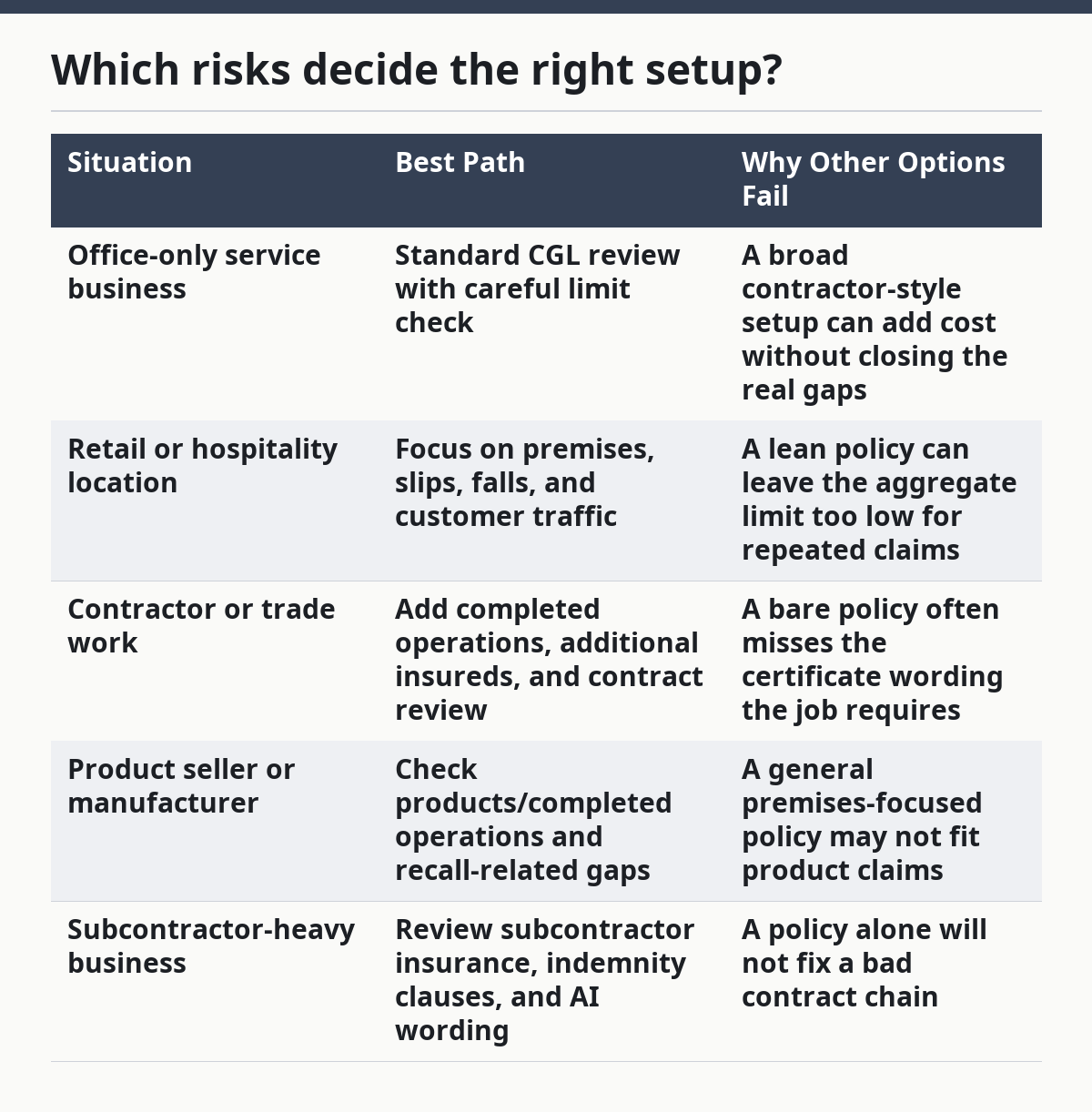
Which risks decide the right setup?
The right setup is driven by the specific risks the business creates, not by a standard form alone. The main drivers are operations, premises, products, completed work, and contracts.
If the business has customers on site, premises liability matters. If it works at job sites, completed operations and additional insured terms matter. If it ships products, product liability exposure matters. If it signs service contracts, the wording in those contracts can change what the policy must do.
Here is the decision pattern that matters most:
| Situation | Best Path | Why Other Options Fail |
|---|---|---|
| Office-only service business | Standard CGL review with careful limit check | A broad contractor-style setup can add cost without closing the real gaps |
| Retail or hospitality location | Focus on premises, slips, falls, and customer traffic | A lean policy can leave the aggregate limit too low for repeated claims |
| Contractor or trade work | Add completed operations, additional insureds, and contract review | A bare policy often misses the certificate wording the job requires |
| Product seller or manufacturer | Check products/completed operations and recall-related gaps | A general premises-focused policy may not fit product claims |
| Subcontractor-heavy business | Review subcontractor insurance, indemnity clauses, and AI wording | A policy alone will not fix a bad contract chain |
If the business operates across more than one state or country, rules can change on policy wording, certificates, and required endorsements. The same form can behave differently once local law enters the picture. That is why a placement done for one jurisdiction should not be copied blindly into another.
The underwriting file should reflect the real exposure. A carrier will usually want the business description, locations, payroll or revenue base, subcontractor use, and contract profile. If any of those are wrong, the premium may look fine while the coverage is misfit.
For a simple setup, the process usually goes in this order:
- List every real operation the business performs, including seasonal or temporary work.
- List every contract term that shifts risk, such as additional insured status or indemnity.
- Identify where losses could happen: premises, job site, product chain, or after work is done.
- Match those exposures to the policy form and endorsement list.
- Check whether the aggregate limit and per-occurrence limit are enough for the worst credible claim pattern.
- Confirm the certificate language matches the actual policy, not just the customer’s template.
Quick check: if the business’s risk comes from jobs, contracts, or products, then setup must be built around those facts, not around a standard “small business” form.
How do limits and aggregates change the placement?
Limits and aggregates change the placement because they decide how much protection is left after the first claim or two. A policy can have a decent per-occurrence limit and still be weak if the aggregate limit is too small for the business’s claim pattern.
The per-occurrence limit is the cap on one covered event, while the aggregate limit is the cap on all covered claims during the policy term. For a business with repeated small losses, the aggregate is often the hidden weak point. That matters in a year with multiple incidents, multiple job sites, or several claims from the same operating period.
The main placement question is not “What is the cheapest policy?” It is “What happens after one serious claim and two smaller ones?” If the answer is that the policy is almost exhausted, then the setup is probably too thin.
A practical comparison helps:
| Limit Structure | What It Does Well | Where It Breaks |
|---|---|---|
| Higher per-occurrence, low aggregate | Handles one large claim better | Can run out after repeated claims |
| Balanced per-occurrence and aggregate | Works better for steady operations | Costs more than bare-bones coverage |
| Low per-occurrence and low aggregate | Cheapest to buy | Weakest fit for active businesses |
| Higher aggregate with targeted endorsements | Better for claims frequency | Needs closer contract and operations review |
If the business signs contracts that require higher limits, the placement must follow the contract, not the other way around. But if the contract asks for a number the business cannot reasonably support, the answer is not to ignore the clause. The safer move is to treat the contract as a negotiation point before binders and certificates go out, and a lawyer should review the wording when it affects insurance obligations.
Placement also includes the excess layer question. If the primary CGL limit is not enough, an umbrella or excess policy may sit above it. That does not fix a bad primary form, but it can help when the primary aggregate is too small for the business’s exposure profile.
A common error is to focus only on the per-occurrence number because it sounds large. The aggregate is what punishes businesses with many smaller claims over 12 months.
Quick check: if one year could bring several claims instead of one big one, the aggregate limit deserves as much attention as the occurrence limit.
What should go into the placement process?
The placement process should start with a clean exposure review, then move to form, endorsements, limits, and documentation. If any of those pieces are skipped, the policy may look complete but still miss the business’s real risk.
A solid placement file usually includes:
- The exact legal entity to be insured.
- A plain-English description of operations.
- Locations, job sites, or service areas.
- Expected contract terms, including additional insured and indemnity language.
- Subcontractor use and what insurance those subs carry.
- The target per-occurrence and aggregate limits.
- The endorsements that must be present before binding.
- The evidence needed for the customer, lender, landlord, or project owner.
The order matters because the policy form comes before the certificate. A certificate is only proof of insurance on a date. It is not the policy and does not rewrite exclusions or add coverage by itself.
This is also where a lot of generic advice fails. A business can have “general liability” on paper and still be exposed if the named insured is wrong, the wrong entity is scheduled, or the operations description is too narrow. A multi-location company should not rely on a one-line description if the actual work varies by site.
When comparing placement paths, the following decision tree is useful:
- Identify whether the risk is premises-based, work-based, product-based, or contract-based.
- Decide whether the policy must satisfy a third party’s insurance requirement.
- Check whether the third party wants additional insured status, primary and noncontributory wording, or waiver of subrogation.
- Confirm whether those endorsements are available on the same form and carrier.
- Review whether the aggregate limit still makes sense after the endorsements and the business’s claim history are considered.
- Bind only after the entity name, operations, and evidence requirements match the file.
For many small businesses, the placement process is short but not simple. For a contractor or distributor, it can turn into a contract-by-contract exercise. The more outside parties control the insurance terms, the less “standard” the placement becomes.
Quick check: if a landlord, customer, or general contractor is asking for proof of coverage, the placement has to satisfy that outside requirement as well as the business’s own risk.
When does the standard advice fail?
The standard advice fails when the business has contract-heavy, project-heavy, or product-heavy exposure, or when the policy has to work across different jurisdictions. In those cases, the usual “buy a CGL and be done” approach misses the hard parts.
Here are the common edge cases:
-
Situation: a contractor is asked to add a project owner as additional insured.
What changes: the endorsement wording becomes critical, and the certificate alone is not enough.
What to do instead: confirm the exact additional insured endorsement and whether it applies on an ongoing or project-specific basis. -
Situation: a business works in more than one state or country.
What changes: local law can affect how the policy is interpreted and what certificates mean.
What to do instead: review the placement under the rules that apply where the work is done, not just where the policy was bought. -
Situation: the business has subcontractors.
What changes: the risk shifts to contract language, certificates from subs, and who is responsible for a loss.
What to do instead: check subcontractor insurance before work starts and make sure the business’s own policy does not assume protection that is not there. -
Situation: the business sells products, not just services.
What changes: product exposure can continue after the item leaves the business’s hands.
What to do instead: verify that the policy’s products/completed operations structure fits the real sales model. -
Situation: the customer wants the cheapest possible policy.
What changes: the aggregate limit may be too low for the business’s actual claim pattern.
What to do instead: compare what one claim would do to the remaining annual limit before agreeing to the lowest premium. -
Situation: the certificate demands do not match the policy wording.
What changes: the paper trail may look fine while the contract is still unmet.
What to do instead: treat the policy as the source document and fix mismatches before binding.
A lot of bad placements happen because the buyer assumes the insurance market will sort out the details later. It will not. If the requirement is specific, the policy has to be specific too.
Quick check: if the business needs coverage for a project, a vendor chain, or a multi-state operation, the normal one-size answer is probably too thin.
How do you set up a policy the right way?
You set up the policy the right way by matching the insured entity, operations, endorsements, and limits before the first binder is issued. If any of those pieces are wrong, placement problems usually show up later as a coverage dispute.
A practical setup path looks like this:
- Confirm the exact legal name of the insured business and any related entities that need coverage.
- Write the operations description so it matches what the business actually does, including any job-site or off-site work.
- Map the contract asks: additional insured, primary status, waiver of subrogation, and evidence of insurance.
- Check the policy form for key exclusions that can shrink the protection the business expected.
- Choose per-occurrence and aggregate limits that fit the claim pattern, not just the premium target.
- Review whether umbrella or excess coverage is needed above the primary CGL.
- Confirm the final certificate language against the policy before any contract is signed.
If the business is a landlord tenant, a retailer, or a contractor, the setup should be tighter than a basic office account. If the business is a consultant with no public-facing work, the issue may be less about premises and more about contract wording and the divide between CGL and professional liability.
The hard part is deciding what is not covered. A good setup gives a clear answer to the question, “If this loss happens, which policy responds first?” If that answer is fuzzy, the placement is not finished.
That is also where professional review matters. A lawyer or broker who knows the jurisdiction can help interpret contract terms and policy language, but the business should not assume one person’s reading will work everywhere. Jurisdictional differences can change the result.
For a quick comparison of setup paths:
| Setup Path | Best For | Main Weak Point |
|---|---|---|
| Basic CGL only | Low-risk office or admin work | May miss contract and ops gaps |
| CGL with targeted endorsements | Businesses with specific third-party requirements | Requires precise form review |
| CGL plus umbrella | Businesses worried about higher claims | Umbrella does not fix a bad primary policy |
| CGL for products/completed ops | Sellers and contractors | Needs careful form and exclusion review |
Quick check: if the policy has not been matched to the business’s legal name, operations, and contract terms, then the setup is not done yet.
What should you ask before binding?
You should ask whether the policy matches the business’s real exposure, the contract requirements, and the claim pattern before binding. That is the moment to catch errors, not after a loss.
These are the questions that matter most:
- Does the named insured match the entity that signs the contracts?
- Do the listed operations match the real work?
- Are additional insured, waiver, and primary wording required?
- Does the aggregate limit fit the number of claims the business could face in one term?
- Are subcontractors covered by the business’s own process, or is the business assuming too much?
- Is the policy written on an occurrence basis or another form, and does that matter for the business’s work?
- Do any exclusions cut out the main source of loss?
If the answer to any of those questions is unclear, the placement should pause. The temptation to “fix it after bind” is strong, but that is how gaps become expensive. A policy that is wrong on day one tends to stay wrong until the claim file proves it.
The best answer is often not a bigger policy but a better fit. A higher aggregate limit can help, but not if the wrong entity is named or the wrong endorsement is missing. A certificate can reassure a customer, but it cannot cure a bad contract or a bad policy form.
This is why the placement process is a checklist exercise, not a sales exercise. The goal is not merely to buy insurance. The goal is to make sure the business can show that its insurance matches what it actually does, in the jurisdiction where it does it.
Quick check: if the policy has not been checked against the contract, the entity name, and the limit structure, it is too early to bind.
What are the biggest mistakes to avoid?
The biggest mistakes are treating the certificate as the policy, treating the premium as the only issue, and treating one jurisdiction’s rules as universal. Those errors are common because they are easy to miss on a busy day.
A few others come up again and again:
- Buying a policy with a low aggregate limit and assuming the occurrence limit tells the whole story.
- Using a business description that is too narrow for the real work.
- Skipping additional insured wording until a project contract is already signed.
- Forgetting that subcontractor issues can create their own insurance chain.
- Ignoring that some risks belong under a different form, such as professional liability or auto.
The cleanest way to avoid those mistakes is to place the policy from the contract back to the policy form, not the other way around. Start with what the business promised to customers, landlords, or project owners. Then make the insurance match that promise as closely as the market allows.
That approach is slower than buying the first quote, but it is usually the difference between coverage that looks good and coverage that works. It is also the right answer for businesses that care about aggregate limit on business liability insurance, because the limit only helps if the policy itself fits the exposure.
This is also where a hard truth belongs: not every risk can or should be forced into a CGL policy. Some exposures need a different policy, a different endorsement, or a different contract term. A narrow policy is not always bad, but a mismatched one is.
Quick check: if the business’s insurance conversation starts and ends with price, the placement process is missing the real risk.
What is the bottom line for placement?
The bottom line is that commercial general liability setup and placement work best when the policy follows the business’s actual operations, contracts, and limits structure. If the policy is set up around a generic form instead of the real exposure, the gap usually shows up when a claim or contract demand arrives.
For a low-complexity business, the process may be straightforward. For a contractor, product seller, or multi-location operation, it needs a much closer look. The important decision is not whether the business has CGL, but whether the CGL is configured to respond the way the business expects in the jurisdiction that governs the loss.
A strong placement does three things at once. It names the right insured, it matches the right exposure, and it leaves enough aggregate limit for more than one claim. If any one of those pieces is weak, the setup deserves another review before binding.
What if my customer asks for an additional insured certificate?
An additional insured certificate is not the same thing as additional insured coverage. The certificate only shows what the policy file says at that moment, while the endorsement controls the actual insurance terms. If the contract requires additional insured status, the endorsement must be checked against the policy form before anyone treats the requirement as satisfied.
Is a higher aggregate limit always better?
A higher aggregate limit is helpful only if the policy is the right fit for the business in the first place. It can reduce the chance that several claims exhaust the annual limit, but it does not fix a wrong entity name, missing endorsement, or excluded type of work. The right number depends on the claim pattern and the contract demands.
Can one CGL policy cover every kind of business risk?
No, one CGL policy usually does not cover every kind of business risk. It often covers third-party bodily injury, property damage, and certain personal and advertising injury claims, but other exposures may belong under other policies or endorsements. Professional services, employee injury, autos, and property damage to the business’s own assets often sit elsewhere.
Why does jurisdiction matter so much?
Jurisdiction matters because insurance rules, contract enforcement, and policy interpretation can change from place to place. A placement that works under one legal system may not work the same way in another. That is why a qualified lawyer should be consulted on the specific matter, especially when contracts or claims cross borders.
What is the first thing to check before buying a policy?
The first thing to check is whether the legal entity, operations, and contract requirements all match the policy draft. If those three pieces do not line up, the policy may look fine but still miss the real exposure. After that, the aggregate limit and endorsements deserve close review.
Drafted with AI; not yet reviewed by a person.