Last updated: November 20, 2026
Quick Answer: the insuring agreement is the coverage grant, and it is usually the first place to look in a commercial liability policy.
Key Takeaways
- The insuring agreement states the insurer’s core coverage promise.
- Bodily injury covers personal harm, while property damage covers tangible property harm or loss of use, depending on the form.
- Personal and advertising injury usually means listed offenses tied to publication, advertising, or reputation claims.
- Read the coverage grant first, then the exclusions.
The insuring agreement in What the Insuring Agreement Means in a Commercial Liability Policy is the clause that says what the insurer agrees to cover and when the coverage starts.
It is the coverage grant, and everything else in the policy is read against it.
The sections below show how to read that promise, what the common wording means, and where the limits begin.
What the insuring agreement does in a commercial liability policy
The insuring agreement states the insurer’s basic promise in plain coverage terms. It usually says the policy applies to certain claims for bodily injury, property damage, and sometimes personal and advertising injury, if the claim fits the policy wording and happens during the policy period.
However, when you read a commercial liability policy after a claim lands on your desk, you need the one paragraph that tells you whether the policy even opens the door. That paragraph is the coverage grant, and it is the first place to look before you read exclusions or endorsements.
For a general explanation of policy parts, the hub on commercial liability insurance policy structure and contract language goes deeper. This page stays with the insuring agreement itself.
- It tells you what kind of harm is covered.
- It tells you which claims trigger the promise.
- It usually points to the duty to defend, if the policy has one.
- It does not list every exception; that comes later in the form.
The key job here is to separate the insurer’s promise from the rest of the policy. If you skip that step, you can read an exclusion as if it were the whole contract. That is a common mistake. Not a small one.
What does an insuring agreement do?
It sets the starting line for coverage. In a commercial liability policy, the insuring agreement is the clause that says the insurer will pay certain sums and may defend certain claims, as long as the claim fits the policy wording.
Therefore, if you have a claim for a customer slip-and-fall, and you are trying to figure out whether the policy responds before any exclusions are discussed, the answer starts with the insuring agreement. It tells you whether the loss even falls inside the grant of coverage.
In many liability forms, the grant is built around three ideas: who is insured, what injury or damage is covered, and what the insurer will do. Those three ideas are the spine of the clause, even when the exact wording changes from form to form.
- Look for the insured’s promise to pay covered sums.
- Check whether the insurer also has the duty to defend.
- Identify the listed harms: bodily injury, property damage, or personal and advertising injury.
- Confirm the claim is tied to the policy period or another stated trigger.
The catch is that the insuring agreement is broad by design, but not limitless. Broad does not mean automatic. If the claim does not fit the wording of the grant, the analysis usually stops there.
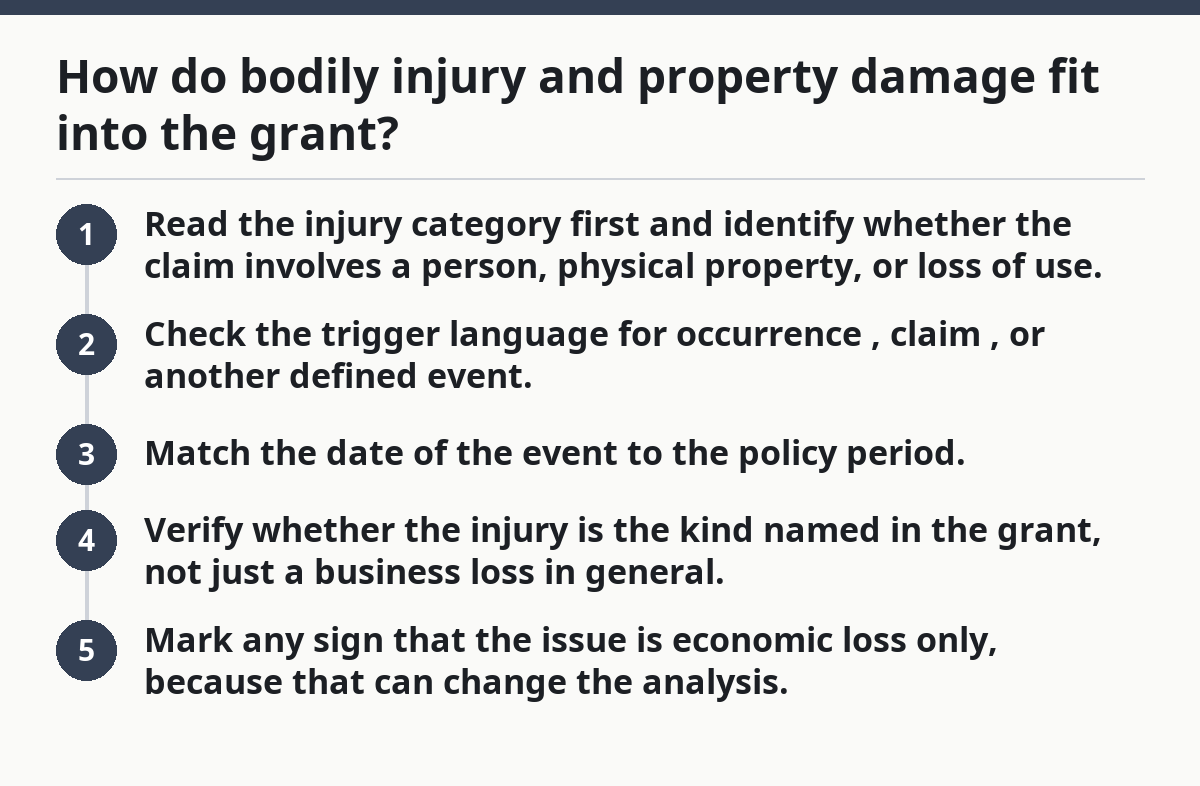
How do bodily injury and property damage fit into the grant?
They are the core physical-harm categories most commercial liability policies use in the coverage grant. Bodily injury means harm to a person, and property damage means harm to tangible property or loss of use, depending on the form’s wording.
Because of that, if a delivery driver is injured at your loading dock, or a machine spills onto a client’s floor and shuts down part of the space, the insuring agreement matters because it tells you whether the policy is even talking about that kind of loss.
The wording is often tighter than people expect. A policy may cover an occurrence that causes bodily injury or property damage during the policy period, and the details of that trigger matter. If the wording is event-based, timing matters. If the wording is claim-made, timing matters in a different way.
- Read the injury category first and identify whether the claim involves a person, physical property, or loss of use.
- Check the trigger language for occurrence, claim, or another defined event.
- Match the date of the event to the policy period.
- Verify whether the injury is the kind named in the grant, not just a business loss in general.
- Mark any sign that the issue is economic loss only, because that can change the analysis.
A common error is treating every business loss as property damage. A qualified professional should review the policy before you make that call. Lost revenue, bad work, and disappointed customers are often handled elsewhere in the policy, if at all. The insuring agreement is narrower than that.
What does personal and advertising injury wording change?
It adds a different kind of covered harm that is not physical injury at all. Personal and advertising injury usually refers to listed offenses such as certain publication, advertising, or reputation-related claims, depending on the form.
Meanwhile, if a competitor says your ad copied its slogan, or a third party claims your online content caused a covered reputational injury under the policy wording, that is not bodily injury and it is not property damage. The insuring agreement has to cover this separate bucket, or there is no path to coverage under that part of the form.
This category matters because readers often assume liability coverage is only about accidents and broken property. That misses a large slice of commercial disputes. The phrase “personal and advertising injury” is a term of art, and the policy definition controls.
- Check the exact listed offenses.
- Look for publication, use of another’s idea, or similar wording in the form.
- Confirm the alleged act fits the policy definition, not just the business problem.
- Watch for timing rules that differ from bodily injury claims.
The trade-off here is simple: this bucket can help with some non-physical claims, but it is not a blank check for every ad dispute or online post. The wording is usually specific, and small changes in phrasing can change the result.
How does the duty to defend fit into the insuring agreement?
It often sits inside the same promise, and that is where many readers miss the point. If the policy says the insurer has the duty to defend, the insuring agreement may describe when that duty starts and whether the insurer defends even weak claims that are potentially covered.
Because of that, if a complaint contains one count that might fit the policy and several counts that do not, the duty to defend language matters. The insurer may have to defend the whole suit, or only part of it, depending on the jurisdiction and the policy language.
That is why this topic is jurisdiction-sensitive. Rules about defense obligations vary by jurisdiction, and the policy form does not erase those local rules. This is general information, not legal advice; a qualified lawyer should be consulted about any actual claim.
A good read of the defense language asks three questions:
- Is the defense obligation part of the insuring agreement or a separate section?
- Does the policy defend against a suit, a claim, or both?
- Does the language require a covered loss, a potentially covered loss, or something narrower?
The duty to defend can be broader than the duty to pay, but the exact relationship depends on the wording and the jurisdiction. That is why you read the exact language before you assume anything.
How do you read the insuring agreement, step by step?
You read it from the grant outward, not from the exclusions backward. That means you start with the promise, match the claim to the words, and only then move to limits and exceptions.
If you are staring at a policy page and trying to decide whether the claim belongs inside the contract, the fast way is to read every line in order. The better way is to use the grant as a filter, because the insuring agreement tells you what kind of claim deserves the rest of the analysis.
- Find the insuring agreement and read the first full paragraph slowly. Verify the clause names the harm covered and the insurer’s promise. If you jump to exclusions first, the reading can go off track.
- Identify the covered harm terms: bodily injury, property damage, or personal and advertising injury. Verify the claim fits one of those named categories. If the claim is only a contract loss or a pure money dispute, the fit may fail.
- Check the trigger language. Verify whether the form uses an occurrence-based trigger, a claim-made trigger, or another defined timing rule. If the loss date and policy period do not line up, coverage may not attach.
- Look for the defense wording. Verify whether the policy says the insurer will defend or simply indemnify. If you treat a payment promise as a defense promise, the analysis can go wrong.
- Match the claimant’s story to the policy words, not to business common sense. Verify the alleged facts fit the definition, not just the label on the complaint. If the story sounds covered but the wording does not, the claim may fail.
- Note any defined terms used in the clause. Verify the policy defines words like occurrence, suit, injury, or damages elsewhere in the form. If you assume a common meaning when the policy gives a special one, the result can be inaccurate.
- Mark the limits of the promise before reading exceptions. Verify what the insuring agreement actually grants. If you read an exclusion as if it were part of the original promise, the analysis shifts the wrong way.
That sequence keeps you from over-reading the policy. It also keeps you from missing coverage that is actually sitting in the grant but is easy to skip past on a first read.
When does the standard reading not work?
The standard reading does not work when the claim falls outside the wording of the grant or when the policy uses special language that changes the usual rule. That happens often enough to deserve a separate check.
Once the claim looks close enough to trigger a quick yes, one detail can pull it out of the grant. Maybe the loss is purely economic. Maybe the timing misses the policy period. Maybe the policy is written on a form with special defense language. That is where the standard reading stops being enough.
The claim is purely economic: this often means no bodily injury, no property damage, and no listed personal and advertising injury offense — read the full form before assuming coverage.
The timing falls outside the policy period: the trigger may fail even when the facts look covered — check whether the policy is occurrence-based or claim-made.
The allegation is only a breach of contract: that may not fit the grant at all — look for an actual covered injury or offense.
The defense wording is unusual: some forms narrow or expand the duty to defend — do not assume the common rule applies.
The claim spans multiple acts or dates: the wrong date can change the analysis — separate each event and tie it to the form’s trigger language.
Here’s the catch: if the claim does not fit the insuring agreement, the rest of the policy may never matter. That is why this clause gets read first, not last.
What mistakes do people make with the insuring agreement?
They treat the insuring agreement like boilerplate, and that costs time and accuracy. A qualified professional should review the wording before you rely on it. It is not boilerplate. It is the promise that gives the policy its shape.
If someone skims the policy, sees the word “liability,” and assumes any lawsuit belongs somewhere inside the form, that assumption is wrong often enough to cause trouble, because the coverage grant is narrower than the word on the cover.
- Reading exclusions first. The result is a distorted view of the policy. The fix is to read the grant first, then the exclusions.
- Treating every lawsuit as covered. The result is false confidence. The fix is to match the alleged harm to bodily injury, property damage, or personal and advertising injury.
- Ignoring the trigger language. The result is a timing error. The fix is to identify the policy period and the event or claim trigger.
- Assuming defense and payment are the same. The result is confusion about what the insurer must do. The fix is to read the defense wording separately.
- Using business logic instead of policy wording. The result is a claim that sounds right but does not fit the form. The fix is to use the definitions in the policy.
The rest of the policy is easier once you learn to read the grant cleanly. The clauses stop fighting each other, and the structure makes more sense.
Where should you go next in the policy?
You should go to the definitions, exclusions, and endorsements after the insuring agreement, because that is where the grant gets narrowed or changed. The insuring agreement gives you the base promise; the rest of the policy tells you how far that promise really reaches.
Therefore, once you have identified the coverage grant, you can move to the next layer of meaning. The definitions tell you what the terms mean. The exclusions carve out what the insurer will not cover. Endorsements can rewrite either one.
Two outside sources help frame that reading: the Insurance Services Office, Inc. form structure used across commercial liability policies, and guidance from state insurance departments that explain how policies are interpreted under local law. Those sources do not replace the contract, but they help you understand how the form is usually built. See also the National Association of Insurance Commissioners and state insurance department resources on policy interpretation.
If you stop at the insuring agreement, you know the opening promise but not the full deal. That is enough for a first pass, not enough for a claim file. The clause is the starting point. Not the finish line.
What does an insuring agreement do?
It states the insurer’s basic promise to cover certain losses and, in many forms, to defend certain claims. In a commercial liability policy, it tells you the kind of injury or damage the policy is even willing to consider. Everything else in the policy builds on that promise.
Where is the insuring agreement in a policy?
It is usually near the start of the main coverage form, before the exclusions and before the endorsement list. In many commercial liability policies, it appears in the first coverage section, where the policy states what the insurer agrees to pay or defend.
How is the insuring agreement different from exclusions?
The insuring agreement gives the coverage grant, while exclusions take coverage away from that grant. That means you read the promise first and the carve-outs second. If a claim does not fit the insuring agreement, exclusions may never come into play.
Drafted with AI; not yet reviewed by a person.