Last updated: November 20, 2026
Ask for a midterm endorsement with the exact wording you want, the effective date you need, and a written confirmation from the broker and insurer. That is the cleanest way to get a liability policy change processed quickly without leaving the request vague. Rules vary by jurisdiction, so treat this as general information, not legal advice, and speak with a qualified lawyer about your own matter.
Key takeaways
- A fast policy change works best when the request names the endorsement, the date, and the exact wording.
- The broker should not guess at coverage terms; the insurer should see the change in writing.
- Proof matters. Send the certificate update or wording request in the same message as the change.
- If the change affects claims-made coverage, retro dates, or contractual wording, the process can get tricky fast.
- The right question is not “Can you fix this today?” but “What exactly do you need to issue the endorsement correctly?”
What should I ask for first?
Ask for a midterm endorsement that changes the policy on a specific date and uses the wording you approve. An endorsement is the written change to the policy; without it, a verbal promise means very little if the file is reviewed later.
Start with the basics: the insurer name, policy number, insured name, and the exact change you want. If the request is tied to a contract, permit, lease, or client form, say that too. The person handling the file needs to know whether the change is for an additional insured request, a name correction, a limit change, a location change, or another wording change.
If the matter is urgent, ask the broker to tell you the earliest effective date the insurer can use and whether the carrier needs a signed request form, a revised application, or both. Some changes can be set to the same day; others cannot be made retroactive, especially if the requested wording would alter the risk already on the books.
A good request also asks for a written copy of the change before it is issued, if the insurer will provide one, or at least a copy of the final endorsement once issued. That protects you from finding out later that the policy was changed in the wrong place or on the wrong date.
What details should I send for a policy change?
Send the policy number, the exact change, the effective date, and any wording the insurer must match. A fast request is only fast when the person processing it does not have to chase missing facts.
Use plain, specific language. “Please add 123 Main Street as an additional location effective 1 June” is better than “Please update the property.” If the change is about a name, include the full legal name and any trade name. If it is about a contract requirement, attach the clause or a copy of the certificate request so the broker can mirror the language.
Ask the broker whether the insurer wants the request in email, on a carrier form, or through an online portal. Many carriers will not act on a loose phone message alone. If there is a deadline from a landlord, lender, vendor, or public body, include that deadline in the first line of the message.
A useful request also asks for the change to be checked against the rest of the policy. A new location, for example, can affect a schedule, a class of operations, or a certificate wording. If the request is narrow, the endorsement should stay narrow. If the requested wording would require a broader policy rewrite, that is a warning that the file may need more review before it moves.
How do I make the request so it moves fast?
Make the request in writing, with one subject line, one change, and one due date. The fastest file is the one that does not force the broker to interpret your intent.
- State the policy number and named insured exactly as they appear on the declarations page.
- Name the endorsement or change you want, such as a limit change, additional insured wording, or a certificate update.
- Give the effective date in a single format, such as 1 June or 1/6, and add the time if the request depends on a same-day cutoff.
- Attach the document that caused the change request, such as a contract, lease clause, certificate instruction, or permit condition.
- Ask for the broker’s instructions on any carrier form, signature, or supporting document.
- Ask the broker to confirm whether the insurer needs the request before a certain daily cutoff.
- Ask for written confirmation of receipt and a copy of the issued endorsement once the carrier acts.
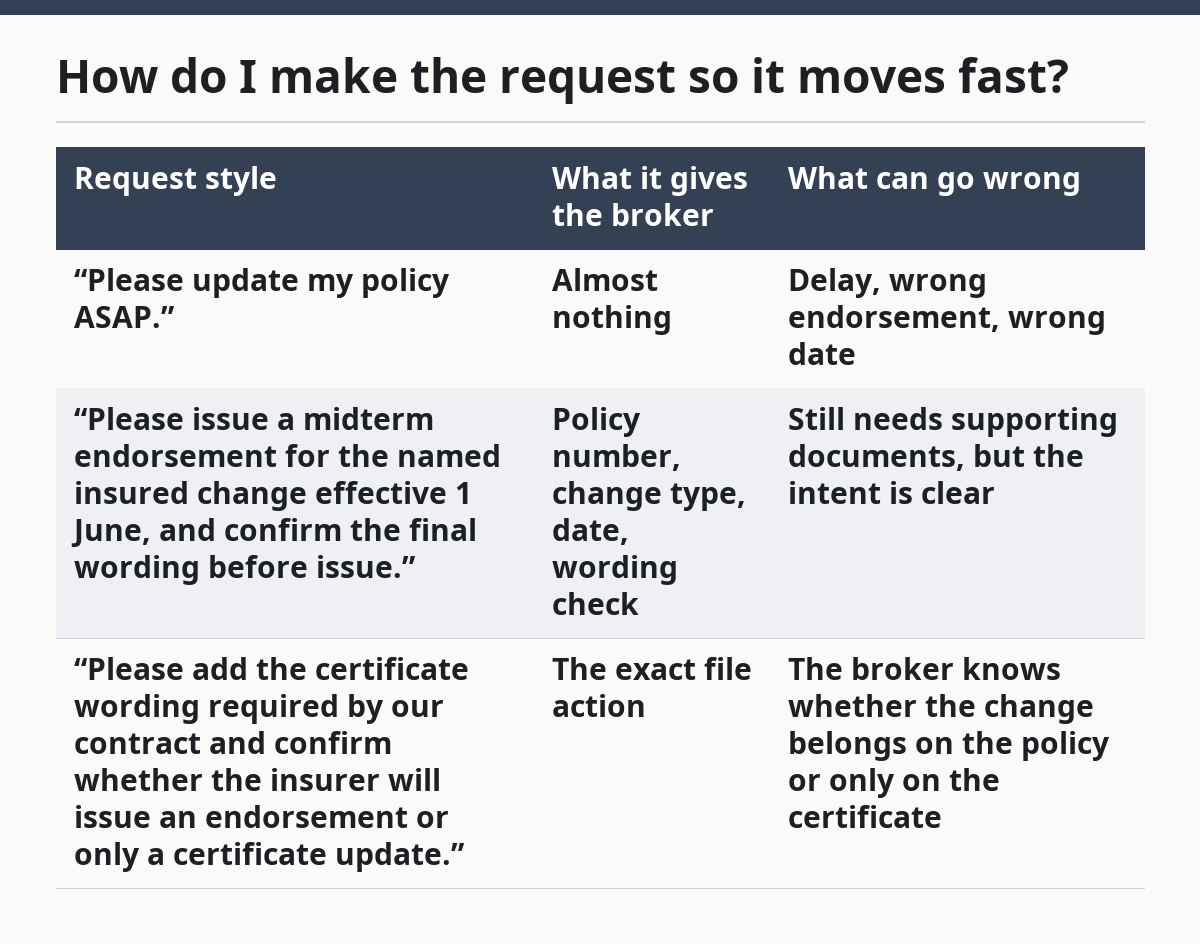
The table below shows the practical difference between a vague request and a clean one.
| Request style | What it gives the broker | What can go wrong |
|---|---|---|
| “Please update my policy ASAP.” | Almost nothing | Delay, wrong endorsement, wrong date |
| “Please issue a midterm endorsement for the named insured change effective 1 June, and confirm the final wording before issue.” | Policy number, change type, date, wording check | Still needs supporting documents, but the intent is clear |
| “Please add the certificate wording required by our contract and confirm whether the insurer will issue an endorsement or only a certificate update.” | The exact file action | The broker knows whether the change belongs on the policy or only on the certificate |
The goal is not to overwhelm the carrier with paperwork. The goal is to remove guesswork. If the broker has to ask three follow-up questions before the file can move, the request is not really urgent yet.
What should I confirm before the insurer issues it?
Confirm the wording, the date, the named insured, and whether the change belongs on the policy or only on the certificate. A certificate of insurance is not the policy itself, and a certificate update does not always change the contract terms.
Check whether the requested wording matches the contract language exactly enough for the person who asked for it. If the certificate needs an additional insured statement, ask whether the insurer will issue the wording as an endorsement or only as a certificate note. Some carriers are careful about what they will print on a certificate, because the certificate cannot create coverage by itself.
Confirm the effective date in writing before the insurer issues the endorsement. A change dated after the event it was supposed to cover may not solve the problem that triggered the request. If the insurer says a same-day effective date is not available, ask what date they can use and whether any interim document can be sent to show the file is in process.
This is also the point to confirm whether the request changes any other policy term. A small wording change can touch a schedule, a named insured line, a limit entry, or a location list. For a claims-made liability policy, a change that looks minor on paper can matter if it touches dates or continuity language. That is one place where the policy design and terms page on this site fits with this topic.
When should I stop and slow down?
Stop and slow down when the change is tied to a claims-made date, a contract deadline, a retro date, a cancellation notice, or a disputed loss. Those are the situations where a quick request can become a bad request if the wording is loose.
The request changes a claims-made date or retroactive date: That can affect which claims are inside the policy period — get qualified help before you ask the insurer to change it.
The insurer wants the change backdated to cover an event that already happened: That may be impossible or may raise a coverage issue — ask the broker to explain what the carrier will and will not do in writing.
A contract requires exact wording on additional insured or certificate language: Small wording differences can matter — send the contract clause and ask for the carrier’s wording before issue.
The policy is already under cancellation, nonrenewal, or audit review: The file may need more than a simple endorsement — get the broker to confirm whether the change will be processed at all.
The request affects several locations, insured entities, or operating names: A one-line fix may not be enough — ask for a full policy review of the changed names and schedules.
The insurer is asking for a revised application or signed statement: That usually means the carrier sees underwriting impact — do not rely on the first draft alone.
If any of those are true, the right move is not to push harder. It is to slow the file down long enough to make sure the endorsement actually matches the problem.
What mistakes cause delays?
The biggest mistakes are vague wording, missing dates, and assuming a certificate update is the same as a policy change. Those errors usually cost time, and they can also create a mismatch between the paperwork and the coverage file.
One common mistake is asking for “the usual wording” without naming the actual phrase. That forces the broker to guess, and guessing is slow. The better move is to attach the clause, form, or contract page that drives the request.
Another mistake is giving a date without saying whether it is the effective date of the change or the date you want the insurer to process the file. Those are not always the same thing. If the distinction matters, say so in the request.
A third mistake is assuming the broker can change the policy alone. The broker is the go-between; the insurer still has to agree, issue, and date the endorsement. If the broker says the file is “sent to carrier,” that is not the same as “changed.”
A fourth mistake is forgetting to ask for proof of the final wording. Without that, the request may sit in email form while the policy file shows something different. Ask for the issued endorsement or a written confirmation that the insurer has accepted the requested wording.
A fifth mistake is sending separate messages to the broker, account manager, and carrier contact with slightly different language. That creates a paper trail that does not match. One clean request, copied where needed, is better than three versions of the same change.
What if the normal process does not fit?
The normal process needs adjustment when the change is tied to a rush deadline, a multi-party contract, or a policy that uses special dates. In those cases, ask for the carrier’s exact process and do not assume the same form works everywhere.
A same-day request may need a specific cutoff time. A late-afternoon request may not be issued until the next business day. If timing matters, ask the broker what daily cutoff applies and what written proof can be sent before the endorsement is issued.
If the change affects a certificate needed by a third party, ask whether the third party wants the certificate alone or the policy endorsement too. Some parties will accept a certificate update first and the endorsement later; others will not. Getting that straight early saves a second round of corrections.
If the policy is part of a layered program, a blanket endorsement request may not be enough. The carrier may need the exact layer, limit, or location affected. In that setting, “change the liability policy” is too broad. The cleaner request is the one that names the exact policy section that must be changed.
How do I know the change was done right?
You know the change was done right when the issued endorsement matches the request, the effective date is correct, and the certificate or schedule reflects the same wording. That is the finish line, not the promise to issue it.
Check the named insured, policy number, date, and wording line by line. If the change was meant to fix a contract requirement, compare the issued language with the contract language. If the carrier changed a term you did not ask to change, flag it at once.
Also ask whether the final file includes the broker’s written instructions and the insurer’s confirmation. That paper trail matters if someone later asks why the policy says what it says. A quick change is only useful if the record is clean enough to explain it.
For a broader look at policy design and terms, the hub page on commercial liability insurance policy design and terms is the right place to start after this request is handled.
What details should I send for a policy change?
Send the policy number, the exact wording you want, and the date the change should take effect. Include any contract, lease, permit, or certificate language that caused the request. If the insurer needs a form or signature, ask the broker to name it in the first reply.
How can I avoid a coverage gap when changing the policy?
Ask the broker to confirm the effective date in writing before the insurer issues the endorsement. If the change is tied to a date-sensitive contract, ask whether the carrier can issue interim proof while the endorsement is being processed. Do not assume a verbal promise covers the gap; only the written record can show what changed and when.
What should I confirm after the insurer makes the change?
Confirm that the endorsement date, named insured, and exact wording match the request. Check the certificate, schedule, or declarations page if the change was supposed to appear there too. If anything differs from the request, ask the broker to correct it right away and keep the correction in writing.
Drafted with AI; not yet reviewed by a person.