Last updated: November 20, 2026
Quick answer: start with the declarations page, the insuring agreement, and the exclusions, because those 3 parts usually tell you what the policy covers, what it does not cover, and how much the insurer may pay. This article on How to Read a Commercial Liability Insurance Policy: Key Terms and Sections Explained is information, not financial advice; because liability coverage rules and wording vary by country and policy, a qualified adviser should review your own contract. For background on policy structure and wording, see IRMI’s overview of commercial general liability policies and the NAIC Consumer Information page on commercial general liability insurance.
Key takeaways
- The declarations page gives the names, dates, limits, and endorsements that change the policy.
- The insuring agreement is the promise, but the exclusions often shrink that promise.
- Limits matter only after you know whether one claim uses 1 limit or reduces the policy by multiple claims.
- Endorsements can rewrite a 20-page policy with a 1-page change.
- If the wording is unclear, the safest next step is to ask for the exact form number and version date before you rely on it, and to have a qualified adviser review the wording if the issue affects coverage.
What should I read first in a commercial liability policy?
Start with the declarations page, because it tells you which policy you actually hold. If you skip that page, you can miss the insured name, policy period, limits, deductibles or self-insured retentions, and any endorsements that alter the standard form. In many policies, the declaration page is only 1 or 2 pages, but it controls the rest.
Read it in this order:
- Named insured. Make sure the legal name matches the business entity, not just the brand name.
- Policy period. Check the start and end dates so you know when coverage applies.
- Limits of insurance. Find the per-occurrence limit, the aggregate limit, and any sublimits.
- Forms and endorsements. List every attached form number and title; these change the wording.
- Premium and payment terms. Confirm the billing schedule if the policy is paid in installments.
- Deductible or self-insured retention. See whether the business pays part of each claim before insurance responds.
If those items are wrong, the rest of the policy may not help much. For example, a policy can show a 12-month term and still fail to cover a claim if the wrong entity is named or the endorsement removes a risk you thought was included. That is why the declarations page comes first.
Quick check: if you cannot point to the named insured, the dates, and the aggregate limit in under 2 minutes, you are not starting in the right place.
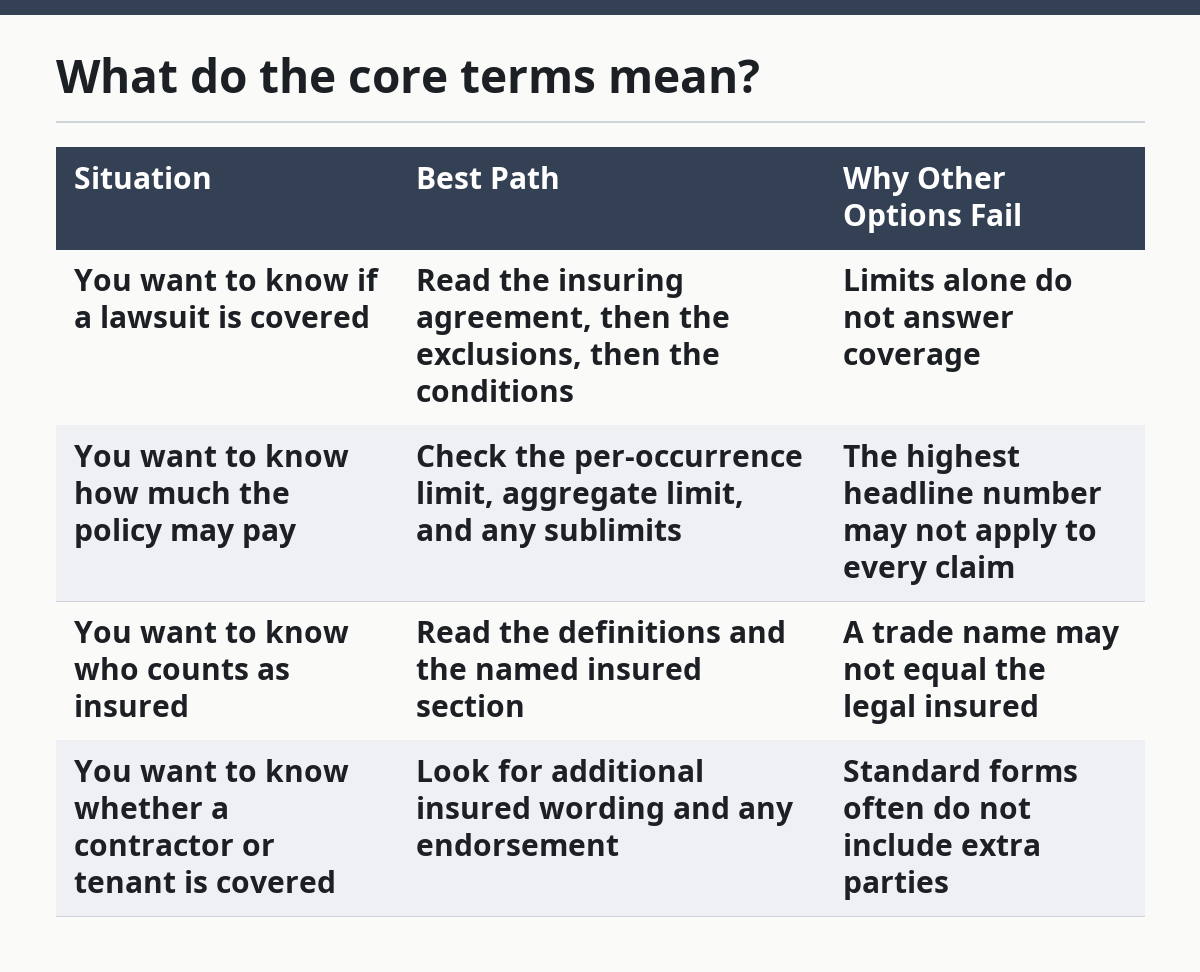
What do the core terms mean?
The core terms tell you who is covered, what triggers coverage, and how much the insurer may pay. If you only read the cover page, you will miss the rules hidden in definitions, conditions, and exclusions.
| Situation | Best Path | Why Other Options Fail |
|---|---|---|
| You want to know if a lawsuit is covered | Read the insuring agreement, then the exclusions, then the conditions | Limits alone do not answer coverage |
| You want to know how much the policy may pay | Check the per-occurrence limit, aggregate limit, and any sublimits | The highest headline number may not apply to every claim |
| You want to know who counts as insured | Read the definitions and the named insured section | A trade name may not equal the legal insured |
| You want to know whether a contractor or tenant is covered | Look for additional insured wording and any endorsement | Standard forms often do not include extra parties |
Here are the terms that matter most:
- Insuring agreement: the insurer’s basic promise to pay for certain covered claims.
- Occurrence or claims-made trigger: the event that must happen for coverage to apply.
- Occurrence: often an accident or repeated exposure that leads to injury or property damage.
- Aggregate limit: the most the insurer will pay during the policy period for covered claims.
- Per-occurrence limit: the most the insurer will pay for one covered event.
- Deductible / self-insured retention: the amount the business pays before insurance responds.
- Exclusion: a loss the policy says it will not cover.
- Endorsement: a written change to the policy form.
A common mistake is to stop at the aggregate limit and assume it answers everything. It does not. A policy may carry one aggregate limit for one category and a different sublimit for another category, and the endorsement may change both. Also, if the policy uses claims-made wording, the date the claim is made can matter as much as the date of the event.
Quick check: if you can define the insuring agreement but not the exclusions, you are still missing the part that usually decides the claim.
How do the limits and exclusions work together?
They work as a filter, and the exclusions usually come first. If a loss is excluded, the limit does not matter because the claim may never reach the payment stage. If the loss is covered, then the limit section tells you how much may remain after other claims, defense costs, or sublimits reduce the available amount.
Use this 3-step reading order:
- Read the exclusion. Ask whether the loss is carved out entirely or only in part.
- Check for exceptions to the exclusion. Some policies bring back limited coverage through an exception.
- Find the matching limit. Confirm whether the claim draws from the main aggregate limit or a smaller sublimit.
This is where many readers get tripped up. They see a large aggregate limit and assume every loss shares that pool. But a policy can treat some claims differently, and an endorsement can add a narrow limit for one hazard; if that happens, it is worth asking a qualified adviser or broker to confirm how the wording works in your policy. That is why the phrase “subject to the terms, conditions, exclusions, and endorsements” matters more than it looks like it should.
If the policy lists defense costs inside the limits, then a lawsuit can eat into the amount left for settlement. If defense costs are outside the limits, the policy may preserve more of the limit for the actual claim, but the wording has to say that clearly. That 1 line can change the math a lot, so compare defense-cost treatment with a qualified adviser or broker and check the policy form carefully.
Quick check: if an exclusion is present, do not compare limits until you know whether the exclusion has an exception.
Which endorsements change the policy most?
The endorsement changes that matter most are the ones that rewrite coverage, not the ones that only tidy language. If an endorsement conflicts with the base form, the endorsement usually controls. That is why a 1-page attachment can matter more than a 20-page policy form.
Read endorsements one by one and mark these items:
- Changed definitions. A term such as “occurrence” or “insured” may be narrowed.
- Added exclusions. The endorsement may remove a risk that the base form included.
- Added insureds. A landlord, lender, or customer may be added as an insured.
- Sublimits. A smaller limit may apply to one class of claim even when the main limit is higher.
- Notice rules. Some endorsements shorten notice requirements or add extra notice duties.
A clean way to read endorsements is to compare the base form and the endorsement line by line. Look for phrases like “this endorsement modifies,” “is amended to read,” and “is replaced in its entirety.” Those are the clues that the new wording overrides the old wording.
This section is especially important if the policy was prepared for a contract requirement, because the contract may ask for one version of coverage while the endorsement quietly changes it. If the endorsement creates a conflict, the contract and the policy may not match, and that mismatch needs review before a loss happens.
Quick check: if the endorsement changes a definition, an exclusion, or a limit, treat it as a major change, not paperwork, and have a qualified adviser confirm the effect.
If the claim is already happening, what do you do first?
If a claim is already happening, read the notice and cooperation conditions first, because missing a deadline can damage the claim. Do not wait until the end of the process to look for notice language. Many policies require prompt notice, and the exact wording matters.
Follow this order:
- Find the notice clause. Look for who must be told, how to tell them, and how quickly.
- Save the date of the event and the date of the first claim or demand. Those dates may control coverage.
- Check whether the policy is claims-made. If it is, the date the claim is made can be decisive.
- Look for a duty to cooperate. The insurer may ask for records, statements, or access to documents.
- Check defense rules. See whether the insurer appoints counsel, reimburses counsel, or has consent rights.
- Review any settlement consent clause. Some policies restrict settling without approval.
A claims-made policy can be unforgiving about timing, so the policy period and reporting rules need special attention. An occurrence policy is different, but it still has notice duties. Either way, the claims section is not a detail to skim.
If you are dealing with an actual claim, a qualified adviser should review the notice wording before any admission, payment, or settlement discussion. This is not the place for guesswork.
Quick check: if a demand letter has arrived, the notice clause is now more urgent than the premium page.
What are the edge cases that change the normal advice?
The normal advice breaks down when the policy form is not standard, the claim timing is unusual, or another contract changes the risk. Here are the cases that most often need a second read.
-
The policy is claims-made, not occurrence-based. What changes: the reporting date may matter as much as the event date. What to do instead: find the retroactive date, reporting period, and any extended reporting options before assuming coverage.
-
The business uses a trade name only. What changes: the named insured may be the wrong legal entity. What to do instead: compare the declaration page to the exact legal name on formation documents and contracts.
-
There is a certificate of insurance, but not the full policy. What changes: the certificate may summarize coverage without changing it. What to do instead: request the policy form and endorsements before relying on the certificate.
-
A contract requires additional insured status. What changes: the policy may need a special endorsement, not just a request. What to do instead: look for the actual additional insured wording and any limits tied to it.
-
The policy has a large aggregate but tiny sublimits. What changes: one kind of claim may have far less available money than the headline number suggests. What to do instead: match each likely loss to its own limit, not the overall aggregate.
-
Defense costs are inside the limits. What changes: legal fees can reduce the amount left for the claim itself. What to do instead: check whether the policy says defense costs erode the limit or sit outside it.
Quick check: if your situation involves a contract, a certificate, or a claims-made form, the standard reading order is not enough on its own.
How do I compare two policies without missing the trap?
Compare them on the 6 items that actually change the result, not on the premium line alone. A cheaper policy can be thinner in the places that matter most. A more expensive policy can still leave gaps if the endorsements are narrow.
Use this comparison order:
- Match the named insured.
- Match the policy period.
- Compare limits, including sublimits.
- Compare exclusions.
- Compare defense-cost treatment, with a qualified adviser or broker if the wording is not clear.
- Compare endorsements side by side.
A 2-policy comparison works best when each point is written in the same order on both sides. If one policy has a $2 million aggregate and another has a smaller sublimit for the risk you actually have, the headline number can mislead you. If one policy covers defense outside the limit and the other does not, that difference may matter more than the premium.
The biggest trap is assuming similar wording means similar coverage. In liability insurance, 2 policies can share much of the same language and still differ in 1 clause that decides the claim. That is why the comparison has to be clause by clause, not summary by summary.
Quick check: if you are comparing by price alone, you are missing the part that can matter most after a loss.
FAQ: related questions
What is the most important page in a commercial liability policy?
The declarations page is usually the first page to read because it shows the named insured, policy dates, and limits. After that, the insuring agreement and exclusions tell you what the policy actually does. If those 2 pages conflict with an endorsement, the endorsement often wins.
Does the aggregate limit mean the insurer pays that amount for every claim?
No, the aggregate limit usually means the most the insurer will pay during the policy period for covered claims as a group. One claim can reduce what remains for later claims, and some losses may be subject to sublimits. The exact result depends on the wording and the policy form.
Why do exclusions matter more than limits sometimes?
Exclusions matter more because a claim that is excluded may not be covered at all, even if the policy shows a large limit. Limits only come into play after a loss survives the exclusions and other conditions. That is why reading the exclusion section is not optional.
What if I only have the certificate of insurance?
A certificate is not the same as the full policy. It may summarize coverage, but it usually does not replace the actual form and endorsements. Ask for the policy documents before you rely on the certificate for a contract or a claim.
Should I read a claims-made policy the same way as an occurrence policy?
No, a claims-made policy needs extra attention on reporting dates and retroactive dates. The date the claim is made can matter as much as the date of the event. If the policy is claims-made, the timing rules deserve the first read, not the last.
Drafted with AI; not yet reviewed by a person.