Last updated: November 20, 2026
Quick answer: a retail store can face 6 major liability risk groups beyond slip and fall claims—employee injuries, product-related harm, vendor accidents, delivery incidents, signage hazards, and access or fixture hazards. This article on What Liability Risks a Retail Store Faces Beyond Slip and Fall Claims is general information, not legal advice; the exact rules vary by jurisdiction, and a qualified lawyer should be consulted on any real dispute or contract. For a quick legal overview, see OSHA’s workplace guidance at https://www.osha.gov/ and the CPSC recall database at https://www.cpsc.gov/Recalls.
Key takeaways
- A store can face claims even when nobody falls on a wet floor.
- The biggest blind spots are often employees, products on shelves, outside vendors, and delivery traffic.
- A small setup change, like a 1-foot protruding sign or an unstable display, can create a claim just as fast as a spill.
- The right review starts with what happens in aisles, stockrooms, loading docks, entrances, and parking areas.
- Contract terms, insurance certificates, and posted warnings matter because they shape who may pay after a loss.
Who this applies to
This applies to anyone responsible for a retail store, from an independent shop with 2 employees to a larger chain with multiple locations. It assumes the reader already knows the basics of premises liability, which is the legal term for harm linked to a property’s condition or operation. In the US, store owners also need to think about workplace safety rules, ADA access issues, and product-safety duties, but the details change by state and city. For accessibility basics, see the ADA at https://www.ada.gov/.
This is the right place to start if the store has a public sales floor, a stockroom, a loading area, or regular third-party traffic. It is also useful if the store sells goods that can be recalled, broken, or dangerous when used as intended.
It is not the right tool for a live dispute, a claim letter, or a contract fight over indemnity; that needs counsel, not a checklist. A generic article gets this wrong by treating “liability” as one bucket, so consult a qualified professional before acting on a real incident. In practice, a retail store has several separate exposure points, and each one can trigger a different claim path. A vendor trip on a back dock, for example, is not the same as a customer injury on the sales floor, even if both happen in the same 30-minute window.
What liability risks do retail stores overlook?
Retail store liability exposure includes injuries and losses that happen away from classic slip and fall claims. The usual blind spots are employee injury, products on the premises, vendor activity, delivery activity, and signage hazards. Those risks often show up in places people do not inspect every day, like the stockroom, the loading dock, the checkout lane, or the exterior entrance.
Employee injury is a major example. A worker can be hurt lifting a 40-pound carton, cutting boxes, using a ladder, or moving a hand truck through a narrow aisle. In the US, that can trigger workplace injury rules and a separate insurance process from a customer claim. According to OSHA, fall protection issues and struck-by hazards remain common workplace concerns, so a store that ignores backroom injuries is missing a very common source of loss.
Product-related harm is another gap. A customer may be injured by a falling item, broken packaging, a leaking container, or a product sold on the premises that later causes harm. If a recalled item stays on the shelf, the risk gets worse. The Consumer Product Safety Commission’s recall listings are one place retailers and manufacturers track those problems: https://www.cpsc.gov/Recalls.
Vendor and delivery risks also matter. A vendor carrying displays into the store, or a delivery driver backing into a dock, can create property damage or bodily injury claims. Those incidents often involve more than one insurance policy and more than one contract. A 5-minute delivery stop can still produce a long claim file, so it helps to review loading rules and certificate requirements before the next delivery arrives.
Signage hazards are easy to miss because they look harmless. A sign that blocks sight lines, hangs too low, has sharp edges, or falls from a bracket can injure a customer or worker. In many cases, the issue is not the message on the sign but its placement, height, weight, or fastening. For ADA-related sight-line and access questions, consult the ADA guidance at https://www.ada.gov/.
How do these risks show up in real stores?
These risks show up as ordinary store operations that go wrong. A display collapses in the middle of a 6-foot aisle. A stock clerk overreaches from a step stool. A delivery driver leaves a pallet in a walkway for 10 minutes. A vendor creates clutter near an exit. The legal issue is often not dramatic; it is operational, and that is why routine checks matter.
A few examples help separate the categories, but consult a qualified lawyer or safety professional for the facts of a real store.
| Exposure | Typical location | Common trigger | Why it matters |
|---|---|---|---|
| Customer injury | Sales floor, fitting room, entrance | Falling merchandise, blocked path, poor lighting | Can create premises liability claims |
| Employee injury | Stockroom, ladder area, receiving dock | Lifting, cuts, falls, loading tasks | May trigger workplace injury rules |
| Products on premises | Shelves, end caps, checkout | Recalled or defective goods, broken packaging | Can create product-related claims |
| Vendor activity | Back door, aisle, stockroom | Unsecured equipment, tools, clutter | Third-party presence raises exposure |
| Delivery activity | Dock, curb, parking lot | Backing incidents, dropped freight, blocked access | Often involves transport and premises issues |
| Signage hazards | Ceiling, wall, entrance | Loose mounts, sharp corners, blocked views | Simple fixtures can become physical hazards |
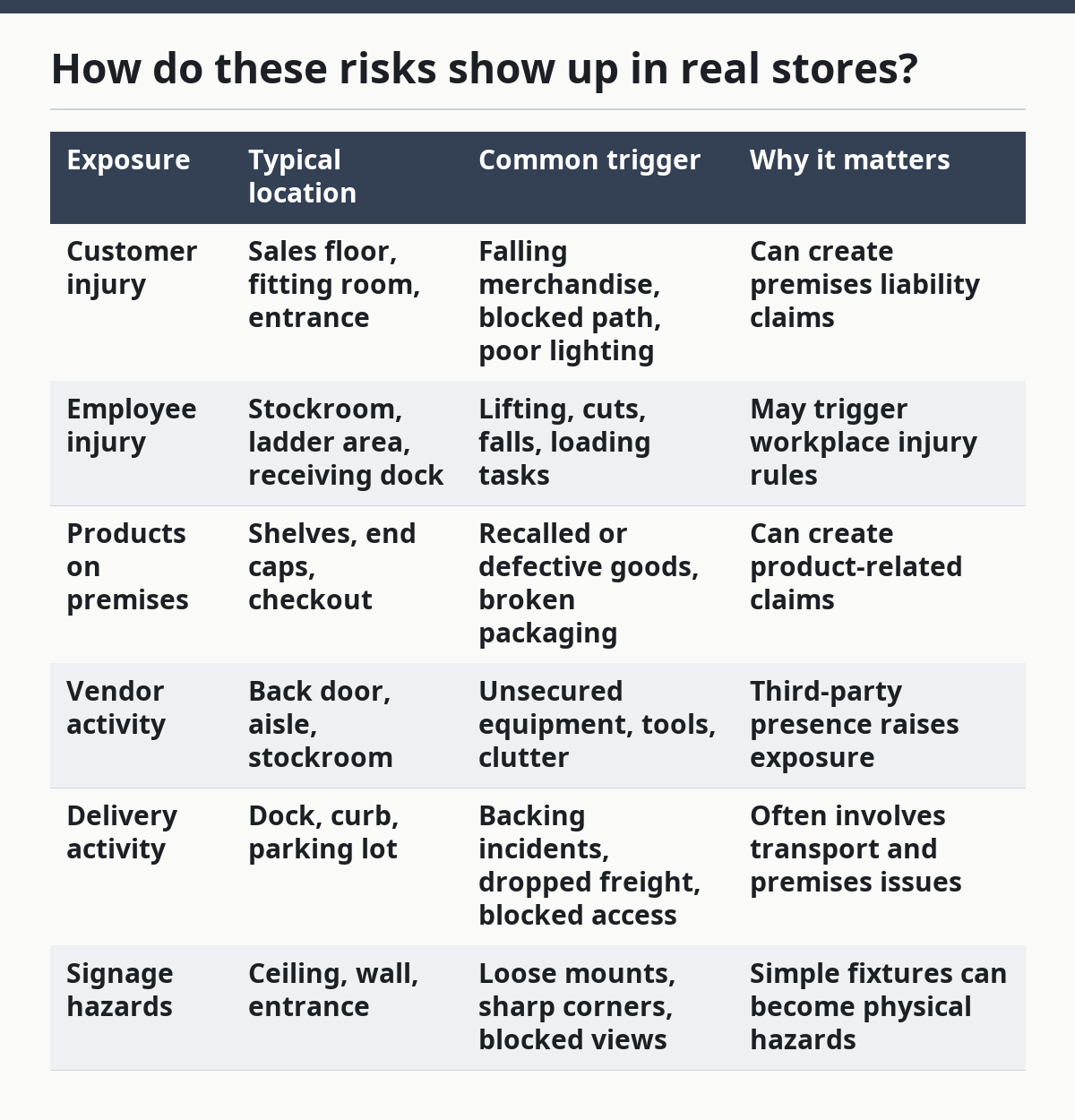
A good review looks beyond the floor surface and asks what happens in each zone of the store. A 15-minute walkthrough during business hours can reveal more than a 2-hour meeting in a back office. The wrong assumption is that if the floor is clean, the store is safe. It is not.
For a broader framework that fits with risk scenario planning, the hub on commercial liability insurance coverage by risk scenario is the right next stop. For more on premises issues, see retail premises liability.
How do I review a retail store’s exposure?
A useful review starts with the customer path, then moves to the worker path, then to the vendor and delivery path. The goal is to spot where a person, cart, box, or sign can cause harm in under 30 seconds. If the store has multiple entrances, repeat the review at each one. That sequence keeps the review practical and makes the next steps easier to assign.
- Map the walk paths: Trace the main customer route, employee route, and delivery route with a 3-foot clearance target where possible. Verify that people can move without squeezing past pallets, carts, or floor stands. A problem is any routine choke point, blocked exit, or blind corner.
- Inspect shelving and displays: Check end caps, high shelves, and freestanding racks for stability and load limits. Verify that heavy items are low and that no item is hanging over the edge. A problem is wobble, leaning, or unsecured merchandise that could fall; consult a qualified safety professional if the setup is uncertain. OSHA guidance on safe storage is a useful starting point: https://www.osha.gov/.
- Review stockroom tasks: Watch how boxes are cut, stacked, lifted, and moved over a 15-minute period. Verify that ladders, step stools, and hand trucks are used as intended. A problem is overstacking, unsafe lifting, or tools left in the path.
- Audit vendor access: Look at how outside vendors enter, stage materials, and leave tools or packaging. Verify that the store has a clear rule for where vendors may unload. A problem is unmanaged clutter, open cartons, or vendor equipment left behind.
- Check delivery points: Examine docks, curbside drop zones, and parking-lot touchpoints for backing hazards and trip hazards. Verify that drivers can approach and depart without crossing customer space whenever possible. A problem is blocked sight lines, loose freight, or mixed pedestrian and vehicle traffic.
- Test signage and fixtures: Look at hanging signs, promotional boards, mirrors, and overhead markers from both standing and seated eye level. Verify that they are secure, legible, and do not block exits or views; if the placement affects access or sight lines, consult a qualified professional. A problem is loose hardware, sharp corners, or signs that swing into traffic. For access standards, see https://www.ada.gov/.
- Check product handling and recalls: Compare current shelf stock against recall notices and pull damaged packaging immediately. Verify that returned, opened, or suspect items are kept out of saleable inventory. A problem is a recalled item still available to customers or a damaged item with no isolation process. The CPSC recall list is updated regularly: https://www.cpsc.gov/Recalls.
- Document the fix: Record what was found, who corrected it, and when. Verify that repeated hazards have a follow-up date, not just a verbal warning. A problem is a pattern of the same issue showing up more than once in 30 days, so a qualified lawyer should review the record if a claim seems likely.
This is not paperwork for its own sake. Records matter because they show whether a hazard was noticed, corrected, and checked again. In a claim, that timeline can matter as much as the hazard itself. It also helps if counsel, a broker, or an insurer later needs the sequence of events.
When should a retail store stop and get legal help?
A retail store should stop treating the issue as a simple checklist when the facts point to a claim, a contract dispute, or a regulatory problem. In a US setting, that includes any incident involving injury, a recalled product, a delivery vehicle crash, or a vendor agreement with indemnity language. Other jurisdictions may use different terms, but the same caution applies. For claims handling and workplace questions, OSHA and the CPSC are useful reference points: https://www.osha.gov/ and https://www.cpsc.gov/Recalls.
An injury has already been reported: That means the matter may now involve notice rules, witness statements, and insurer reporting — preserve the scene and contact a qualified lawyer before making detailed statements.
A recalled product is still on the shelf: That can create a product-safety and notice problem — remove the item, quarantine the stock, and get legal guidance on next steps.
A vendor or delivery driver caused damage or injury: That may trigger contract and insurance questions — gather the agreement, certificates, and incident record before anyone assigns fault.
The store has repeated the same hazard 2 or more times: That pattern can matter in a negligence dispute, so consult counsel on notice and foreseeability before assuming it is just a housekeeping issue.
The incident involves an employee, not a customer: That may move the issue into workers’ compensation or employment law territory — do not treat it like an ordinary premises claim.
The hazard ties to access, exits, or signs near the entrance: That can raise code or disability-access questions, so get qualified advice before changing the setup again.
A common mistake is to keep talking about the event as if it is only a housekeeping problem. Once a claim is possible, the facts should be handled with care. In law, casual explanations can become exhibits.
What mistakes do stores make most often?
The most common mistake is treating every hazard as a floor-cleaning issue. That can leave the stockroom, dock, and signage problems untouched. The result is predictable: the store fixes one surface but leaves the higher-risk areas open.
Another mistake is assuming vendor work is the vendor’s problem. If a contractor leaves cords across an aisle or a delivery driver blocks an exit, the store may still face exposure depending on jurisdiction and contract terms. A store that never checks vendor certificates or loading rules is working blind, so it should review those documents before the next job starts. For insurance basics, see commercial general liability insurance.
A third mistake is storing heavy items high because the shelf is empty. That saves space for the day, then creates a falling-object risk for the next customer or worker. A better rule is simple: if the item is heavy, bulky, or unstable, it belongs lower, not higher. OSHA safe-storage guidance is a useful benchmark here: https://www.osha.gov/.
A fourth mistake is weak signage. A sign can warn people, but it can also create a hazard if it hangs too low, blocks a view, or has sharp hardware. The fix is not “more signs”; the fix is safer placement and secure mounting. For access and visibility questions, review the ADA guidance at https://www.ada.gov/.
A fifth mistake is ignoring the back door because customers never see it. Delivery access, trash pickup, and vendor unloading still create liability. A 10-minute gap in supervision is enough for a trip, collision, or dropped load, and a short check before and after deliveries is often worth the effort.
What changes in edge cases?
Standard guidance changes when the store has unusual traffic, unusual goods, or unusual space. A boutique with a narrow 4-foot aisle needs a different layout review than a warehouse-style retailer with pallet jacks. A store selling glass, knives, cosmetics, chemicals, or other fragile or hazardous items also needs tighter handling rules than a store selling folded clothing. Those details are why a one-size policy often misses the real risk.
The same is true when the site shares space with another business. Shared entrances, shared parking, and shared loading docks make it harder to separate who created the hazard. That means the store should be careful about contracts, access control, and incident records, and it should keep those records current after each incident.
Seasonal displays are another edge case. A temporary display can be legal and useful, but it also changes sight lines and walking paths fast. If the display is moved daily, the store should inspect it daily, not weekly. A 1-day promotion can create a 1-day hazard, so the inspection schedule should match the setup schedule.
Multi-location retailers need consistency, but not copy-paste policy. A store in a mall, a strip center, and a standalone building will face different traffic patterns, dock access, and exterior hazards. The right question is not “What policy do all stores have?” It is “What risk does this store have on this block, in this layout, with these deliveries?”
What should a retailer review first?
A retailer should review the highest-traffic areas first, then the highest-risk tasks, then the third-party touchpoints. Start with entrances, aisles, checkout, stockrooms, and loading zones, because that is where the most common exposures pile up. A 20-minute walkthrough can reveal the hazards that matter most, and it is usually enough to spot the highest-priority fixes.
The best first pass is practical: look for unstable displays, blocked exits, poor lighting, loose signs, damaged packaging, and unsafe lifting or unloading habits. Then ask who controls each risk: the store, the landlord, the vendor, or the driver. That answer shapes the next move, and it also shows which insurance policy or contract may matter later. If you need a starting point, review retail premises liability and commercial liability insurance coverage by risk scenario.
The wrong first step is shopping for a policy answer before the facts are clear. Insurance terms, exclusions, and claim handling depend on the actual exposure. A store that understands its own risk map is in a much better position to discuss coverage terms with counsel or a broker later.
What risks do retail stores overlook?
Retail stores overlook the risks that happen off the main sales floor. Employee injuries, vendor activity, delivery incidents, and signage hazards often cause claims because they are routine, not because they are rare. A store that only watches for wet floors is missing half the picture.
The biggest blind spot is the back-of-house area. Stockrooms, docks, and temporary storage zones create fast-moving risk because people are lifting, stacking, cutting, and unloading there all day. A 5-minute shortcut in those areas can turn into a long liability problem, so the store should check them as often as the sales floor.
Does retail liability only mean customer injury?
No. Retail liability can also involve employees, vendors, delivery drivers, and product-related harm. In many cases, the person hurt is not the person the store expected to worry about first.
That is why the analysis has to cover the whole site, not just the customer path. A worker cut by box cutters, a vendor tripping over freight, or a driver backing into a dock can all create very different legal and insurance questions. The label changes, but the exposure still exists, and the store still needs a site-specific review.
What exposures should a retailer review first?
A retailer should review customer paths, employee tasks, delivery points, and vendor access first. Those are the places where a 10-second hazard can turn into a real claim.
After that, the store should check products on the premises and all signage or fixtures that can fall, block views, or injure someone. The first review does not need to be perfect; it needs to find the obvious gaps before an incident does.
Drafted with AI; not yet reviewed by a person.