Last updated: November 20, 2026
Quick Answer: In this Commercial Liability Exclusions, Endorsements, and Manuscript Changes guide, the key point is that 3 policy parts can change the claim outcome: exclusions, endorsements, and manuscript wording. Commercial liability policies change in three places: the exclusions, the endorsements, and any manuscript wording added to the form. Those three pieces decide what is covered, what is carved out, and what special terms override the boilerplate. This guide sorts out the differences, shows how they work together, and flags the traps that usually get missed.
This is general information, not legal advice, and rules vary by jurisdiction; a qualified lawyer should review any real policy language for your situation.
Key takeaways
- Exclusions take coverage away; endorsements add to it or trim it back.
- Manuscript changes are custom-drafted words that can outrank standard form language.
- The same endorsement can help one insured and hurt another, depending on the wording.
- A policy can look broad on the declarations page and still be narrow once the fine print is read.
- If a clause is hand-written or specially drafted, it often deserves more attention than the base form.
What are exclusions, endorsements, and manuscript changes in a commercial liability policy?
They are the three tools insurers use to shape the final contract, and each one does a different job. Exclusions remove categories of loss from coverage, endorsements modify the form, and manuscript changes are custom policy words written for a specific account or risk.
Picture this: you’re reading a policy that says “occurrence-based commercial general liability” on the front, but the back pages quietly cut out cyber losses, fungi claims, and damage to your own work. That gap is where disputes start. The front page is not the whole deal.
A standard CGL form is only the starting point. The insurer can narrow it through a broad exclusion, then add an endorsement that narrows one exclusion, then add manuscript language that overrides both. The order of operations matters. So does the exact wording.
Here’s the catch:
- An exclusion usually says a claim is outside coverage.
- An endorsement can add a duty, remove a risk, or replace a sentence in the form.
- A manuscript change is custom drafting, often used for larger accounts, specialty risks, or negotiated placements.
Two sources that are useful for background are the Insurance Services Office form structure described by industry groups like the National Association of Insurance Commissioners and the policy-interpretation guidance published by state insurance departments, which vary by jurisdiction. A reader who wants to understand the moving parts should look at the policy itself first, not the marketing summary.
How do exclusions work, and why do they matter so much?
Exclusions matter because they are often the shortest words in the policy with the biggest effect. If an exclusion applies, the insurer can deny a claim even when the loss otherwise fits the insuring agreement.
Picture this: your business is sued after a subcontractor’s work fails, and the claim description sounds like “property damage caused by your operations.” Then you find an exclusion for your own work, your own product, or contractual liability. That one paragraph can change the whole claim.
A good reader checks exclusions in layers:
- Start with the insuring agreement.
- Read every exclusion.
- Read the exceptions to the exclusion.
- Check endorsements that change the exclusion.
- Check manuscript wording that may override the form.
Common commercial liability exclusions often address:
- Expected or intended injury
- Employer’s liability
- Pollution
- Auto-related loss
- Professional services
- Liquor liability
- Damage to your product or your work
- Recall or remediation costs
Those labels sound familiar, but the effect depends on the actual text. For example, a pollution exclusion in one form may be broad enough to reach mold or fumes; in another, an endorsement may narrow it for certain operations. A court or claims adjuster will not guess what you meant. They read the words.
The biggest mistake is treating exclusions as a checklist rather than a drafting problem. If the wording is unclear, consult a qualified insurance lawyer or broker before relying on it. A broad exclusion with a narrow exception can still provide some protection. A narrow exclusion with no exception can still wipe out the claim if the facts fit. In practice, the fight usually turns on phrases like “arising out of,” “related to,” or “in whole or in part.” For more on policy wording and interpretation, see the NAIC consumer insurance resources and state insurance department guidance.
What does an endorsement actually do?
An endorsement changes the policy text, and it can help the insured, help the insurer, or do both at once. It is not just an add-on sheet; it is part of the contract once issued.
Picture this: you buy a policy because the base form looks wide, then the endorsement schedule lists a version number you didn’t read. That’s where the real coverage often lives. The endorsement can beat the base form.
Endorsements are used for a few common reasons:
- To add an insured, such as a landlord, contractor, or additional insured.
- To broaden coverage, such as adding completed operations or waiver wording.
- To restrict coverage, such as adding a class-specific exclusion.
- To change conditions, such as notice, territory, or deductible language.
- To fit a risk class that the standard form does not handle cleanly.
The most important detail is that an endorsement may replace only one sentence, one definition, or one paragraph. That means a small change can have a large effect. A waiver of subrogation endorsement, for example, may matter a great deal in a construction contract. A professional services exclusion may matter more in a tech or consulting account than in a retail one.
The reader should also watch for conflict language. Some endorsements say they control over inconsistent policy terms. Others say they are subject to the rest of the policy. That is not filler. It tells you what wins if two clauses collide.
A practical red flag is an endorsement title that sounds narrow but the body is broad. Another is an endorsement that is not fully explained on the schedule. If the form number or edition date is missing, that is a cue to slow down and read every line. No assumption helps here. The ISO form structure and edition details matter because a one-line change can alter coverage.
Why are manuscript changes different from standard endorsements?
Manuscript changes are different because they are drafted for one account, not pulled from a standard library. They are usually the most customized and the least predictable part of the policy.
Picture this: the broker says the account was “papered on manuscript wording,” and the policy has a custom exclusion or definition that does not appear in the standard form. That language may have been negotiated, but it may also be buried. Custom wording deserves custom attention.
A manuscript change can appear in several forms:
- A custom endorsement drafted for one insured
- A rewritten exclusion or definition
- A special condition that modifies the insuring agreement
- A negotiated schedule that changes the priority of terms
The main advantage is precision. A writer can tailor the policy to the risk instead of forcing the risk into a generic form. That can help with unique operations, unusual contracts, or layered programs. The downside is that precision can hide sharp edges in the manuscript wording. A manuscript exclusion may be narrower in one spot and broader in another.
That is why manuscript changes often create more dispute than a standard endorsement. The text may be shorter, less tested, and less uniform than a common ISO-style form. It may also interact badly with the rest of the policy. One custom definition of “pollution condition” or “professional services” can change the entire claim picture.
The reader should assume manuscript wording matters most when:
- The account is large or highly tailored
- The risk is unusual
- The policy was negotiated through manuscript papers
- The loss involves a term that was custom-defined
A manuscript change can also create interpretation problems if the drafter did not define a key word. In that case, the dispute often shifts to the ordinary meaning of the language and the rules of policy interpretation in the relevant jurisdiction. If the wording is unclear, a qualified lawyer should review it before anyone relies on it.
The real difference between exclusions and endorsements
Exclusions usually take away coverage, while endorsements usually modify the policy, but the practical difference is narrower than it first looks. A well-drafted endorsement can function like an exclusion, and a well-drafted exclusion can contain an exception that restores coverage.
Picture this: you see an endorsement called “Exclusion” in the title, but the body of the form actually adds coverage back for a small slice of loss. That is not a typo. The title does not control the result.
Here is the core rule:
- If the wording removes a risk from the insuring grant, it acts like an exclusion.
- If the wording changes the form, it is an endorsement.
- If the wording was specially drafted for the account, it is a manuscript change.
The title matters less than the operative text. A form called an endorsement may be read like a limitation. A clause called an exclusion may contain an exception that makes it almost neutral in a specific case. Read the actual sentence that controls the claim.
A comparison table helps because the differences show up in day-to-day claims handling.
| Criteria | Exclusions | Endorsements | Winner for [condition] |
|---|---|---|---|
| Main function | Removes categories of loss from coverage | Changes the base form, up or down | Endorsements for tailoring a policy |
| Typical use | Broad claim carve-outs | Targeted policy edits | Endorsements for negotiated changes |
| Risk of surprise | High if the exclusion is broad | High if the endorsement is not read | Exclusions for predictability once known |
| Effect on coverage | Usually narrows it | Can narrow or broaden it | Endorsements when coverage needs adjustment |
| Placement in policy | Often in the exclusions section | In an endorsement schedule or attached form | Exclusions for quick spotting |
| Interaction with other language | May have exceptions and carve-backs | May override base wording | Endorsements when there is a conflict |
| Likely to be custom | Sometimes | Often | Endorsements for account-specific terms |
| Common dispute point | Scope of the carve-out | Whether it replaces the base wording | Exclusions for claim denials |
| Best reading strategy | Read every exception carefully | Check whether it amends or replaces text | Endorsements for drafting control |
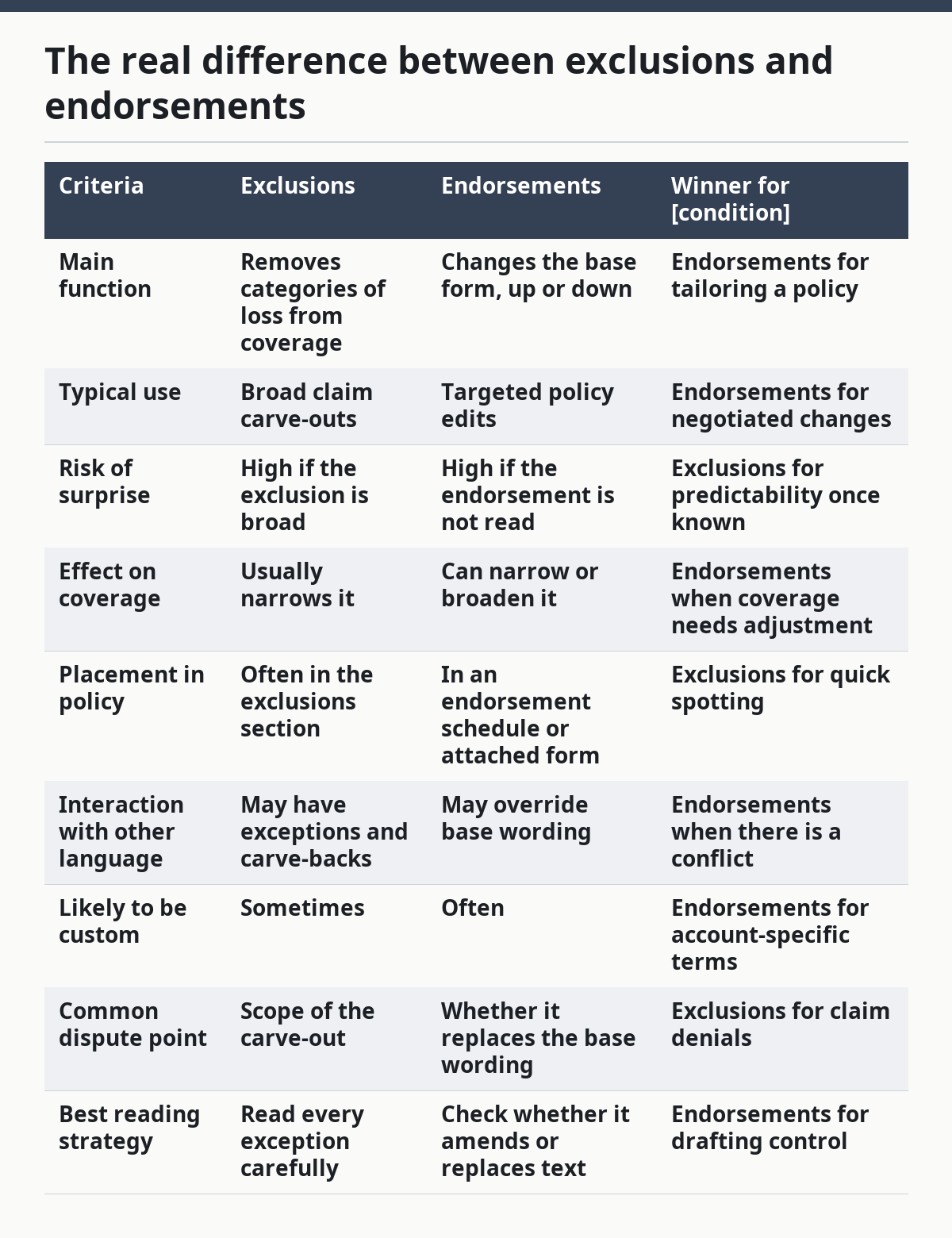
The table is a starting point, not the answer. In a real claim, the endorsement can be the more powerful document because it may directly rewrite the form. In a real placement, exclusions are often the first place a buyer should look because they show what was removed from the promise.
How should you read a policy with manuscript wording?
You should read it from the grant of coverage to the last custom sentence, because manuscript wording can shift the meaning of everything before it. That sounds simple, but it is where many people go wrong. They read the declarations page, then stop.
Picture this: you have a policy package with 40 pages, three endorsements, and one custom manuscript section. The claim turns on one sentence in the custom section, not the premium, not the class code, and not the summary sheet. The last page can beat the first.
A practical reading order looks like this:
- Declarations page
- Insuring agreement
- Definitions
- Exclusions
- Endorsements
- Manuscript changes
- Schedules and special conditions
Why this order? Because the policy is a layered contract. Definitions can change the scope of coverage before any exclusion is read. Endorsements can rewrite definitions. Manuscript changes can rewrite the endorsement. If you read out of order, you can miss the part that actually controls the claim.
There are three drafting signals that deserve extra attention:
- “This endorsement changes policy number…”
- “In consideration of the premium…”
- “Notwithstanding anything to the contrary…”
That last phrase is the loudest one in the room. It often means the custom wording overrides conflicting language elsewhere. It does not always win every fight, but it is designed to sit above ordinary text. In many disputes, those two or three words decide which clause controls.
A second signal is a definition that looks harmless but is used everywhere. If “occurrence,” “professional services,” or “property damage” is redefined, the entire policy may shift. A reader who treats definitions as background noise is reading the wrong part of the contract. If the term matters, consult a qualified lawyer or broker before treating the definition as routine. For background, see state insurance department guidance on policy wording and interpretation.
What are the biggest traps buyers miss?
The biggest trap is assuming the schedule tells the whole story when the body of the policy says something else. Another is reading endorsements one at a time without checking how they interact.
Picture this: you confirm an additional insured endorsement is attached, but you miss that a separate manuscript clause narrows the other party’s rights back down. Or you see a broad exception to an exclusion, then miss a later endorsement that deletes it. Conflict language wins.
Common traps include:
- Overlooking a form version or edition date
- Missing an endorsement that amends a definition
- Treating a summary sheet as if it were the policy
- Ignoring manuscript language because it looks “administrative”
- Missing a “subject to” clause that subordinates one form to another
The reader should also be careful with chained modifications. A base exclusion may be softened by one endorsement and then narrowed again by a manuscript change. That chain can be hard to follow if the policy packet is assembled from different sources, such as a carrier form, broker manuscript, and schedule of forms.
One more trap: assuming a familiar clause works the same way in every state or country. It doesn’t. Policy interpretation rules vary by jurisdiction, and so do default rules on ambiguity, the use of extrinsic evidence, and the treatment of conflicting endorsements. A clause that is routine in one place can be argued differently in another. For jurisdiction-specific questions, consult counsel and review the local insurance department guidance.
If the policy is meant for a commercial insured with layered coverage, the reader should also check whether the wording affects the primary layer, excess layer, or both. An exclusion may sit in the primary form but still influence a follow-form excess policy. That is not a rare issue. It happens in real claims.
When does manuscript wording help, and when does it hurt?
Manuscript wording helps when the risk is unusual and the parties need a precise fit; it hurts when the wording is custom but unclear. That trade-off is the heart of the issue.
Picture this: a contractor, manufacturer, or specialty service firm has coverage needs that a standard form only partly fits. The broker asks for custom wording, and the policy comes back with a manuscript clause. Tailored can mean better—or worse.
Manuscript wording tends to help when:
- The risk class does not fit a standard CGL form
- A contract demands a specific additional insured or waiver setup
- A product, service, or project needs a custom definition
- The placement involves layered or manuscript-heavy paper
It tends to hurt when:
- The wording is broad but hard to read
- The custom clause conflicts with a standard endorsement
- Key terms are left undefined
- The policy is assembled from different drafts and redlines
The reason is simple: custom drafting can solve one problem while creating another. A narrow manuscript exception may restore coverage for one claim type while taking away another benefit in the same sentence. A clause that seemed like a fix during placement may turn into a fight after loss.
The best practice in reading manuscript wording is to ask one question: what did this language change from the base form? If the answer is not clear, the clause is not clear enough. That does not mean the policy is wrong, but it does mean it should be read as a live negotiation document, not as a standard product sheet.
The verdict: which one matters most in a claim?
Endorsements and manuscript changes usually matter more than exclusions when they directly rewrite the policy, but exclusions are often the first place a claim gets denied. That is the cleanest way to think about it.
Picture this: a claim lands on the desk, and the insurer points to an exclusion. The insured points to an endorsement. Then someone finds manuscript wording that changes the definition tied to both. The last clear word usually controls.
Choose exclusions as the first place to read if you want to know what coverage was removed. Choose endorsements if you want to know what the carrier changed, added, or limited. Choose manuscript changes if the policy was tailored, negotiated, or issued on custom paper. Neither if you are trying to rely on the declarations page alone.
That call is especially true in commercial liability, where one sentence can shift the outcome. A retailer, contractor, landlord, consultant, or manufacturer may all have the same broad label on the front of the policy and very different results at claim time. The difference is buried in the wording.
The practical rule is straightforward:
- Exclusions tell you what is carved out.
- Endorsements tell you what was modified.
- Manuscript changes tell you what was custom-built.
If the policy is important enough to matter after a loss, it is important enough to read in full before the loss.
What should a reader do before relying on the policy?
A reader should compare the full policy forms, not just the summary, and should have a lawyer review the wording if the amount at stake is significant or the language is unusual. That is especially true where the policy contains manuscript drafting or conflicting endorsements.
Picture this: you’re about to sign or renew a commercial liability policy, and the binder looks clean. The real risk is in the attachments you may never open. That is where coverage changes.
Use this checklist:
- Collect every form attached to the policy.
- Identify every exclusion.
- Read every endorsement in the order listed.
- Find any manuscript or custom pages.
- Compare the final packet to the quoted proposal.
- Check the jurisdiction-specific rules if a claim could be contested.
Two authoritative places to start for general background are the NAIC and the insurance department or regulator in the state where the policy is issued. Trade groups and policy form libraries can help with structure, but they do not replace the contract itself.
The hard truth is that commercial liability disputes often begin because someone trusted the form title more than the form text. That is avoidable. Slow reading is not a luxury here. It is the job.
FAQ
What is the difference between an exclusion and an endorsement?
An exclusion removes a category of loss from coverage, while an endorsement changes the policy wording. An endorsement can broaden, narrow, or clarify coverage, so you have to read its body text, not just its title.
What is a manuscript change in insurance?
A manuscript change is custom policy wording drafted for a specific account. It is often used when the standard form does not fit the risk well, but it can also create new conflicts with the base policy or other endorsements.
Can an endorsement override an exclusion?
Yes, sometimes it can, if the endorsement is written to replace or limit the exclusion. The exact result depends on the wording and the policy’s conflict language, and that varies by jurisdiction.
Why do manuscript changes cause so many disputes?
They cause disputes because they are custom drafted and may not track the standard form cleanly. If a key word is undefined or a clause conflicts with another part of the policy, people end up arguing over which sentence controls.
What should I read first in a commercial liability policy?
Read the insuring agreement first, then the definitions, exclusions, endorsements, and any manuscript pages. That order helps you see how each later change affects the earlier promise of coverage.
Drafted with AI; not yet reviewed by a person.