Last updated: November 19, 2026
Claims-made coverage mechanics and reporting rules — The Complete Guide explains when a claim is covered, when it must be reported, and how the policy’s dates control the result. In short, a claim is generally covered only if it is first made during the policy period and reported within that same period or any applicable extended reporting window. Miss either clock, and a covered event can turn into your problem fast. The sections below sort out the two clocks, the traps, and what to do before a policy changes.
Key Takeaways
- Claims-made coverage runs on two timing tests: when the claim is made and when it is reported.
- A common mistake is assuming a loss date controls coverage; with this form, the reporting date can matter just as much.
- Tail coverage, sometimes called an extended reporting period, can preserve reporting rights after a policy ends.
- Retroactive dates and prior-acts terms decide how far back the insurer will reach.
- A renewal, a cancellation, or a carrier switch can create a gap if the reporting rules are not handled with care.
What claims-made coverage actually covers
Claims-made coverage responds when the claim is first made against the insured during the policy period, not just when the error, injury, or omission happened. That timing rule is the whole game in claims-made coverage mechanics and reporting rules, and it is why claims-made policies are common in professional liability lines.
Picture this: you made a mistake in March, nobody complained until November, and your policy ran from January to December. The key question is not only “did the loss happen during the year?” It is “was the claim first made, and usually reported, in the right policy window?”
Here’s the catch: a claims-made form usually has three moving parts.
- The claim is made during the policy period.
- The insurer is notified within the policy period or the extended reporting period, depending on the wording.
- The claim must fit any retroactive date or prior-acts grant in the policy.
A generic article often stops at “claims-made means the claim must be made while the policy is active.” That is incomplete. Many policies also require prompt notice, and the policy wording may define a claim broadly enough to include a demand letter, a lawsuit, or even a written allegation. For the exact wording, review the policy and, if needed, consult a broker or coverage attorney, because forms vary.
Here are the practical differences:
- A claim is the accusation or demand made against you.
- A report is the notice you give the insurer.
- A circumstance notice is a warning shot that may protect later claims tied to the same facts.
If you handle these like separate chores, you are less likely to lose coverage because of a date stamp. If you lump them together, you can miss the reporting window while still thinking the claim itself is “covered.”
How do reporting rules work under a claims-made policy?
Reporting rules tell you when notice must be given, and the deadline can be stricter than many policyholders expect. In a standard claims-made-and-reported form, the insurer wants both the claim and the report inside the policy period unless an extended reporting period applies.
Picture this: you get a demand letter on December 20, but your office does not forward it until January 15 after the policy expires. If the policy is claims-made-and-reported, that delay can matter just as much as the claim date itself.
A few reporting rules come up again and again:
- Notice of claim: you tell the insurer a claim has been made.
- Notice of circumstance: you report facts that may later become a claim.
- Prompt notice: the form may require notice “as soon as practicable” or “immediately,” depending on the wording.
- Extended reporting period: the insurer lets you report claims after expiration, but only for claims first made during the covered period or arising from covered acts.
The truth is, people often confuse a report with a claim. They are not the same. A letter to the insurer saying “we may have a problem” can preserve rights if the policy allows notice of circumstances, but it does not automatically equal a formal claim report unless the form says it does.
Here are the practical differences:
- A claim is the accusation or demand made against you.
- A report is the notice you give the insurer.
- A circumstance notice is a warning shot that may protect later claims tied to the same facts.
What is the difference between claims-made and occurrence coverage?
Occurrence coverage is tied to when the act or injury happened; claims-made coverage is tied to when the claim is first made, with reporting rules layered on top. That is the main difference in claims-made coverage mechanics and reporting rules, and it changes how you manage renewals, cancellations, and late notice.
Picture this: two policies cover the same professional mistake. Under an occurrence form, the policy in force when the mistake happened may respond years later. Under a claims-made form, the policy in force when the claim is first made is usually the one that matters.
That difference has real consequences:
- Occurrence can be easier to understand after the fact because the loss date drives the analysis.
- Claims-made usually costs less at first, but it demands stricter calendar control.
- Claims-made often has a retroactive date that limits how far back the insurer will go.
- Occurrence usually does not need tail coverage the same way a claims-made policy does.
The trade-off is simple. Claims-made coverage can be more affordable early on, but it puts more pressure on reporting discipline and continuity of coverage. Occurrence coverage spreads the risk differently and often reduces the “did I report it in time?” problem.
This is where people make the wrong assumption: they think a policy with a later expiration date still protects them for old conduct automatically. Not even close. With claims-made coverage, continuity matters. If the policy ends and a claim surfaces later, the reporting rule and any tail option decide whether there is still a path to coverage.
For professionals, this is why switching carriers, retiring, selling a practice, or letting a policy lapse can turn into a coverage event of its own. The policy is not just about the work you did. It is about the timing of the demand and the notice.
What is a retroactive date, and why does it matter?
The retroactive date is the oldest date of work or conduct the insurer will cover under the claims-made form, and it can cut off protection even when the claim is first made on time. If the act happened before that date, coverage may be blocked unless the policy has a prior-acts grant that reaches back.
Picture this: you buy a policy in 2026 with a retroactive date of January 1, 2024. A client later alleges a mistake from 2023. The claim may be timely reported, but the underlying act may still sit outside the covered window.
The retroactive date matters because it defines the policy’s reach backward in time. That date can stay the same for years if coverage is continuous, or it can be reset if you have a gap or move to a new insurer without preserving prior acts.
Watch for these terms:
- Retroactive date: the earliest covered act date.
- Prior acts coverage: protection for past work done before the current policy start date, subject to the retro date.
- Full prior acts: broader wording that may extend as far back as the insurer agrees, often still excluding known problems.
- Continuity: uninterrupted coverage that helps preserve the older date.
A common mistake is treating the policy inception date as the beginning of coverage for all past conduct. It is not. The retroactive date can be earlier than the inception date, and that earlier date is what often saves old work; if you are unsure how the wording applies, ask a broker or coverage attorney to read the form with you.
The flip side is just as important: if you let a policy lapse and then buy a new one, the new policy may come with a later retroactive date or no prior-acts protection at all. That can leave a quiet hole in your timeline. The claim may look old and harmless right up until the day it lands outside the covered period.
What happens if you report late?
Late reporting can forfeit coverage even when the claim itself is serious, because many claims-made policies are written to require notice within the stated reporting window. That is the hard truth, and it is why claims-made forms punish delay more than occurrence forms do.
Picture this: you receive a complaint, set it aside while you gather facts, and wait until the policy renews to notify the carrier. If the form says claims must be reported during the policy period, that delay may break coverage.
Late reporting creates several risks:
- The insurer may deny the claim as untimely reported.
- A defense could be delayed while coverage is investigated.
- A renewal carrier may point to the prior policy period instead of the current one.
- A missed reporting deadline can complicate settlement leverage.
Here’s the catch: not every late report is fatal in every policy, and some forms allow reporting of circumstances that later ripen into claims. But that protection only works if the notice is detailed enough and sent through the right channel in time.
A careful notice package usually includes:
- the date the claim or circumstance first came to light,
- the names of the people involved,
- a description of what happened,
- the date you first received a demand or allegation,
- any documents that show why the matter may become a claim.
If the policy requires notice “as soon as practicable,” delay still hurts. If the policy requires notice within the policy period, the margin is even tighter. The point is not to create paperwork for its own sake. The point is to keep the insurer from later saying the report came too late to count.
How do tail coverage and extended reporting periods work?
Tail coverage gives you extra time to report claims after the policy ends, but it usually does not extend the policy’s act coverage date or make new work covered. That is the most misunderstood part of claims-made reporting rules.
Picture this: you close a practice, cancel a policy, or move to a different carrier. A month later, a past client makes a claim based on work done while the policy was active. A tail may let you report that claim after the policy ended.
The mechanics matter. A tail, or extended reporting period, usually means:
- the claim must arise from acts during the covered policy period or prior-acts period,
- the claim must be first made in the allowed tail window, and
- the insurer gets notice within the tail timeframe set by the policy.
Tails can be short or long, depending on the contract. Some are automatic for certain events, such as death, retirement, or disability. Others must be purchased, and the cost can be material.
There are two mistakes here. First, people buy a tail and assume it covers new work. It does not. Second, people think a tail fixes every gap. It does not. If the claim falls outside the retroactive date, or if the policy excluded the conduct in the first place, a tail will not rescue it.
The best use of a tail is simple: it preserves the reporting door after the policy ends. That matters most when a business closes, a professional retires, or a practice changes carriers and wants to keep old exposures alive long enough for a claim to show up.
If you remember one line, make it this: the tail extends time, not subject matter.
What usually goes wrong with claims-made reporting?
The usual failure is a timing mistake, and it often starts with a claim or circumstance that nobody thinks is serious enough to report yet. By the time the issue grows into a formal demand, the policy period may be over.
Picture this: an email complaint arrives in April, a phone call follows in June, and a letter arrives in September. The insured waits until a lawsuit is filed in the next year. That delay can turn a manageable notice problem into a coverage fight.
The most common breakdowns are these:
- No early notice of a circumstance that later becomes a claim.
- Wrong assumption that only a lawsuit counts as a claim.
- Gap in coverage between policies, often during a carrier switch.
- Missing tail purchase after cancellation or retirement.
- Late internal routing so the insured learns of the claim too late.
The cost of the mistake can be large. It can mean the insurer denies the defense, disputes indemnity, or argues that the notice landed outside the stated period. Even if the claim would have been covered on the merits, the reporting error can still sink it.
This is the section people wish they had read before the problem arrived. A claims-made policy is not just “insurance you renew every year.” It is a calendar system with legal consequences. One missed date can be enough to move a claim out of the covered lane.
The best defense is boring but effective: train staff to forward anything that looks like a demand, allegation, or complaint the same day it arrives. Then review the policy wording before the renewal date, not after the claim.
Claims-made coverage mechanics and reporting rules: the checklist that actually helps
Claims-made coverage works when the claim is made on time, reported on time, and tied to a covered act date. That is the full test, and every other rule hangs off those three points.
Picture this: you are renewing a policy, changing insurers, or closing a practice. The right move is not guessing. It is checking the dates, the claim definition, the notice rule, the retroactive date, and the tail language in the same sitting.
Use this checklist:
- Read the claim definition and see what counts as a claim.
- Find the retroactive date and compare it to the earliest act date.
- Check the reporting deadline for claims and for circumstances.
- Ask whether a tail is available or needed if the policy ends.
- Confirm continuity if you are switching carriers.
- Send notice early when a demand or allegation first appears.
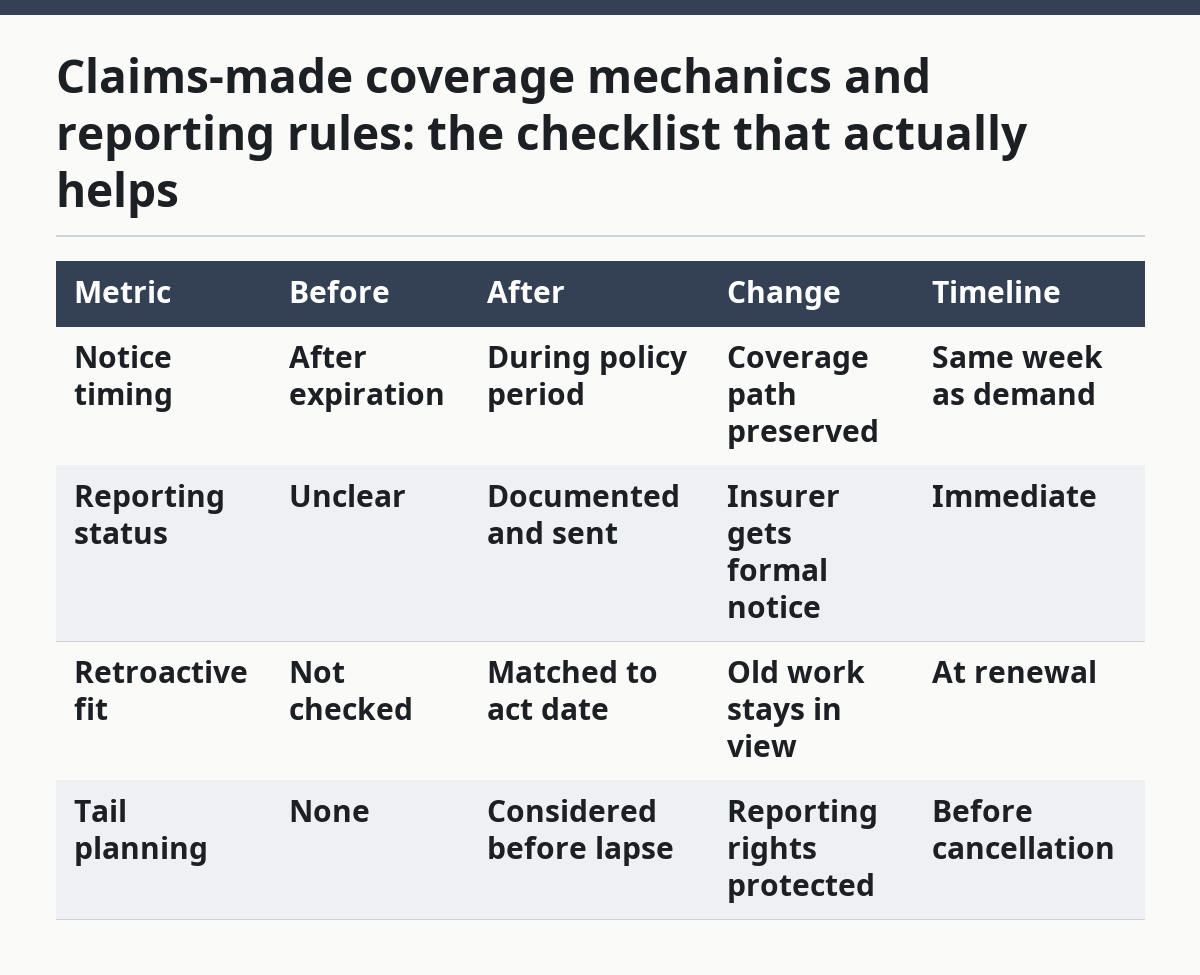
Here is a simple before-and-after view of what changes when reporting is handled correctly.
| Metric | Before | After | Change | Timeline |
|---|---|---|---|---|
| Notice timing | After expiration | During policy period | Coverage path preserved | Same week as demand |
| Reporting status | Unclear | Documented and sent | Insurer gets formal notice | Immediate |
| Retroactive fit | Not checked | Matched to act date | Old work stays in view | At renewal |
| Tail planning | None | Considered before lapse | Reporting rights protected | Before cancellation |
The hard part is not understanding the words. It is respecting the dates. Claims-made forms reward the person who reads the endorsement before the deadline, not the person who reads it after the denial.
What should you ask before you buy or renew a claims-made policy?
You should ask how the policy handles claims first made, claims reported, prior acts, and tail rights before you sign or renew. That question set is the difference between a policy you understand and one you only think you understand.
Picture this: you are sitting with a renewal quote and a stack of endorsements. The carrier says the form is “standard.” That is exactly when you need the fine print, because the notice rule and the retroactive date can differ from one form to the next.
Ask these questions:
- What is the retroactive date?
- Does the policy require the claim to be both made and reported during the policy period?
- Is there notice of circumstance coverage?
- What happens if the policy is cancelled or not renewed?
- Is a tail available, and when must it be bought?
The best part is that these are not abstract questions. They go straight to whether a future demand will land inside or outside the policy window. If the broker cannot explain the reporting rule in plain English, that is a warning sign.
A claims-made policy is worth having only if the insured can keep track of it. Otherwise the form is too easy to lose by accident.
What does “claims-made and reported” mean?
It means the claim must be first made and also reported within the time the policy requires, unless the policy gives an extended reporting period. That wording is stricter than a simple claims-made form, because notice timing becomes part of coverage itself.
Is a lawsuit the only thing that counts as a claim?
No. Many policies define a claim to include a demand for money, a written allegation, a lawsuit, or other formal accusation. The exact definition controls, so a warning letter can matter even when no suit has been filed.
What is notice of circumstance?
It is a report to the insurer about facts that could turn into a future claim. A good notice of circumstance can preserve coverage rights later, but only if the policy allows it and the notice is specific enough to tie future claims to the reported facts.
Does a tail coverage policy extend the retroactive date?
No. Tail coverage usually extends the time to report claims after the policy ends, but it does not move the retroactive date backward. If the act date is outside the covered period, the tail does not fix that problem.
Sources
- NAIC glossary: claims-made policy
- Insurance Information Institute: Claims-made vs. occurrence policies
- Cleveland Clinic Foundation v. Continental Casualty Co., 369 F.3d 1288 (11th Cir. 2004)
Drafted with AI; not yet reviewed by a person.