Last updated: November 20, 2026
A contract insurance requirement review has one quick answer: if the policy’s limits, endorsements, dates, and named insured match the contract in all four areas, the policy matches the contract requirement. This review of How to Tell Whether a Liability Policy Matches a Contract Requirement starts with the contract, the policy, and the evidence that ties them together. If the limits, additional insured wording, primary and noncontributory wording, and waiver of subrogation all line up, the policy matches the contract requirement; if even one of those pieces is missing or worded differently, it does not. For general background, see the Insurance Information Institute and IRMI. This is general information, not legal advice, and a qualified lawyer should be consulted for a real dispute or high-value deal.
Key takeaways
- Compare the contract to the policy, not the certificate alone.
- Check the limit amount, the coverage type, and every endorsement named in the contract.
- A certificate of insurance is only evidence on paper; it does not change the policy.
- The wording of an additional insured endorsement matters as much as the phrase “additional insured.”
- If the contract asks for primary and noncontributory treatment or a waiver of subrogation, consult a qualified insurance professional or lawyer and verify the policy or endorsement language, not just the certificate. See Commercial General Liability basics and Additional insured coverage.
- When the wording is vague, expired, or inconsistent, the safest answer is usually not “close enough”; it is to verify the policy language with a qualified professional.
What does a matching liability policy look like?

A matching liability policy has the same core insurance pieces the contract asks for, in the same form the contract requires. That usually means the right coverage part, the right limit amount, and the right endorsement language, not just a certificate that lists the policy number.
A reader doing this review should already have the contract, the full policy declarations page, and any endorsements attached to the policy. If the contract says “commercial general liability” and the policy is a claims-made professional liability form, that is a mismatch even if the dollar figure looks right. If the contract asks for a $1 million per occurrence limit and a $2 million general aggregate, the declarations page must show those numbers or the contract is not satisfied.
This review also assumes the reader knows the difference between a requirement and proof. A contract can require an endorsement. A certificate can point to it. Only the policy and endorsements actually provide the coverage language.
For general background on contract requirements in liability insurance, the Insurance Information Institute and IRMI publish plain-language material that can help frame the terms. The core question is whether the policy file in front of you contains the exact pieces the contract asks for.
How do I compare a policy to a contract?
You compare a policy to a contract by matching each requirement line by line against the declarations page, the endorsement schedule, and the endorsement text. The goal is not to guess intent; the goal is to confirm that the policy side contains what the contract side demands.
- Gather the contract, the declarations page, and every endorsement, then verify the policy number, named insured, and effective dates on all three pages match.
- Check the limit numbers on the declarations page, including per occurrence and general aggregate if the contract names both, and mark a mismatch if the contract asks for a higher amount than the policy shows.
- Read the coverage grant to confirm the policy is the right type, such as commercial general liability, and not another liability form with a different trigger or scope.
- Inspect the additional insured endorsement for the exact wording the contract requires, and verify that the entity named in the contract is actually covered by that endorsement.
- Locate any primary and noncontributory endorsement or wording, and confirm it is attached to the policy rather than only mentioned in the certificate.
- Find the waiver of subrogation language, if the contract requires it, and verify whether the waiver applies broadly or only in limited situations such as a written contract. If the contract asks for primary and noncontributory treatment or a waiver of subrogation, consult a qualified professional before treating a certificate line as proof. See [Policy endorsements explained](/policy-endorsements/) and [Waiver of subrogation](/waiver-of-subrogation/).
- Compare the certificate of insurance to the policy only after the policy review, and treat any certificate language that conflicts with the endorsements as a warning sign, not proof of compliance. For more on certificates, see [Certificate of insurance guide](/certificate-of-insurance/).
- Record each match and mismatch in a simple checklist so that every item in the contract has one yes-or-no answer, with no blank spots left to assumption.
A problem shows up when the contract uses broad words and the policy uses narrow ones. A contract may ask for “any entity required by written agreement” as an additional insured, while the endorsement may cover only “that person or organization for whom you are performing operations.” Those are not the same. A mismatch also appears when the contract requires a waiver of subrogation and the policy gives one only for scheduled contracts or only if the waiver is endorsed before loss.
The right comparison method is mechanical. If the contract requires three things and the policy proves only two, the review is incomplete.
Which policy details matter most?
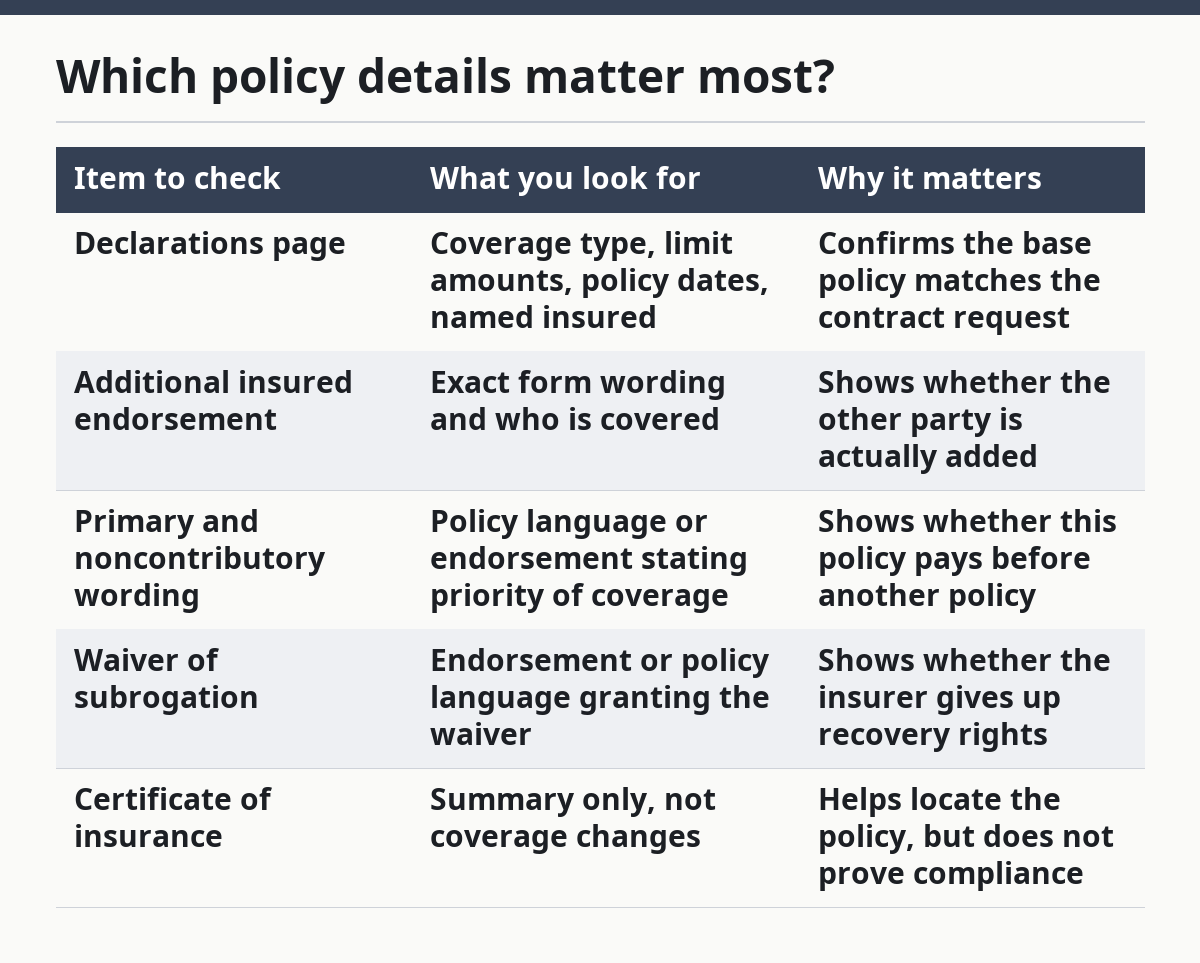
The policy details that matter most are the ones that change who is covered, who pays first, and whether the limit is big enough for the contract. Those details are the declarations page, the endorsement forms, and the policy dates.
A general liability policy can look acceptable at first glance and still miss the contract requirement in one line of wording. The declarations page tells you the limit structure, such as per occurrence and aggregate limits. The endorsements tell you whether the policy adds the other party as an additional insured, makes coverage primary, or waives subrogation. The dates tell you whether the contract period and policy period overlap in a way that makes sense.
The certificate of insurance sits lower on the list. It can help show that a policy exists, but it does not rewrite the policy. If the certificate says “additional insured” and the attached endorsement is missing or narrower than the contract, the endorsement controls.
A simple way to sort the details is below.
| Item to check | What you look for | Why it matters |
|---|---|---|
| Declarations page | Coverage type, limit amounts, policy dates, named insured | Confirms the base policy matches the contract request |
| Additional insured endorsement | Exact form wording and who is covered | Shows whether the other party is actually added |
| Primary and noncontributory wording | Policy language or endorsement stating priority of coverage | Shows whether this policy pays before another policy |
| Waiver of subrogation | Endorsement or policy language granting the waiver | Shows whether the insurer gives up recovery rights |
| Certificate of insurance | Summary only, not coverage changes | Helps locate the policy, but does not prove compliance |
A common trap is to treat the certificate as the final answer. It is not. A certificate can be clean while the policy is wrong, and that gap matters. For a broader checklist, see Liability insurance basics.
How do additional insured, primary, and waiver terms fit together?
They fit together as separate contract tests, and each one has to be present in the policy file if the contract asks for it. One endorsement does not replace another.
An additional insured endorsement adds another person or company to the liability policy for some level of coverage. The wording matters because some endorsements cover only ongoing operations, while others extend to completed operations or other limited situations. If the contract requires the landlord, owner, or upstream party to be an additional insured, the endorsement has to name or describe that party in the way the contract requires.
A primary and noncontributory clause means this policy should respond first and should not seek help from the other party’s insurance, to the extent the policy language says so. If the contract asks for that treatment and the policy has no endorsement or no matching wording, the requirement is not fully met. A certificate line that says “primary and noncontributory” does not fix a policy that says something else.
A waiver of subrogation means the insurer gives up a right to pursue another party after paying a loss, if the waiver applies. Contracts often ask for this in service or construction settings. The important point is whether the waiver is attached to the policy and whether it covers the type of risk and contract the agreement describes.
These items can travel together, but they are not interchangeable. A policy can satisfy one and miss the others. That is why a line-by-line review is better than a quick yes-or-no glance.
What should I check before I say it matches?
You should check the exact policy forms before you say it matches, because form wording can change the result even when the cover name stays the same. The first pass should be on the declarations page and endorsements, not the certificate.
Look first at the named insured and the policy term. If the contract requirement is tied to a specific job or project and the policy expired before that work started, the paperwork may not support the requirement. Check the limit structure next. A contract that asks for both per occurrence and aggregate limits needs both numbers to align, not just one.
Then verify the endorsement schedule. If the contract requires an additional insured endorsement by form number or by a specific wording standard, look for that exact form or language. If the policy instead uses a different endorsement with narrower wording, the mismatch is real even if the certificate looks polished.
After that, check whether the policy says what the contract wants on priority of coverage and subrogation rights. If those terms are missing from the policy or only appear in a summary document, the match is weak. A solid review ends with a written checklist, because memory is the easiest place for this process to fail.
When should I stop and get qualified help?
You should stop and get qualified help when the policy file and the contract do not clearly line up, because a guess on a legal insurance requirement can leave a real gap. That is especially true in higher-value contracts and in any situation where the wording is unusual.
The contract names a specific endorsement form and the policy uses a different one: this means the wording may not grant the same coverage — get a lawyer or qualified insurance professional to compare the forms.
The certificate says one thing and the endorsement says another: the certificate is not the policy — stop relying on the certificate and review the actual endorsement language.
The contract asks for completed operations coverage and the endorsement only covers ongoing operations: the contract requirement is only partly met — do not assume the broader item is included.
The policy period does not match the contract period or the work period: the timing may leave a gap — pause and have the dates reviewed before treating the policy as compliant. For related timing issues, see Policy effective dates.
The contract uses unusual wording for primary, noncontributory, or waiver of subrogation terms: standard endorsement language may not satisfy it — get a qualified review instead of forcing a fit.
The policy is manuscripted or heavily modified: standard checklist logic may fail — ask someone who can read the full form package, not just the summary page.
This is where a simple review stops being simple. If the contract is routine and the policy is standard, the checklist works well. If either one is unusual, the safest move is to slow down.
What mistakes do people make most often?
The most common mistake is reading the certificate as if it were the policy. That can cause a false pass, because the certificate is only a snapshot and can leave out limits, exclusions, or narrow endorsement wording. The fix is to verify the declarations page and endorsements first.
Another mistake is matching only the dollar amount. A policy can meet the limit requirement and still fail the contract because the additional insured endorsement is too narrow or the waiver of subrogation is missing. The correct approach is to match every required item, not just the largest number on the page.
A third mistake is ignoring the exact insured party name. If the contract names a parent company, landlord, project owner, or manager, and the endorsement names someone else or uses a limited description, that mismatch matters. The better habit is to compare the contract name against the endorsement text character for character.
A fourth mistake is assuming primary and noncontributory wording is automatic. It is not. Some policies do not include it unless the endorsement is attached, and some contracts require the wording in a very specific form. The correct alternative is to confirm the actual endorsement or policy clause.
A fifth mistake is skipping dates. A policy can be correct on paper and still miss the contract because the term is wrong or the coverage was not in force when the work happened. The alternative is to verify the effective dates before any other comfort check.
How do I know the review is complete?
A review is complete when every contract item has a matching policy source and no item depends on guesswork. That usually means one answer each for limits, additional insured, primary and noncontributory, waiver of subrogation, and the certificate’s consistency with the policy.
A complete review also leaves a paper trail. If the contract asks for a $1 million limit, note where the declarations page shows it. If it asks for additional insured status, note the endorsement form or language that grants it. If the contract asks for a waiver of subrogation, note the endorsement or clause that does so. A 5-line checklist is often enough if it names the exact page or form for each requirement.
The review is not complete if you have only a certificate, only a broker note, or only a verbal assurance. It is also not complete if the contract says “as required by written agreement” and the policy language is narrower than that phrase. In that case, the mismatch remains until the wording is reconciled.
For the broader placement process, this page sits under the hub on commercial liability insurance contract requirements. That hub belongs with this review because the policy side only makes sense when it is read against the contract side.
How do I compare a policy to a contract?
Match each contract line to one policy source: declarations page, endorsement schedule, or endorsement text. If any required item has no policy proof, the policy does not fully match the contract.
What should I verify first in a contract requirement?
Verify the policy type, the named insured, and the limit amounts first. Those three items tell you whether the policy is even in the right category before you spend time on endorsements.
Can a certificate alone prove compliance?
No. A certificate can point to a policy, but it does not change the policy’s wording or fill in missing endorsements. The policy and endorsements are the documents that control.
Drafted with AI; not yet reviewed by a person.