Last updated: November 20, 2026
Quick Answer: Commercial Liability Coverage for Business Exposures is usually built around a 12-month policy term, and the aggregate limit is the most the insurer will pay for covered claims during that term. For a business trying to understand commercial liability coverage for business exposures, the key question is not just “Do I have coverage?” but “What claims are covered, what is excluded, and will the aggregate limit run out before the year does?”
This is general information, not legal advice. Liability rules, policy wording, and court treatment vary by jurisdiction, so a qualified lawyer or insurance professional should be consulted about any specific matter. The NAIC and the SBA business insurance guide are useful starting points, but they do not replace advice on a specific policy or claim.
Key takeaways
- Commercial liability coverage is built to handle third-party claims, not damage to the business’s own property.
- The aggregate limit is a ceiling on total covered payments during the policy term, while a per-occurrence limit caps one claim.
- A standard commercial general liability form, often written as CG 00 01, is the starting point for many small and mid-sized businesses.
- The biggest risk is not a single large claim alone; it is a series of smaller claims that can use up the same annual limit.
- An umbrella policy can help when a business’s exposure is bigger than the primary policy’s aggregate limit, but it does not replace careful policy wording.
- Businesses should check exclusions, endorsements, and defense-cost treatment before deciding that a limit is “enough,” and they should consult a qualified professional with the policy in hand.
What does commercial liability coverage actually cover?
Commercial liability coverage covers claims by other people for bodily injury, property damage, and related losses that arise out of a business’s operations, premises, products, or completed work. In a common commercial general liability policy, often built on the CG 00 01 form, the core promise is to defend and pay covered claims subject to the policy limits and exclusions.
The most useful way to think about it is this: the policy is there when the business is accused of causing harm to someone else. That is different from property insurance, which is about the business’s own building, inventory, or equipment, and different from workers’ compensation, which is usually about employee injury claims and is handled under separate rules.
A generic article often gets this wrong by treating “liability insurance” as one bucket. It is not one bucket. A retail store, contractor, consultant, manufacturer, landlord, and event host can all buy liability coverage, but the exposures are different. A consultant’s biggest problem may be an allegation of faulty advice. A contractor’s may be a completed-operations claim after the work is done. A store’s exposure may be a slip-and-fall at the front door.
The phrase “business exposures” matters because the policy follows the exposure, not the industry label. A business with public foot traffic, delivered products, subcontracted work, or advertising activity has a different liability profile than a home-based office with little client contact.
The SBA business insurance guide is a useful starting point for the general idea of business insurance, and the policy form itself should be read line by line because the form controls more than the sales summary. The commercial general liability policy is broad in concept, but not broad in every claim type. That difference is where many coverage disputes begin.
What is an aggregate limit in business liability insurance?
An aggregate limit is the total amount the insurer will pay for covered losses during the policy period, usually a 12-month term. Once that limit is used up, the policy does not keep paying new covered claims unless another policy or another layer of coverage responds.
That sounds simple, but the practical effect is easy to miss. A business may think in terms of “one claim, one limit,” yet the aggregate limit can be consumed by several claims, several settlements, or a mix of claims and defense costs depending on the policy wording. The policy may also have separate sublimits for certain hazards, which means the headline number is not always the number that controls a specific loss.
Here is the difference that matters:
- Per-occurrence limit: the most the policy will pay for one covered event.
- Aggregate limit: the most the policy will pay in total for all covered claims during the policy term.
The aggregate limit is the ceiling that often gets overlooked when a business reviews renewal quotes. A policy can look fine on a per-claim basis and still be weak if the business faces repeated small claims. That is common in settings like customer foot traffic, recurring contractor work, rented premises, or product distribution.
A generic guide often stops at “limits matter.” That is too vague. The real issue is that the aggregate limit can be eroded by multiple claims that seem modest on their own. One slip claim, one product claim, and one completed-work claim can matter more together than a single large incident.
For a reader comparing policies, the first question is not “Is the number high?” The first question is “What uses the aggregate, what does not, and does the policy make defense costs count against it?” Those details can vary by form and endorsement, and they matter more than a brochure summary. The NAIC consumer resources and a qualified insurance professional can help translate that wording into plain English.
Why do claims use up the same limit?
Claims use up the same limit because the policy usually treats all covered claims in the term as drawing from the same aggregate pool. That pool can be reduced by settlements, judgments, and sometimes defense costs, depending on the exact policy language and the jurisdiction interpreting it.
This is where business owners get surprised. A business may assume a claim must be “large” to matter, but repeated smaller claims can do the damage. If the policy has a single annual aggregate and the business has several incidents in the same year, the next claim may find less protection left than expected.
The following table shows the practical difference between a primary CGL policy with a strong aggregate limit and a commercial umbrella policy that sits above it. The comparison is for choosing structure, not for reading a quote in isolation.
| Criteria | Primary CGL with strong aggregate | Commercial umbrella above primary | Winner for this condition |
|---|---|---|---|
| Where it pays | First layer | Above the primary policy | CGL for routine claims |
| Relation to aggregate limit | Uses the policy’s own aggregate | May extend protection once primary limits are reached | Umbrella for large loss protection |
| Best use | Day-to-day business liability | Catastrophic or stacked losses | Depends on exposure size |
| Policy complexity | Usually simpler | More moving parts and coordination issues | CGL for simpler administration |
| Cost structure | Often the baseline purchase | Added layer on top of primary coverage | CGL for basic compliance needs |
| Defense-cost treatment | Varies by form and wording | Also varies, and can be tricky | Neither without close review |
| Works after many small claims | Only until the aggregate is used | Helps if primary limits are exhausted | Umbrella for repeat-claim risk |
| Contracting fit | Often required by landlords or clients | Usually supplemental, not a substitute | CGL for contract minimums |
| Best for | Businesses with modest exposure and few claims | Businesses with larger or more volatile exposure | Depends on risk profile |
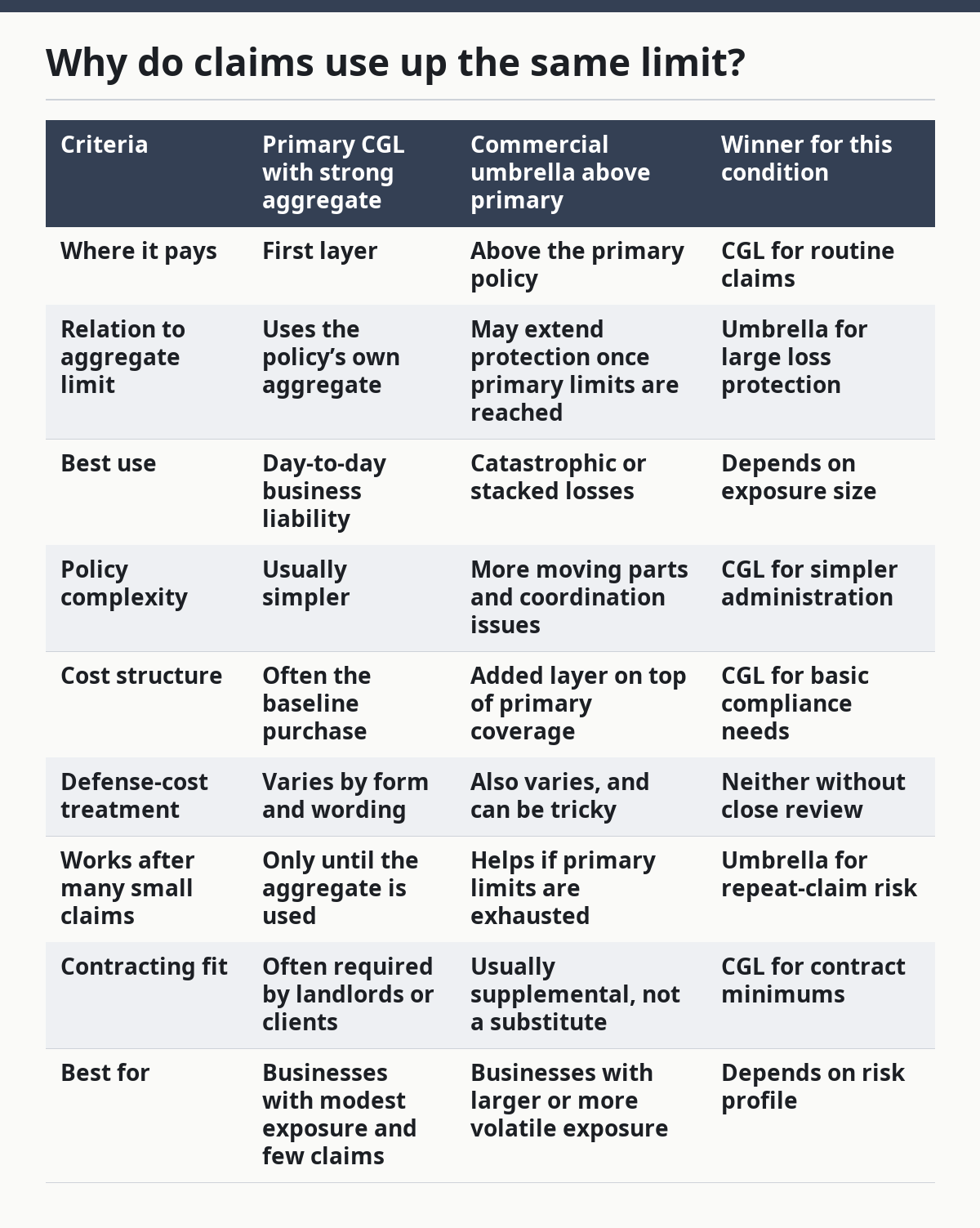
The biggest mistake is to compare only premium and ignore claim frequency. A business with frequent low-severity claims may need a different structure than a business that is exposed to rare but severe claims. The aggregate limit is the number that separates those two situations.
When is a primary policy enough?
A primary policy is enough when the business’s exposure is modest, the claim pattern is limited, and the aggregate limit is comfortably above the likely run rate of claims for the term. That answer depends on the business, not on a universal rule.
A small professional office with low foot traffic and few client visits may be able to manage with a straightforward CGL policy if the exposures are narrow and the contract requirements are light. A service business that works on a few sites and has limited public contact may also fit that pattern, though the policy still needs to match the work being done.
The strength of the primary policy is its clarity. A standard CGL structure built on a form such as CG 00 01 is familiar to insurers, brokers, landlords, and contract reviewers. That familiarity matters because certificate requests and lease requirements often track the primary policy first.
The weakness is that the primary policy can be too thin if the business has recurring exposure. A business with products in the stream of commerce, frequent visitor traffic, subcontracted work, or a contract that demands high liability proof may find the policy’s aggregate limit tight. The policy may also leave gaps if it excludes professional advice, cyber events, pollution, auto-related loss, employee injury, or intentional acts.
This is not the right choice for a business that has any of the following:
- Frequent customer visits
- Work performed away from the business site
- Products sold or installed into other people’s property
- A contract that requires high proof of liability
- A history of repeated claims
The line between “enough” and “not enough” is not about the business’s size alone. A small business can face a big liability problem, and a larger business can sometimes carry a tidy exposure if its work is narrow and its contracts are well controlled. The question is how the policy fits the actual exposure pattern.
When does an umbrella policy win?
An umbrella policy wins when the business needs protection above the primary policy’s aggregate limit and wants a second layer for severe loss. It is the better fit for businesses whose exposure can outgrow the base policy before the term ends.
Umbrella coverage can be useful when a business has more than one exposure line that could produce a large claim. A contractor, distributor, landlord, event operator, or business with high visitor volume may need that extra layer because one bad year can produce several claims, not just one. The umbrella is there to catch losses after the primary policy is used up, though the terms must be checked carefully because umbrella policies usually have their own conditions, exclusions, and attachment points.
That said, an umbrella is not a magic fix. It does not erase the primary policy’s exclusions, and it may not fill every gap the business hopes it will fill. If a claim is excluded under the underlying form, the umbrella may not help unless the umbrella specifically grants broader follow-form or drop-down protection. Those details are policy-specific and jurisdiction-specific, so a qualified professional should review them before purchase.
The weakness of the umbrella is administration. It adds another policy layer, another set of conditions, and another place where wording matters. A business that wants simple certificate management and very limited exposure may not need that complexity.
A good rule of thumb is that the umbrella becomes more attractive as the business’s liability profile becomes more layered. If one year’s losses could reasonably spill past the primary aggregate, the umbrella deserves attention. If the business’s claims history is sparse and the work is narrow, the extra layer may be unnecessary.
A generic article often treats umbrella coverage as an automatic upgrade. It is not. It is a second layer for businesses that can justify the extra protection because the exposure is real, not because the word “umbrella” sounds safer.
The honest side-by-side
The primary CGL policy wins on simplicity and baseline protection, while the umbrella wins on capacity above the first layer. The right choice depends on whether the business is trying to satisfy ordinary liability needs or guard against a year with several claims.
Below is the comparison that usually changes the decision:
| Criteria | Primary CGL policy | Umbrella policy | Winner for this condition |
|---|---|---|---|
| Core role | First-dollar liability coverage | Excess protection above underlying limits | Primary CGL for basic needs |
| Aggregate risk | Can be exhausted by multiple claims in one term | Helps after the base limit is hit | Umbrella for higher exposure |
| Contract acceptance | Commonly requested by landlords and clients | Usually supplemental | Primary CGL |
| Policy wording risk | Standardized but still detailed | Can be harder to coordinate with underlying policy | Primary CGL for clarity |
| Best for repeated smaller claims | Limited by its own aggregate | Better, if attachment conditions are met | Umbrella |
| Best for single severe loss | May be too shallow | Better protection above the base layer | Umbrella |
| Setup burden | Usually simpler to place and explain | Requires alignment with the primary policy | Primary CGL |
| Likely fit | Low-to-moderate exposure businesses | Higher-exposure businesses | Depends on exposure |
| Common mistake | Assuming the aggregate is “enough” without stress testing | Assuming it replaces the base policy | Neither alone |
The real trade-off is not premium versus protection in the abstract. It is whether the business wants a single policy that handles routine third-party claims or a layered structure that can absorb a bad year. The first protects the ordinary case. The second protects the ugly one.
For many businesses, the right structure is not an either-or choice. The primary policy handles the first layer, and the umbrella handles what the first layer cannot. But that answer only works if the underlying policy is sound, the exclusions are understood, and the aggregate limit is not already too low for the exposure.
What should a business check before buying?
A business should check the aggregate limit, exclusions, defense-cost treatment, endorsements, and any contract-required wording before buying. The limit alone is not enough because the policy may look strong while still missing the exposure that matters.
Start with the policy form. If the business is being offered a CGL policy, ask what form is being used and what endorsements change it. The standard form may be familiar, but endorsements can narrow or expand important protections. That includes additional insured wording, waiver of subrogation language, and any special exclusions tied to the business’s line of work.
Next, look at how the aggregate applies. Some policies have a general aggregate and a products-completed operations aggregate, and some risks sit in one bucket more than the other. A contractor and a retailer may not use the same limits in the same way. If defense costs erode the same limit, that can change the practical value of the policy even when the headline number looks comfortable.
Then check the exclusions. The most common disappointment is assuming “liability” means “all liability.” It does not. Professional services, cyber events, pollution, auto use, employee injury, and intentional acts are commonly handled separately or excluded. A business with those exposures may need other coverages, not a bigger CGL limit alone.
The best source for a general starting point is the SBA business insurance guidance, but the final reading should be on the policy itself and, when needed, through a qualified lawyer or insurance professional. That is especially true where local law affects interpretation of the policy wording.
A good buying question is not “How much coverage can I get?” It is “What exact claims will this policy pay, what will count against the aggregate, and what happens when the first layer is gone?”
What business exposures are most likely to strain the limit?
The exposures most likely to strain the limit are repeated third-party claims, higher-severity bodily injury claims, product-related claims, completed-work claims, and contract-driven claims from clients or landlords. Those are the claims that can use up an annual aggregate faster than the business expects.
A business with many visitors has different risk than a business with almost none. A repair shop, storefront, gym, restaurant, event venue, contractor, wholesaler, and property owner can all face claims that stack up in the same policy year. The more often the business interacts with the public or with other people’s property, the more likely the aggregate will matter.
Completed work is a classic pressure point. Work that looked fine at handoff can become a claim later if something fails after the project ends. Product claims create a similar problem because a defect may generate several claims from several buyers. In both cases, the business may be surprised by how quickly the policy can be used.
A second pressure point is contractual transfer of risk. A lease, vendor agreement, or service contract may ask for proof of insurance and additional insured status. That does not make the exposure go away; it usually shifts how the claim is handled and who is defending whom. If the contract demands higher limits than the business can actually carry, the policy will not fix the gap by itself.
This is where a generic article often falls short. It talks about “risk” without naming the claims that cause the aggregate to fall. The practical answer is that exposure is not an abstract concept. It shows up as the kind of claim that can recur, multiply, or arrive after the work is finished.
What is the verdict?
Choose a primary commercial general liability policy with a well-matched aggregate if the business has modest exposure, simple operations, and few third-party claims in a year. Choose a layered structure with an umbrella if the business has public traffic, product risk, completed-work risk, or contract demands that could outgrow the first policy. Neither is enough by itself if the policy excludes the main exposure or the business needs advice on a specific legal question.
The split is clear. The primary policy is for routine liability protection. The umbrella is for the year that goes sideways. If the business has no meaningful third-party exposure, neither a large aggregate nor a second layer may be the right answer; another form of coverage may be more relevant.
What if the business has no clients on site?
A business with no clients on site may still need commercial liability coverage, but the exposure is usually narrower than a storefront or service location. Remote work does not remove liability, especially if the business gives advice, ships products, or signs contracts that require proof of insurance.
The first question is what third-party harm could still happen. A vendor delivery, a faulty product, a website claim, or a completed service can still produce a claim. The policy form and the aggregate limit should match those exposures, not just the address of the office.
Does a bigger aggregate always mean better coverage?
A bigger aggregate does not always mean better coverage because the policy can still exclude the loss, cap sublimits, or shift defense costs in a way that matters. A high number is helpful only if it applies to the claim type the business actually faces.
That is why a policy should be read as a package, not as a number. A business can pay for a larger limit and still miss the exposure that counts most.
Should a small business always buy an umbrella?
A small business should not assume an umbrella is automatic because the right answer depends on claim frequency, contract demands, and the size of the underlying exposure. If the business has very limited third-party contact and a modest risk profile, the extra layer may not be necessary.
The stronger the exposure to repeated claims, the more useful the umbrella becomes. The weaker the exposure, the less useful the added layer is likely to be.
What if the policy runs out before the year ends?
If the policy runs out before the year ends, the business may face uncovered losses on later claims unless another policy layer responds. That is the core purpose of tracking the aggregate limit in the first place.
The practical fix is not to guess. Review the policy form, the claim pattern, and any contract requirements before the limit is tested in real life. If the business is close to the limit, a qualified insurance professional should review the renewal before the next policy term begins.
Sources and further reading
- U.S. Small Business Administration, business insurance guidance: https://www.sba.gov/business-guide/launch-your-business/get-business-insurance
- National Association of Insurance Commissioners, consumer insurance information and state-based regulation resources: https://content.naic.org/consumer
Drafted with AI; not yet reviewed by a person.