Last updated: November 19, 2026
Commercial liability insurance risk transfer in contracts is how one business pushes another business’s liability exposure into an insurance-backed promise, usually through insurance requirements, additional insured status, and indemnity language. Quick answer: in a typical commercial deal, the transfer works only when the contract, the policy, and the evidence all match. Done right, it moves the loss to the right insurance layer; done badly, it leaves a gap where everyone thinks someone else is paying. This guide explains the clauses, the mechanics, and the failure points.
Key takeaways
- Risk transfer is not one clause. It is a chain: contract wording, policy wording, and proof that the policy really follows the contract.
- The two biggest tools are indemnity and additional insured status, but they do different jobs and have different limits.
- Certificate of insurance alone is weak evidence. It shows a policy may exist, not that the policy covers your deal.
- The wrong wording can leave you paying defense costs, uninsured losses, or both.
- This is information, not financial advice. Insurance terms, limits, and required wording vary by country and change over time, so a qualified adviser should review your own contract and policy setup.
Who this applies to, and what it assumes
This applies to anyone who signs commercial contracts that shift liability between businesses: landlords, tenants, contractors, subcontractors, suppliers, service firms, and clients who hire them. It assumes you already know the deal basics—who is doing the work, where it will happen, and what could go wrong, such as bodily injury, property damage, or a third-party lawsuit.
Because this topic is often misunderstood, the first step is to identify the contract and the insurance together. Picture this: you are reviewing a contract and the other side wants a broad indemnity, proof of insurance, and “additional insured” status before work starts. You need to know what each term does, what it does not do, and where the insurance can refuse to respond. That is the problem this page solves.
The truth is, many people treat contract risk transfer like a checkbox. It is not. A clause can be beautifully written and still fail if the policy excludes the loss, the required party is named wrong, or the contract asks for coverage the insurer never agreed to provide. For a professional review, consult a qualified insurance or legal adviser, because standards and enforceability vary by jurisdiction.
A few situations need qualified help rather than a do-it-yourself reading:
- Multi-party projects with layered contracts: one loss can pass through several contracts and several insurers.
- High-limit requirements: a $1 million request may be normal in one deal and nowhere near enough in another.
- Professional services or design work: errors and omissions coverage works differently from general liability.
- Work across borders: insurance terms, compulsory cover, and enforceability differ by country.
- Large indemnity language: if the clause covers another party’s own negligence, many policies limit or exclude that exposure.
Therefore, risk transfer works only when the contract creates an obligation, the policy picks up that obligation, and the claim facts fit both. If any one of those three pieces breaks, the transfer fails.
What “risk transfer” actually means in a commercial contract

Risk transfer means one party agrees to bear, defend, or insure against losses that another party might otherwise have to absorb. In commercial liability insurance, that usually happens through three tools: indemnity, additional insured status, and insurance requirements. Indemnity is the promise to reimburse a loss. Additional insured status extends some policy protection to the other party. Insurance requirements force one side to carry specific cover.
Here’s the catch: those three tools are not interchangeable. An indemnity clause may be broad enough to require payment for a claim, but the insurance policy may only cover part of that promise. A certificate may prove the policy exists, but not that it covers the contract’s exact risk.
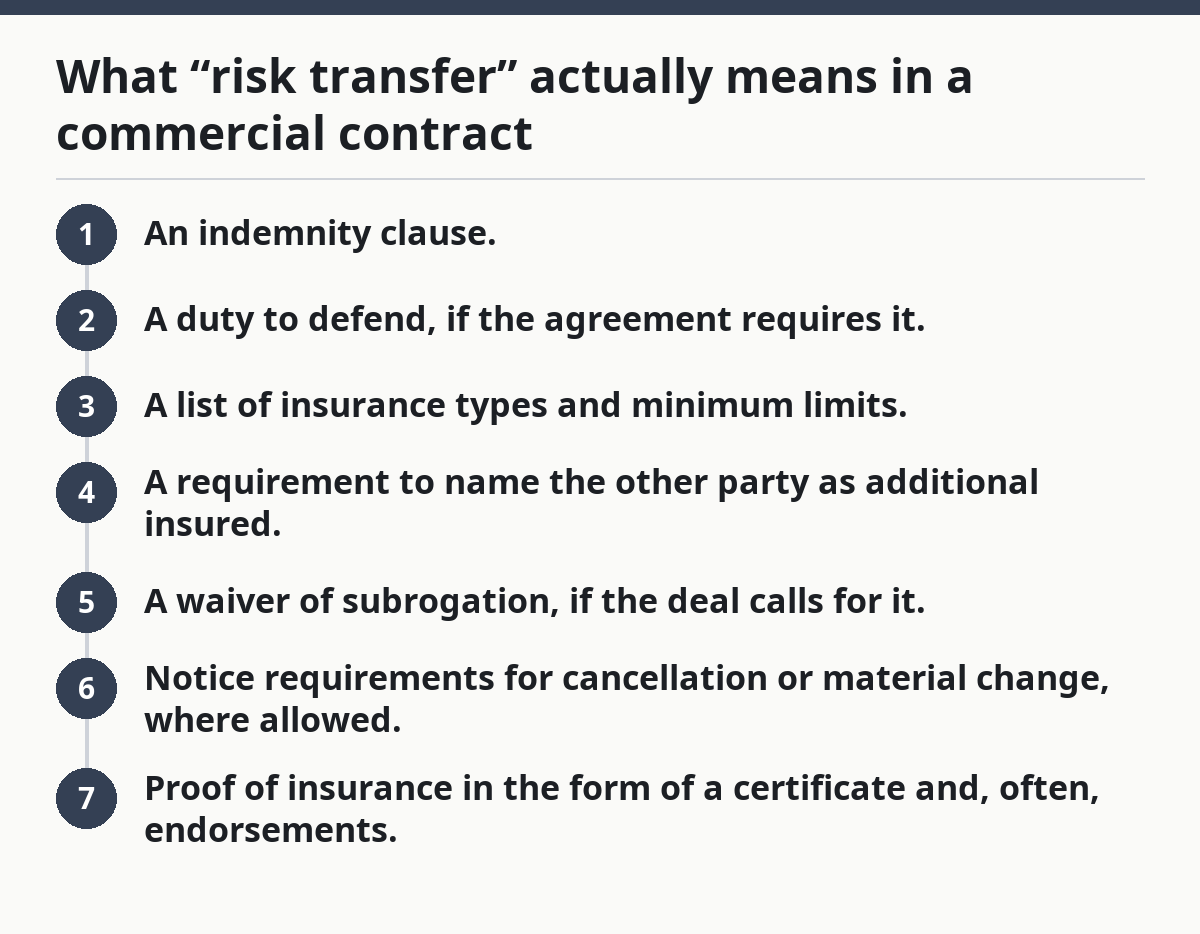
A standard contract package often includes:
- An indemnity clause.
- A duty to defend, if the agreement requires it.
- A list of insurance types and minimum limits.
- A requirement to name the other party as additional insured.
- A waiver of subrogation, if the deal calls for it.
- Notice requirements for cancellation or material change, where allowed.
- Proof of insurance in the form of a certificate and, often, endorsements.
The term endorsement means a policy amendment. It matters because endorsements can add, narrow, or delete coverage. A certificate is only a snapshot; an endorsement is the change itself.
The mistake many readers make is assuming the contract alone controls. It does not. Insurance policies are separate contracts with their own exclusions, conditions, and definitions. If the policy says “you are insured only for liability arising out of your ongoing operations,” then completed work, product liability, or professional services may need separate language or separate coverage.
A simple way to think about the flow is this:
- Contract creates the promise.
- Policy responds to the legal exposure.
- Claim must fit both.
If the loss fits the contract but not the policy, the promise may be uninsured. If the policy exists but the contract does not require the right status, the money may still go to the wrong place.
The main tools, in plain English
- Indemnity: one party repays another for certain losses.
- Duty to defend: one party or its insurer must pay for the defense of a claim, often before fault is decided.
- Additional insured: another party gets insured status under your policy for defined risks.
- Waiver of subrogation: the insurer gives up, in some situations, the right to chase the other party after paying a claim.
Each tool solves a different problem. A strong contract uses them with care, not as boilerplate.
How commercial liability insurance risk transfer works, step by step
Commercial liability risk transfer works best when the contract, the insurance request, and the policy wording are checked in the same sequence. A rushed review is where most failures start. For that reason, a careful review is worth the extra time because it can reduce avoidable coverage gaps later. Consult a qualified adviser if the deal is complex or cross-border.
Picture this: you are about to sign a service agreement and the other side wants “full insurance naming us as additional insured.” That phrase sounds simple. It is not. You need to make the request specific enough that an insurer can actually issue what the contract asks for.
- Identify the loss you are trying to shift. Write down the exact exposure: bodily injury, property damage, completed operations, products, pollution, or professional error. Verify the risk type against the work description. A problem shows up if the clause uses vague words like “all liabilities” without tying them to a real loss category.
- Match the contract to the policy form. Check whether the needed cover is general liability, excess liability, professional liability, employers’ liability, or automobile liability. Verify that the policy form actually covers the activity. A problem shows up if the deal is for design work but only a general liability policy is requested.
- Draft the indemnity with clear scope. State who is indemnifying whom, what losses are covered, and whether the duty includes defense costs. Verify whether the clause covers only the indemnitor’s negligence or also the indemnitee’s partial negligence, because that affects enforceability in many places. A problem shows up if the wording tries to cover the other party’s sole negligence where local law may restrict that.
- Require the right additional insured wording. Ask for additional insured status on a primary and noncontributory basis only if the policy form can support it. Verify the endorsement names the right entity and covers the right operations. A problem shows up if the certificate says “additional insured” but no endorsement is attached.
- Set realistic insurance limits. Use the project size, location, and loss potential to choose limits, not a generic template. Verify whether the contract wants per-occurrence, aggregate, or umbrella limits and whether those are available on the market you are using. A problem shows up if the contract demands a limit that the counterparty cannot reasonably obtain.
- Check exclusions that can hollow out the cover. Read exclusions for professional services, subsidence, product recall, cyber, pollution, or abuse and molestation, depending on the work. Verify whether a missing exclusion is actually covered or just omitted from the certificate. A problem shows up if the exclusion removes the very loss the indemnity was meant to transfer.
- Confirm defense and settlement control. Decide who appoints counsel, who approves settlement, and whether defense costs erode the liability limit. Verify the policy’s defense language, because some policies pay defense outside limits and others do not. A problem shows up if the contract promises defense but the policy pays defense from the same limit as damages.
- Collect the right evidence before work starts. Request the certificate plus the endorsement page, and check named insured, policy period, limits, and project-specific language. Verify renewal dates and notice provisions. A problem shows up if the certificate expires mid-project or lists a different legal entity than the contractor actually using the policy.
Because this sequence catches mismatches early, it also tells you when the contract is asking too much from the policy. That is the point where the risk transfer needs revision, not wishful thinking.
A few practical checks keep the process from becoming theater:
- The named insured must match the actual contracting entity.
- The additional insured wording must match the contract’s promised protection.
- The policy period must cover the work dates and any completed-operations tail that matters.
- The territory and jurisdiction must fit the work location.
- The exclusions must not wipe out the exact exposure you meant to transfer.
What to check before you rely on a certificate of insurance
A certificate of insurance is evidence that a policy may exist, not proof that your contract risk is covered. That is the single biggest misunderstanding in this area. A COI is useful, but it is not the policy, and it is not an endorsement.
Picture this: you receive a one-page certificate with the right policy type and a decent limit. It feels complete. Then a claim lands, and the insurer says the contract-required additional insured status was never endorsed, or the claimed loss falls under an exclusion. That is where the paper fails.
Check these items before relying on the certificate:
- Legal names: the insured party, the certificate holder, and the additional insured party should be identified correctly.
- Policy dates: coverage must be in force on the date of the loss or, for some claims-made forms, during the correct reporting period.
- Policy form: occurrence-based and claims-made policies work differently.
- Endorsements: ask for the actual additional insured endorsement, not only the certificate.
- Limits: confirm whether the listed limit is per occurrence or aggregate.
- Deductibles and self-insured retentions: a high retention can delay or reduce practical recovery.
- Cancellation and notice: many certificates say notice will be given, but policy terms and local law may limit that promise.
- Operations covered: make sure the work, site, or project falls inside the policy’s business description.
The term claims-made means the policy responds to claims first made during the policy period, subject to any retroactive date and reporting rules. That matters because a late-reported claim can miss coverage even if the work happened years earlier.
A certificate that looks perfect can still fail in three common ways:
- It names the wrong legal entity.
- It lists the right policy type but the wrong endorsement.
- It ignores an exclusion that removes the exact risk.
That is why serious contract review looks at the policy wording, not just the certificate. In many deals, the certificate is the starting point, not the finish line.
Two authoritative places to study standard insurance language are the Insurance Services Office forms used in the market and your local insurance regulator or professional association. The details vary by jurisdiction, so the same clause can behave differently from one country to another.
What the standard approach does not cover
Standard contract wording does not cover every loss, and it breaks down fast when the work gets unusual. That is the right time to modify the clause, split the risk, or seek qualified review of the insurance structure.
Picture this: you are working on a project that touches design, data, site work, and subcontractors. A single “we are insured” sentence will not sort that out. Some losses are not suited to commercial general liability at all, and some need specialized policies that the contract should name directly.
Stop using the standard approach when any of these situations appear:
- Professional judgment is part of the job: design, advice, engineering, architecture, or consulting often needs professional liability, not just general liability. The consequence of using the wrong form is a denial for the core error you were trying to transfer.
- The work is high hazard: roofing, excavation, demolition, crane work, or similar operations can trigger exclusions or require special controls. The consequence is a narrow policy response or a premium structure that makes the requested limits unrealistic.
- There is pollution or environmental exposure: standard liability policies often exclude or restrict pollution loss. The consequence is a false sense of protection where cleanup or third-party injury is involved.
- The contract is cross-border: local enforceability, admitted insurance rules, and compulsory cover can make a domestic template useless. The consequence is a clause that reads well but cannot be cleanly honored.
- The indemnity reaches another party’s own negligence: some places limit that wording, and many policies will not fully back it. The consequence is a clause that creates a paper promise with no practical insurance support.
- The agreement includes data or cyber loss: traditional liability forms may not fit privacy, breach, or network interruption claims. The consequence is a transfer gap between contract language and the actual event.
This is where a one-size-fits-all template becomes dangerous. A standard clause is built for standard risk. Once the job moves outside that box, the contract should change too.
The right response is usually one of these:
- narrow the indemnity,
- add a separate insurance requirement,
- use a project-specific endorsement,
- or split the deal into covered and uncovered parts.
No single clause fixes every exposure.
The mistakes that blow up risk transfer
Commercial liability risk transfer fails most often through wording errors, not dramatic disasters. The contract looks fine, the certificate arrives on time, and the claim still lands on the wrong desk.
Because old language is often reused, a procurement team may copy last year’s insurance clause into a new deal. The project changed, the parties changed, and the old language stayed put. That is how problems survive into signed contracts.
- Using generic boilerplate. The consequence is that the clause names the wrong risks or wrong parties. The better move is to tie the wording to the actual work and the actual legal entity.
- Assuming the certificate is enough. The consequence is false comfort. The better move is to obtain the endorsement and verify the policy details behind it.
- Demanding impossible coverage. The consequence is delay, pushback, or a clause nobody can satisfy. The better move is to ask for realistic limits and the right policy type.
- Confusing indemnity with insurance. The consequence is a contract that shifts liability but not money. The better move is to make the insurance requirement match the indemnity.
- Ignoring defense costs. The consequence is a dispute over who pays lawyers while the claim is still open. The better move is to say clearly whether defense is included and whether it erodes limits.
- Overlooking completed operations or post-work exposure. The consequence is a gap after the job is done. The better move is to check whether the policy follows the work after handover.
A simple example shows the risk. If the contract requires the contractor to indemnify the owner for property damage arising from the work, but the policy excludes that damage after completion, the owner may still have a contractual claim that the insurance will not fund. The paper transfer exists; the cash transfer does not.
Another common miss is the wrong party name. “ABC Services” and “ABC Services LLC” are not automatically the same insured. That difference can matter when a claim is denied or a certificate is challenged.
How do I know the contract matches the policy?
The contract matches the policy when the promised loss, the named insured, the additional insured wording, and the exclusions all point in the same direction. If one of those four pieces is off, the transfer is incomplete.
Because this check is factual, it helps to compare the two documents side by side. Picture this: you have the clause in front of you and the policy paperwork in a second file. You are trying to decide if they really line up or just look aligned. That check should be deliberate, not casual.
Use this quick review:
- Loss type: does the contract target bodily injury, property damage, completed operations, or a different exposure?
- Insured status: is the right entity named as insured or additional insured?
- Policy trigger: is the policy occurrence-based or claims-made, and does that fit the timing of the risk?
- Exclusions: does any exclusion cut away the exact exposure the clause was written to transfer?
- Defense language: does the policy pay defense separately, or inside the limit?
- Evidence: do the certificate and endorsement agree with the contract language?
If those six points do not line up, the transfer is shaky. The fix may be a contract change, a different endorsement, or a different policy form.
A good result is one where the paperwork looks plain because the match is already clear. The contract names the exposure clearly. The insurance evidence shows the right legal entity and the right endorsement. The claim, if it comes, lands where the deal said it should.
When the usual clause needs a different structure
The usual clause needs a different structure when the project creates more than one type of liability, or when one party cannot reasonably insure the full promise. That often means splitting obligations instead of forcing everything into one sentence.
Once the risk types are separated, the contract is easier to read and easier to insure. Picture this: you are dealing with a landlord-tenant deal, a contractor-subcontractor chain, or a service agreement with design input. One clause may cover premises liability, another may cover worksite injury, and a third may address professional mistakes. That is cleaner than stacking every risk into one block of text.
Useful modifications include:
- Separate indemnity buckets: one for bodily injury and property damage, another for intellectual property, another for professional services.
- Different insurance lines: commercial general liability for site injury, professional liability for advice or design, cyber insurance for data exposure.
- Different limits for different risks: a high limit may be appropriate for one exposure and excessive or unavailable for another.
- Primary and noncontributory wording: use only if the actual policy structure supports it.
- Waiver of subrogation only where it fits: overusing it can remove a recovery path you did not mean to surrender.
One important trade-off: the more exact the clause, the more negotiation it can trigger. That is normal. Precision helps when the claim arrives, but it can slow the deal if the parties want simple paper. So the choice is usually between speed now and clarity later.
What does a good risk transfer setup look like in practice?
A good risk transfer setup is one where the contract, the insurance proof, and the project facts all tell the same story before work begins. It should not depend on luck, memory, or a broker’s assurance that “it should be fine.”
Because timing matters, the review should happen before work starts and before renewal dates. Picture this: the job starts next Monday, the owner wants proof by Friday, and the contractor’s insurance renews mid-project. A workable setup gets ahead of that timing issue instead of waiting for a claim to expose it.
A healthy setup usually includes:
- A clause that names the exact parties and the exact risk.
- Insurance requirements that match the actual work.
- A valid endorsement for additional insured status.
- A certificate checked against the policy period and entity name.
- Renewal tracking so coverage does not lapse mid-job.
- A claim-handling plan that says who notifies whom and when.
The key is alignment. If the contract says one thing and the policy says another, the transfer is only partial. If both say the same thing, the chance of a surprise drops sharply.
This is where a plain-English summary helps internal teams. If procurement, operations, and legal all understand the same risk transfer model, fewer errors make it into signed paper.
Questions people ask before they sign
Is additional insured status the same as indemnity?
No. Additional insured status gives the other party some direct protection under the policy, while indemnity is a contract promise to reimburse loss. They often work together, but one does not replace the other.
Is a certificate of insurance enough?
No. A certificate is only evidence that a policy may be in force. It does not prove the endorsement exists, and it does not override exclusions or policy conditions.
Do I always need a duty to defend?
No. A duty to defend is a separate and powerful promise, and it can be broader than a duty to indemnify. Some deals need it; others do not. The right answer depends on the work, the risk, and the policy structure.
Can one policy cover every contract risk?
No. General liability does not cover every exposure, and neither does any single specialty policy. Professional services, cyber, pollution, and auto exposures often need separate coverage or separate language.
What is the biggest mistake in risk transfer?
The biggest mistake is assuming the contract controls by itself. A clause, a certificate, and a policy endorsement all have to work together, or the transfer may fail when the claim arrives.
Drafted with AI; not yet reviewed by a person.