Last updated: November 19, 2026
Quick Answer: A class code on a commercial liability policy tells the insurer how to classify the business, and it can affect rating by a single code tied to the operation description and premium basis. This page explains what the What a Class Code Means on a Commercial Liability Policy topic means, how it connects to the business class and premium basis, and what to do when the code does not match the real operation.
Key Takeaways
- A class code is the insurer’s shorthand for your business activity, not a label you invent yourself.
- The code is tied to the operation description and the premium basis, so a mismatch can change how the policy is set up.
- If the code is too broad, too narrow, or plain wrong, the carrier may need a correction before the policy sits right.
- Disputes usually come down to what the business actually does day to day, not what the owner hopes it counts as.
- This is information, not financial advice; a qualified adviser should be consulted for your own situation.
If you want the bigger picture, the hub on commercial liability buying and underwriting sits one level up and shows how classification fits into the wider process.
What a class code means on a commercial liability policy
A class code is the insurer’s code for the business class being insured, and it points to the type of operation the policy is built around. In plain terms, it tells the carrier whether the risk looks like a restaurant, a contractor, a retail store, a professional office, or something else.
Picture this: you’re looking at a declarations page and see a string of numbers tied to your business name. You need to know whether that code is just paperwork or something that changes the policy. It matters because the code feeds the operations description and the premium basis the insurer uses to classify the risk.
The truth is, a class code is not just an internal label. It is part of the underwriting language that helps the carrier place the business into a rating bucket under the policy form, often alongside a general liability class description or a similar class system used by that insurer.
- It identifies the kind of operation.
- It helps match the policy to the real exposure.
- It can signal where the business fits within the carrier’s rating plan.
- It is not the same thing as a business license, tax code, or industry label.
How the code connects to business classification
A class code is the bridge between what your business does and how the carrier classifies that work. The insurer takes the facts of the operation—what is sold, done, installed, repaired, or served—and maps them to a class code that fits the policy form.
Picture this: you run one business name, but half the revenue comes from office work and the other half comes from field service. The code has to reflect the actual business class, not the logo on the van. If the class description is off, the policy can be rated on the wrong exposure.
Here’s the catch: many people think the code is chosen from a menu like a product SKU. It usually is not that simple. Carriers, agents, and underwriting staff often look at the main operation, any secondary operation, and where the revenue actually comes from before settling on the class.
- Main activity matters more than marketing language.
- Secondary activities can change the class if they create a different liability exposure.
- Two businesses in the same industry can land in different classes if the work is different on the ground.
- A class code tied to the wrong exposure can trigger a correction later.
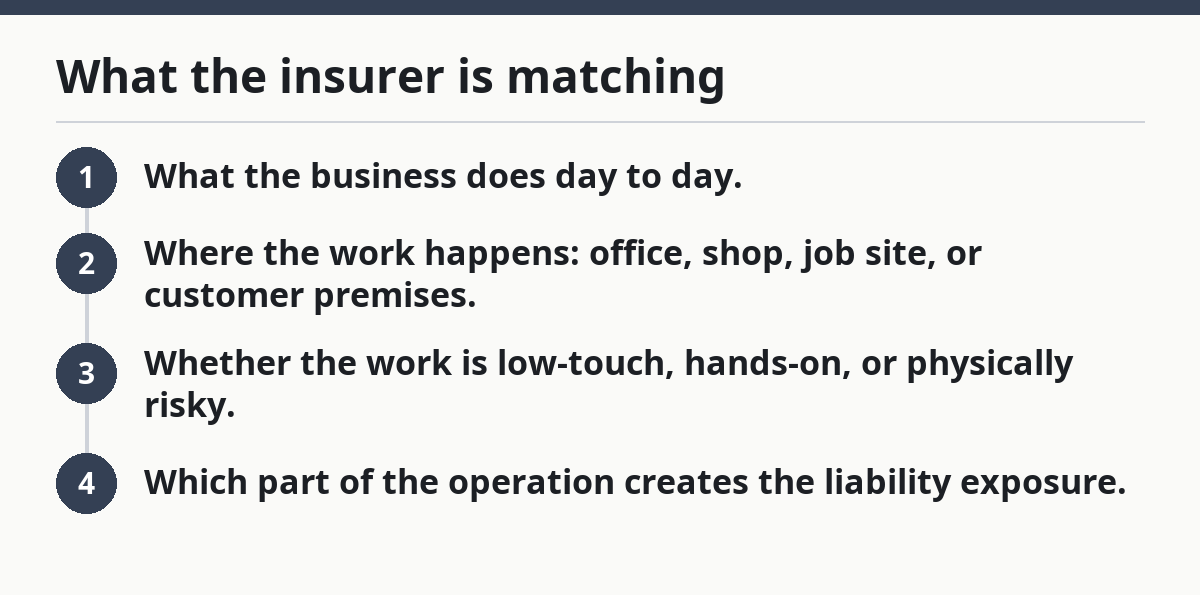
What the insurer is matching
The class code is usually built around a few things:
- What the business does day to day.
- Where the work happens: office, shop, job site, or customer premises.
- Whether the work is low-touch, hands-on, or physically risky.
- Which part of the operation creates the liability exposure.
That is why one company can have a class code that fits one line of work and not another. A cleaning company, a wholesaler, and a repair shop may all carry commercial liability, but they do not sit in the same bucket.
What is the premium basis behind a class code?
The premium basis is the measurement the insurer uses to apply the class code, and it can be different depending on the business and the policy. For liability policies, that basis may be tied to payroll, sales, area, receipts, or another unit the carrier uses for rating.
Picture this: you find the class code, but the number still does not make sense because the policy also asks for sales or payroll. That is normal. The code tells the insurer what the business is; the premium basis tells the insurer what quantity to attach to that class.
A class code and a premium basis are different pieces of the rating process. The code is the category. The basis is the measuring stick.
- Class code = the type of work.
- Premium basis = the amount used to rate that work.
- The two work together.
- A wrong basis can distort the policy just as much as a wrong code.
Common premium bases you may see
Different liability programs use different rating bases. A carrier may use:
- payroll for some contractor-style operations,
- gross sales or receipts for service businesses,
- square footage for certain premises-based risks,
- or another basis defined by that insurer’s manual.
The exact basis depends on the policy and the country or market rules in play, which can change over time. That is why the declarations page, rating worksheet, or underwriting notes matter so much.
How to read the code on your policy
A class code makes sense only when you read it with the rest of the policy, not by itself. The code, the business description, and the premium basis should point to the same story.
Picture this: you are checking the declarations page and want to know whether the code is right before the next renewal. Start with the printed description of the operation, then compare it to what the business actually does now. If those two do not match, the code may need a correction.
Step by step, check the classification
- Find the class code on the declarations page or rating sheet. Look for the code next to the business description, not just on a quote summary. Verify that the policy number and effective date line up. A problem is when the code appears only in a proposal and disappears from the issued policy.
- Read the operations description word for word. Match it against the real business activity, including any service work, installation, or off-site jobs. Verify that the wording covers the main revenue source. A problem is a description that sounds broad but leaves out the most exposed part of the work.
- Check the premium basis shown for the class. Confirm whether the policy uses payroll, sales, receipts, or another unit. Verify that the number is the same basis used in the quote and issue documents. A problem is a basis that changes without explanation, which can distort the rating.
- Separate primary and secondary operations. List the core work first, then any side activity that creates a different exposure. Verify that the code follows the main operation, not a one-off task. A problem is a side service being treated like the whole business; if that happens, consult a professional and review the carrier’s documentation or underwriting guidance.
- Compare the class description to actual operations over the last 12 months. Review invoices, job orders, or sales records if needed. Verify that the mix of work has not shifted. A problem is an old class code staying in place after the business model changed.
- Look for exclusions or endorsements tied to the class. Some policies limit certain operations by endorsement even when the business description looks broad. Verify that the class code and any endorsements do not conflict. A problem is assuming the code covers work that the endorsement actually removes.
- Ask whether the code reflects the current legal entity and location. A merger, new branch, or added trade can change the classification. Verify that the named insured and operating details match the business now. A problem is a code built for an old entity or a different site.
- Check for a clear path to correction if the code is wrong. Ask how the insurer wants a classification dispute documented. Verify that you can show invoices, contracts, or a written operations summary. A problem is trying to argue the point without facts the carrier can use; if the file still does not fit, consult a professional and get the insurer’s underwriting position in writing.
What happens when the class code is wrong?
A wrong class code can misstate the risk and create a policy that does not line up with the business. That can lead to rating changes, underwriting questions, or a request to rewrite the classification when the issue is found.
Picture this: the policy is already issued, but the code was built around a service the business barely does anymore. The carrier may treat that as a classification error rather than a harmless clerical mistake, but if the facts are unclear you should consult a professional and review the insurer’s source documents. The consequence is usually correction, not a shrug.
On the flip side, not every mismatch is a crisis. Some are simple wording fixes. Others point to a real underwriting issue that needs more review.
- The policy may be re-rated.
- The carrier may ask for more detail.
- A renewal quote may change.
- A coverage dispute can start if the class description and operations do not line up.
Common mistakes people make
-
Using the industry name instead of the actual activity. A shop can be described as “construction” in one document and “electrical service” in another. That mismatch can push the policy into the wrong class. The better move is to describe the work plainly and consistently.
-
Letting the office title drive the code. A business called “consulting” can still include field work, product handling, or job-site exposure. That can make a simple office class wrong. The better move is to classify by what creates the liability exposure, not the business card.
-
Ignoring mixed operations. A company that does two different lines of work may need the class split or the primary class clarified. If the side work is large enough, the code can be off. The better move is to show the revenue split and ask how the carrier wants it classified.
-
Treating the premium basis like a guess. If payroll or sales is estimated badly, the code may be right but the rating still goes wrong; if you are unsure, consult a professional and check the carrier’s rating basis instructions or underwriting materials. The better move is to verify the basis with records and note the period the number covers.
-
Waiting until renewal to raise a dispute. A bad code can sit for months if nobody checks it. That may complicate adjustments later. The better move is to raise the issue as soon as the issued policy arrives.
When does a class code dispute need extra care?
A class code dispute needs extra care when the business has changed, the operations are mixed, or the policy wording is narrow. Those are the situations where the standard class description may no longer fit.
Picture this: you are looking at a code that seemed fine last year, but now the business does a new line of work, uses subcontractors, or works in a different place. That can change the classification even if the business name did not change.
The business added a new line of work: The old code may no longer match the exposure — document the new activity and ask for a fresh classification review.
The policy uses a narrow operations description: The code may cover only part of the business — compare the endorsement language before assuming it fits.
Revenue now comes from a different activity: The premium basis may still be tied to the old operation — update the underlying numbers before the next billing cycle.
The carrier and agent use different descriptions: The file may contain two versions of the business class — ask which one controls on the issued policy.
The class is tied to a regulated trade or specialty work: Small wording changes can matter — get the class explanation in writing before the policy is renewed.
Who assigns the class code, and can it change?
The class code is usually assigned by the insurer or its underwriting team, often with help from an agent or broker, and it can change if the business changes. The code is not fixed forever just because it was correct once.
Picture this: you started with a small office operation, then expanded into field work during the year. The old class code may no longer fit the current business. That is why classification gets revisited at renewal, endorsement, or audit points in some markets.
The change usually comes from new facts, not from a random rewrite.
- New services can change the class.
- A different mix of revenue can change the basis.
- A move to a new site can change the exposure.
- A corrected operations description can change the rating.
What should you compare before the policy is finalized?
You should compare the class code, the business description, the premium basis, and the endorsements before you accept the policy as issued. Those four items should tell the same story.
Picture this: the quote looked right, but the issued policy added a different description and a different basis. That is a warning sign. If the code is right and the basis is wrong, the policy can still be misclassified.
The cleanest check is simple:
- Does the code match the real operation?
- Does the description match the code?
- Does the premium basis match the records?
- Do the endorsements remove anything the class seems to cover?
If the answer to any of those is no, the file needs another look.
FAQ
How do class codes affect premium?
A class code affects premium because it places the business into the insurer’s rating bucket, and the premium basis is then applied to that bucket. The exact effect depends on the carrier, the market, and the country’s rules. If the class is wrong, the premium can be mispriced for the exposure.
Who assigns class codes?
The insurer usually assigns the class code, often with help from an agent, broker, or underwriter. The code should reflect the actual operations, not just the business name or the owner’s preference. If the facts are unclear, the carrier may ask for more detail before assigning or confirming it.
Can class codes change at renewal?
Yes, class codes can change at renewal if the business operations, revenue mix, or premises have changed. A change can also happen if the carrier updates how it classifies the risk.
Drafted with AI; not yet reviewed by a person.