Last updated: November 19, 2026
Key Takeaways
- A commercial liability policy uses five core documents: declarations, coverage form, exclusions, conditions, and endorsements.
- Declarations and endorsements can change the deal without rewriting the whole form.
- A commercial liability policy starts broad, then narrows through definitions, exclusions, and conditions.
- Declarations list the deal, and the coverage form explains the rules.
A commercial liability policy structure and documents review is easier when you read the declarations, the insuring agreement, the exclusions, the endorsements, and the conditions in that order. Quick answer: most business readers need 5 documents to see the deal. That order can help you see what is covered, what is carved out, and what paperwork can change the deal. The sections below settle how the policy is built, which documents matter most, and where readers in the United States usually get tripped up.
I write about commercial insurance forms and claims language for U.S. businesses, and this guide to commercial liability policy structure and documents is general information, not legal advice; a qualified lawyer should be consulted for your specific situation.
What is a commercial liability policy made of?
A commercial liability policy is built from a few core documents: the declarations page, the coverage form, the exclusions, the conditions, and any endorsements attached later. In the U.S., those papers work together as one contract, and the declarations page usually shows the named insured, policy limits, and policy period. The NAIC explains that insurance contracts rely on the policy form and endorsements, while the declarations page identifies the basic terms of the contract.
Picture this: you’re holding a renewal packet after a broker forwards it, and you need to know whether the form changed or just the date did. The policy answer is rarely in one line. It’s in the declarations page, the coverage form, and the endorsements that amend both. Here’s the catch: a clean-looking certificate or summary sheet does not replace the policy itself. The Insurance Information Institute notes that policy language controls, not a summary page.
- Declarations page: who is insured, what line of coverage applies, and the limits.
- Coverage form: the basic promise to pay for covered claims.
- Exclusions: the parts the insurer refuses to cover.
- Conditions: duties, notice rules, and claim procedures.
- Endorsements: later changes that can add, narrow, or replace language.
The best way to read it is usually from front to back, then back again. The front pages tell you the business name and limits, while the later pages tell you what those numbers actually buy. The National Association of Insurance Commissioners and the IRMI both describe these documents as the core parts of a commercial policy package.
Which policy documents matter most?
The declarations page and endorsements matter most because they can change the whole bargain without rewriting the whole form. A standard liability form may look ordinary, but one endorsement can add an insured, delete a location, or replace an exclusion. In practice, that is where most surprises live. The NAIC and IRMI both treat endorsements as contract changes, not side notes.
Picture this: you’re reviewing a policy after a loss and the claims adjuster says the endorsement controls. That happens because endorsements are part of the contract, and they often override the printed form if the wording conflicts. The policy number on the declarations page is not enough.
- Declarations page: confirms the policy number, named insured, limits, and deductible or self-insured retention if listed.
- Coverage form: gives the main grant of coverage and definitions.
- Endorsements: modify terms for a specific business, job, or risk.
- Schedule of forms and endorsements: shows what documents are attached.
- Common policy conditions: explain notice, cooperation, and cancellation rules.
A generic article often misses the schedule of forms, but that page matters because it tells you what the insurer says is actually in the packet. If a form number is missing there, ask for the complete issued copy before you rely on anything else.
How does a commercial liability policy work from first page to last?
A commercial liability policy works by starting with a broad promise, then narrowing it through definitions, exclusions, and conditions. The insuring agreement usually tells you what kind of bodily injury, property damage, personal injury, or advertising injury claim can trigger the policy, but the rest of the form decides whether the claim stays inside the fence. The broad grant and the later limits are why the coverage form and endorsements matter so much.
Picture this: you’re reading a policy after a customer slip-and-fall claim, and you want the shortest path to the answer. Start with the insuring agreement, then check whether the event fits the definitions, then check exclusions, then check conditions for notice and defense obligations. That sequence saves time.
- Confirm the insured person or business named on the declarations page.
- Match the event to the coverage grant in the form.
- Read the definitions that shape key terms.
- Read the exclusions that remove risk.
- Read the conditions that can bar or delay coverage if not followed.
Here’s the part people skip: defense coverage may be addressed separately from indemnity. In many liability forms, the insurer’s duty to defend can be broader than the duty to pay a judgment, but the exact wording controls and varies by jurisdiction and form version. That is why the document set matters more than the policy label. IRMI explains that a policy’s defense duty and indemnity duty can be different obligations.
What is the difference between the declarations page and the coverage form?
The declarations page lists the deal, and the coverage form explains the rules behind the deal. If you want the quickest read on limits, names, dates, and forms, start with the declarations page. If you want to know whether a claim fits the policy, go to the coverage form and then the exclusions.
Picture this: you need to confirm whether a contractor’s policy covers one job site or several, and the agent sends only the declarations page. You can learn a lot from that page, but not enough to decide coverage. The declarations page is the map; the form is the terrain.
- Declarations page usually shows:
- named insured
- policy period
- limits of insurance
- deductibles or self-insured retention, if stated
- attached forms and endorsements
- Coverage form usually shows:
- insuring agreement
- who is an insured
- definitions
- exclusions
- conditions
The common mistake is treating the declarations page like the whole policy. It isn’t. It can be changed by endorsement, and it does not usually explain the legal effect of the coverage grant. That is why any serious review of a commercial liability policy needs both documents side by side. The NAIC’s consumer materials also point readers to the declarations page and policy forms as separate parts of the contract.
Which exclusions and conditions can change the answer?
Exclusions and conditions can change the answer more than the title of the policy does. A business may think it bought liability coverage, but the exclusion section may carve out the exact kind of event that caused the loss, and the conditions may require prompt notice or cooperation before the insurer owes anything.
Picture this: you’re reading after a claim is already underway, and you keep seeing references to “expected or intended injury,” “contractual liability,” or “care, custody, or control.” Those phrases are not filler; they are the doors that close coverage. Conditions can do the same job from another angle by setting deadlines or reporting duties.
- Exclusions remove certain risks from the promise.
- Conditions set the insured’s duties after a loss.
- Definitions decide what counts as a covered event.
- Endorsements can narrow an exclusion or add one.
- Policy limits cap the insurer’s maximum payment.
A lot of beginner guides treat exclusions as rare exceptions, but that is not always a safe assumption. In practice, they are central. The reader who only scans the summary misses the real work of the policy, which is often done in exclusions, endorsements, and definitions rather than in the headline promise. The IRMI and NAIC both emphasize that coverage depends on the full policy language.
What endorsement changes should you look for?
Endorsements can rewrite the policy in plain sight, so they deserve the same attention as the main form. A business often gets the policy it asked for on the declarations page and a different policy in the endorsements, especially when the carrier uses a manuscript change or a scheduled endorsement for a specific account.
Picture this: you renew a policy and the limits look the same, but the endorsement list grew by three pages. That is not harmless paper. An endorsement can add an additional insured, alter completed operations language, change notice requirements, or replace the governing exclusion wording.
- Watch for endorsements that:
- add or remove insureds
- schedule locations or operations
- amend exclusions
- change primary and noncontributory wording
- alter waiver of subrogation language
- Check whether the endorsement says it “amends,” “replaces,” or “adds to” the form.
- Check whether the schedule names a project, property, or class of work.
The sharpest mistake is assuming endorsements only help the insured. They can do that, but they can also restrict coverage. If the endorsement and the printed form conflict, the endorsement often wins because it is the later, more specific wording. That is why policy review should never stop at the first page.
How do certificates of insurance fit in?
Certificates of insurance do not usually change the policy, and that is the mistake most people make with them. A certificate can show that coverage was issued, but it is not the policy itself and usually does not grant rights beyond what the policy already says. The ACORD certificate form itself says it confers no rights and does not amend coverage.
Picture this: a general contractor asks for proof of coverage before a job starts, and the subcontractor sends a certificate the same day. The certificate may be useful as proof of existence, but it does not rewrite the policy, extend coverage by itself, or replace endorsements. In U.S. practice, the policy controls unless a separate written agreement or valid endorsement says otherwise.
- A certificate is evidence, not the contract.
- It may summarize policy data.
- It may omit exclusions and special conditions.
- It usually does not create broader rights on its own.
- It should be matched to the actual policy packet.
This is where generic articles often overstate the certificate. The better rule is simple: use the certificate to spot-check, not to decide coverage. If the certificate and the policy disagree, the policy documents are the place to look.
The Honest Side-by-Side
The front-of-policy documents help you find the deal, and the back-of-policy documents tell you what the deal really means. If you compare just two things, compare the declarations page against the endorsement list, because that pair reveals most of the business changes that matter after a loss.
Picture this: you have two copies of the same liability policy from different dates, and you need to know which one governs. The declarations page gives you the version date and form list, while the endorsements show whether the insurer changed key terms between renewals. That is often the fastest practical comparison.
| Criteria | Declarations Page | Coverage Form | Winner for this condition |
|---|---|---|---|
| Named insured | Shows the business or person named on the policy | Usually not the main source | Declarations Page for identifying the insured |
| Policy period | Shows effective and expiration dates | May not repeat them clearly | Declarations Page for timing |
| Limits | Lists liability limits and sublimits if stated | Usually explains how limits apply | Declarations Page for quick limit checks |
| Core promise | Rarely explains it fully | States the insuring agreement | Coverage Form for coverage scope |
| Definitions | Sometimes references them | Contains the definitions section | Coverage Form for term meaning |
| Exclusions | May list form numbers only | Usually contains them in full or by reference | Coverage Form for exclusions |
| Endorsement effect | Shows attached forms | May be amended by endorsements | Endorsements when wording changed |
| Claim duties | Rarely explains duties in detail | Often contains conditions | Coverage Form for notice and cooperation |
| Version control | Shows the policy packet basics | Can be amended after issue | Schedule of forms / endorsements for what was issued |
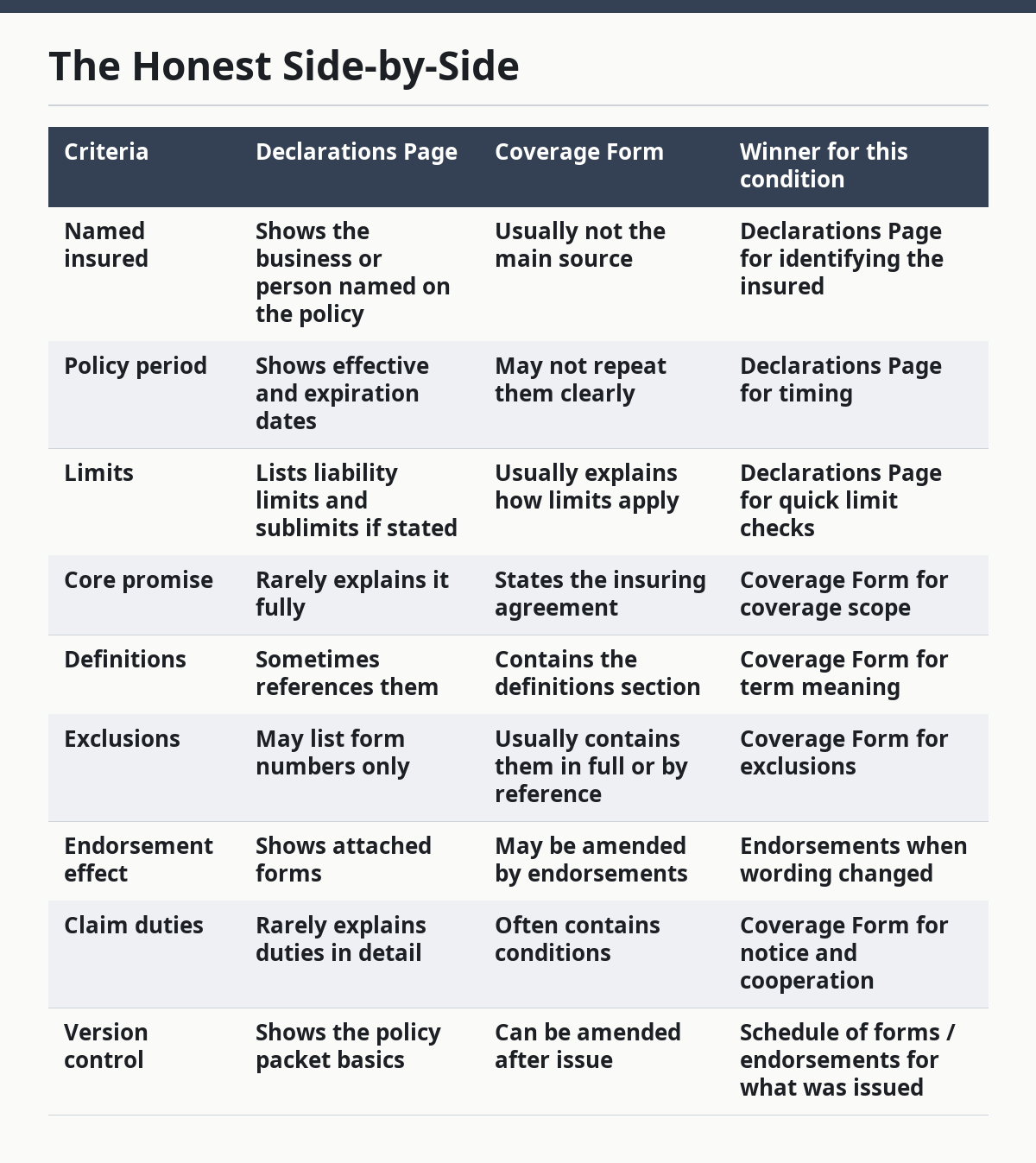
The winner changes by task, which is the point. If you are confirming dates and limits, the declarations page wins. If you are trying to see whether a claim is covered, the form and endorsements win.
When does the reading order change?
The reading order changes when the endorsement or a negotiated manuscript form appears to conflict with the printed policy. In that case, the specific later wording usually matters more than the general printed language, though the exact outcome depends on the policy language and the governing jurisdiction.
Picture this: you think you have a standard policy, then you find an endorsement tied to a particular client contract or project. That should change your reading order immediately. Start with the endorsement, then return to the form it amends, and only then compare the declarations page.
- First read the endorsement if it says it replaces wording.
- Next read the exact section it changes.
- Then check the declarations page for the related form number.
- Finally check the schedule of forms to confirm the packet is complete.
A second shift happens when the policy is written on a claims-made basis instead of an occurrence basis. The structure still uses the same documents, but the date language becomes much more important because the trigger can depend on when the claim is made and reported. That is a document issue, not just a coverage issue.
What should a beginner ask for before relying on a policy?
A beginner should ask for the full policy packet, not a summary, because the packet is what controls. That means the declarations page, all coverage forms, all endorsements, and the schedule of forms and endorsements, in the version actually issued by the carrier.
Picture this: you are handed a one-page summary and told the business is “fully covered.” That is not enough. Ask for the complete issued policy, the endorsement list, and any manuscript changes tied to the account. If the policy is in PDF form, check that every page is present and that the forms listed match the pages provided.
- Ask for the full declarations page.
- Ask for every endorsement attached at issue.
- Ask for the policy form number and edition date.
- Ask for the schedule of forms and endorsements.
- Ask for the complete packet, not a marketing summary.
An incomplete packet means you should not treat the policy as fully reviewed. A policy that cannot be matched to its forms is not ready for real use, and a missing endorsement can change the answer on coverage, defense, or limits.
The Verdict: how to read commercial liability documents without getting burned
Choose the declarations page first if you need the insured name, dates, and limits. Choose the coverage form and endorsements first if you need to know whether a claim fits the policy. Neither is enough alone if the packet is incomplete or the endorsement list is missing.
Picture this: you are sitting with a policy stack and trying to answer one practical question—“Is this covered?” The right move is to read the packet in layers, not to trust the cover sheet, the certificate, or the sales summary. That approach is plain, slower than guessing, and far safer.
What if the policy packet is incomplete?
An incomplete packet means you should not treat the policy as fully reviewed. If the declarations page lists endorsements that are missing, the missing pages may contain the exact language that changes coverage, limits, or duties.
Picture this: you have a PDF with the declarations page and a few endorsements, but the schedule lists four more forms that are not attached. That gap matters. The answer may be in the missing pages, not the ones you already read.
- Missing endorsement pages can hide exclusions.
- Missing schedules can hide form replacements.
- Missing manuscript changes can hide special terms.
- Missing version dates can make comparison impossible.
The safe rule is simple: a policy packet is only as useful as its missing pages allow. If the packet is incomplete, the review is incomplete too.
FAQ
What documents should be in a commercial liability policy packet?
A complete packet should include the declarations page, the main coverage form, all endorsements, and the schedule of forms and endorsements. Those documents together show the named insured, the limits, the policy period, the covered risks, and any changes made after the base form was issued.
Is a certificate of insurance the same as the policy?
No, a certificate of insurance is not the same as the policy. It usually summarizes coverage existence, but the policy documents control the actual rights and obligations. If the certificate and the policy conflict, the policy language is the document set to read first.
Why do endorsements matter so much?
Endorsements matter because they can change the policy without rewriting the whole form. An endorsement can add an insured, narrow an exclusion, change reporting duties, or replace language in the printed form, so it can alter coverage in a way that is easy to miss.
What is the first page I should read?
The declarations page is usually the first page to read because it tells you who is insured, what the limits are, and what forms are attached. After that, read the coverage form and the endorsements that the declarations page lists.
Do the rules work the same way everywhere?
No, insurance and contract rules vary by jurisdiction, and local law can affect how policy wording is read. This is general information only, not legal advice, and a qualified lawyer should be consulted if the policy matters to a live claim or dispute.
Drafted with AI; not yet reviewed by a person.