Last updated: November 20, 2026
Quick Answer: In 3 common situations—privacy injury, published material, or advertising injury—a cyber claim can raise general liability questions. In this article on How Cyber-Related Claims Can Trigger General Liability Questions, the overlap usually turns on wording, exclusions, and the exact claim being made. This is general information, not legal advice; because insurance law can vary by jurisdiction, a qualified lawyer should be consulted on any real dispute. For background on incident response and data-breach basics, see the FTC’s Data Breach Response: A Guide for Business and NIST’s Cybersecurity Framework. For coverage-specific questions, start with Key takeaways and What usually triggers the question?
Key takeaways
- Cyber facts and liability wording can collide in the same claim, even when the loss started with a digital event.
- The labels matter: privacy injury, advertising injury, published material, and data breach exclusions can point in different directions.
- A cyber liability policy and a commercial general liability policy are not the same thing, and one does not automatically fill the other’s gaps.
- The first question is usually not “Was there a breach?” but “What exactly does the claimant say was wrong?”
- A media liability overlap can appear when content, posts, emails, or website material are part of the allegation.
Who this applies to
This applies to business owners, risk managers, brokers, and claims handlers who need to understand why a cyber-related liability exposure can become a general liability issue. It assumes the reader already knows the basics of insurance words like policy, exclusion, and claim, and has heard the terms cyber liability policy, commercial general liability policy, and advertising injury.
It does not apply well to someone looking for a coverage promise or a prediction about a live dispute. If the dispute is already in motion, the facts, the policy form, and the jurisdiction matter too much for generic guidance. A lawyer who handles insurance coverage questions is the right person for that stage.
The useful starting point is simple: a cyber event can create more than one kind of allegation. One party may say the business exposed private data, another may say the business published false or infringing material, and a third may say both. Those different theories can push the claim toward different coverage grants, and a 2-page summary will miss that split.
A good background source on the incident side is the FTC’s Data Breach Response: A Guide for Business and the NIST Cybersecurity Framework materials, which help frame what a breach or security failure looks like before coverage even enters the picture. That is not the same as saying those materials decide insurance coverage, because they do not. If you need help mapping those facts to a policy, ask a qualified coverage lawyer.
Why cyber facts can matter to general liability
Cyber facts can matter to general liability because the claim language, not the computer event, usually decides the coverage question. A commercial general liability policy is built around third-party claims for bodily injury, property damage, personal and advertising injury, so a cyber event matters most when the complaint fits one of those buckets.
That is where privacy injury allegations enter the picture. A claimant may say a business disclosed private information, used it without permission, or failed to protect it in a way that caused harm. In some forms, that kind of allegation sits near personal and advertising injury language; in others, a data breach exclusion narrows the path.
The same pattern shows up with advertising injury. If the claim says the business used another person’s slogan, copied a competitor’s content, or published material that misled the public, the issue may be less about the breach and more about the publication. Published material is a key term here: it usually means content made available to others, such as a website page, email blast, social post, or ad copy, not a private internal file. For a basic definition of publication disputes, see the Cornell Legal Information Institute entry on defamation and publication concepts.
The hard part is that cyber facts and liability wording often overlap. A hacked account can lead to an unauthorized post, a leaked customer list, or a false message sent from the business’s domain. Each of those can support a different theory of injury, and each theory can point to a different coverage analysis.
What usually triggers the question?
The question usually gets triggered by a complaint, demand letter, or tender that sounds like more than a simple data breach. When the allegations mention privacy injury, publication, false statements, copyright-style harm, or misuse of data in advertising, the general liability policy starts to matter.
A simple way to sort the problem is to ask what the claimant says happened, not just what the IT team found. If the story is only “someone got into the system and stole records,” the issue may stay closer to cyber liability policy language. If the story says “the business published our private information” or “the website ad used our material without permission,” general liability questions appear fast.
| Claim feature | Why it matters | Common policy question |
|---|---|---|
| Private data exposed | Can look like privacy injury | Does the personal injury grant respond, or does a data breach exclusion block it? |
| Content posted or sent publicly | Can look like published material | Was there publication, and by whom? |
| Misleading ad, copied slogan, or similar content | Can look like advertising injury | Does the claim fit advertising injury wording? |
| Network intrusion only | Often points first to cyber wording | Is the loss really outside the CGL form? |
| Media content overlap | Can create a media liability overlap | Is the dispute about content, not the breach itself? |
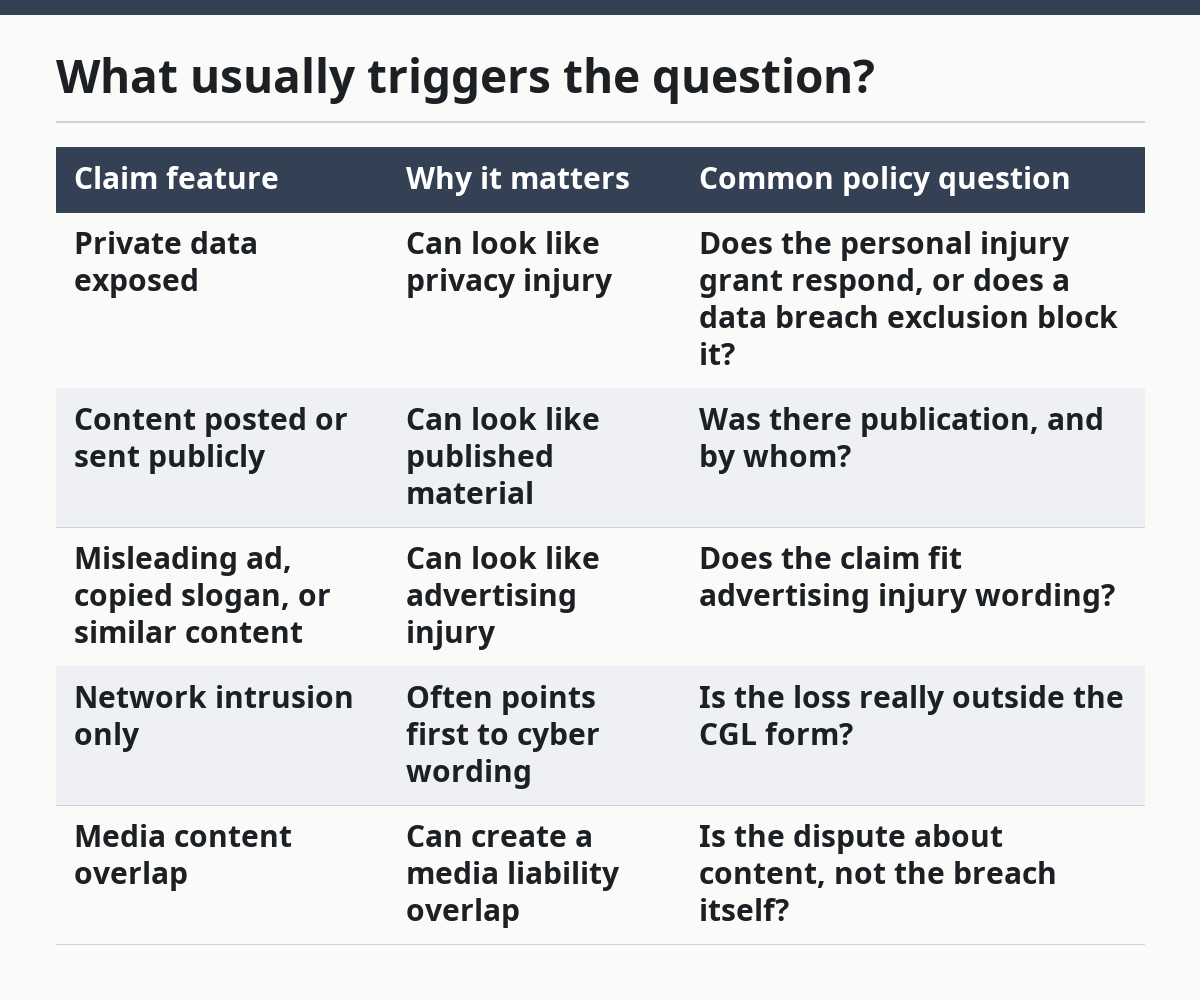
That table is only a sorting tool. It does not decide coverage, and it does not replace the actual policy wording. A 1-line summary can hide the clause that controls the result.
How do the policy terms line up?
The policy terms line up by claim theory, not by technology. A commercial general liability policy usually speaks the language of injury categories, while a cyber liability policy usually speaks the language of data, systems, notification, and privacy-related loss. The same facts can fit both descriptions in different ways.
Here is the practical comparison:
| Issue | Commercial general liability policy | Cyber liability policy |
|---|---|---|
| Privacy injury allegations | May respond if the form includes that injury and no exclusion applies | Often designed to address privacy and network events directly |
| Advertising injury | May respond if the claim involves publication, misuse of material, or similar wording | Usually not the main focus unless the cyber form includes media or content claims |
| Published material | Important when the claim is about what was posted, emailed, or broadcast | Important if the cyber event involved content on a site or account |
| Data breach exclusions | Can remove part of the path to coverage | May be narrower or structured differently |
| Media liability overlap | Can create a dispute over which policy is primary | May or may not include media-style coverage |
The useful lesson is not that one policy is “better.” It is that the same event can trigger different questions under each form. A cyber liability policy may be built to address the breach side of the loss, while a commercial general liability policy may be examined for the publication or injury theory. That overlap is where claims slow down.
One common mistake is treating “cyber” as a separate universe. It is not. Many cyber claims are also content claims, privacy claims, or advertising claims in disguise, so a professional coverage review is often the safest next step.
What should be checked first in a claim?
The claim should be checked first by matching the alleged wrong to the policy language, line by line. That means looking at who is suing, what they say was published or disclosed, which policy period applies, and whether the form contains a data breach exclusion or a personal and advertising injury grant.
A practical review often follows these steps:
- Identify the exact allegation in the demand, complaint, or notice and copy the key wording into a clean 1-page summary.
- Separate the digital event from the legal theory and ask whether the claim is about privacy injury, advertising injury, or both.
- Check the commercial general liability policy for the personal and advertising injury grant, then mark any exclusion that mentions data, privacy, access, or electronic transmission.
- Check whether the claim alleges published material, and note whether the material was public-facing content, such as a website, ad, or email.
- Compare the alleged conduct with the cyber liability policy to see whether the same facts are framed as a breach, a network event, or a content problem.
- Look for media liability overlap if the dispute involves posts, ads, articles, social content, or website text.
- Record the dates of the alleged act, the publication, and the loss, because timing can change which policy year is in play.
- Flag any mismatch between the claim theory and the policy wording, because that mismatch is often where coverage questions start.
The verification point at each step is simple: the complaint should match a policy phrase, not a guess. If the claim says “published private information” but the policy excludes electronic data claims, that is a problem worth isolating early. If the claim says “copied our ad copy” but the policy never reaches advertising injury, that is another warning sign.
The wrong result here is a rushed coverage label. A claim can be cyber-related and still be mainly a defamation, publication, or advertising dispute.
When does privacy injury matter?
Privacy injury matters when the claimant says the business harmed a person’s private information or private life in a way that fits the policy language. That is often the point where a general liability form gets examined for personal and advertising injury coverage, even though the facts started with a cyber event.
The phrase has limits. Not every data problem becomes privacy injury, and not every privacy allegation is covered. If the claim is only about stolen records with no allegation of publication or improper use, the policy analysis may stay narrower. If the complaint says the business disclosed private information publicly, the question changes.
The size of the data set does not control the issue by itself. A file with 50 names and a file with 50,000 names can raise the same coverage question if the legal theory is the same. What changes is the factual record, the policy wording, and the amount of damage claimed.
This is also where people overread the label. Privacy injury is a coverage term, not a verdict. It does not mean the claimant wins, and it does not mean the policy responds. It means the claim has entered a lane that general liability lawyers and adjusters usually have to inspect closely.
Where the standard approach breaks down
The standard approach breaks down when the claim mixes content, privacy, and breach allegations in one file. That happens often enough that a single “cyber” label becomes too coarse to be useful.
The complaint alleges both published material and data exposure: that means two coverage theories may be in play — separate the allegations and review each policy grant on its own.
The policy has a broad data breach exclusion: that may cut off what looks like a privacy claim — do not assume the CGL form will still respond.
The alleged harm came from ads, website text, or social media: that may be a media liability overlap — check whether the dispute is about publication, not only access.
The claimant is a competitor, not a customer: that can shift the issue toward advertising injury or business disparagement — read the exact words used in the demand.
The same facts are tendered under both a cyber liability policy and a commercial general liability policy: that creates an allocation problem — the claim may need a side-by-side coverage review rather than a one-policy answer.
The jurisdiction treats publication or privacy injury differently: that can change the result entirely — local law matters, so a generic answer is unsafe and a qualified lawyer should be consulted.
The wrong move in these situations is to force the claim into one box. The better move is to identify the legal theories, then match each one to the policy language that actually uses that theory.
What mistakes cause the most trouble?
The most common mistakes are about labels, timing, and exclusions, and each one can change the coverage analysis by a lot.
First, people assume every cyber event belongs under the cyber liability policy. That misses the publication side of the claim and can leave the general liability questions unread.
Second, people assume a commercial general liability policy always covers privacy injury. That is too broad when the form has a data breach exclusion or when the alleged conduct does not fit the injury grant.
Third, people treat advertising injury as a catch-all for any online dispute. That can misfire when the content was not public, not promotional, or not the kind of published material the form addresses.
Fourth, people look only at the loss event and ignore the claim wording. The complaint is usually the map; the server log is only part of the terrain.
Fifth, people miss media liability overlap. A post, article, ad, or website page can make the case look like a media claim even when it started as a cyber event.
The safer alternative is a claim-first review: identify the theory, then the wording, then the exclusion, then the jurisdiction. That order avoids the most expensive wrong turn.
FAQ
Can a CGL policy respond to cyber events?
Yes, sometimes, but only when the claim fits the policy’s injury language and no exclusion blocks it. A commercial general liability policy is not a general cyber policy, so the analysis turns on the complaint, the publication facts, and the exact wording of the form.
When does privacy injury matter?
Privacy injury matters when the claim alleges harm tied to private information or private rights in a way that the policy recognizes. It becomes important when the claimant says the business disclosed, used, or exposed information, not just when a technical breach occurred.
What claim types overlap between general liability and cyber?
Claims about published material, advertising injury, privacy injury, and media content can overlap between the two. The overlap usually shows up when the same facts can be described both as a cyber incident and as a publication or content dispute.
The point that saves time
The key question is not whether the event was cyber-related; it is which legal theory the claimant is using. Once the theory is clear, the policy wording, the exclusions, and the possible overlap with a cyber liability policy or advertising injury clause become much easier to sort.
Drafted with AI; not yet reviewed by a person.