Last updated: November 20, 2026
Quick Answer: product liability exposure is the better fit in 3 common situations: when a product fails after sale, when a warning is missing, and when a recall issue starts with the item itself. In this article, How Product Liability Exposure Differs From General Liability Exposure means a simple split: product liability exposure is the risk tied to harm caused by a product after it leaves the seller’s hands; general liability exposure is the wider risk of bodily injury, property damage, or advertising injury that can happen in day-to-day business operations. In plain terms, product liability starts with the thing you made, sold, or distributed, while general liability starts with the business activity around it.
Key takeaways
- Product liability exposure follows the product into the market, especially when a manufacturer, distributor, or seller faces a defect or a warning problem.
- General liability exposure is broader in day-to-day business life, but it is not the same risk bucket as a finished product claim.
- Failure-to-warn claims and recall-related issues sit much closer to product liability exposure than to ordinary premises-style general liability exposure.
- If a business touches finished goods, product liability exposure deserves separate attention, even when the company also carries a general liability policy.
- This is general information, not legal advice. A qualified lawyer or insurance professional should be consulted because rules vary by jurisdiction.
What is the real difference?
The real difference is when the risk starts and what caused the injury. Product liability exposure begins when a product allegedly causes harm after sale, while general liability exposure begins with accidents or injuries tied to business operations, premises, or advertising conduct.
That timing matters for a manufacturer, seller, or distributor. A cracked component, a missing warning, or a packaging mistake can create a claim even after the product has moved through several hands. A general liability policy is usually discussed in a different lane because the trigger is not the product itself but the business’s broader conduct.
This split also matters for recall-related issues. A recall often grows out of a product problem, not a sidewalk slip or a store display accident. The U.S. Consumer Product Safety Commission and the FDA both show how product-related harm is handled as a product-safety problem, not a general business mishap. See the CPSC recalls page and FDA recalls information for the kind of public action that usually follows a product defect: CPSC Recalls and FDA Recalls, Market Withdrawals, & Safety Alerts.
Product liability exposure: who carries it?
Product liability exposure hits hardest when the business helps put a finished product into the stream of commerce. A manufacturer is the clearest example, but a seller and distributor can face the same exposure when a defect, warning failure, or contamination issue is tied to the product.
This exposure is not limited to the final assembly plant. A distributor can be pulled into a claim because it moved the product, stored it, relabeled it, or passed it along without catching a problem. A seller can face exposure when the finished product reaches the customer with an unsafe design, a manufacturing flaw, or a warning that never should have been missing.
The strongest clue is this: if the claim says the product itself failed, product liability exposure is usually in play. That includes manufacturing risk, sale of finished products, and failure-to-warn claims. A business that only rents space, cleans a site, or runs a storefront with no product role may still have general liability exposure, but product liability is a weaker fit.
Who should pay closest attention? Businesses that make, package, label, import, distribute, or resell finished goods. The more a company touches the product before the customer gets it, the more likely the claim will land in the product-liability lane.
General liability exposure: what makes it different?
General liability exposure is broader, but it is also less tied to the product itself. It usually starts with ordinary business conduct, such as a visitor injury at the premises or damage caused during operations, not with the product breaking after sale.
That difference changes the claim story. In a general liability case, the question is often what happened during the business’s own operations. In a product liability case, the question is usually what was wrong with the product, what warning was missing, or how the product was handled before it reached the buyer.
A general liability policy may respond to many business accidents, but that does not make every injury a general liability issue. If the injury happened because a finished product failed, the exposure often shifts into product liability territory. That is why the line between the two matters before a claim ever reaches a lawyer or insurer.
For a business that only wants a rough rule, use this one: if the problem is the place, the people, or the process, general liability exposure is more likely. If the problem is the thing sold, product liability exposure is more likely.
How do the risks compare side by side?
Product liability exposure wins as the more specific risk when the business’s finished goods are the source of harm. General liability exposure is broader for day-to-day operations, but it is less precise for product defects, warning failures, and recall-driven claims.
| Criteria | Product Liability Exposure | General Liability Exposure | Winner for this condition |
|---|---|---|---|
| Main trigger | Injury or damage tied to a product after sale | Injury or damage tied to operations, premises, or conduct | Product liability for finished goods claims |
| Best fit for manufacturer | Strong fit, especially for design, manufacturing, and warning issues | Possible, but less direct | Product liability |
| Best fit for seller | Strong fit when the seller helped place the finished product into market | Better for store or premises accidents | Product liability for product-related claims |
| Best fit for distributor | Strong fit when the distributor handled, stored, or relabeled goods | Better for unrelated business accidents | Product liability |
| Failure-to-warn claims | Core exposure area | Usually not the main fit | Product liability |
| Recall-related issues | Often central | Usually secondary | Product liability |
| Sale of finished products | Direct exposure | Indirect at best | Product liability |
| Premises slip-and-fall | Not the natural fit | Core exposure area | General liability |
| Advertising injury | Usually not the main issue | Often part of the broader exposure picture | General liability |
| Risk starts when | Product enters the market | Business activity occurs | Depends on the claim source |
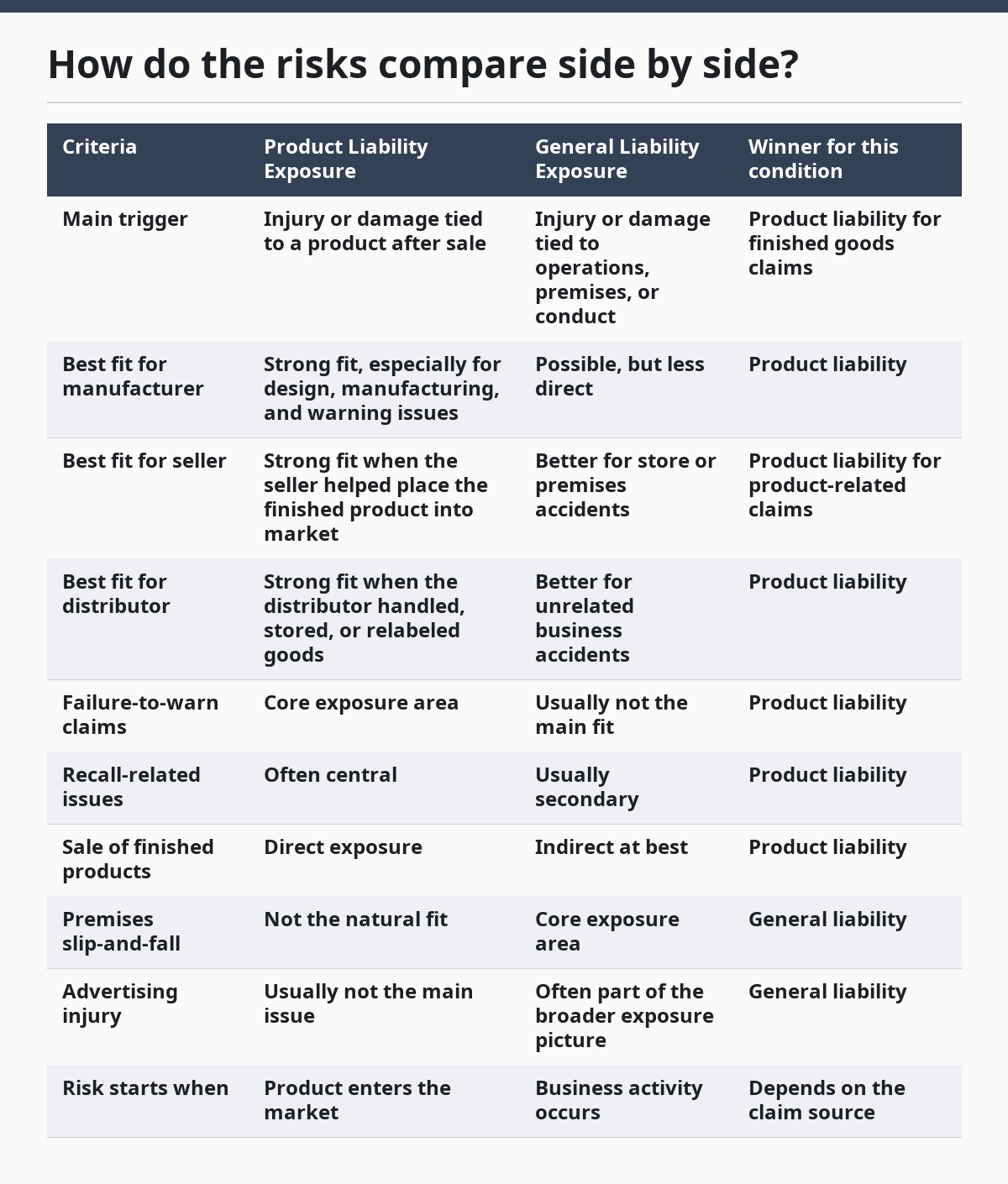
This table shows the real dividing line: product liability exposure is about the product as sold, while general liability exposure is about the business as operated. A company that handles finished goods may face both, but the claim label changes with the cause.
Product liability exposure: strengths and limits
Product liability exposure is the better lens when the question is, “What happens if the product itself causes harm?” It matches the way claims are built around defects, warnings, and recall events. That makes it especially useful for manufacturers, sellers, and distributors who deal in finished products.
Its strength is precision. A claim can point to a bad batch, a design flaw, a missing label, or a packaging problem. That kind of detail matters because it puts the loss in the product chain, not in the general run of business operations. For a business handling a product that moves through several hands, that distinction can be the difference between a clear exposure map and a muddy one.
The limit is just as important. Product liability exposure is not a catch-all for every business accident. A store injury, a warehouse fall, or a delivery-area mishap may belong elsewhere. A company that reads every loss as product-related can end up using the wrong frame for the claim.
This is also where recall-related issues create pain. A recall can bring public attention, inventory disruption, and follow-on claims, but the recall itself is usually a sign that product liability exposure has already become real. That is why businesses that sell finished products should often treat it as a separate risk, not a footnote, and they should consult a qualified lawyer or insurance professional before relying on general liability alone. See the CPSC recalls page and FDA recalls information for examples of product-safety action: CPSC Recalls and FDA Recalls, Market Withdrawals, & Safety Alerts.
General liability exposure: where it still matters most
General liability exposure wins when the loss comes from running the business, not from the product in the customer’s hands. That includes common premises claims and many operational accidents, which is why a general liability policy sits at the center of day-to-day business risk planning.
Its strength is breadth. One policy category can sit over a wide set of ordinary business events, which is useful for a company that deals mostly with people, property, and business operations. It is the first place many businesses look because a lot of claims do not involve a product at all.
The limit is that broad coverage language can hide the real source of a loss. A company that sells finished goods may see a claim and assume it belongs under general liability simply because the business has a policy by that name. If the injury follows a defect, a missing warning, or a product recall issue, the exposure is likely closer to product liability.
That is why a business should not treat general liability exposure as a substitute for product liability exposure without checking the facts. It may overlap in a business sense, but the legal theory behind the claim is different. The wrong label can blur the risk map, especially for a seller or distributor that handles product flow but does not manufacture the item. A qualified lawyer or insurance professional should be consulted on the specific claim.
Which one should a business focus on first?
Product liability exposure should come first for any business that makes, sells, or distributes finished products. General liability exposure should come first for a business whose main risk is premises, visitors, or routine operations.
The better choice depends on what the business actually does, not on the policy label alone. A manufacturer faces a direct product-risk profile. A seller that moves boxed goods through a store or warehouse has product exposure even if it never makes the item. A distributor can also face product exposure because the product passes through its hands on the way to market.
A service business with no product role may spend less time on product liability exposure and more on general liability exposure. That does not make product risk impossible, but it makes it less central. The practical test is simple: if the claim would still exist after the business closed its doors for the day, product liability exposure may be the stronger issue; if the claim is tied to the day-to-day business setting, general liability exposure is usually the better fit.
For readers who want the broader coverage map, the hub on commercial liability insurance coverage by risk scenario is the better next stop. This page is only about the risk split itself, not the policy product or the coverage grant.
When does the answer flip?
The overall answer flips in a few concrete situations, and those cases matter because they change which exposure is primary.
First, if the injury comes from a premises event rather than the product, general liability exposure takes the lead. A customer hurt by a store condition is not facing the same risk pattern as a customer hurt by a defective item.
Second, if the business only tangentially touches the product and the claim is really about operations, the general liability side may matter more. A business can be near a product without owning the product risk.
Third, if the issue is a failure-to-warn claim or a recall-related issue, product liability exposure usually moves to the front of the line. Those claims are about what the product was, what it lacked, or what happened after it entered the market.
Fourth, if the company is a distributor or seller rather than a manufacturer, the exposure can still be product liability exposure even without making the item. The link back to the product matters more than the job title does.
The Verdict: which one should a reader focus on?
Choose product liability exposure if the business makes, sells, or distributes finished products and the claim would center on a defect, warning failure, or recall issue. Choose general liability exposure if the business’s main risk is premises accidents, visitor injuries, or ordinary operations. Neither fits well if the question is really about a pure insurance policy form without a claim source.
When does product liability matter more than general liability?
Product liability matters more than general liability when the injury or loss is tied to the product itself after sale. That includes manufacturing risk, sale of finished products, failure-to-warn claims, and recall-related issues. If the claim story starts with the item and not the business setting, product liability exposure is the better frame.
Which businesses face product liability exposure?
Manufacturers, sellers, and distributors face product liability exposure most often. Businesses that package, label, import, relabel, or move finished goods can also face it, because the product chain does not stop at the factory gate. A service-only business usually faces less of this exposure unless it also places products into the market.
Can one policy cover both?
One policy may respond to different kinds of claims, but the exposures are still different. A general liability policy and product liability exposure are not the same thing, and a business should not assume one risk category automatically covers the other. The exact answer varies by jurisdiction and policy language, so a qualified lawyer should be consulted.
Drafted with AI; not yet reviewed by a person.