Last updated: November 19, 2026
Key Takeaways
- It usually covers bodily injury, property damage, and some defense costs tied to a sold product.
- The manufacturer carries most of the risk, but sellers can still be named.
- Claims often move from allegation to notice, defense, and settlement or denial.
- Recall-related coverage is usually limited, so it should not be treated as broad recall protection.
Product liability insurance for sellers and manufacturers: what it covers is product liability insurance helps pay for claims tied to bodily injury, property damage, and some recall-related losses caused by a product you made, sold, or distributed.
It does not make every product claim disappear, and the coverage can shift depending on whether you are the manufacturer, distributor, or seller.
The sections below sort out what it usually covers, where the limits sit, and why that split matters.
Scope: who this applies to, and what it assumes
This applies to sellers, distributors, importers, and manufacturers who face claims after a product leaves their hands. It assumes you already know the product line, the supply chain, and the kind of harm a bad unit could cause. If the issue touches a real injury claim, a recall notice, or a contract dispute over coverage, a qualified insurance broker, attorney, or claims professional should review the policy language for your situation. This is information, not financial advice.
Picture this: you sell a toaster, a hand tool, or a small appliance, and a customer says it caused a fire or an injury. Product liability insurance is meant to respond to that kind of claim, not to your day-to-day sales risk. The policy language decides whether the loss sits with the maker, the importer, the distributor, the retailer, or some mix of them.
That split is the whole game.
Not the marketing.
- Manufacturers usually face the broadest exposure because defects often start at design or production.
- Sellers and distributors may still face claims if they put the product into the market, relabeled it, or failed to pass along warnings.
- Importers can get pulled in when the overseas maker is hard to reach or the local claimant names every entity in the chain.
What product liability insurance actually covers
Product liability insurance usually covers claims that a product caused bodily injury, property damage, or certain legal defense costs after the product was sold. The policy may also address recall-related claims, but recall cover is often narrower and may sit in a separate endorsement or policy form. For example, the Insurance Information Institute explains that product liability claims are often tied to injury, property damage, and defense costs, and the U.S. Consumer Product Safety Commission reported 869 recalls in 2023 involving about 73 million units.
Here’s the catch: the cause matters as much as the loss. A burned kitchen wall is not the same as a cracked plastic housing, and the policy may treat those differently depending on the defect alleged. Common triggers include manufacturing defect, design defect, and failure to warn. If the wording is unclear, a qualified broker or attorney should review how it applies to the facts.
- Manufacturing defect: one batch, run, or unit was built wrong.
- Design defect: the product was built as planned, but the plan itself was unsafe.
- Failure to warn: the product may have needed clearer instructions, labels, or safety warnings.
A claim does not have to prove the label “product liability” before it reaches the insurer. It usually has to fit the policy’s insuring agreement and exclusions. That is why two policies that look alike on the shelf can behave very differently at claim time.
What often fits inside the claim bucket
- Customer injury from a defective item
- Damage to a customer’s property
- Defense costs tied to covered allegations
- Some recall-related expenses if the policy says so
What often does not
- Pure warranty disputes over whether the product met a sales promise
- Planned replacement of your own faulty stock
- Losses tied only to your poor workmanship after delivery, if another policy form is meant to handle that
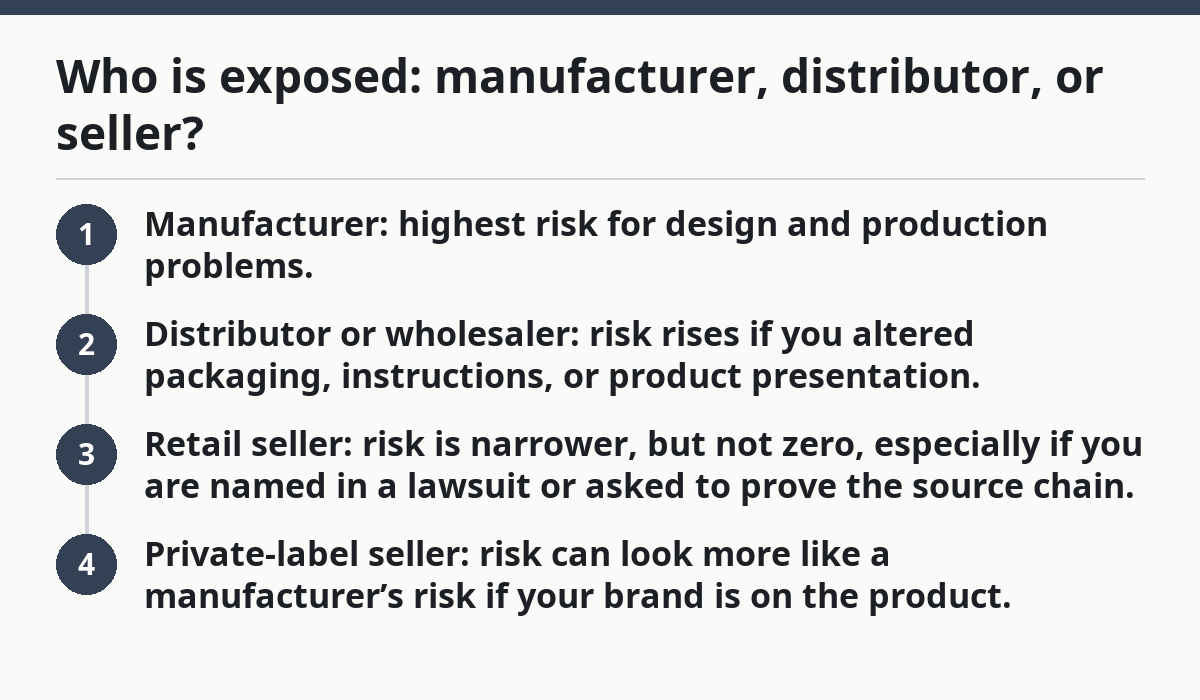
Who is exposed: manufacturer, distributor, or seller?
The manufacturer usually carries the main product-risk burden, but the seller is not invisible. Courts and claimants often name every entity in the chain, because each one may have touched the product, the packaging, or the warning label. If the policy wording is unclear, a qualified claims professional should review how each role is insured.
Picture this: you are a retailer or reseller and a customer says the item failed and caused damage. Even if you did not design or build it, your name can still land in the claim. That is why product liability insurance for sellers matters even when the seller never opened the box.
The exposure often changes by role:
- Manufacturer: highest risk for design and production problems.
- Distributor or wholesaler: risk rises if you altered packaging, instructions, or product presentation.
- Retail seller: risk is narrower, but not zero, especially if you are named in a lawsuit or asked to prove the source chain.
- Private-label seller: risk can look more like a manufacturer’s risk if your brand is on the product.
The truth is, the policy is often written to follow the role, not the title. A seller who merely passes along sealed goods may have a very different exposure profile from a seller who specs the product, sets the warning language, or imports it under its own label.
- A pure reseller usually cares most about whether the policy reaches claims against the entire distribution chain.
- A private-label seller should care about design and warning claims.
- An importer should care about defense costs, because even weak claims can be expensive to answer.
How a product claim moves through the policy
A product claim usually starts with an allegation, then moves to notice, defense, and settlement or denial. The policy does not react to every complaint the same way, so the first few days matter. A prompt notice can also help if the insurer needs documents before replacement or shipping costs rise.
Picture this: a customer’s lawyer sends a letter saying your product caused injury and property damage. You need to check the policy form, the dates, the named insureds, and whether the alleged event falls inside the coverage trigger. Miss that, and the insurer may argue late notice or a mismatch in the policy period.
- Identify the product and loss date. Match the product SKU, batch, or lot number to the incident date; verify whether the harm happened after delivery; if the date is unclear, coverage timing can break down.
- Pull the policy declarations and form. Check the named insured, business description, and policy period; verify that the entity being sued is actually insured; a mismatch is a problem.
- Separate injury from warranty. Decide whether the complaint is about bodily injury or property damage, not just a failed product; if it is only a performance dispute, product liability may not apply.
- Read the defect allegation. Look for manufacturing defect, design defect, or failure to warn; verify whether the facts line up with the theory; if the facts point elsewhere, the claim may sit outside the grant.
- Check recall language. See whether recall-related claims are included, excluded, or subject to a sublimit; if there is no recall grant, do not assume it is covered.
- Notice the insurer fast. Report the claim as soon as the policy requires; verify the notice instructions and any supporting documents; late notice can create a coverage fight.
- Track who touched the product. List the maker, distributor, importer, and seller; verify each role in writing; if the chain is unclear, the insurer may contest the allocation of blame or defense costs.
- Preserve records. Keep invoices, warnings, batch logs, test reports, and recall notices for the retention period in your business files; missing records make defense harder and can weaken the claim file.
The point of this sequence is simple: product liability is a facts-and-forms problem.
Not a guess.
What recall-related claims can and cannot do
Recall-related claims can cover some of the costs tied to removing a dangerous product from the market, but they are rarely broad enough to treat like a blank check. A product recall is usually a formal action to pull back, repair, replace, or warn about a product before more harm spreads. A qualified broker or attorney should confirm whether the policy needs a government order or a documented danger.
The catch is that a recall is often expensive for reasons that have nothing to do with a bodily injury claim. You may face shipping, disposal, notification, and replacement costs. Some policies address parts of that, but many do not, or they apply a strict sublimit.
That means the word “recall” on the policy is not enough. You need to know:
- whether the recall was voluntary or required;
- whether the policy covers only third-party claims or also your own recall expenses;
- whether the product had to be “dangerous” in the policy sense, not just unpopular or defective;
- whether a government order, customer complaint, or internal test triggered the action.
On the flip side, a recall endorsement does not usually pay for every business hit you take during the event. Lost sales, reputational damage, and customer churn are often outside the grant unless the form says otherwise. A recall can be partly covered and still leave you with a large bill.
If you sell into channels with strict safety rules, this part deserves close review before a crisis, not during one.
The mistakes people actually make, and what they cost
Product claims go sideways when people assume every insurance policy works the same way. It does not.
Picture this: you renew a general business policy, then assume product claims are covered the same way as slip-and-fall losses in your shop. That mistake can leave a large gap, especially if the policy wording treats product claims separately or excludes certain recall losses. If the wording is unclear, a qualified broker or claims professional should review it before a loss.
-
They assume the seller is too small to matter.
Consequence: the seller still gets named, served, and pulled into defense costs.
Better move: make sure the seller’s role is named in the insured structure. -
They read “recall” as full recall protection.
Consequence: they discover too late that only narrow recall expenses are covered, or that a sublimit applies.
Better move: read the recall wording line by line. -
They ignore warning labels and instructions.
Consequence: a simple label issue turns into a failure-to-warn claim.
Better move: keep instructions, translations, and label approvals in the file. -
They do not keep batch records.
Consequence: the business cannot prove which units were affected.
Better move: retain lot numbers, shipping records, and QC notes. -
They think a distributor can hide behind the manufacturer.
Consequence: both get named, and the defense starts before blame is sorted out.
Better move: check how the policy treats each entity in the supply chain. -
They confuse product liability with warranty.
Consequence: they expect coverage where the policy only responds to injury or property damage.
Better move: separate product performance disputes from third-party harm.
The pattern is consistent.
Bad records cost money.
When the standard policy needs a closer look
A standard product liability form needs extra scrutiny when the supply chain is messy, the product is recalled, or the policyholder is only one link in a larger chain. Those are the situations where the usual one-size reading breaks down.
Picture this: you import a branded item, sell it under a private label, and the manufacturer is overseas. That is not a routine claim file. The insurer may look hard at who designed the product, who approved the warnings, and who had the practical ability to fix the hazard.
Private label products: the seller may be treated more like the maker — check whether design and warning claims are fully included.
Imported goods: cross-border claims can be hard to resolve — verify who is named as the insured and who controls recall notices.
Mixed supply chains: more than one party may be at fault — the policy should not leave one link uncovered.
Silent recall pressure: a customer tells you to pull the product, but no formal recall exists — confirm whether the policy needs a government order or a documented danger.
Long-tail injury claims: the harm appears much later — verify the policy trigger and the reporting deadline.
Contract-heavy sales: your customer demands indemnity wording — review the contract and the policy together, because one does not erase the other.
If the answer depends on more than the policy jacket, the claim deserves a careful read.
Quick guesses are expensive.
Product liability insurance is part of the broader map of commercial liability insurance coverage by risk scenario, but it answers a very specific problem: who pays when a product hurts someone or damages something.
What a good fit looks like
A good fit is a policy that matches the role you actually play in the supply chain, not the role you hope no one notices. If you manufacture, import, private-label, or resell, the wording should fit the exposure profile that comes with that job.
Picture this: you are comparing policies and one form looks broader because it uses simpler language. That can be a trap. Simpler language is not the same as stronger protection, and a missing endorsement can matter more than a glossy summary page.
A decent match usually has:
- clear naming of the insured entities;
- wording that fits your role as seller, distributor, importer, or manufacturer;
- a defined response to injury and property damage claims;
- a separate look at recall-related claims;
- a clear notice process;
- enough records to back up lot tracing and warning language.
A weak match often shows up as missing role language, vague recall handling, or a policy that reads well but leaves out the exact claim type you fear most. That is where a qualified broker or claims professional can help read the gap before the gap becomes a claim.
Does general liability insurance cover product claims?
Often, yes, but the answer depends on the policy wording and the loss facts. General liability policies commonly include product-related liability through a products-completed operations structure, but exclusions and state-specific wording can change the result. For a real claim, the declaration page and the insuring agreement matter more than the label on the policy. The Insurance Information Institute and the U.S. Small Business Administration both note that policy language and business risk profile matter when buying liability coverage.
Do resellers need product liability insurance?
Often, yes, because resellers can still be named in a product claim even when they never built the item. The exposure is usually narrower than for a manufacturer, but it is not zero. A reseller that rebrands, repackages, or imports goods should pay even closer attention to the policy language.
What is the difference between product liability and completed operations?
Product liability deals with harm caused by a product after it leaves your control, while completed operations deals with harm tied to completed work after the job is finished. The two can overlap in some policies, but they are not the same risk. A product claim centers on the item; a completed-operations claim centers on the work.
Drafted with AI; not yet reviewed by a person.