Last updated: November 19, 2026
Key Takeaways
- Pair a clear request with evidence that your loss exposure is lower than the insurer expects.
- Check claim history, liquidity, and wording before asking for a lower retention.
- Treat the structure as an underwriting issue, not just a price complaint.
- In those cases, the issue is broader than premium alone.
A liability insurance deductible or self-insured retention can change your claim cash flow fast. How to negotiate liability insurance deductibles and self-insured retentions starts with the structure, not just the price. You can often negotiate the structure, but not by asking for a lower number alone—you need a cleaner risk story and a tighter claim process. The steps below show what to ask for, what to bring, and where the trade-offs usually show up.
What this applies to, and what it assumes
This applies if you are buying or renewing liability coverage and want to change the deductible or self-insured retention (SIR) on the quote. It assumes you already know your basic loss history, your current policy term, and roughly how much cash you can set aside if a claim hits. How to negotiate liability insurance deductibles and self-insured retentions also assumes you will review the policy language before you ask for any change.
Picture this: you’re reviewing a renewal quote with a $5,000 deductible or a SIR that has to be paid before the insurer starts defending the claim. You want lower cash exposure, but you also don’t want to pay for a structure that your business will never use well. That’s the real problem.
The catch is that deductible and SIR negotiations are not just about premium. They affect claim handling, defense costs, reimbursements, and how quickly money leaves your account. If you change the retention amount without changing the wording around claims administration, you can end up with a cheaper quote and worse cash flow.
- A deductible is usually paid after a covered loss is adjusted.
- A SIR is usually paid before the insurer responds, subject to the policy wording.
- The difference matters when a claim arrives.
For a broader buying framework, the hub on policy decisions and buying guidance helps place this decision in the bigger underwriting picture.
How do I ask for a lower deductible or SIR?
You ask for it by pairing a clear request with evidence that your loss exposure is lower than the insurer thinks. That means a lower retention request, a reason for it, and proof that supports the change.
Picture this: you’re on the phone with a broker or underwriter, and you want a smaller retention than the quote shows. Saying “Can you lower it?” is weak. Saying “I want to move from a $10,000 retention to a lower point because our loss frequency is down and we can show stronger controls” gives the conversation a shape.
You do not need to argue from instinct. You can build the ask around three things insurers already price: frequency, severity, and cash handling.
-
State the change clearly. Ask for a specific retention structure, such as a lower deductible or a lower SIR, and confirm whether you want the same defense terms.
Verify the exact dollar amount and whether it applies per claim or per occurrence.
Problem sign: the underwriter answers with a premium change but no wording change. -
Bring 3 to 5 years of loss runs. Use the full period the carrier asks for, even if it is not flattering.
Verify that open claims, closed claims, dates, and paid amounts line up.
Problem sign: missing reserves or unexplained gaps in the claim file. -
Show your cash flow limit. Explain the largest retention you can absorb without disrupting payroll, vendor payments, or project work.
Verify that your number covers more than one claim if a bad month hits.
Problem sign: the requested retention only works if nothing else goes wrong. -
Connect the request to controls. Point to training, contracts, supervision, safety steps, or other loss controls that reduce claim frequency.
Verify the controls are current, not a policy from 2 years ago.
Problem sign: the story sounds generic and cannot be checked. -
Ask how the insurer treats defense costs. Some forms erode the retention with defense; others do not. Ask your broker or a qualified adviser to confirm the policy wording.
Verify who pays first and whether the legal bill counts toward the retention.
Problem sign: the quote looks cheaper because defense treatment is different. -
Compare total expected cost, not just premium. Look at premium plus the cash you would need for a claim under each structure.
Verify the quote covers the same coverage period and the same limits.
Problem sign: you are comparing two quotes that are not actually alike. -
Request a middle option. If the insurer will not drop the retention enough, ask for a step-down structure or a smaller change.
Verify the carrier has priced the alternate option on the same basis.
Problem sign: only one structure is on the table and you have no negotiation room.
For policy wording and consumer explanations, the Insurance Information Institute and your state insurance department can help you check the basics before you ask.
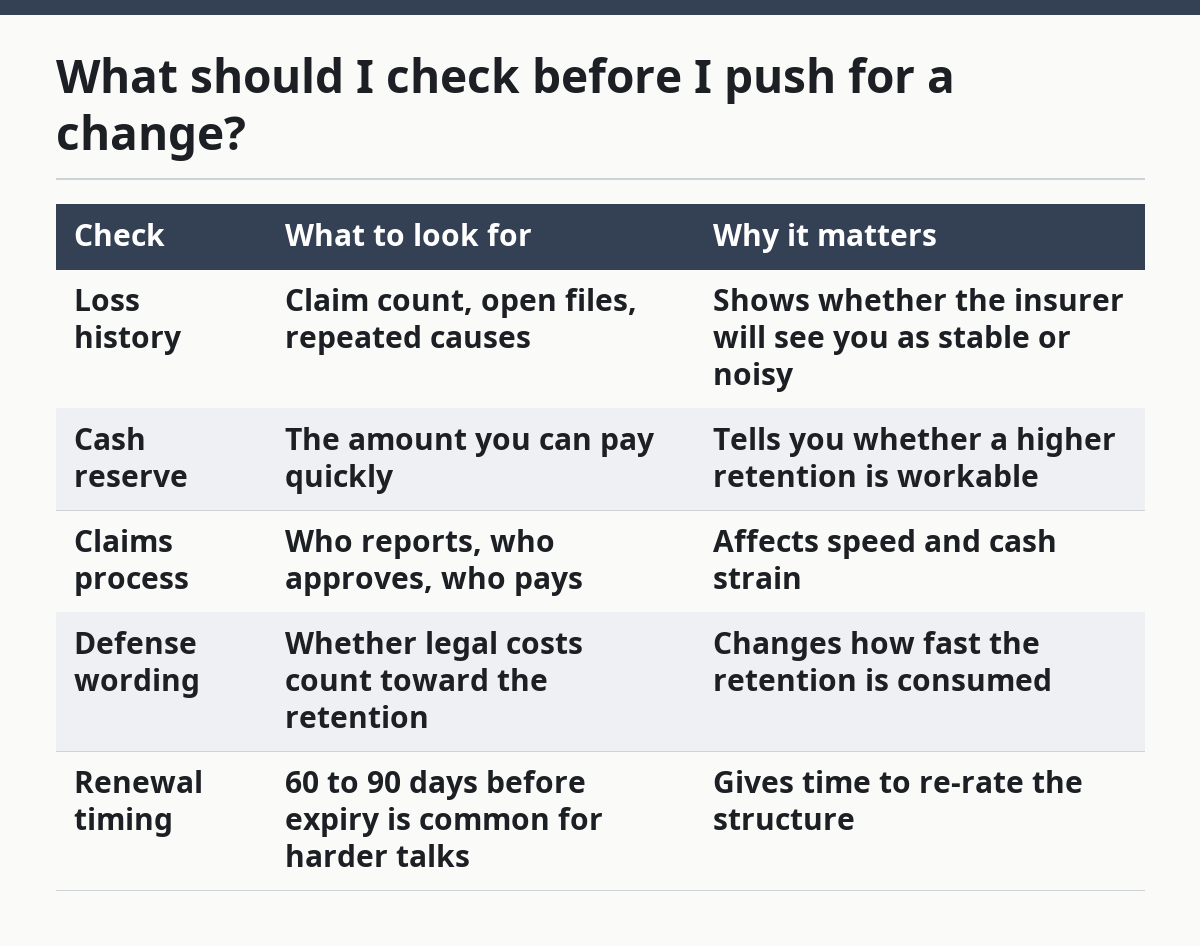
What should I check before I push for a change?
You should check your claim pattern, your liquidity, and the policy wording before you ask for a lower retention. The wrong setup can make a cheaper quote look better than it is.
Picture this: you’re 30 days from renewal and someone tells you a lower deductible should be easy. That may be true. But if the policy has tight claims reporting language, a reimbursement delay, or a SIR that affects defense, the real cost can rise even while the quote falls.
Use this short pre-check before you negotiate:
| Check | What to look for | Why it matters |
|---|---|---|
| Loss history | Claim count, open files, repeated causes | Shows whether the insurer will see you as stable or noisy |
| Cash reserve | The amount you can pay quickly | Tells you whether a higher retention is workable |
| Claims process | Who reports, who approves, who pays | Affects speed and cash strain |
| Defense wording | Whether legal costs count toward the retention | Changes how fast the retention is consumed |
| Renewal timing | 60 to 90 days before expiry is common for harder talks | Gives time to re-rate the structure |
If one of those checks is weak, the ask gets harder. Not impossible. The best next step is to fix the weak point before you reopen the negotiation.
How to negotiate liability insurance deductibles and SIRs, step by step
You negotiate the structure by treating it like an underwriting question, not a price complaint. The point is to make the insurer comfortable enough to change the retention without guessing.
Picture this: you’re preparing for a renewal meeting and you want to go in with a clean file. The underwriter is not looking for a speech. The underwriter is looking for a reason to believe the claim exposure is lower, the cash process is clearer, and the policyholder will not create collection problems later.
- Map the current structure. Write down the exact deductible or SIR, whether it is per claim or per occurrence, and whether defense costs reduce it. Verify the declarations page and endorsements match. A mismatch is a warning sign that the quote file is messy.
- Measure your claim pattern. Pull 3 to 5 years of loss runs and separate frequency from severity. Verify whether claims are small and frequent or rare and large. If you cannot describe the pattern, the underwriter will fill in the blanks for you.
- Set a cash number you can live with. Decide the maximum retention you can fund without strain for 60 to 90 days, because reimbursement may not be instant. Verify that number still works if two claims happen in the same policy year. If it does not, the request is too aggressive.
- Write the ask in one sentence. State the retention you want, the reason, and the proof you are offering. Verify that the sentence includes the policy term and the class of business. If it sounds vague, it will be treated as a wish.
- Attach evidence of controls. Include incident procedures, contract controls, supervision steps, or safety changes that reduce claim frequency. Verify the documents are current. If the evidence is old, the underwriter may discount it.
- Ask for pricing on at least two structures. Request the current retention and one lower or alternative option so you can compare the cash effect. Verify both quotes use the same limits and the same claims handling assumptions. If not, the comparison is tilted.
- Press for claims language, not just price. Ask how reporting deadlines, defense counsel selection, and reimbursement timing work under each option. Verify the answer in writing. If the carrier will not commit, the hidden cost may be in administration, not premium.
- Review the result for total exposure. Add premium, likely claim outlay, and timing pressure together. Verify the structure still fits your working capital. If the lower retention creates a bigger operational problem, the negotiation missed the point.
Because of that, the best negotiation result is often not the lowest retention. It is the retention you can fund, explain, and administer without surprise.
When does the standard approach stop making sense?
The standard approach stops making sense when the retention is bigger than your liquid cash, the policy wording is unclear, or the insurer sees a claim pattern that makes the request look risky. In those cases, the problem is not just price.
Picture this: you’re trying to negotiate down a SIR, but the last 12 months included multiple claims, late reporting, and one file still open. That is not the time to push for a deep reduction and hope the carrier overlooks it. You need a different structure or more time.
Cash on hand is below the proposed retention: You may not be able to pay the first dollars of a claim without hurting operations — ask for a lower retention or a different payment structure.
Loss runs show repeated small claims: The insurer may see the lower retention as more admin work and more claim leakage — bring controls before you ask again.
Defense costs are inside the retention and claims are lawyer-heavy: The cash drain can happen before the indemnity payment — ask for wording clarity and compare the real out-of-pocket path.
The policy term is starting in less than 30 days: Underwriting time is short and leverage is thin — use the current quote as the baseline and keep the request narrow.
The insurer wants a higher retention for a new line of work: That can signal uncertainty about the exposure — separate the new work from the old risk if the policy allows it.
The file has unresolved claim disputes: The carrier may treat the account as unstable — settle the documentation first, then reopen the retention talk.
What mistakes cost policyholders the most?
The biggest mistakes are treating deductible talks like a premium haggle, ignoring claim handling, and comparing quotes that are not built the same way. Those errors can raise the cash cost of a claim even when the annual premium goes down.
Picture this: you’re focusing on a smaller premium and missing the fine print on reimbursement. A claim hits, you pay the lawyer, and then you learn the carrier treats that expense differently than you expected. That is where negotiation errors become real money.
- Asking for a lower number without evidence. The consequence is a weak negotiation and little carrier interest. The better move is a documented case built on loss runs and controls.
- Ignoring defense cost treatment. The consequence is a retention that gets used up faster than you planned. The better move is to ask whether defense erodes the deductible or SIR.
- Comparing unlike quotes. The consequence is false savings. The better move is to compare the same limits, same term, and same claim rules.
- Setting the retention too high. The consequence is strain on cash flow after a claim. The better move is a retention that fits your 60- to 90-day liquidity.
- Waiting until the last week. The consequence is a rushed renewal with no room to negotiate. The better move is to start early enough for the underwriter to re-run the structure.
- Missing open claims in the story. The consequence is a credibility problem. The better move is to explain the file honestly and show how it is being managed.
What changes the answer for larger or messier risks?
Larger or messier risks need more structure because the retention is tied to claim administration, not just price. That usually means more documentation, more exact wording, and tighter coordination between the policyholder, broker, and claims team.
Picture this: you’re running a business with multiple locations, contractors, or a legal file that is already active. A simple “lower the deductible” request may not be enough because the insurer wants to see how claims will be reported, who will manage them, and how payment will move through the file.
Two situations need extra care. First, if the claim stream is high frequency but low severity, a lower deductible can add administrative burden fast. Second, if the file involves serious defense costs, the timing of those costs can matter more than the indemnity amount. In both cases, ask for the claims mechanics in writing.
For filing and claim-admin questions, the Insurance Information Institute and your state insurance department can help explain standard consumer and business policy terms. For policy wording and market practice, the carrier form and endorsements matter more than a general definition.
What a good negotiation result looks like
A good result is one where the deductible or SIR fits your cash flow, the claim process is clear, and the quote you accept still makes sense if a claim arrives on day 3 or day 300. It is not just the lowest number.
Picture this: you’re looking at the final proposal and you can answer four questions without guessing. What do I pay first, when do I pay it, who handles the claim, and what changes if defense costs show up early? If you can answer those, the negotiation worked better than a simple premium cut.
A solid result usually has these traits:
- the retention is stated in plain terms;
- the claim reporting path is written down;
- defense treatment is clear;
- the cash exposure is one you can actually fund;
- the premium trade-off is understandable.
That is the practical test.
FAQ
What is the difference between a deductible and a self-insured retention?
A deductible is usually paid after the insurer adjusts the covered claim, while a self-insured retention is often paid before the insurer responds, depending on the policy wording. The difference affects both cash flow and claim handling, so the exact form language matters. Check the declarations page and endorsements before you compare them.
Drafted with AI; not yet reviewed by a person.