Last updated: November 20, 2026
Quick Answer: 4 areas most often change liability terms: operations, loss history, subcontractors, and risk controls. Underwriting questions can change a liability policy’s terms when your answers point to a different risk, a different class of business, or a need for exclusions, higher premiums, or added conditions. The questions that matter most are the ones about operations, loss history, subcontractors, and risk controls. This guide explains which answers tend to move the needle and how that process usually works for what underwriting questions change a liability policy’s terms.
Key Takeaways
- Underwriters care most about what you do, where you do it, and who does the work.
- Bad loss history can change terms faster than almost anything else.
- Subcontractor use and written contracts often affect exclusions and conditions.
- Risk controls can help shape terms, but only if they are real and documented.
- This is general information, not legal advice; rules vary by jurisdiction and a qualified lawyer should be consulted.
What underwriting questions change a liability policy’s terms?
Underwriting questions change a liability policy’s terms when the answer affects how likely a claim is, how large that claim might be, or who will be blamed for it. In the United States and many other jurisdictions, an underwriter may use those answers to adjust the premium, add exclusions, change deductibles, or attach conditions before binding coverage. A 2023 NAIC report noted that personal and commercial lines rates are reviewed and filed differently by state, so the exact result can vary.
Picture this: you’ve submitted an application, and the underwriter comes back with follow-up questions about your work site, your contracts, and your prior claims. That is not a fishing trip. It is the point where application questions start shaping the policy language itself.
The questions that most often move terms are the ones tied to:
- Operations details: what you do, for whom, and where.
- Loss history: prior claims, incidents, or suits.
- Subcontractors: whether they work under your name and under what contracts.
- Risk controls: safety programs, training, inspections, and written procedures.
If a response shows a hazard the carrier does not want to cover, the answer may lead to a narrower form, a special exclusion, or a condition the insured has to meet. That can happen even after the application is already submitted.
Here’s the catch: the underwriter is not just grading the form. The answers can change the policy’s terms.
Which answers matter most to an underwriter?

The answers that matter most are the ones that change the shape of the exposure, not the ones that sound impressive on paper. A 20-person office, a 2-person handyman crew, and a roofing contractor all buy liability insurance for different reasons, and the questions reflect that. A 2-person crew can still create a 1,000-square-foot job-site exposure if the work is physical or mobile.
Picture this: you run a business that looks simple from the outside, but one job involves ladders, one involves a customer’s property, and one involves a subcontractor. The underwriter wants the facts that explain where a claim could start and how far it could spread.
The main buckets are usually these:
- What the business does: services, products, side jobs, seasonal work.
- Where work happens: customer premises, your own premises, travel, or job sites.
- Who performs the work: employees, temporary workers, subcontractors, or independent contractors.
- What contracts say: hold harmless language, additional insured requests, indemnity promises.
- Past claims and incidents: even small claims can matter if they show a pattern.
A generic answer like “we do general contracting” is often too thin. Underwriters usually need the real trade line, the size of the projects, and whether you touch structural work, roofs, water systems, food, chemicals, or other higher-risk areas. A business that stores nothing on site is not the same as one with flammables or customer property in a warehouse.
The truth is, specificity changes the term sheet. Vague answers invite follow-up.
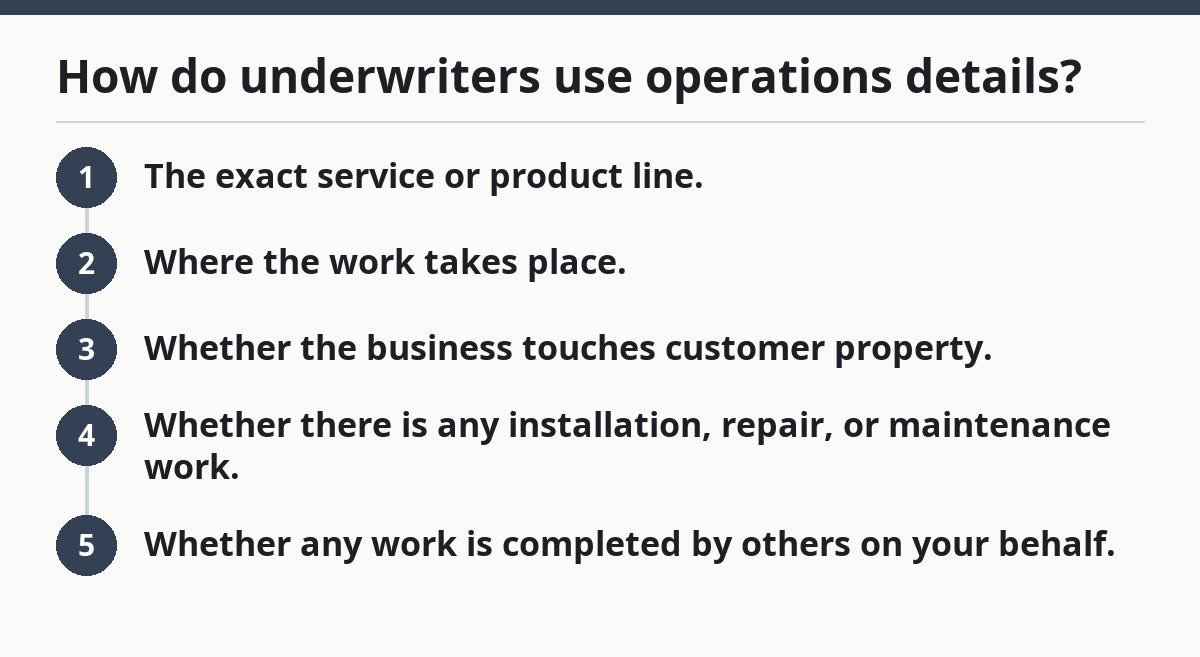
How do underwriters use operations details?
Underwriters use operations details to decide whether the policy should cover the business as described, or whether it needs a narrower scope. The same answer can affect exclusions, limits, and pricing because operations tell the carrier what kind of loss is likely to happen.
Picture this: you answer a question about your services and mention that you also do occasional installation work, even though the main business is sales. That one sentence can matter. It may move the risk away from a simple premises form and toward something with products-completed operations exposure, job-site work, or a separate class code.
A strong answer usually includes:
- The exact service or product line.
- Where the work takes place.
- Whether the business touches customer property.
- Whether there is any installation, repair, or maintenance work.
- Whether any work is completed by others on your behalf.
A weak answer hides the edges. If an underwriter later learns that half the revenue comes from a riskier line of work, the carrier may revise terms or decline to renew. That is especially true when the application said one thing and the actual operation is broader.
Good verification points:
- Do the application answers match the invoice descriptions?
- Do certificates, contracts, and website copy tell the same story?
- Are the workers named the same way everywhere?
If those do not line up, the underwriter sees uncertainty. Uncertainty often leads to a tougher form.
Why does loss history change exclusions or limits?

Loss history changes exclusions or limits because it shows the carrier how the business has actually performed, not how it describes itself. A clean application with repeated water damage claims, premises incidents, or completed-operations losses can still lead to tighter terms. The ISO commercial lines filings and many carrier guides treat prior losses as a core rating and underwriting factor, and the effect can be material.
Picture this: the application says “no prior claims,” but the loss runs show three slip-and-fall incidents and one property damage suit in the last 5 years. That is the kind of mismatch that gets attention fast. The underwriter may ask for details on dates, amounts paid, what caused the losses, and whether the same fix was made each time.
Loss history can affect:
- Exclusions, if the losses point to a repeat hazard.
- Limits, if the carrier wants to cap its exposure.
- Deductibles, if the carrier wants the insured to absorb more of the smaller losses.
- Conditions, such as required inspections or maintenance logs.
The best answers are factual and complete, but they are not the only factor. Missing dates, missing claim descriptions, or a “closed” file that still has an open reserve can create a mess. A reserve is the amount the carrier sets aside for a claim that may not be fully paid yet. If the reserve is high, the underwriter may treat the risk as less predictable, so a qualified broker or lawyer should review the file before the application is finalized.
One useful rule: if the loss happened, explain it. If it was fixed, say how. If it keeps happening, that pattern matters more than the first incident.
Not even close to trivial.
What do subcontractor questions change in the policy?
Subcontractor questions can change who is covered, what work is excluded, and whether the policy treats outside labor as part of your operation. That matters because a claim caused by a subcontractor can come back to the named insured if the contract language is loose or the risk transfer is weak.
Picture this: you hire a subcontractor to finish part of a project, and they damage a customer’s property. The underwriter wants to know whether the subcontractor carries their own insurance, whether they name you as an additional insured, and whether you require written contracts before work starts. If the answers are unclear, a qualified broker or insurance lawyer should help before terms are set.
The questions often center on:
- Whether subcontractors are used at all.
- What work they perform.
- Whether they are licensed where required.
- Whether they provide certificates of insurance.
- Whether your contracts require indemnity or additional insured status.
These answers can change terms in practical ways. A carrier may exclude certain subcontracted work, require a project-by-project review, or limit coverage unless written contracts are in place. If you use subs for high-risk trades—roofing, excavation, electrical, HVAC, or demolition—the underwriter may ask for much more detail than they would for clerical support or cleanup.
The issue is not just “Do you use subs?” It is “How much of the risk did you hand off, and did you really transfer it?” If the answer is no, the policy may be written as if the work is still yours.
Common subcontractor facts that change terms
- No written contract
- No certificate of insurance
- No additional insured wording
- High-risk trade work
- Work done without license checks
What risk controls do underwriters care about?
Underwriters care about risk controls that are written down, used in practice, and relevant to the loss the business could face. A policyholder saying “we train staff” is weaker than showing a training schedule, inspection log, or incident report process.
Picture this: your business says it has safety procedures, but nobody can produce them when asked. That gap matters. The underwriter is not grading your intentions; the underwriter is checking whether the controls exist and whether they are used often enough to lower the chance of a claim.
Risk controls can include:
- Employee training records
- Written safety manuals
- Customer-site checklists
- Incident reporting procedures
- Property maintenance logs
- Vehicle and equipment inspection schedules
These controls can affect terms because they help the underwriter separate a managed risk from an unmanaged one. A stronger control environment can support broader terms or better pricing, while a weak one can lead to exclusions or conditions. A policyholder with a 24-month training log and monthly inspections looks different from one with no records at all.
The detail matters. A fire extinguisher policy is not the same thing as a working extinguisher. A checklist is not the same thing as a practice. Underwriters usually care about the second item in each pair.
On the flip side, paper alone does not fix a bad process.
When do the answers change the terms after the application is filed?
The answers change the terms after the application is filed when new information arrives before binding, or when the underwriter follows up and learns something that was not clear in the original submission. That can happen with new loss details, revised payroll, a new trade, a subcontractor program, or a different contract structure.
Picture this: you submit the application on Monday, then send an updated loss run on Wednesday, then mention a side business on Friday. The file is no longer the same file. The underwriter may rewrite the quote, narrow the coverage, or ask for an endorsement that changes how the policy will respond.
A few common triggers:
- The description of operations changes.
- Loss history is corrected or expanded.
- A new class of work is added.
- The business starts using subcontractors differently.
- The insured asks for higher limits or broader terms.
The later the change, the more likely the carrier will re-underwrite the file from scratch. That can mean a new quote, a different deductible, or a policy that excludes a particular trade, location, or activity. In some markets, even a small change can move the account to a different underwriting appetite.
For readers tracking the larger process, this topic fits inside the broader commercial liability insurance buying process and underwriting hub, which handles the full path from application to bind. This page stays on the narrower question: which answers move the terms.
That distinction matters.
What questions should make you stop and get qualified help?
You should stop and get qualified help when the underwriting question touches a legal duty, a contract promise, or a disputed claim fact that could change the policy wording. In a high-stakes subject like insurance law, the answer can vary by jurisdiction, and a qualified lawyer should be consulted.
Picture this: the underwriter asks whether your contract creates an obligation to defend another party, or whether a prior incident was “your fault.” Those are not casual questions. They can affect exclusions, additional insured wording, and how a claim is handled later.
Specific situations that need help:
- A contract requires broad indemnity: it may affect who bears the loss and how the policy is written.
- A prior claim is disputed: the wording of the response can affect later coverage issues.
- The business spans more than one jurisdiction: rules and policy forms may differ.
- A subcontractor arrangement is informal: the risk transfer may be weak or unclear.
- The underwriter asks for a warranty or condition: that language can have consequences if it is wrong.
The main point is simple: if the answer is not just factual but legally loaded, slow down. A bad answer can create a policy that looks fine until a claim forces the fine print to matter.
Do not guess.
What mistakes do people make with underwriting questions?
People make the same few mistakes with underwriting questions, and each one can cost them in terms, time, or both. The biggest error is treating the application like marketing copy instead of a risk document, so a qualified broker or lawyer should review it if the facts are complex.
Picture this: you leave out a side service because it feels minor, or you round off a loss history because the exact date is hard to find. That shortcut can come back as an exclusion, a higher deductible, or a request for a revised submission.
Common mistakes:
- Vague operations descriptions — The underwriter cannot price what is not described. Use the actual service lines and job types.
- Incomplete loss history — Missing incidents can trigger re-rating or trust issues. Provide the full history the insurer asks for.
- Hiding subcontractor use — The policy may not match the real work. List the trades and the controls.
- Claiming controls that do not exist — The carrier may attach conditions based on false comfort. Describe only what is in place.
- Ignoring follow-up questions — Silence can stall the file or cause a narrower offer. Answer directly and on the same facts.
The best alternative is plain, consistent disclosure, because it is easier for the underwriter to test against the file. If the operations changed, say so. If the loss file is messy, explain the mess. Underwriters can work with difficult facts better than with hidden facts.
Hidden facts age badly.
FAQ
Which application answers matter most?
The answers about operations, loss history, subcontractors, and risk controls matter most. Those four areas usually tell the underwriter whether the exposure is stable, changing, or badly controlled. A complete answer in those sections often matters more than a long explanation elsewhere.
Can an underwriter add exclusions based on answers?
Yes, an underwriter can often add exclusions or narrow coverage based on the answers, subject to the policy form and the rules in the jurisdiction.
Drafted with AI; not yet reviewed by a person.