Last updated: November 19, 2026
Quick Answer: 1 definitions section can control the whole liability policy. What the Definitions Section in a Liability Policy Means is that words like insured, claim, suit, and occurrence are given contract meanings that can be narrower than everyday English. That section controls the rest of the policy. The guide below shows how to read it, what it changes, and where endorsements can rewrite it.
The short answer: a liability policy’s definitions section sets the contract meanings that apply when coverage is tested. For a real dispute, consult a qualified lawyer.
Key Takeaways
- The definitions section tells you how the policy uses its own terms, not how a dictionary would use them.
- A word may be capitalized, defined, or used with a special meaning that changes coverage.
- Definitions often reach beyond the section itself and affect the insuring agreement, exclusions, and conditions.
- Endorsements can change a definition, so the main form is only part of the story.
- If a policy term has a narrow definition, the ordinary-language meaning may not help you.
What the definitions section does in a liability policy
Picture this: you’re reading a liability policy after a loss, and one word seems to decide the whole claim. The definitions section gives that word its contract meaning, and that meaning can control whether the policy responds.
A liability policy is not read like a normal article. It is read as a contract, and the definitions section tells you what the contract means by each defined term. In many policies, the same word appears in the insuring agreement, exclusions, and conditions, but it carries the meaning assigned in the definitions section. That is why a phrase like occurrence can matter more than its plain-English sense.
The term can also be broader or narrower than expected. For example, insured may include the named insured, certain employees, or other people only for specific acts. Claim may mean a written demand for money or services, while suit may mean a civil proceeding filed in court or a similar arbitration in some forms. Those details matter because coverage often turns on whether the triggering event fits the policy’s own wording.
Here’s the catch:
- The definitions section does not stand alone.
- It works together with the insuring agreement, exclusions, and endorsements.
- A term defined in one place can reshape several other parts of the policy.
For a broader map of policy structure, this page sits under the hub on commercial liability policy language and contract structure.
How should you read the definitions section?
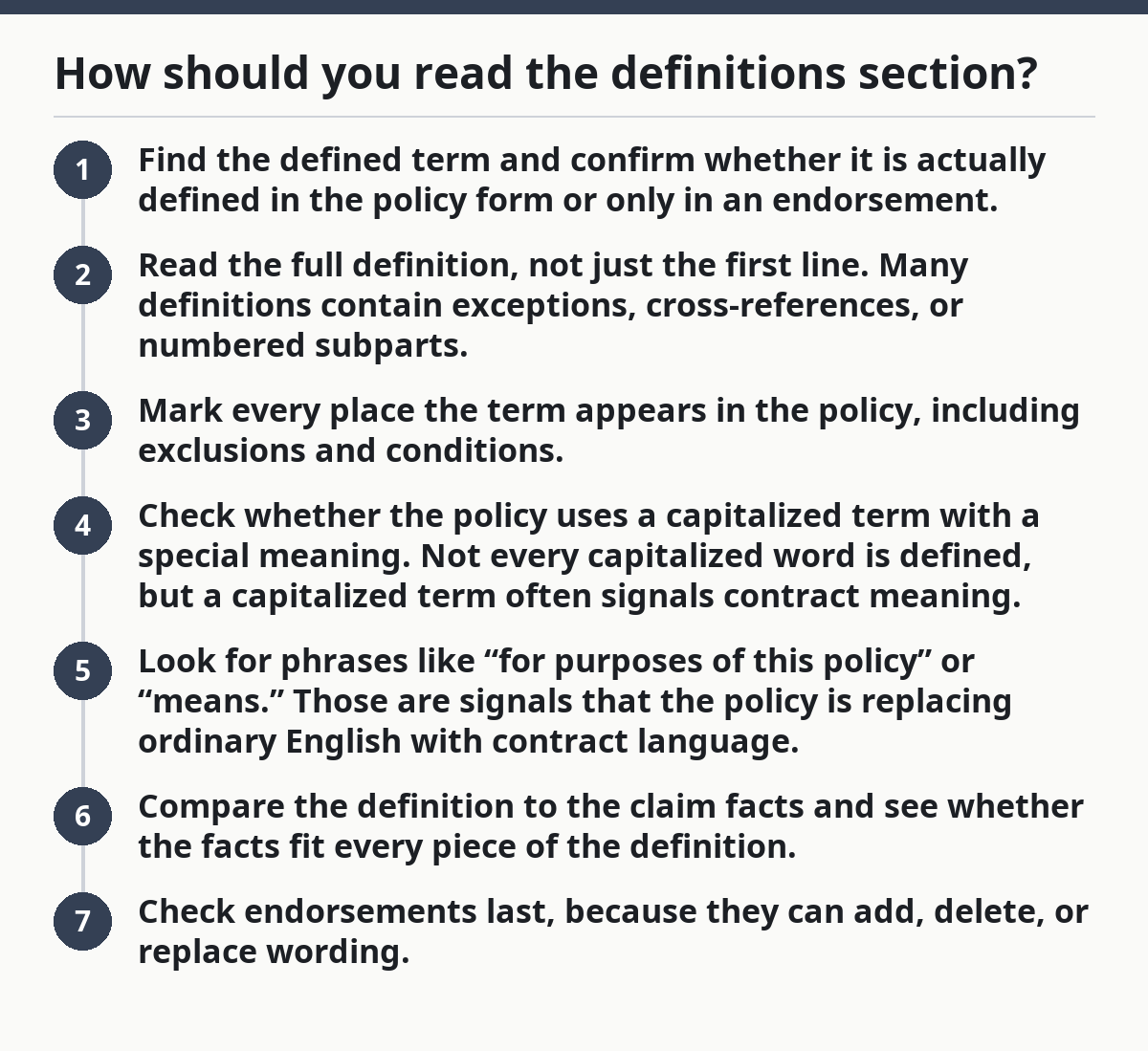
You should read the definitions section term by term, then check every place each term appears elsewhere in the policy. Start with the defined words that show up in the insuring agreement, because those are the words most likely to drive coverage.
Use this order:
- Find the defined term and confirm whether it is actually defined in the policy form or only in an endorsement.
- Read the full definition, not just the first line. Many definitions contain exceptions, cross-references, or numbered subparts.
- Mark every place the term appears in the policy, including exclusions and conditions.
- Check whether the policy uses a capitalized term with a special meaning. Not every capitalized word is defined, but a capitalized term often signals contract meaning.
- Look for phrases like “for purposes of this policy” or “means.” Those are signals that the policy is replacing ordinary English with contract language.
- Compare the definition to the claim facts and see whether the facts fit every piece of the definition.
- Check endorsements last, because they can add, delete, or replace wording.
A useful habit is to look for the 2 or 3 terms that do the most work. In many liability forms, those are insured, claim, suit, occurrence, and sometimes property damage or bodily injury. If one of those terms is defined tightly, the policy may be narrower than the reader expects.
A warning sign is a definition that sends you elsewhere. If the policy says a term means what is stated in the declarations, an endorsement, or another section, you need to follow that cross-reference before assuming the meaning is fixed.
What does “insured,” “claim,” “suit,” and “occurrence” usually mean?
These terms usually have contract meanings that are tighter than everyday speech, and they often decide when coverage starts or stops.
An insured is the person or entity the policy protects, but that can be more limited than “anyone working for the business.” A claim is often a demand for relief, usually money, and it may require writing or a formal request. A suit is often a civil proceeding, not just a complaint or threat. An occurrence is often an accident or repeated exposure to the same harmful condition.
The same term can be used differently across policy forms. Some forms treat a claim as made when the demand is received; others require a lawsuit or a written demand. Some forms define suit to include arbitration or alternative dispute resolution only if the policy says so. For a live coverage question, consult a professional and check the policy wording.
Common ways these definitions change the result:
- Insured may include a company, its members, its executive officers, or temporary staff only in narrow settings.
- Claim may require a written demand, not just a phone call.
- Suit may not include every dispute forum.
- Occurrence may exclude expected or intended harm, depending on the wording.
- A single event may be one occurrence or several, depending on the policy language and the facts.
The truth is, those words are not just labels. They are gates. If the facts do not fit the definition, the coverage argument often stops there.
Why do policy definitions matter?
Policy definitions matter because they decide how the rest of the contract works, and they can change the result even when the facts sound simple.
The first place this shows up is the insuring agreement. A policy may promise to pay because of a claim made against an insured for an occurrence, and each of those words depends on the definition section. If one word misses the facts, the coverage path gets harder or ends.
The second place is the exclusions. Exclusions often reuse defined terms, and those terms can narrow or expand the exclusion. A definition can also work in the insured’s favor if it is broader than ordinary language would suggest. A policy that defines “employee” or “damages” in a special way can change the analysis without changing the headline label.
The third place is the conditions section. Notice requirements, reporting duties, and defense obligations may all depend on defined terms. If “claim” means a written demand, then the clock may not start at the first verbal complaint. If “suit” is defined more narrowly, defense obligations may not begin until the policy’s trigger is met.
What to check before you rely on the wording:
- Is the term defined in the main form or only in an endorsement?
- Does the definition include exceptions?
- Does the policy use the word the same way in every section?
- Does a cross-reference send you to another definition?
- Does the term appear in plural form, singular form, or with a modifier that changes it?
A policy definition is not decoration. It is part of the bargain.
Can endorsements change the definitions section?
Yes, endorsements can change definitions by replacing, deleting, or adding policy language.
An endorsement is an attached change to the policy, and it can be more specific than the base form. If an endorsement says a defined term has a new meaning, that new meaning usually controls for the subject addressed by the endorsement. In practice, that means the definitions section is not always the last word.
That is why a reader should never stop after the main policy form. A definition in the base form may look generous, but an endorsement can narrow it. The reverse can happen too: an endorsement can broaden a term or add a special definition for a particular risk, class of insured, or coverage part.
Watch for these signs:
- The endorsement says it replaces a definition.
- The endorsement says it adds a definition.
- The endorsement says “for purposes of this endorsement only.”
- The endorsement uses a term that is not defined anywhere else.
- The endorsement conflicts with the base policy, which means the later or specific wording may control.
Here’s the practical problem: if you read only the definitions section in the body of the policy, you may miss the exact wording that governs the loss. That is especially true when the endorsement uses the same word in a narrower way.
When the standard reading does not work
The standard reading does not work when the policy uses a term in a special way, when the facts do not fit the whole definition, or when an endorsement changes the term.
Stop and slow down in these situations:
- The term is defined across two places: The base form and an endorsement both define it — you may need to read them together, not separately.
- The definition has exceptions: A term that looks broad may exclude certain people, acts, or forums — ignore the exception and you misread coverage.
- The policy uses a term in a different section: A word may have one meaning in the insuring agreement and another in a manuscripted endorsement — check the local context.
- The claim is informal: A verbal complaint may not count as a claim if the policy requires a written demand — the reporting trigger may not have started.
- The dispute forum is unusual: A mediation, arbitration, or administrative proceeding may not be a suit unless the policy says so — defense language may not be triggered the same way.
- The act spans time: A string of incidents may not fit one occurrence if the policy treats repeated events separately — consult a professional on aggregation and read the policy wording.
The consequence of a bad read is simple: you may think a policy responds when the defined terms say it does not, or miss coverage that is actually there. That is why the definitions section gets read with the rest of the contract, not alone.
The mistakes people make with defined terms
People most often make five mistakes, and each one can distort the coverage reading.
First, they assume a defined term means the same thing it means in ordinary speech. That can turn a narrow policy term into a false expectation. The fix is to read the policy definition first, then compare it to the facts.
Second, they stop after the main form and ignore endorsements. That can miss a replacement definition buried in a short attachment. The fix is to check every endorsement that mentions the same term.
Third, they treat every capitalized word as defined. That is not safe. Some capitalized words are only stylistic, while others are defined elsewhere. The fix is to confirm the definition before assigning legal weight.
Fourth, they read one section in isolation. A term in the definitions section may affect an exclusion, a condition, or a defense duty. The fix is to trace the term through the whole policy.
Fifth, they assume a single word settles the issue. It rarely does. Policy meaning often depends on the full phrase, not one label. The fix is to read the complete definition, including punctuation, exclusions, and cross-references.
You do not need to memorize insurance jargon to read the section well. You do need to track the words exactly as the policy uses them.
What should you check first in a liability policy?
You should check the defined terms that appear most often in the insuring agreement and the exclusions, because those terms usually carry the most weight.
Start with the policy’s own list of defined words, then look at:
- insured
- claim
- suit
- occurrence
- any term tied to the loss, such as “damages” or “property damage” if the policy uses them
Then compare those definitions to the facts of the event. If the policy says a claim must be written, a verbal demand may not count. If suit includes only certain proceedings, a different forum may fall outside the term. If occurrence is tied to an accident, intentional conduct may be treated differently.
The best part? This part of the policy is mechanical. You are not guessing at tone or intent; you are matching defined words to known facts. That makes the definitions section one of the few places where careful reading can change the result without needing to read the whole policy again.
Frequently asked questions
Why do policy definitions matter?
Policy definitions matter because they tell you what the contract words mean. A liability policy may use familiar terms in a narrower or more specific way, and that meaning can affect coverage, exclusions, reporting duties, and defense obligations.
Can endorsements change definitions?
Yes. An endorsement can replace, add to, or narrow a definition in the base policy. If an endorsement and the main form use the same term differently, the endorsement may control for the part of the policy it changes.
Do defined terms override plain English?
Yes, inside the policy they usually do. A defined term is used in its contract sense, even if that sense is narrower than everyday language. That is why the full definition, not the dictionary meaning, usually controls the reading.
Drafted with AI; not yet reviewed by a person.