
Last updated: November 19, 2026
The operations description can narrow or support commercial liability coverage because it tells the insurer what the business actually does, and the policy usually responds only to the insured operations described there. If the description is too narrow, a claim can fall outside the coverage scope even when the policy form looks broad. This is general information, not legal advice, and a qualified lawyer should be consulted for any specific matter, especially because rules vary by jurisdiction.
Key takeaways
- The business description is not filler; it helps define what the insurer agreed to cover.
- A named activity, product, or service can protect coverage for that line of work, but it can also leave out anything not named.
- The safest description is the one that matches real operations, the application, and the policy wording.
- Big gaps usually appear when a business adds services, changes sites, or starts handling a new product line.
- A short description is not always bad, but a vague one can create room for disputes.
What does the operations description do?
The operations description tells the insurer the scope of the insured operations it is pricing and agreeing to cover. In plain terms, it is the sentence or paragraph that says what the business does, such as “interior painting,” “food distribution,” or “janitorial services for offices.” That wording matters because commercial liability coverage is tied to the risk that was described, not to every risk a business might someday create.
A generic business description can leave out work that is routine on the ground but invisible on paper. If the description says “consulting” and the business also installs equipment, the installation work may sit outside the policy’s intended scope unless it is also described. If the description says “retail sales,” but the business ships products, warehouses goods, or does online fulfillment, those activities may need to appear somewhere in the underwriting file and policy wording.
This is not about one magic phrase. It is about alignment among the application, the business description, the named operations, and the final policy form. A mismatch can affect how a claim is handled, even if the policy has a broad liability grant on page 1. The insurer still reads the contract through the lens of the described business.
Why does the business description matter?
The business description matters because it helps set the coverage scope, the class of risk, and the expectations on both sides. Insurers use it to classify exposure, decide whether a class is acceptable, and attach the right exclusions or endorsements. If the description says one thing and the actual work says another, the dispute often starts there.
A simple example shows the problem. Suppose the description names “office administration services” but the business actually performs onsite cleaning at client premises. Those are different insured operations. The second activity creates slip-and-fall exposure, chemical-use exposure, and a different loss pattern than desk-based work. If the policy was priced and issued on the first description, the carrier may argue the loss came from an activity it was never told about.
The reverse problem is also real. A description that is too broad can make the application look inconsistent with the business, which can trigger questions about classification consistency. If the file says “general contracting” but the business only does bookkeeping, the mismatch can create confusion in underwriting and claims handling. The best description is specific enough to show the real risk, but not so narrow that it leaves out ordinary parts of the job.
For background on how classification fits into the broader buying process, the commercial liability insurance buying process and underwriting hub can sit beside this page.
How should a business description be written?
A business description should be written to match the real operations, the words used in contracts, and the policy wording. The task is not to make the business sound bigger or smaller. The task is to describe what the business actually does in a way that can be matched to insured operations later.
A practical way to do that is to describe the core activity first, then add the parts that create exposure. If a business manufactures a product, note the product line and any installation, repair, or delivery work tied to it. If a business serves clients on-site, note whether work happens in offices, homes, warehouses, or job sites. If a business sells online, note whether it stores inventory, ships goods, or uses third-party fulfillment.
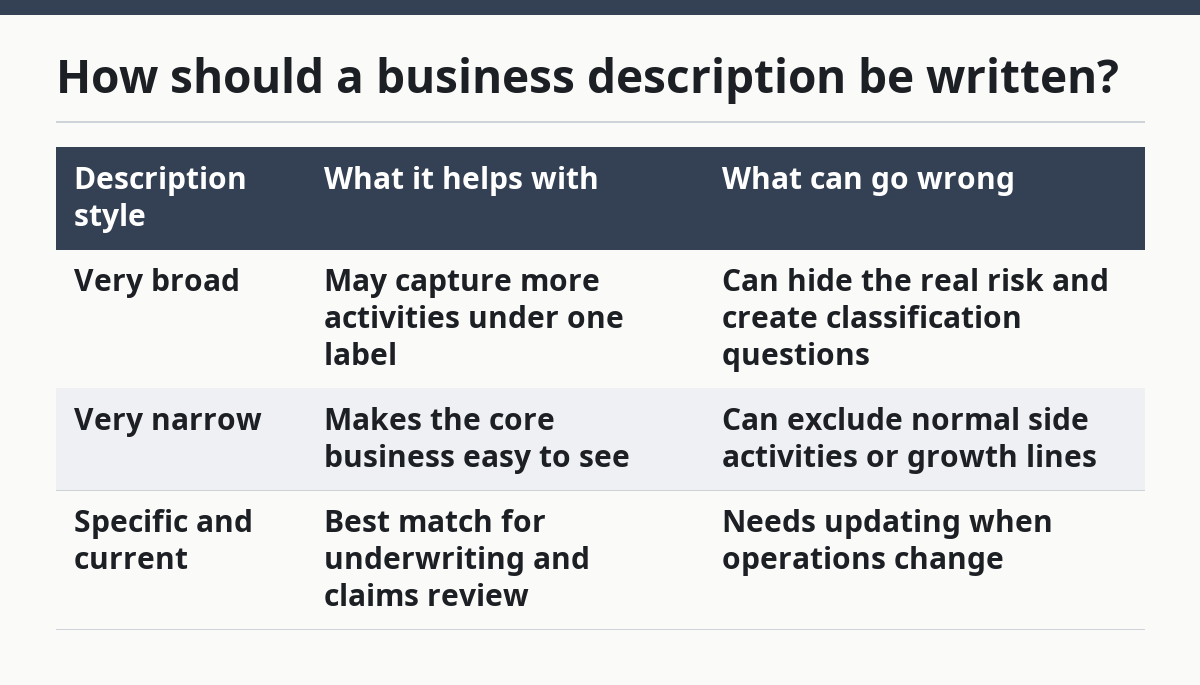
Here is the comparison that usually matters most:
| Description style | What it helps with | What can go wrong |
|---|---|---|
| Very broad | May capture more activities under one label | Can hide the real risk and create classification questions |
| Very narrow | Makes the core business easy to see | Can exclude normal side activities or growth lines |
| Specific and current | Best match for underwriting and claims review | Needs updating when operations change |
The description should also match the business name in contracts when that name describes the same work. If one document says “software support” and another says “field maintenance,” the insurer sees two different risk stories. That does not automatically mean no coverage, but it does make the file harder to defend if a claim lands in the gray area.
How do mismatches affect a claim?
A mismatch can affect a claim by giving the insurer a reason to question whether the loss came from covered operations. The issue is usually not the title of the business alone. It is whether the activity that caused the loss fits the insured operations described in the policy file.
Claims tend to get harder when the description and the loss facts do not line up. If the policy was written for light office work and the loss came from loading freight, operating machinery, or performing work off-site, the carrier may say the operation was outside the described class. If the business changed its work after binding and never updated the insurer, the file may no longer reflect the actual exposure.
The problem is not just denial. A mismatch can also slow the claim, create extra document requests, or lead to a narrower settlement discussion than the business expected. That is why classification consistency matters. The business description should match the application, the policy declarations, and the day-to-day work. A clean match gives the claim adjuster less room to argue about what the insurer agreed to cover.
A useful rule: if the work would change the class, the hazard, or the way the business is described to a customer, it should be reviewed against the policy file. A one-paragraph description that worked at startup may not fit after a second location, a new product line, or a shift from services to sales.
What are the common gaps and mistakes?
The most common gaps come from omitted work, not from exotic policy tricks. The first mistake is describing only the main service and forgetting the support tasks. A business may say it offers “consulting” but also does setup, training, or site visits. If a claim arises from the omitted task, the insurer may treat it as outside the described operations.
The second mistake is using a trade name that sounds safe but hides the actual work. “Solutions,” “services,” or “management” tells the insurer almost nothing. Those words can be too thin to support the coverage scope if a loss arises from a physical task, a product sale, or a location-based exposure.
The third mistake is failing to update the description after growth. A business that started with one service may add delivery, assembly, or rental activity within 12 months. If the description stays frozen while the work changes, the file can drift away from reality.
The fourth mistake is treating every side project as if it is automatically included. That is rarely true. A side project can create a new insured operations issue, especially if it changes the class of business or adds a different hazard.
The fifth mistake is assuming the policy form alone controls everything. The form matters, but the description matters too. A broad grant of coverage does not always rescue a risk that was never described.
When does the standard description stop working?
The standard description stops working when the business’s actual operations no longer match the file on which the policy was written. In those cases, the right move is to pause and get the description, application, and policy wording reviewed by a qualified lawyer or other licensed professional who handles commercial liability matters in the relevant jurisdiction.
The business added a new service line: This means the original description may omit a whole class of exposure — Review whether the new work belongs in the insured operations before a claim happens.
The business moved from service work to product sales: This changes the risk from service errors to product-related loss — Check whether the policy file and class description still fit the business.
The business now works on customer sites instead of only at its own premises: This adds premises and on-site hazard exposure — Confirm that the description reflects off-site work, not just office-based activity.
The business began using subcontractors or third-party fulfillment: This can change who performs the work and where the risk sits — Make sure the description and related policy language still track the actual operation.
The description is too vague to identify the work: Words like “services” or “management” may not show what is really being insured — Replace vague wording with a concrete description of the actual activity.
The policy was issued under one class, but the invoices show another: That inconsistency can create a claim dispute — Bring the application, invoices, and policy file into the same story.
For general information on commercial liability underwriting and classification, the National Association of Insurance Commissioners is a useful starting point, and so are insurer and broker guides that explain class descriptions in plain language. The key is to read the description as a risk statement, not a marketing line.
What should be checked before the policy is issued?
The business description should be checked against at least three things before the policy is issued: the real work, the contracts, and the policy wording. A 10-minute review is often enough to catch a mismatch, but the review has to be specific.
First, list the actual operations, not the planned ones. Note the core service, any physical work, any sale of goods, any delivery or installation, and any off-site activity. Second, compare that list with the description used in the application. Third, compare both to the final declarations and any endorsements that narrow or expand the scope.
A simple check can prevent a larger problem later. If the business name, invoice language, and contract language all point to one kind of work, the policy file should point there too. If one of those points in a different direction, the difference should be explained before the policy is placed, not after a loss.
Why does this matter for claims and renewals?
This matters for claims and renewals because the description is part of the paper trail the insurer uses to decide what it took on. A claim is easier to place when the loss facts, the stated operations, and the policy form all tell the same story. A renewal is easier too, because the insurer can see what changed since the last term.
A business that updates its description when operations change has a better chance of keeping the policy aligned with reality. A business that lets the description drift can end up paying for a policy that does not fit the work it is actually doing. That is the trade-off: a careful description takes more attention up front, but a sloppy one can cost time and coverage later.
What if my operations change after binding?
If your operations change after binding, the description should be reviewed and, if needed, updated with the insurer or broker handling the policy. A change in work can change the insured operations, the classification, and the coverage scope.
Small changes may not matter, but a shift in service type, site type, or product line can matter fast. For example, a business that adds installation work after a 12-month term should not assume the original “sales only” description still fits. The safest move is to treat the description as a live part of the policy file, not a one-time form field.
Does the description need to match contracts?
The description should match contract language when the contracts describe the same business activity. If the contract says the business provides on-site repair, but the policy file says only office consulting, the gap can become important during a claim.
The contract does not control the insurance policy, and the policy does not rewrite the contract. Still, the two should tell the same basic story about the business. If they do not, the mismatch can create a classification problem, a claims problem, or both.
Why does the business description matter?
It matters because the insurer uses it to understand the risk it agreed to cover. If the description leaves out an activity, a claim from that activity may fall into a gray area. A clear, current description reduces that risk and gives the policy a better chance of matching the real business.
What if my operations change after binding?
A change after binding can make the old description incomplete. If the business adds services, shifts locations, or starts handling a new product, the policy file may need an update. The issue is not whether the business has grown; the issue is whether the policy still describes the same business.
Does the description need to match contracts?
Yes, when the contracts describe the same work, the description should line up with them. A mismatch can make the file harder to defend if a claim is disputed. The goal is the same story across the contract, the application, and the policy wording, even if the exact phrasing is different.
Drafted with AI; not yet reviewed by a person.

