Last updated: November 19, 2026
Quick answer: the endorsements schedule usually answers 3 questions — what endorsements are attached, when they apply, and whether the policy packet is complete. On a commercial liability policy, What the Endorsements Schedule Means on a Liability Policy is the place to check when you want to know whether a policy form was altered by a manuscript endorsement, what document was added, and which version applies as of the endorsement effective date.
Key takeaways
- The endorsements schedule is an index, not the endorsement itself.
- It helps you find attached changes fast, especially when a policy has several forms.
- A manuscript endorsement is a custom-written change, not a standard form.
- The schedule matters because the effective date can differ from the policy’s main start date.
- If the schedule and the attached forms do not match, the policy file needs a closer look.
Who this is for
The endorsements schedule is for anyone reading a liability policy and trying to figure out what extra documents are part of it. That includes a business owner, broker, risk manager, claims staff member, or in-house counsel who already has the declarations page and the policy forms in front of them.
If a policy dispute, claim, or coverage question turns on one endorsement, a qualified lawyer should review the full policy packet rather than relying on the schedule alone. That matters most when there are multiple endorsements, a manuscript endorsement, or a date mismatch of even 1 day.
The key assumption here is simple: the reader is not trying to learn how endorsements change coverage in the abstract. The reader wants to know what the endorsements schedule does on the paper, where to find it, and how to read it without confusing it with the schedule of forms. The two often sit close to each other, but they do different jobs.
The endorsements schedule supports the broader policy structure. If the policy is a stack of documents, the schedule is the index that points to the added pages. It is also one of the quickest places to spot whether the insurer attached a standard endorsement form or a manuscript endorsement written for one account.
What is the endorsements schedule?
The endorsements schedule is the page or section that lists the endorsements attached to the liability policy. It usually names the endorsement, often by form number or title, and shows enough detail to identify which document belongs in the policy packet.
Think of it as a contents list for changes. The endorsement is the change itself; the policy form is the base language; and the endorsements schedule points to the added paper that comes with the policy. If a form is listed there, it is part of the contract documents even if the policyholder never read the attachment line by line.
A schedule can include standard endorsements and custom ones. A standard endorsement is a prewritten form used across many policies. A manuscript endorsement is written or revised for a specific risk, which means the wording may be different from the insurer’s usual form language. For a general definition of manuscript wording, see IRMI’s discussion of manuscript endorsements. For policy-form basics, see the commercial liability insurance policy forms guide.
The schedule matters because the liability policy is not just the declarations page. A policy packet can include a base form, many endorsements, and a few amended pages. The endorsements schedule is the road map that shows what was added after the base form was issued.
How do I read the endorsements schedule?
You read the endorsements schedule by matching each listed item to the attached document and checking the date, title, and form reference. The goal is to confirm that the endorsement shown in the schedule is actually in the policy and that the version on file matches the one the insurer intended.
- Start with the policy number and declaration page. Verify that the endorsements schedule belongs to the same policy number and named insured. If the schedule is for a different policy form or a different 12-month term, that is a filing problem.
- Find the endorsement title or form number. Look for a label such as an endorsement number, form code, or title on the schedule. If the title is vague or incomplete, the risk is that the wrong attachment was inserted.
- Check the effective date shown beside the endorsement. Confirm whether the endorsement applies from the policy start date or from a later date. If the endorsement is dated after the policy incepted, it may apply only from that later point.
- Match the schedule to the attached form. Open the actual endorsement and compare the title, form reference, and date. If the schedule lists a form but the attachment has a different form number, the packet may be incomplete.
- Identify whether the endorsement is standard or manuscript. A manuscript endorsement usually stands out because it is custom wording tied to one account. If the policy says one thing in the schedule and the attached page reads like a custom rewrite, verify the file carefully.
- Look for duplicate or conflicting entries. Two endorsements can point to the same topic, such as one general change and one narrower amendment. If both appear, a conflict may need a lawyer or broker to sort out the order of control, especially when the policy turns on a single clause.
- Check whether the schedule is part of the policy issue or a later change. Some schedules are attached at issuance, while others appear after an endorsement midterm. If the schedule was updated later, the policy record should show the timing.
- Confirm that every listed endorsement is attached. If the schedule shows 4 endorsements but only 3 appear in the packet, the file is incomplete. That is a red flag because a missing page can hide a material change.
The practical test is simple: if you can point from the schedule to the actual endorsement, and from the endorsement back to the policy form it changes, the paper trail is intact. If you cannot, the packet is not ready for a coverage review.
What does the schedule tell you about attached forms?
The endorsements schedule tells you which forms are attached to the policy and which of those forms are changes rather than base wording. That is useful because liability policies often carry several attachments, and not every attachment has the same job.
A policy form is the main contract language. An endorsement is an add-on that changes, explains, or limits some part of that language. The schedule helps you separate those roles without guessing from the title alone. A form may be standard, but once it appears on the endorsements schedule, it becomes part of the contract packet for that term.
This is where people get tripped up. A document can look minor because it is only 1 page long, yet still change the way the policy reads. The schedule is a warning sign to read beyond the declarations page. It also helps you see whether the policy was issued with a full set of attachments or whether a later amendment was dropped in after the fact.
The schedule is not the only place to look. Some policies cross-reference attachments in more than one section, and the final rule can depend on the order of forms. For that reason, the schedule is useful but not complete by itself. See also the declarations page guide and the endorsement review checklist.
When does the endorsements schedule matter most?
The endorsements schedule matters most when the policy has been changed after the original issue date or when several attachments could affect the same part of the contract. That happens often enough on commercial liability policies that ignoring the schedule can leave a reader with the wrong version of the policy.
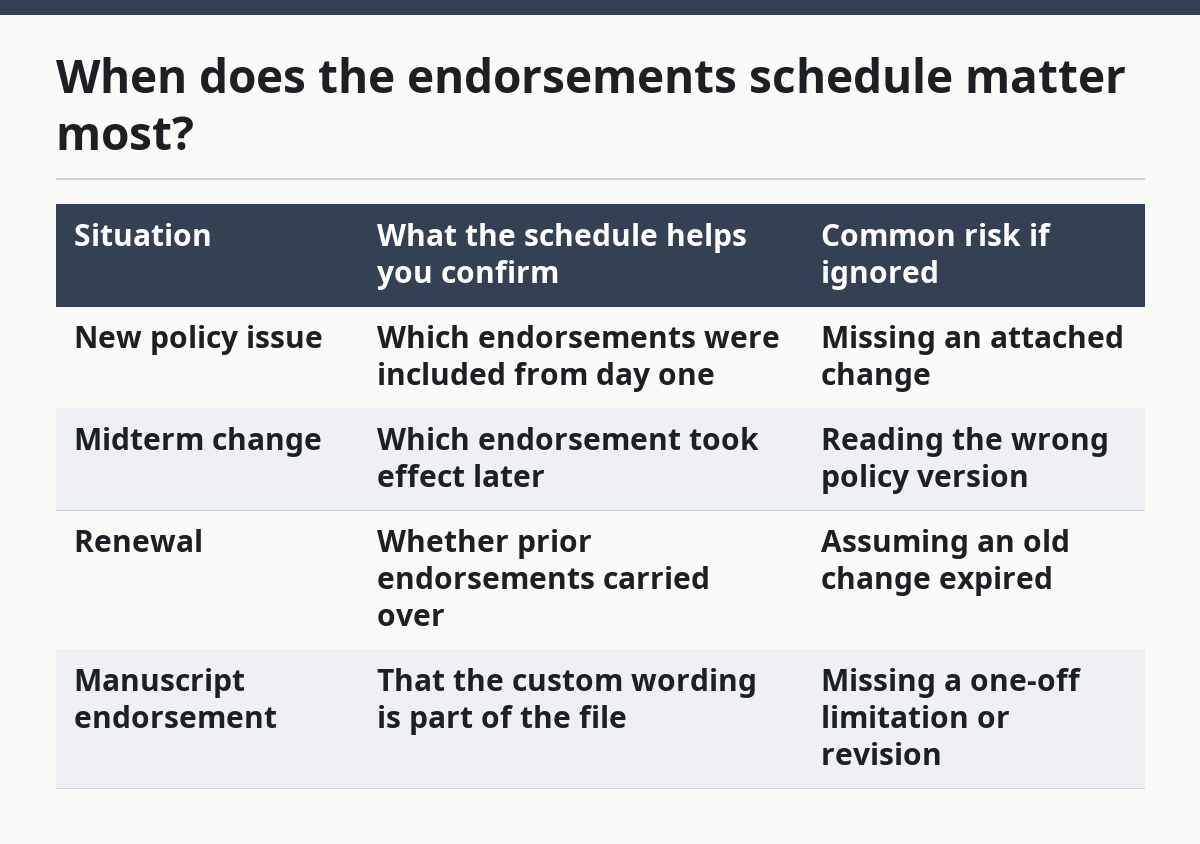
It matters on renewal, midterm changes, and manuscript placements. A renewal can carry old endorsements forward, new endorsements can be added during the term, and a manuscript endorsement can override a standard form for one insured. If the schedule is updated, the effective date tells you which version controls for that period.
| Situation | What the schedule helps you confirm | Common risk if ignored |
|---|---|---|
| New policy issue | Which endorsements were included from day one | Missing an attached change |
| Midterm change | Which endorsement took effect later | Reading the wrong policy version |
| Renewal | Whether prior endorsements carried over | Assuming an old change expired |
| Manuscript endorsement | That the custom wording is part of the file | Missing a one-off limitation or revision |
The schedule is also useful when the policy packet is thick. In a file with a base form and several endorsements, the schedule gives you a fast way to sort the documents before you read them. That saves time, but it does not replace a full reading when a claim or dispute depends on one clause. For related background, see the commercial general liability guide and the policy documents checklist.
What are the common mistakes?
The most common mistake is treating the endorsements schedule like the endorsement itself. It is not the change; it is the list that points to the change. If someone stops at the schedule, they may miss the actual wording and read only the title.
Another mistake is ignoring the effective date. A policy can begin on one date and carry an endorsement that starts later, so the schedule can show a change that does not apply to the entire 12-month term. That matters because timing can change how the policy reads for a specific loss date.
A third mistake is assuming every listed item is a standard form. A manuscript endorsement may look routine in the schedule, but the attached wording can be custom and account-specific. If the reader treats it like a boilerplate page, the result can be a bad read of the policy, so a qualified professional should check the wording when it affects coverage.
A fourth mistake is not checking whether the attachment is actually in the packet. A schedule with 5 listed endorsements but only 4 attached forms is incomplete. That kind of gap should be fixed before anyone relies on the policy text.
A fifth mistake is confusing the endorsements schedule with the schedule of forms. Those are different lists. One identifies endorsements; the other identifies the forms making up the policy. If a reader mixes them up, the file can look correct while still being incomplete.
When should you stop and get the policy reviewed?
You should stop relying on the endorsements schedule alone when the paper trail does not line up. In a legal setting, the problem is not that the schedule is useless; it is that the schedule is only one piece of the contract.
The schedule lists an endorsement that is not attached: this means the policy packet is incomplete — do not assume the missing page is harmless.
The attached endorsement has a different form number than the schedule: this suggests a mismatch — compare the full policy set before relying on either document.
The endorsement effective date is later than the policy start date: this means the change may not apply to the entire term — check the date sequence carefully.
The policy includes a manuscript endorsement: this is custom wording and can carry account-specific changes — have the exact language reviewed if the wording matters.
Two endorsements point to the same topic but seem to conflict: this can mean one form modifies the other — look at the order and the dates before drawing a conclusion.
The schedule appears to belong to a different policy number or named insured: this may be the wrong packet — stop and confirm the file before using it.
When any of those shows up, the safe move is to get a qualified lawyer or other appropriate professional to review the actual policy documents in the relevant jurisdiction. The risk is not just confusion; it is relying on the wrong contract language.
What mistakes do people make with manuscript endorsements?
People often assume a manuscript endorsement is just a nicer version of a standard form. It is not. It is custom wording, and that means the exact text matters more than the label on the schedule.
They also assume a manuscript endorsement must be short or obvious. Some are brief, but brevity does not make them unimportant. A 1-page manuscript endorsement can still change the meaning of a standard policy form.
Another mistake is reading the schedule and the endorsement separately without checking whether they fit together. The schedule may say one thing, while the attached manuscript page uses tighter or different wording. If the two do not match cleanly, the issue is not cosmetic.
Because the wording is custom, the schedule alone is not enough to decide which clause controls. The better approach is to read the title, the form number, the date, and the actual wording as one package. That is the only practical way to know whether the listed endorsement is the one that governs the policy period in question.
How does this fit with the rest of the policy?
The endorsements schedule fits into the broader policy by showing where the changes sit in relation to the base form and the declarations page. It helps the reader locate the added language, but it does not replace the need to read the whole contract.
On a liability policy, the base policy form sets the starting rules, then the endorsements can alter pieces of that structure. The endorsements schedule shows the map of those changes. If the site’s broader hub on commercial liability insurance policy structure and contract language explains the main building blocks, this page explains the list of attached changes that sits beside them.
That division matters because a reader looking for the schedule’s meaning does not need a full endorsement guide here. The better question is whether the schedule tells you what is attached, when it applies, and whether the policy file is complete. In practice, that is usually enough to spot the documents that need a closer read.
How do you know which endorsements apply?
You know which endorsements apply by matching the schedule to the attached forms and checking the dates. If the endorsement appears on the schedule and is attached to the policy packet, it is part of the contract documents for that term unless the policy language says otherwise.
Does the endorsements schedule change coverage?
The endorsements schedule itself does not change coverage; the endorsement does. The schedule lists the change and helps identify it, but the actual coverage effect comes from the wording of the attached endorsement and its effective date.
Where is the endorsements schedule on a policy?
The endorsements schedule is usually in the policy packet near the other schedules or attachments. It may sit close to the declarations page, the policy forms list, or the endorsement pages, but its exact placement varies by insurer and policy format.
Drafted with AI; not yet reviewed by a person.