Last updated: November 19, 2026
Commercial liability claims and notice handling rise or fall on timely notice, clean records, and the exact policy wording.
This guide to Commercial liability claims and notice handling: The Complete Guide shows what notice usually means, what insurers look for, and where businesses get into trouble. In many commercial liability files, the first 24 hours matter most because the notice record starts immediately.
Quick Answer: give notice within 24 hours if you can, or as soon as the policy requires. General information only, not legal advice. Laws and deadlines vary by jurisdiction, so a qualified lawyer should review your situation.
Key Takeaways
- Notice is not a formality; it is part of the claim itself in many liability policies.
- The first question is usually not “Who was at fault?” but “Did the insured give notice the way the policy requires?”
- A late report can hurt coverage, even when the underlying claim is weak or the loss looks minor.
- Good notice handling means one intake path, a written timeline, and no guesswork about who knew what and when.
- The safest process is to preserve documents, report early, avoid admissions, and track every insurer reply.
Picture this: a customer slips, a vendor sends a demand letter, and your team is still debating whether the incident is “serious enough” to report. The answer is to give notice early, in the format the policy requires, and keep proof of the report. The steps below explain what counts as notice, what to send, and where businesses usually miss the mark.
What notice means in a commercial liability claim
Notice is the insured’s formal way of telling the insurer that an event, demand, suit, or circumstance may trigger coverage. In many commercial general liability policies, the notice clause is one of the first things checked after a loss.
You are not just “telling someone what happened.” You are creating a coverage record.
That often matters.
A claim file often starts with a simple question: did the business report the matter within the time and in the manner the policy asks for? Some policies ask for notice of an “occurrence,” some for a “claim,” and some for a “suit” or a “circumstance” that may lead to a claim. Those words are not interchangeable. If the policy uses these terms, treat them as different buckets, not synonyms, and consult a lawyer or broker familiar with the form; the ISO Commercial General Liability Coverage Form is one common reference point.
What should be reported, and when?
Report the matter as soon as the policy says notice is required, or sooner if the facts suggest a potential claim. The right trigger depends on the policy language, not on how large the invoice is or whether the other side has hired a lawyer.
A generic rule is risky here. A demand letter, a lawsuit, a serious injury, or even a written threat of legal action may all trigger notice obligations under different policies. A small incident can still matter if it later becomes a large one.
Here’s the catch:
- Some policies require notice of an occurrence that may lead to liability, even before anyone demands payment.
- Some require notice only after a claim is made in writing.
- Some require separate notice when a suit is filed.
- Some policies also require notice of potential claims or circumstances that could lead to a claim.
How to handle notice the right way
Picture this: you are the person inside the business who has to route the report from reception, operations, or HR to the carrier, the broker, and maybe defense counsel. The pressure is not about law school language; it is about not losing coverage because the file went nowhere for 30 days.
Therefore, one intake path, one written timeline, and one person responsible for sending notice and saving proof can be enough to keep the process usable. One intake path, one written timeline, and one person responsible is the core of good claims handling.
Use a standard packet that includes:
- Date, time, and location of the event.
- Names of people involved and witnesses.
- Photos, video, incident reports, and repair records.
- Any demand letter, email, text, or service of process.
- The exact policy number and carrier name.
- The date notice was sent and by what method.
- A copy of every reply from the insurer, broker, or defense counsel.
If your policy allows notice by email or online portal, save the sent message, portal confirmation, and the attachment list. If notice is sent by mail, keep tracking and proof of delivery.
What the insurer usually checks first
The insurer usually checks three things before it spends real time on the file: whether the policy was in force, whether the event falls within the insuring agreement, and whether notice was proper. The notice piece can be decisive even before fault is discussed.
That is why claims teams should think like record keepers. A clean file answers the basic questions fast.
The carrier may look at:
- Who knew what and on what date.
- What exactly was reported in the first notice.
- Whether the report described the event, the injury, the threatened claim, or the lawsuit.
- Whether the insured sent later updates when facts changed.
- Whether the insurer asked for more information and received it.
If the first notice is vague, the carrier may ask for more detail or reserve rights while it investigates. If the notice is late, the carrier may raise a coverage defense. That defense may or may not succeed under the law that applies, but it is still a real problem to manage.
The difference between a claim, a circumstance, and a suit
A claim is usually a demand for money or other relief. A circumstance is a fact pattern that might turn into a claim. A suit is a filed lawsuit or similar legal action. Those categories sound close, but they often trigger different notice duties under commercial liability policies.
This is where businesses make avoidable errors. Someone gets hurt, but no one sends notice because no letter has arrived yet. Or a manager receives a complaint, calls it “just noise,” and never escalates it. Then a lawsuit lands months later and the insurer asks why the earlier warning signs were not reported.
The truth is, many policies reward earlier reporting. Even if the loss never turns into a payment, reporting a circumstance can help protect coverage if the facts later harden into a claim.
Common signs a circumstance may need notice
- A written complaint about injury or property damage.
- A demand for records after an incident.
- An email saying the business “will hear from my lawyer.”
- A report of repeated damage from the same condition.
- A serious incident that triggers an internal investigation.
None of those automatically mean liability is proven. They do mean the file should move.
The real risks of late or sloppy notice
Late notice can weaken coverage, delay defense funding, and create a fight about prejudice, waiver, or policy compliance. The business may still have a defense under the law that applies, but the insurer is not forced to ignore a bad notice record.
Sloppy notice causes another problem: the story changes. If the first report says one thing and later records say another, the insurer may question the entire timeline. That can affect both defense and settlement posture.
The most common mistakes are simple:
- Waiting for a formal lawsuit before reporting.
- Sending notice to the broker only and assuming that is enough.
- Reporting the event but leaving out the date, the injured person, or the demand.
- Failing to send updates after the claim grows.
- Not saving the actual notice sent to the carrier.
A bad notice file is like a bad ledger. Even a valid claim can become harder to manage.
The honest side-by-side: early notice vs delayed notice
Early notice often gives a business more options because it preserves the record. Delayed notice can still work in some places, under some policies, but it gives the insurer more room to argue noncompliance.
| Criteria | Early Notice | Delayed Notice | Winner for [condition] |
|---|---|---|---|
| Coverage defense risk | Lower, because the carrier gets the issue while facts are fresh | Higher, because delay gives the insurer a notice argument | Early Notice for any claim with real exposure |
| Defense appointment | Faster in most files | Often slower while the carrier reviews the delay | Early Notice if a lawsuit is threatened |
| Record quality | Better, because dates and documents are easier to collect | Worse, because memories fade and files go missing | Early Notice for incidents with witnesses |
| Broker coordination | Easier, since the team can route the file calmly | Harder, because everyone is reacting at once | Early Notice for multi-location businesses |
| Chance to fix the story | Better, because updates can be added as facts change | Poorer, because the first packet may already be stale | Early Notice for evolving facts |
| Risk of waiver fight | Lower, because the policy path is followed cleanly | Higher, because the insurer may reserve rights | Early Notice where the policy uses strict notice wording |
| Internal workload | Front-loaded and manageable | Back-loaded and messy | Early Notice for risk teams with thin staff |
| Chance of missing a deadline | Lower if the process is standardized | Higher if notice is ad hoc | Early Notice for any business without a claims system |
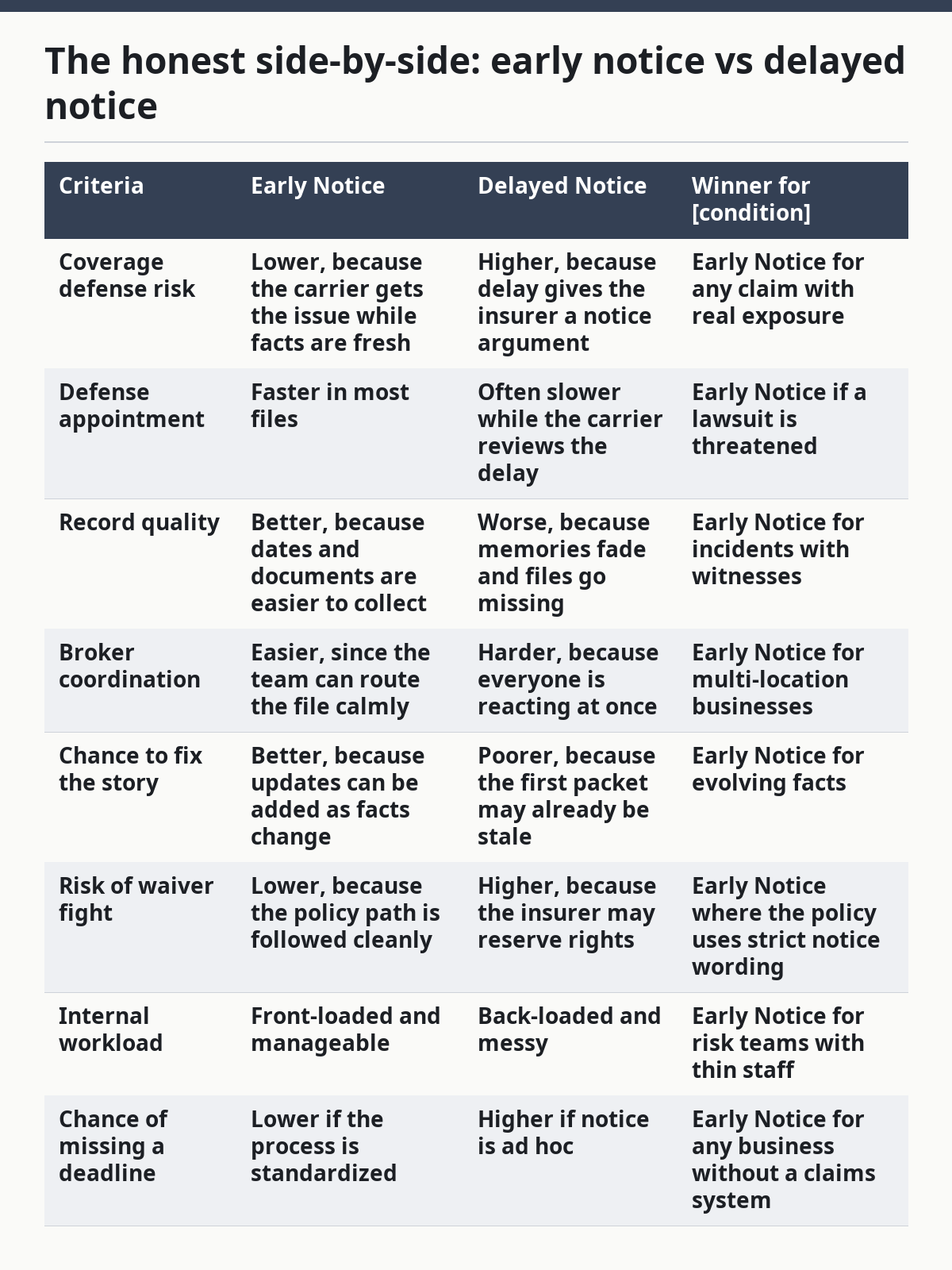
The table does not mean late notice always loses. It means early notice is the safer operating habit. In claims handling, safer is usually cheaper.
When late notice can still come up, and what changes the analysis
Picture this: the business only learns about the possible claim after a lawsuit is served, or a supervisor sits on an incident report for weeks. Now the notice problem is already here, and the question shifts from prevention to damage control.
The result can turn on several things, and those things vary by jurisdiction and policy wording:
- Whether the policy requires notice “as soon as practicable,” “promptly,” or by a set method.
- Whether the insured had a reasonable excuse for the delay.
- Whether the insurer can show prejudice from the delay under the law that applies.
- Whether the notice reached the right entity, not just a broker or a local office.
- Whether the policy is claims-made, occurrence-based, or written with a separate reporting rule.
Claims-made policies can be especially unforgiving about timing, because reporting windows may be built into coverage itself. Occurrence-based policies may allow more room for argument, but that is not the same as permission to wait.
A useful rule of thumb
If the facts are enough to make a reasonable risk manager nervous, they are enough to start the notice file.
What a good notice file should contain
A good notice file is short, dated, and complete. It does not need drama; it needs proof.
At minimum, keep:
- The policy number and insurer name.
- The event date and report date.
- The notice letter, email, or portal submission.
- Any demand, complaint, summons, or preservation letter.
- Photos, video, logs, and witness statements.
- Internal notes showing who knew what and when.
- The insurer’s acknowledgment, reservation of rights, or coverage letter.
If the policy requires notice of additional insured claims, endorsements, or special reporting channels, add those to the file too. Missing one attachment can matter more than a polished cover note.
Practical workflow for businesses and claims teams
A practical workflow is a short checklist that people actually use. Long procedures fail when the front desk, operations team, and executive team all think someone else is handling the notice.
Use a simple path:
- Front-line staff report incidents the same day.
- Risk, legal, or a designated manager decides whether the matter is a claim, suit, or circumstance.
- Notice goes to the carrier in the method the policy allows.
- Proof of delivery is saved in the file.
- The team calendars follow-ups and updates.
If your business uses multiple insurers, create a carrier map. A wrong recipient can cost time. A missing recipient can cost coverage.
Red flags that call for immediate escalation
- A person is injured and asks for your insurance information.
- A lawyer sends a letter.
- A vendor threatens suit.
- A fire, water loss, or contamination event could trigger third-party claims.
- The policy has a reporting condition that is easy to miss.
Where generic advice gets it wrong
Generic advice often treats notice as a paperwork issue. It is not. Notice is a coverage condition, a fact record, and a defense against later arguments all at once.
Another common mistake is assuming that sending something to the broker is enough in every case. Sometimes it is not. The broker may help route the file, but the policy or local law may still require notice to the insurer or another named recipient.
A third mistake is copying the same report into every claim. That creates noise and sometimes contradiction. Each file should match the actual policy form, the event type, and the jurisdiction involved.
This page is general information only, not legal advice. A qualified lawyer should review the policy language, the notice dates, and the law that applies before any decision is made on a real claim.
The verdict: what to do first, and what not to do
Choose early, documented notice if the policy language is unclear, the facts are changing, or there is any real chance the event could turn into a liability claim. Choose formal, policy-specific notice handling if your business has multiple locations, multiple carriers, or staff who may receive complaints before legal or risk teams do. Neither if you plan to wait until the file “looks serious,” because that is how coverage fights start.
That is the cleanest rule in this area.
What if the insurer says the notice was late?
The first step is to check the policy wording and the jurisdiction that applies, because the result can depend on both. A late notice issue is not the same in every place, and some laws require the insurer to show prejudice before denying coverage.
The second step is to gather the timeline. Dates, emails, portal receipts, and internal reports matter more than memory. A lawyer familiar with insurance disputes should review the file before the business assumes the carrier’s first position is the last word.
Does notice have to go to the insurer directly?
Often, yes, or at least to the recipient named in the policy or required by the policy form. Sending notice only to a broker may help, but it may not satisfy every policy condition in every jurisdiction.
That is why the notice file should show exactly where the report went. If the policy allows notice by agent, portal, or email, keep proof of that route. If it does not say that clearly, do not assume the broker-only route is enough.
Is a demand letter always a claim?
Not always, but it often is. A written demand for money, repair, or legal action is commonly treated as a claim under commercial liability policies, depending on the form.
The safer move is to treat a demand letter as reportable until the policy says otherwise. Waiting for a stronger threat usually adds risk without adding much value.
Should a business report every incident?
Not every scrape or complaint becomes a claim, but any event that could reasonably lead to one should be reviewed for notice. The policy language controls, and some forms ask for notice of potential claims even before a demand arrives.
A practical screen is whether the event involves injury, property damage, a serious service failure, or a written threat. If yes, the file should at least be assessed for reporting.
What records matter most if notice is disputed?
The most useful records are the policy, the original notice, proof of delivery, and the internal timeline showing who knew what and when. Those are the records that help resolve a notice dispute.
Photos, witness names, emails, and the insurer’s response also matter. If the file is thin, the argument usually gets harder, not easier.
Drafted with AI; not yet reviewed by a person.