Last updated: November 19, 2026
Quick Answer: a commercial liability policy usually uses 2 limits — a per-occurrence limit and an aggregate limit — plus either a deductible or a self-insured retention (SIR). In this article on What Limits and Deductibles a Commercial Liability Policy Usually Uses, the exact mix depends on how much loss the business can absorb before the policy pays. This is general information, not legal advice, and a qualified lawyer should be consulted for any actual policy dispute or coverage decision.
Key takeaways
- A liability policy usually has two limit layers: one for a single claim and one for the whole policy term.
- A deductible and an SIR both shift some loss back to the insured, but they do not work the same way.
- A low-cost structure can leave a business exposed if one claim, or a run of claims, uses up the policy quickly.
- Some policies add a per-project aggregate, which caps losses for one job rather than the whole policy period.
- An additional limit endorsement can change the available limit, but it does not erase all other policy terms.
Who this applies to
This applies to someone reading a commercial liability policy for a business, a project, or a renewal quote, and already knowing the basic policy form in use. It assumes the reader wants to compare a per-occurrence limit, an aggregate limit, a deductible, and an SIR without getting lost in sales language.
It is most useful for a buyer who needs to understand the trade-off between premium and out-of-pocket risk before signing a declarations page. It is not for someone trying to settle a disputed claim or decide how a court will read a policy clause; that is where jurisdiction and facts control, and the policy should be reviewed by qualified counsel.
The practical question is simple: how much does the policy pay for one loss, how much can it pay over time, and what part of the loss stays with the business? A commercial general liability form often answers that with 2 numbers on the declarations page and 1 cost-sharing device in the policy wording.
For background on policy terms, see the NAIC glossary and the IRMI explanation of self-insured retentions.
What limits usually show up?
A commercial liability policy usually shows a per-occurrence limit and an aggregate limit, and those 2 numbers do different jobs. The per-occurrence limit is the most the insurer pays for one covered claim or one covered occurrence, while the aggregate limit is the most it pays during the policy period, often 12 months, for all covered claims combined.
That split matters because a policy can look strong on one claim and still run out of room later. If one loss is large, the per-occurrence limit controls. If several smaller claims pile up, the aggregate limit controls, even when no single claim looks dramatic.
Here is the plain comparison, but buyers should still confirm the wording with the policy and, if needed, a qualified professional:
| Limit type | What it caps | What it means in practice | Typical pressure point |
|---|---|---|---|
| Per-occurrence limit | One covered occurrence or claim event | One loss cannot draw more than that amount from the policy | A single large claim |
| Aggregate limit | All covered losses during the policy term | Several claims can drain the same total bucket | A year with multiple claims |
| Per-project aggregate | One project, if endorsed | One job has its own cap separate from the policy-wide aggregate | One construction or service project |
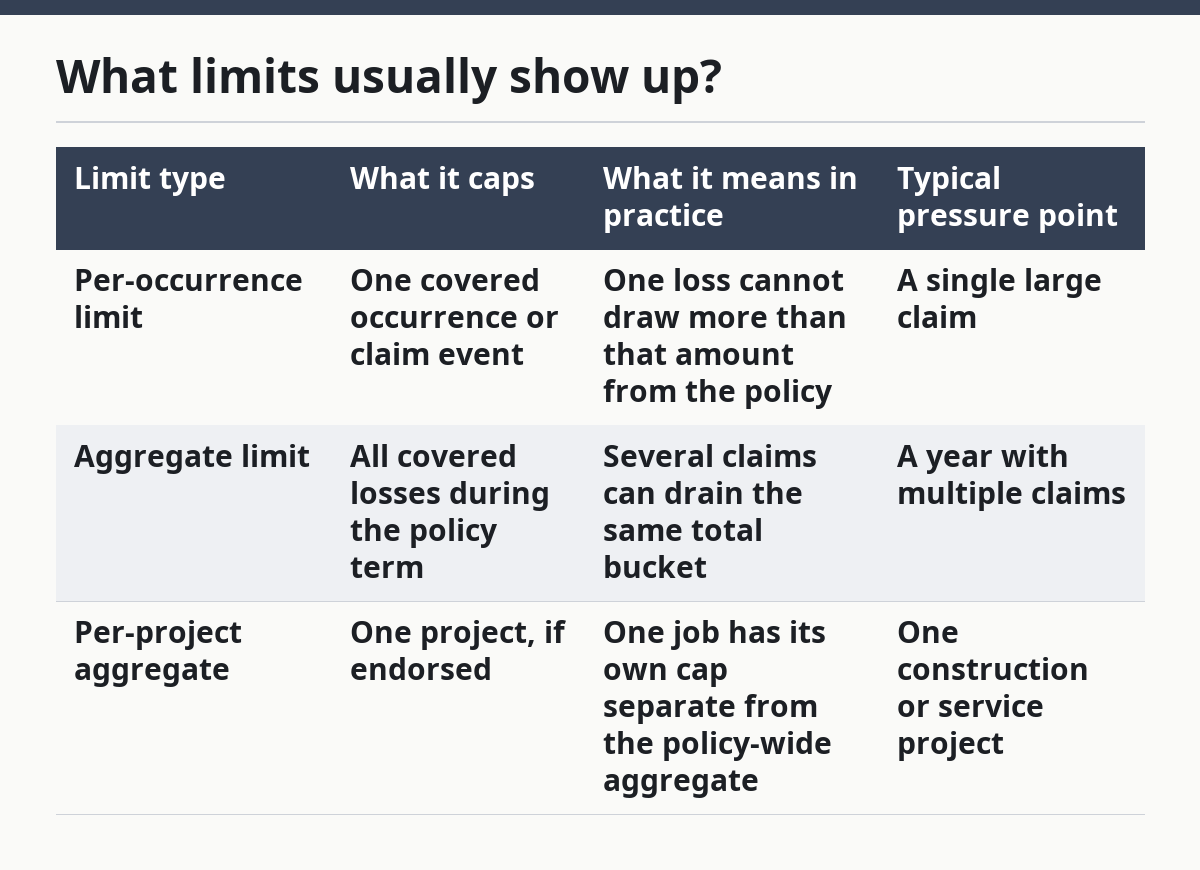
A generic article gets this wrong when it treats “limit” as one number. On a real policy, 2 limits can sit side by side, and sometimes a project-level cap sits on top of them. That structure changes how fast coverage disappears after a claim sequence.
For more on policy terms and limits, see the NAIC glossary and IRMI’s definitions.
How does a deductible differ from an SIR?
A deductible usually means the insurer handles the claim first and then collects the deductible amount from the insured, while an SIR means the insured absorbs the loss first and the insurer may not step in until the retention is satisfied. That difference sounds small on paper, but it changes who manages the claim and when the carrier’s obligation begins.
A deductible is often easier to picture as a shared cost after the claim is handled. An SIR is closer to a front-end layer the insured must fund before the policy layer responds. In many policies, the SIR can affect defense costs too, while a deductible may be treated differently; the policy wording controls, and jurisdiction can matter.
The trade-off is real. A deductible can be simpler for claims handling, but it still creates an out-of-pocket obligation. An SIR can reduce premium in some placements, but it can leave the business responsible for early claim work, cash flow, and administration before the carrier pays anything.
If the wording is unclear, a buyer should consult the policy form and a qualified professional. The IRMI explanation of self-insured retentions and the NAIC glossary are useful starting points.
How do you read the limit structure step by step?
A good read starts with the declarations page, then moves through the insuring agreement, then through exclusions and any endorsements. The goal is to match the 2 limit numbers to the 1 or 2 cost-sharing terms that actually control payment.
- Identify the policy period, usually 12 months. Verify the start and end dates on the declarations page. If the term is shorter or longer, the aggregate can shrink or stretch with that period, and a mismatch means the quote was compared on the wrong basis.
- Find the per-occurrence limit. Check the exact number and whether it applies to each occurrence, each claim, or another trigger. If the wording is unclear or the limit is split across sublimits, the problem is that one loss may not reach the number you thought you bought.
- Find the aggregate limit. Confirm whether it is policy-wide or tied to a specific coverage part. If the policy shows only one aggregate for the whole term, multiple claims can consume it faster than a single-loss buyer expects.
- Look for a deductible. Note the amount and whether it applies per claim, per occurrence, or per suit. If the deductible appears only in one endorsement, the main form may not tell the whole story.
- Look for an SIR. Read when the SIR attaches, who pays defense costs inside it, and whether the insured must advance payments before the carrier responds. If the policy uses an SIR, a business that cannot fund the early layer may have a cash-flow problem even with strong paper limits.
- Check for a per-project aggregate endorsement. Verify whether the project has its own cap and whether that cap replaces or sits beside the policy-wide aggregate. If the project aggregate is smaller than expected, one project can exhaust its own protection while the rest of the policy remains untouched.
- Check for an additional limit endorsement. Confirm whether it adds limit only for a named coverage or only for certain losses. If it does not clearly increase the relevant layer, it may not help the part of the policy that actually runs out.
- Test the structure against one large claim and several small claims. Run both examples through the numbers. If the policy works in the single-claim example but fails in the multiple-claim example, the aggregate is too low for the business’s real risk pattern.
This is the part a generic summary often skips: the policy should be read as a stack, not as a single limit. The stack matters because one endorsement can change the order in which money is spent, and a 1-line reference to “limits” can hide a lot of risk.
When does the usual structure not fit?
The usual structure does not fit when the business’s losses are likely to cluster, when one project has its own exposure, or when cash flow cannot handle a front-end retention. Those situations change which number matters most and can make the standard setup a poor fit.
One claim could wipe out the annual aggregate: that means the policy may look adequate until a single serious loss arrives — the business needs to check the per-occurrence limit, not just the total annual limit.
Several mid-sized claims are more likely than one large claim: that means the aggregate is the pressure point — the policy should be checked for how fast multiple claims can drain the limit.
The policy uses a per-project aggregate: that means one job has its own ceiling — the business should verify whether that ceiling is enough for the largest project, not just the average one.
The policy uses an SIR and the business has thin cash reserves: that means the company may have to fund claims before the insurer pays — the retention size should be treated as an operational cash requirement, not just an insurance term; buyers should consult a qualified professional if the cash flow is tight.
The policy adds an endorsement that changes the limit structure: that means the declarations page alone is not enough — the endorsement must be read line by line to see what it changes and what it leaves alone.
The business expects contract-required limits, not just policy comfort: that means the number on the quote may not satisfy the contract — the policy should be checked against the actual wording in the contract before placement.
The wrong tool here is to assume a higher number automatically fixes the problem. Sometimes the issue is not the size of the limit but its shape: 1 claim cap, 1 annual cap, and 1 retention layer can interact in ways a buyer does not see at first glance.
What mistakes cost the most?
The most expensive mistake is buying a policy for the headline limit and ignoring the aggregate, the deductible, and the SIR. That mistake can leave a business exposed even when the first page looks generous.
The second mistake is assuming a deductible and an SIR work the same way. They do not, and the difference can affect who pays first, who handles the claim, and how quickly the carrier must respond. If the policy language is unclear, the safe assumption is that the wording matters more than the label.
A third mistake is forgetting that project work can change the math. A 1-project endorsement, a specific jobsite, or a contract-driven requirement can make the standard policy-wide aggregate too broad or too narrow for the real exposure.
A fourth mistake is reading only the declarations page. That page gives the numbers, but not always the conditions that attach to those numbers. The endorsement schedule and the form wording can change the payment order in ways the declarations page does not explain.
A fifth mistake is focusing on premium alone. Lower premium can mean a tighter aggregate, a higher retention, or a narrower payment trigger. The cheaper policy is not cheaper if the first claim shows the missing layer.
How should a buyer compare options?
A buyer should compare 3 things at once: the limit size, the retention structure, and the claim pattern the business actually faces. A policy with a 1-layer deductible may fit one business, while another needs an SIR because the loss handling and cash flow are different.
The comparison is less about “best” and more about fit:
| Question | Better fit when… | Worse fit when… |
|---|---|---|
| Higher per-occurrence limit | One claim could be severe | Claims are usually small but frequent |
| Higher aggregate limit | Several claims may occur in one term | Only one isolated claim is expected |
| Deductible | The business can tolerate paying a smaller amount after claim handling | The business wants the insurer to handle more of the front-end process |
| SIR | The business can fund the first layer and manage claim administration | Cash flow is tight or claim handling capacity is limited |
This is also where the hub topic on commercial general liability insurance policy design and terms fits naturally, because limit structure is one piece of a larger placement decision. A buyer who treats the policy as a set of knobs, not a single price tag, usually asks better questions before binding.
What is a typical limit structure?
A typical limit structure uses 2 limits, one per occurrence and one aggregate, with either a deductible or an SIR added as the cost-sharing layer. That is the normal shape of the policy, but the exact numbers and wording vary by jurisdiction, carrier form, and the risk being insured.
The important point is not that the policy always looks the same. It is that the policy usually has a ceiling for one loss, a ceiling for the policy term, and a way to shift part of the loss back to the insured. If one of those pieces is missing from the review, the buyer is not seeing the full structure.
For related reading, see commercial liability coverage terms and policy limits explained.
FAQ
What limit structure is typical for a liability policy?
A typical structure uses a per-occurrence limit and an aggregate limit. The first caps one covered claim, while the second caps all covered claims during the policy period, often 12 months. Some policies also add a deductible or an SIR, which changes how early losses are paid.
How does a deductible differ from an SIR?
A deductible usually applies after the insurer handles the claim, while an SIR usually applies before the insurer responds. In practice, that means the insured may have to fund more of the front end under an SIR. The policy wording controls, and local law can affect how the clause works.
What is a per-occurrence limit?
A per-occurrence limit is the maximum the insurer pays for one covered occurrence or claim event. If one loss is larger than that number, the extra amount is not paid by the policy unless some other coverage part or endorsement applies. The aggregate limit is a separate cap for the whole policy term.
Drafted with AI; not yet reviewed by a person.