Last updated: November 19, 2026
Key Takeaways
- A no-gap switch means neither carrier has an uninsured day.
- Confirm dates, coverage type, and cancellation rules before you switch carriers.
- Treat the policy as the contract, not the quote.
- If the policy is claims-made, a contract controls cancellation, or prior acts change, adjust the plan.
How to switch liability insurance carriers without a coverage gap starts with lining up the new policy’s effective date before the old one ends. Quick answer: the safest switch is to get the replacement policy issued first, then cancel the old policy only after the new carrier has confirmed coverage dates in writing. The steps below show how to avoid overlap, lapse, and retroactive-date problems.
Who this is for, and what you need before you start
This applies if you already have liability insurance and want to move to a different carrier without leaving a day uncovered. It assumes you know your current policy period, your renewal date, and whether your coverage is occurrence-based or claims-made, which means claims-made policies only respond to claims reported during the policy term or extended reporting period.
This is information, not financial advice. Liability terms vary by country, state, line of business, and carrier, so a qualified adviser should review your own situation if the policy is tied to contracts, leases, licensing, or a claims-made retroactive date. For consumer basics and state oversight, see the National Association of Insurance Commissioners: https://content.naic.org/consumer.
Picture this: you’re trying to change carriers before renewal, and the old policy ends on a Friday at 12:01 a.m. while the new one starts on Saturday. That one-hour gap is enough to create trouble if a loss happens in between. You need the dates, forms, and cancellation timing to line up.
- Check the current declaration page.
- Note the effective date and expiration date.
- Confirm whether your policy is claims-made.
- Pull any certificate of insurance requests.
- Gather the new carrier’s quote and bound terms.
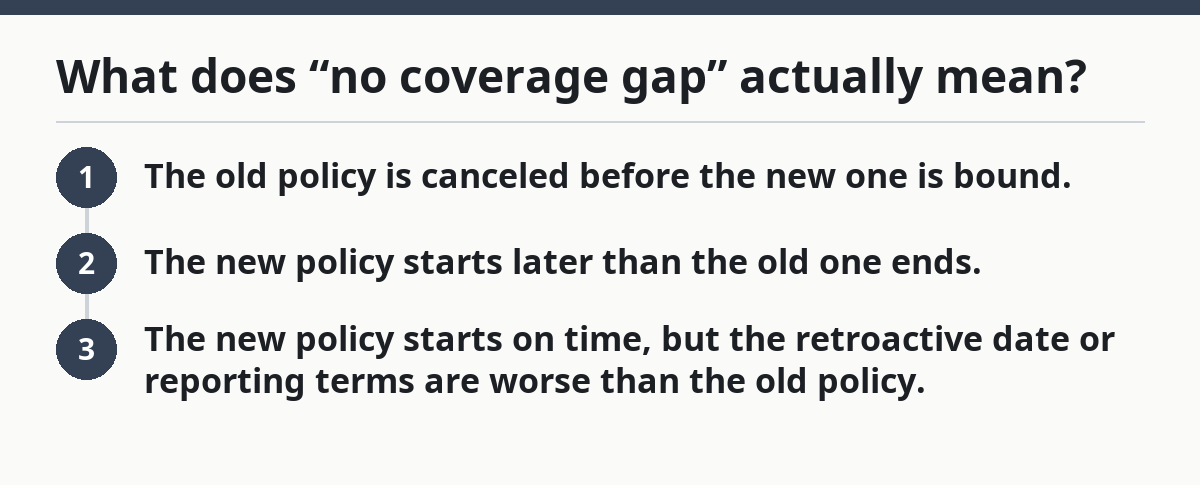
What does “no coverage gap” actually mean?
A no-gap switch means there is no moment when neither carrier owes you coverage. The clean result is simple: the old policy ends exactly when the new policy begins, with no empty day, hour, or minute in between.
The catch is that “coverage” is not one thing. On a claims-made policy, the key issue is not just the new effective date; it is also the prior acts coverage date, sometimes called the retroactive date. If that date moves forward, older claims may fall outside the new policy even if you never had a visible lapse.
A gap can happen in three ways:
- The old policy is canceled before the new one is bound.
- The new policy starts later than the old one ends.
- The new policy starts on time, but the retroactive date or reporting terms are worse than the old policy.
One source worth checking is the National Association of Insurance Commissioners, which explains consumer insurance basics and state oversight: https://content.naic.org/consumer. For claims-made questions, the policy form and declarations page matter more than a sales summary.
- No gap means continuous dates.
- Claims-made adds a second date to watch.
- A quote is not proof of coverage.
- A certificate is not the policy.
- “Bound” means the carrier has accepted the risk and the policy is in force.
How do I change liability insurers safely?
You change liability insurers safely by binding the new policy first, then canceling the old one only after the new carrier confirms the start date, limits, and any prior acts terms in writing. That order keeps the old policy alive until the new one is real.
Step-by-step: the carrier transition
- Check the current policy end date. Find the expiration time on the declarations page, not in an email summary. Verify the exact day and time; many commercial policies end at 12:01 a.m. local time. If the policy is being renewed automatically, a mistake here can create an overlap or an unexpected lapse.
- Ask for the new effective date in writing. Request a start date that matches the old policy’s end date, or begins one second after the old term ends if the carrier documents times that way. Verify the quote, binder, and declarations all match. If any document shows a different date, stop.
- Confirm whether the policy is occurrence or claims-made. If it is claims-made, verify the retroactive date and any extended reporting provisions. A new policy with a later retroactive date can leave earlier work uninsured, even with perfect date overlap. That is a red flag.
- Compare limits, exclusions, and endorsements line by line. Check the liability limit, deductible or self-insured retention if there is one, and any new exclusion for professional services, subcontractors, products, or completed operations. If a limit dropped, or an endorsement adds a new carve-out, the switch may not be an even swap.
- Get the replacement policy issued before canceling the old one. Do not rely on a quote or verbal promise. Ask for the policy number, binder, or written confirmation of in-force coverage. If the new carrier cannot confirm the start date and terms, the replacement policy is not ready.
- Cancel the old policy only after the new one is confirmed. Send a cancellation request that states the exact end date and time you want. Keep proof of delivery. If the old carrier requires advance notice, note that the request may not stop billing immediately, even if coverage ends on the requested date.
- Check for overlap and refund timing. An overlap of a few days may be acceptable if it prevents a gap, but consult a professional because it can also mean double premium for that period. Verify whether the old carrier issues a pro-rated return premium or charges a short-rate cancellation penalty. If the refund math is unclear, ask for it in writing.
- Keep the final documents together. Keep the declarations pages, binder, cancellation notice, and any endorsement that changes the retroactive date or cancellation terms. If a claim or audit comes later, those papers prove what was in force on a given day.
If the carrier transition touches a lease, lender requirement, or contract, review the wording before you send cancellation. A required 30-day notice can matter. So can a contract that demands an additional insured endorsement on the new policy.
- The new policy must be bound.
- The start date must match the old end date.
- Claims-made policies need the retroactive date checked.
- Cancellation should be documented.
- Overlap is often less damaging than a lapse.
What should you confirm before switching carriers?
You should confirm the dates, the form of coverage, and the cancellation rules before you switch carriers. Those three checks catch most mistakes before they become uninsured time.
Picture this: you have a clean quote, but you never compare the declarations pages. The premium looks better, so you move fast. Then a claim lands on work done before the new retroactive date, and the cheaper policy does not answer the loss you expected it to cover.
Here’s the short list to verify:
- Effective date and expiration date: both policies should line up with no empty time.
- Claims-made retroactive date: it should stay the same or earlier if you need prior acts protection.
- Cancellation terms: see whether the old carrier needs written notice, advance notice, or a signed form.
- Coverage scope: compare exclusions, endorsements, defense-cost treatment, and any split between each-claim and aggregate limits, and consult a professional if the forms differ.
- Named insured and entity name: a typo can matter if the policy names the wrong legal entity.
- Certificates and contract wording: if a client or landlord needs proof, make sure the new policy can satisfy it.
The best part is that this is usually a paperwork problem, not a guessing problem. The declarations page and endorsements tell the story. If one line contradicts a sales email, the policy language wins.
For more on how coverage choices fit into buying decisions, the hub on policy decisions and buying guidance is the right next stop.
The mistakes people make when they change carriers
People usually fail at the switch because they treat the quote like the policy. The quote is only a promise to consider coverage; the policy and endorsements are the real contract. Consult a professional if the switch involves claims-made coverage or contract deadlines.
Common errors and what they cost
-
Canceling the old policy too early.
This can leave a gap if the new carrier delays issuance or changes the effective date. The fix is simple: do not cancel until the replacement policy is confirmed in writing. -
Ignoring the retroactive date on a claims-made policy.
This can strip away coverage for older work even when the policy is active today. The fix is to keep the prior acts date the same unless you understand exactly what changes. -
Trusting a certificate of insurance.
A certificate usually proves coverage exists; it does not rewrite exclusions or dates. The fix is to read the declarations page and endorsements. -
Missing a cancellation notice deadline.
Some policies and contracts require advance notice, so you may pay longer than planned or stay bound through a notice period. The fix is to check the policy form before you send the request. -
Letting the legal entity name drift.
If the old policy names “ABC Holdings LLC” and the new one names “ABC Holding LLC,” the mismatch can cause claim friction. The fix is to match the insured name exactly. -
Assuming overlap is always bad.
A few days of overlap can be cheaper than one uncovered loss. The fix is to compare the cost of overlap with the risk of a gap, then document both policies clearly.
A trade-off matters here: overlap can cost money, but a gap can cost much more if a claim falls in the empty time. That is why clean dates matter more than a perfect premium.
When the standard switch plan does not apply
The standard plan needs adjustment if the policy is claims-made, if a contract controls the cancellation date, or if the new carrier changes your prior acts protection. Those are the situations where a simple date swap is not enough.
Claims-made coverage with a new retroactive date: This can leave earlier work outside the new policy — Keep the old policy in force until you confirm the new retroactive date, and consider how prior acts are protected before canceling.
Active claims or known incidents: A known loss can trigger reporting rules under the old policy — Report the matter under the policy that may respond before you cancel anything.
Contractual notice periods: A lease, lender, or client contract may require 10, 30, or another notice period — Send the cancellation only after you confirm the contract deadline.
Policy issued with different named insureds: A different entity name can break continuity — Match the legal name and ownership structure before binding the new policy.
New exclusions or reduced limits: The replacement policy may look cheaper because it covers less — Compare endorsements, not just the premium, and stop if the new form drops needed protection.
The truth is, some switches are not just a carrier change. They are a coverage change. That means the right question is not “Can I move?” but “What exactly changes when I move?”
How long does a clean switch take?
A clean switch can take the length of a renewal cycle, but the actual handoff is often a same-day paperwork event once the new policy is ready. The slow part is collecting quotes, reviewing forms, and getting the binder and cancellation notice right.
Picture this: you have 48 hours before renewal, and the old policy is set to roll over automatically. That is still enough time to prevent a gap if the new carrier can issue the policy quickly and the old carrier accepts a timely cancellation request. If not, the safer path is to let the old policy continue until the new one is live.
A good result looks like this:
- The new declarations page shows the intended start date.
- The old policy shows a clean cancellation date.
- The insured name matches on both policies.
- The retroactive date is unchanged, if claims-made coverage applies.
- You have written proof of both actions.
If any of those items is missing, the switch is incomplete. Do not assume a phone call fixed it.
What if the policies overlap?
Overlap is usually acceptable for a short period if it prevents a lapse, but it should be intentional and documented. The overlap should be long enough to bridge uncertainty, not long enough to hide a mistake.
This happens most often when the new carrier wants to bind before the old carrier processes cancellation. The old policy may keep running for a few days or weeks depending on notice rules. That can produce double premium for the overlap period, but it also gives you a margin if the new policy is delayed.
Use overlap only with clear notes:
- State the exact start date of the new policy.
- State the exact cancellation date of the old one.
- Keep proof that both carriers accepted the dates.
- Recheck endorsements after any change in limits or retroactive terms.
If the overlap exists because nobody checked the dates, that is not a strategy. It is a billing surprise.
How do I change liability insurers safely?
You change liability insurers safely by lining up the new effective date, checking the policy form, and canceling the old policy only after the replacement policy is confirmed. The safest switch is one where the declarations pages, retroactive date, and cancellation notice all agree.
The main risk is not the premium; it is a date mismatch or a claims-made gap. If the policy is tied to prior work, a qualified adviser should review the switch before you send cancellation.
When should I cancel my old policy?
You should cancel your old policy only after the new carrier confirms the replacement policy is in force and the dates match. If the old policy is claims-made, make sure the retroactive date and any reporting terms are still acceptable before you end the old coverage.
If there is any uncertainty, overlap is usually less risky than a lapse. Keep written proof of the cancellation request and the policy dates.
What should I confirm before switching carriers?
You should confirm the effective date, the expiration date, the retroactive date if the policy is claims-made, and any changes in exclusions or limits. Also confirm the named insured, cancellation notice rules, and whether the new carrier has actually bound the policy.
If any one of those items is unclear, stop and get the document that answers it. A sales quote alone is not enough.
Drafted with AI; not yet reviewed by a person.