Last updated: November 20, 2026
A contractor usually needs the same core liability policy across a project, but the limits, endorsements, and proof of coverage can change at bid stage, during active work, and after the job is done. This is information, not financial advice; a qualified adviser should review the contractor’s own facts, contracts, and country-specific rules before any decision is made.
Key takeaways
- Bid-stage paperwork can matter as much as the policy itself, because a 1-page certificate or a contract clause can change what has to be shown before work starts.
- During active work, the main question is whether the policy matches the job’s day-to-day exposures, including site damage, third-party injury, and any subcontractor work.
- After handover, the risk does not end at the final invoice; completed operations can still matter if a problem shows up months later.
- Per-project aggregate limits can help separate one job from another, but the wording matters more than the label.
- If a contract asks for additional insured status, the contractor should check the exact wording, not just the certificate.
What liability insurance does a contractor need at each stage?
A contractor needs proof of coverage at bid stage, active liability protection during the job, and completed operations protection after the work is finished. The details shift by stage, but the goal stays the same: show that the policy matches the project’s risk from first quote to final closeout.
| Project stage | What usually matters | What to verify | Common weak point |
|---|---|---|---|
| Bid stage | Certificate of insurance, required limits, additional insured wording, and any per-project aggregate request | The certificate matches the named contractor and dates the contract expects | A certificate that looks fine but does not satisfy the contract |
| Active work | Ongoing operations coverage, site damage, injury claims, and subcontractor risk | The policy is in force for the full work period and covers the type of site activity involved | Assuming a subcontractor’s policy fixes the general contractor’s gap |
| Closeout and after | Completed operations and any claim that appears after handover | The policy still responds to post-completion claims for the work performed | Letting the policy lapse too soon or misunderstanding post-job exposure |
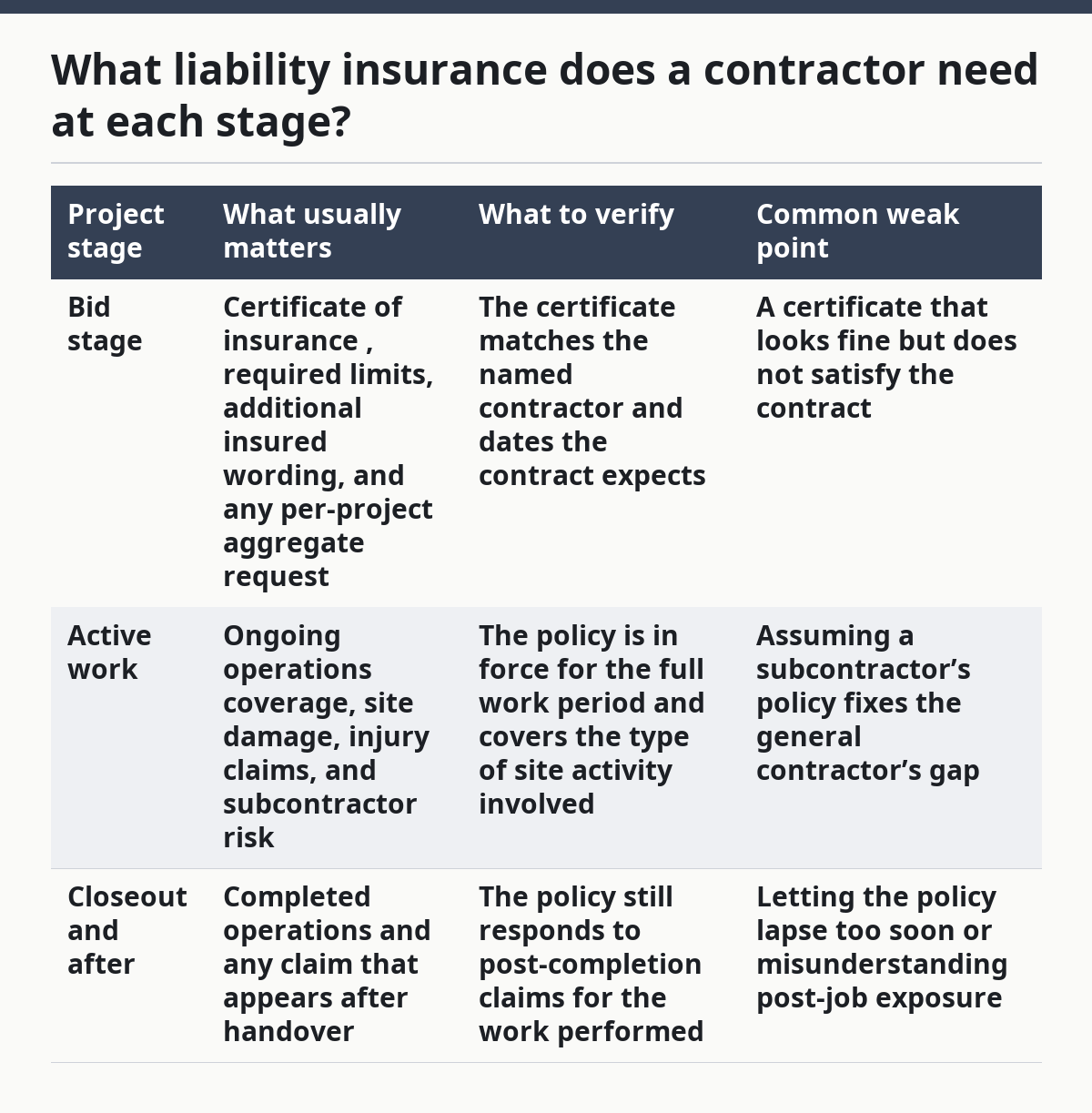
The biggest mistake is treating insurance as a single snapshot. A project can last 6 weeks or 18 months, but the exposure changes several times inside that window.
What should be checked before the bid goes out?
Before a bid goes out, the contractor should match the insurance request line by line with the project documents. The bid package often asks for a certificate of insurance, named insured wording, additional insured status, and sometimes a per-project aggregate arrangement.
The first check is the contract itself, because that is where the insurance promise usually lives. If the bid requires additional insured status, the contractor should confirm whether the request applies only during the work or also after completion. If the contract asks for a 30-day notice period or a specific form, a standard certificate may not be enough on its own.
The second check is the project size and type. A small interior remodel, a roof replacement, and a long general contractor buildout do not create the same liability pattern. A contractor who works through a general contractor may also face pass-through requirements, which means the subcontractor’s own policy may need to line up with the upstream contract.
The third check is whether the policy has a per-project aggregate. That term means the total available limit for one project may be tracked separately from the contractor’s other jobs. It is not a magic shield, and it can be structured in different ways, so the wording on the policy form matters.
A bid-stage problem usually shows up as a document mismatch, not a claim. If the certificate says one thing and the contract asks for another, the job can stall before a shovel hits the ground.
How do the requirements change during the job?
The requirements change because the loss patterns change as soon as workers are on site. Active operations bring third-party injury, property damage, equipment movement, and subcontractor issues into play.
- Match the policy period to the job dates. Check that the policy is in force for the full build period, from mobilization to final punch list. If the dates do not line up, the gap can leave a portion of the work exposed.
- Verify the right business name and entity. The named insured on the policy should match the contractor entity signing the contract. If the policy names a different entity, claim handling can become a problem fast.
- Confirm the operations fit the work. A contractor doing general building work should confirm the policy responds to that kind of on-site activity. If the job includes work outside the normal scope, that mismatch needs attention before the first day on site.
- Check additional insured requirements. If the owner or general contractor wants additional insured status, verify the exact endorsement language. A certificate alone usually does not prove the endorsement is in place.
- Track subcontractor risk. If a subcontractor causes damage or injury, the claim may still come back through the general contractor’s contract chain. The contractor should verify each subcontractor has its own coverage and does not create a gap in the project’s risk transfer.
- Watch the limits, not just the policy title. The same policy type can have very different limit structures. A project with one large exposure may need a different setup than a job with many smaller claims.
- Keep claim paperwork together. If an incident happens, photos, work logs, contracts, and certificates should be kept with the job file. Missing records can turn a manageable claim into a paperwork fight.
The issue during active work is rarely “does the contractor have insurance?” The real question is whether the policy responds to the exact work being performed on that site.
When does completed operations matter?
Completed operations matters when a problem shows up after the contractor has left the site and handed the work over. That can happen after a short 2-week job or after a longer commercial build, because the timing of the claim is separate from the timing of the work.
Completed operations is the part of liability protection that can respond to claims tied to finished work. A reader does not need the technical definition here to see the point: the exposure does not end on the final day of labor. If a defect, failure, or damage appears later, the policy structure at that point becomes important.
This is where a generic article often gets sloppy. It treats “project finished” as “risk finished,” which is wrong for contractor liability setup. The handover date, final payment, and warranty period are not always the same thing, and the contract may still point back to the contractor long after the crew has gone home.
Completed operations is also where the per-project aggregate can matter again. A contractor who has several jobs open across the year needs to know whether one project’s claims can eat into another project’s limit structure. That is a wording issue, not a slogan.
If the contractor’s work is only a tiny part of a larger build, post-completion claims can still trace back to that piece of work. That is why the closeout file matters just as much as the start-up file.
What mistakes cost contractors the most?
The most expensive mistakes are the ones that look harmless on paper: a wrong certificate, a missed endorsement, or a subcontractor with thin coverage. Those errors can delay a project, trigger a coverage dispute, or leave one job exposed while the contractor thinks the policy is “in place.”
| Mistake | What it can cost | Better alternative |
|---|---|---|
| Relying on a certificate alone | The contract may still be unsatisfied, even if the certificate looks correct | Check the actual endorsement and contract wording |
| Treating all project stages the same | The contractor may miss bid-stage wording or post-completion exposure | Separate the project into bid, active work, and closeout |
| Ignoring subcontractor risk | A subcontractor’s mistake can still pull the contractor into the claim chain | Require proof of coverage and keep it on file |
| Assuming completed operations is automatic | A finished project can still generate a claim later | Confirm how the policy handles finished work |
| Overlooking per-project aggregate wording | One job may affect another if the structure is not what the contractor expected | Review the policy form, not just the summary |
A contractor who reads only the declarations page can miss the real trap. The declarations page is useful, but it does not always tell the full story about additional insureds, project aggregates, or how finished work is treated.
When should a contractor stop and get help?
A contractor should stop and get qualified help when the contract, the policy, and the jobsite do not line up cleanly. That is not a sign of failure; it is a sign that the project has moved beyond a simple setup.
The contract asks for additional insured wording that is not on the certificate: This means the paperwork may not satisfy the owner or general contractor — get the exact endorsement checked before work starts.
The job involves a general contractor with multiple subcontractors: This means one claim can move through several layers of contracts — get the risk transfer reviewed line by line.
The project has a per-project aggregate requirement: This means the limit structure needs careful reading — get help if the policy wording is not clear about how one job is isolated from another.
The work is finished, but claims could still appear later: This means completed operations still matters — get the closeout documents checked before the policy period changes.
The contractor is working in more than one country or under different local rules: This means rates, limits, and policy wording may not translate well — get local advice before relying on a familiar setup.
A generic “just add insurance” approach breaks down fast in these situations. The right move is to slow down for the contract review, not to guess.
What should a contractor check before moving to the next stage?
A contractor should check 5 things before each handoff: dates, names, endorsements, subcontractor proof, and post-job exposure. That short list catches most stage-to-stage problems before they turn into claim disputes.
The practical rhythm is simple. Before bidding, confirm the contract asks for what the policy can actually show. Before mobilizing, confirm the policy is active for the job period. Before closeout, confirm the finished-work exposure is still understood.
The point is not to build a perfect insurance file for its own sake. The point is to keep one project from creating a gap in another, which is where contractor liability setup often goes wrong.
FAQ
Do contractors need different coverage at different project stages?
Yes, because the project’s exposure changes from bidding to active work to closeout. The core policy may stay the same, but the proof, endorsements, and limit structure can change at each stage. A contractor should treat the bid package, the work period, and the post-completion period as three separate checks.
When does completed operations matter?
Completed operations matters after the contractor has finished the work but a claim still arises from that work. That can happen well after handover, so the closeout date does not always end the risk. The policy wording and timing both matter, especially when the contract points back to finished work.
How do subcontractors affect liability needs?
Subcontractors can expand the contractor’s liability exposure, even when they carry their own insurance. A general contractor may still be drawn into a claim if the subcontractor’s work causes damage or injury. That is why additional insured wording, certificates, and subcontractor records all need to be checked for each project stage.
Drafted with AI; not yet reviewed by a person.