Last updated: November 19, 2026
Key Takeaways
- Notice counts when it clearly identifies the insured, the event, and the policy link well enough for the insurer to act.
- Notice can come from the insured, a broker, a lawyer, or another authorized person, depending on the policy and jurisdiction.
- Notice is usually safest in writing, with enough detail to tie the event to the policy, and sent to the address or portal the policy names.
- Notice is often best in writing, but the answer depends on the policy and the jurisdiction.
If you need to know whether your notice of claim actually reached the insurer, the short answer is this: for What Counts as Notice to an Insurer Under a Liability Policy, notice counts when the insurer gets information that fairly tells it a covered event may trigger the liability policy. This page explains what that means, who can give notice, and what usually belongs in the notice.
Notice of claim: what it is, and what this page covers
A notice of claim is the communication that tells the insurer, or someone acting for the insurer, that a loss, accident, demand, or other event may lead to liability under the policy. This article is general information, not legal advice; rules vary by jurisdiction, and a qualified lawyer should be consulted on a live matter.
Picture this: you have a liability policy, a complaint, and a broker in the middle. The real question is not whether the paper says “notice” in so many words, but whether the insurer got enough facts to understand that a claim may follow. That is the line this article draws.
- It focuses on notice to an insurer under a liability policy.
- It covers incident notice, tender of claim, and who can give notice.
- It does not cover claims-made reporting mechanics or the full claims process.
For the broader sequence after notice, the hub page on commercial liability insurance claims and incident management is the right next stop.
What counts as notice to an insurer under a liability policy?
Notice counts when it is a communication that identifies the insured, the event, and the policy connection well enough that the insurer can act on it. In many policies, that can be a letter, email, portal entry, or formal claim form; the label matters less than the content.
The safest practical test is this: notice is usually enough when it says, in substance, “this happened, this insured may be responsible, and this policy may respond.” The exact wording is less important than whether the insurer can see the basics. A vague heads-up with no facts may not do the job.
What the insurer needs to learn from the notice
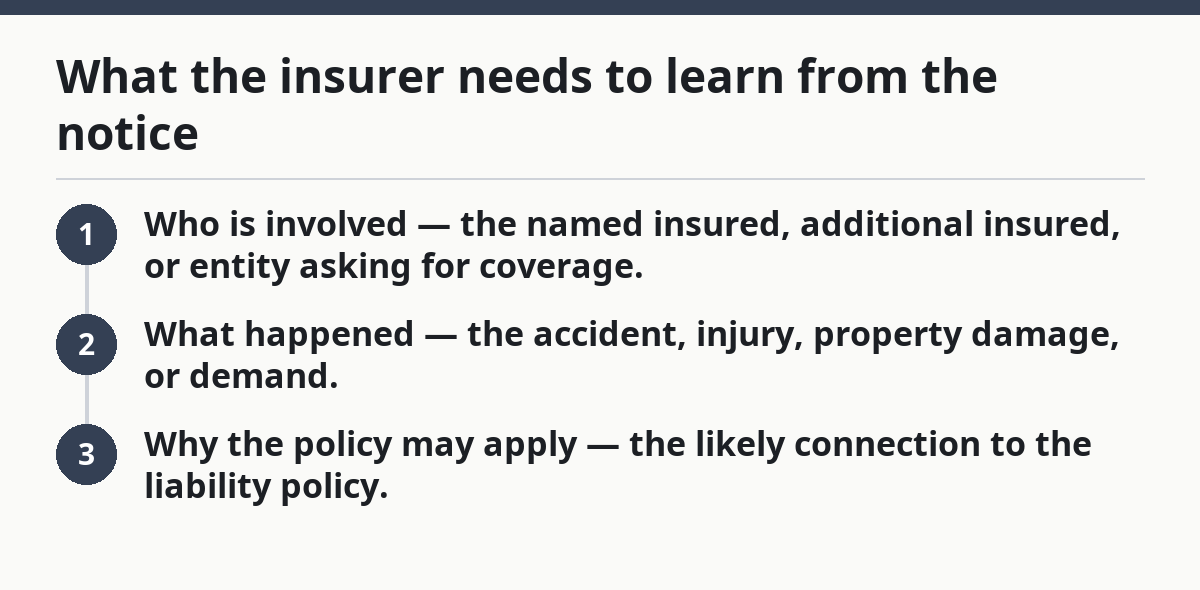
The notice usually needs three things at minimum:
- Who is involved — the named insured, additional insured, or entity asking for coverage.
- What happened — the accident, injury, property damage, or demand.
- Why the policy may apply — the likely connection to the liability policy.
A notice that leaves out one of those pieces may still start a file, but it may not be good notice. That is where disputes begin.
Here’s the catch: an insurer does not need a full lawsuit packet to receive notice. But it also does not need to guess. If the facts are so thin that the insurer cannot tell whether a claim exists, the notice may be challenged later.
Common forms notice can take
In practice, notice often arrives as one of these:
- A written email to the insurer or claims address
- A broker’s transmittal of the insured’s report
- A letter from defense counsel
- A portal submission on the insurer’s claims system
- A formal tender of claim with attachments
The form is not the whole story. A fax, for example, can still be notice if the right insurer gets it and the message is clear. A polished form with no policy or event details can still fail. For a general overview of how insurers handle claims intake, see the Insurance Information Institute’s claims resources at https://www.iii.org/article/insurance-claims and the NAIC consumer guidance at https://content.naic.org/consumer/insurance-basics.
Who can give notice?
Notice can be given by the insured, a broker, a lawyer, or another person authorized to speak for the insured, depending on the policy and the jurisdiction. The safe assumption is that the insurer should receive the notice from someone with a real connection to the claim, not a random third party.
Picture this: you hand the incident report to your broker and assume the job is done. Sometimes that is enough. Sometimes it is not, because the policy may require notice to the insurer itself, and a broker may be only an intermediary.
The people who usually send notice
- The insured: the named business, owner, or policyholder can usually give notice directly.
- A broker: often forwards the notice, but may not always be the place the policy requires notice to go.
- A lawyer: can give notice on behalf of the insured if the communication makes that clear.
- An agent or risk manager: may send notice if authorized and if the policy language allows it.
The important question is not only who sent it, but who received it and whether the policy says that recipient counts. Some policies require notice to a specific claims department. Others are less rigid.
When a broker’s notice may be enough
A broker’s notice may count if the broker is acting for the insured and the insurer actually receives the information in a way the policy accepts. But a broker is not automatically the insurer’s mailbox.
That distinction matters. If the insured gives the broker a short email and assumes the broker handled it, the record should show the insurer got the message too. If the broker never forwarded it, the insured may face an avoidable argument. The National Association of Insurance Commissioners’ consumer materials on claims reporting can help frame the issue, but counsel should still review the policy and the local law.
How to give notice step by step
Notice is usually best given in writing, with enough detail to tie the event to the policy, and sent to the address or portal the policy names. A clean notice takes 7 steps and leaves a record behind.
- Check the policy notice clause. Look for the section on notice, claim reporting, or tender. Verify the required recipient, method, and any stated address or portal. If the policy names a specific claims office and you send it elsewhere, that is a problem.
- Identify the insured exactly. Use the named insured and any additional insured status exactly as shown on the declarations page. Verify the entity name matches the policy. A trade name alone can create confusion.
- State what happened in plain facts. Give the date, location, type of loss, and the people or property involved. Verify that the account is specific enough to show a potential liability event. A bare “something happened” notice is weak.
- Explain why coverage may be implicated. Say why the insured believes the policy may respond, such as bodily injury, property damage, or an allegation of negligent conduct. Verify that the statement connects the event to the policy, not just to a business problem.
- Attach the first supporting documents. Include the demand letter, incident report, summons, photos, contract, or correspondence that shows the event. Verify the attachments are readable and complete. Missing pages can make the insurer ask for a resend.
- Send it to every required place. If the policy requires notice to the insurer and a broker is involved, send to both unless the policy clearly says otherwise. Verify delivery by email receipt, portal confirmation, or certified mail record. No proof of receipt is a problem.
- Keep the proof and log the date. Save the email, PDF, upload confirmation, and any response. Verify the timestamp, recipient, and file names. If the notice is later disputed, that record is often the first thing asked for.
A good notice is not fancy. It is complete enough that a claims person can open the file and see why the policy might be in play. A bad one forces the insurer to hunt for the basics.
Does notice have to be in writing?
Notice often should be in writing, but the answer depends on the policy and the jurisdiction. Many liability policies are built around written notice because it creates a record, yet some disputes turn on whether an oral message, voicemail, or phone call was enough.
A phone call can start the conversation, but it is a weak place to stop. If the policy says “written notice” or “notice in writing,” that usually means an email, letter, or portal submission is safer than a verbal report alone. A follow-up email with the date and substance of the call often matters.
What written notice should include
Written notice should usually include:
- The policyholder’s name
- The policy number, if known
- The date and place of the event
- A short factual description
- The name of any claimant, injured person, or opposing party
- Any demand letter, suit papers, or other first notice
That is not a magic formula. It is a practical minimum. If the notice omits the event date or policyholder name, the insurer may argue it never received usable notice.
Why the paper trail matters
A paper trail is usually the strongest proof that notice was sent and received. Email headers, portal receipts, and certified mail slips can settle arguments that would otherwise turn into months of back-and-forth.
On the flip side, a verbal report can be hard to prove later. If the only evidence is “I called somebody,” the insurer may dispute whether the notice arrived in usable form.
When standard notice is not enough
Standard notice is not enough when the policy, the facts, or the timing make the insurer need something more specific. These are the situations that usually change the analysis, and they matter because the wrong form of notice can leave a coverage argument hanging.
The policy names a specific notice address or portal: notice to the wrong office may not count — send it exactly where the policy says and keep proof of receipt.
The insured is not the named policyholder: coverage status may be unclear — identify whether the sender is an additional insured, additional named insured, or another protected party.
The communication only hints at trouble: a vague warning may not alert the insurer to a claim — send a fact-based description with the event date and a short explanation of why liability may arise.
The notice is coming through a broker: the broker may not be the final recipient the policy requires — confirm the insurer itself received the notice or that the policy treats broker notice as enough, and consider asking coverage counsel or another qualified professional to review the wording.
The matter has already escalated into a demand or suit: the notice may need to include the actual claim papers — send the tender promptly and attach the first demand or lawsuit documents.
A notice problem is often a proof problem, not a drama problem. The facts may exist, but if the insurer never received them in the right way, the argument gets harder.
The mistakes people make with notice
Most notice disputes come from delay, vagueness, or a bad mailing chain. The policyholder thought the message went out; the insurer says it never got what it needed.
- Waiting for more facts — this can delay notice until the insurer argues it was late. The better move is to send the known facts now and supplement later.
- Using only a phone call — that leaves no clean record. Follow the call with writing the same day.
- Sending to the broker and stopping there — the broker may not be the required recipient. Confirm that the insurer got the notice too.
- Leaving out the policy number or insured name — this can slow the file opening or cause misrouting. Use the exact policyholder name from the declarations page.
- Mixing notice with argument — a long dispute letter can bury the basic facts. Keep the notice short, factual, and easy to log.
- Assuming one notice covers every policy — a general liability policy, excess layer, or additional policy may each need separate notice. Check each contract.
The fix is boring, but it works: send the facts, send them in writing, and save the proof. That routine usually beats a clever paragraph almost every time.
What counts as incident notice, and how is it different from tender of claim?
Incident notice is a report of an event that may become a claim, while tender of claim is the formal request that the insurer take up a made claim or lawsuit under the policy. They are related, but they are not the same thing.
Picture this: a customer slips in your lobby on Monday, and a demand letter arrives three weeks later. The first message may be incident notice; the second may be tender of claim. The difference matters because a policy may treat early reporting and formal tender as separate acts, so it is worth checking the policy or asking a professional.
Why the distinction matters
An incident notice says, “this may turn into a claim.” A tender says, “this claim has arrived, and I want coverage for it.” Some insurers treat both as part of the same file, but the policy language can separate them.
That is why a notice that works for one purpose may not be enough for the other. If the matter is already a demand or lawsuit, the insurer usually needs the actual claim papers, not just a summary.
Where a beginner can go wrong
The common mistake is assuming that telling the insurer about an accident automatically tenders the later claim. That is not safe to assume. If a formal demand or suit arrives later, it usually needs a fresh notice or tender that refers to the earlier report.
This page is not the place to sort out claims-made mechanics in full. But the basic lesson is simple: the label on the event matters less than the stage the matter has reached.
How do I know I’ve given enough notice?
You have probably given enough notice when the insurer can identify the insured, the event, and the possible policy connection from the materials you sent. If a claims handler could open the email and start a file without guessing, that is a good sign.
The problem is that “enough” is not a single universal rule. It depends on the policy wording and local law, which is why this remains general information and not legal advice.
A practical checklist for adequacy
A usable notice usually has these features:
- It names the policyholder or protected insured
- It gives the date and place of the event
- It describes the loss, injury, or allegation in plain terms
- It shows why the liability policy may apply
- It identifies the claimant or opposing party if known
- It was sent to the right recipient
- It left proof of delivery
If several of those pieces are missing, the notice may still be enough in some jurisdictions, but it is harder to defend. The safest course is to make the notice clear enough that no one has to infer the basics.
When to get the record cleaned up
If the notice was sent informally, through the wrong channel, or without a receipt, send a correcting message right away. State that it confirms or supplements the earlier notice and repeat the key facts.
Drafted with AI; not yet reviewed by a person.