Last updated: November 19, 2026
A notice of circumstances should be sent to the insurer in writing, with enough detail to show what happened, who may claim, and why a potential claim could follow. The main job is to preserve the chance of later reporting protection under a claims-made policy, not to argue the claim itself. This is general information, not legal advice, and a qualified lawyer should be consulted for any live matter.
Key takeaways
- A notice of circumstances is a pre-claim notice. It is not the same thing as an incident report, and it is not a lawsuit response.
- The notice should be factual, short, and specific: date, place, people involved, what happened, and why a claim might come later.
- Timing matters because the insurer may only treat the notice as effective if it is sent according to the policy wording.
- Keep copies of everything you send, including the email, attachments, and proof of delivery.
- If the facts are unclear, the policy wording controls the notice content and timing, not guesswork.
What is a notice of circumstances?
A notice of circumstances is a written warning to the insurer that an event may turn into a claim later. It is used when there is no formal claim yet, but the facts already suggest one may follow.
This matters most on a claims-made policy, where reporting rules can affect later coverage. The notice usually sits between an incident report and a claim notice: it is more formal than an internal incident report, but it is not the same as a demand letter or lawsuit response. The wording in the policy controls what counts, so a 2-line email that leaves out key facts can be too thin.
A useful way to think about it is this: the insurer is being told, “Here are the facts that may lead to a claim.” That is different from saying, “A claim has already been made.” It is also different from asking the insurer to accept liability or start settlement talks.
For a broader view of the claims process, the hub page on commercial liability insurance claims and incident management gives the bigger picture, while this page stays on the notice stage only.
Who should send it?
The person who should send it is the insured, or someone authorized to act for the insured, when the policy requires notice of a possible claim. In practice, that often means the business owner, risk manager, broker, or in-house legal team.
This is not for a reader trying to decide the strength of a claim on the merits. It is for someone who already has a reportable event and needs to avoid a reporting mistake. If the policy says notice must come from a named insured, a 3rd party contractor or site manager may not be enough on their own.
One common trap is assuming the internal incident report will do the job. It may help document the event, but it is usually not the same thing as formal notice to the insurer. Another trap is waiting for a demand letter before acting. By then, the reporting window may already be harder to manage.
When the policy is unclear, the safer reading is the one that matches the actual wording in the contract. Policy language, not office habit, controls the process.
How do you handle it step by step?
Handle it by matching the policy wording, writing a short factual notice, and sending it to the insurer in the form the policy requires. The process below is a general model, not legal advice, and it should be checked against the policy and local law.
- Read the policy wording and locate the notice clause before writing anything. Verify the exact words used for “circumstances,” “claim,” and “notice,” and look for any delivery rule such as email, portal, or written mail. If the policy is silent on format, that is a problem because the insurer may later dispute whether the notice was proper.
- Gather the incident report and pull out the basic facts: date, place, parties, and what happened. Verify that the report is consistent with witness notes and internal records. If there are 2 different versions of the event, stop and reconcile them before sending a notice that may later need correction.
- Draft the notice letter in plain language and keep it factual. Include who was involved, what conduct or condition caused concern, and why a claim may arise. If the draft contains blame, legal argument, or guesses about damages, that is a sign it has gone too far.
- Attach the supporting documents that the policy or insurer may need: incident report, photos, emails, site notes, and any written complaint. Verify that each file is readable and labeled. A notice with no attachments can be too thin if the event is complex or disputed.
- Send the notice to the insurer using the channel named in the policy, then keep proof of delivery. That may mean email sent logs, portal confirmation, or postal receipt. If there is no proof, the problem is not the notice alone but whether the insurer can be shown that it received it.
- Record the submission date in the claim file and note exactly what was sent. Verify the date against any policy timing rule and any internal incident log. If the file has no submission record, later staff may not know whether the notice was sent before a claim developed.
- Track follow-up questions from the insurer and answer them with the same facts, not a new story. If the insurer asks for clarification, provide it in writing and keep the 2 versions together. A shifting account is a red flag because it can make the original notice look unreliable.
- Escalate the file to a qualified lawyer if the facts suggest a serious exposure, a disputed coverage issue, or possible litigation. Verify whether the policy has a special notice rule or preservation requirement before the file moves any further. If the matter is already moving toward a demand or suit, the notice stage may no longer be the right tool.
What facts belong in the notice?
The notice should include the facts that let the insurer identify the event and understand why a claim may follow. That usually means the date, place, people, what happened, and the reason the event could lead to a potential claim.
A good notice is specific without being dramatic. It should state the incident report number if there is one, the names of known witnesses, and a short account of the sequence of events. If there are 3 possible causes, list them as possibilities only if the policy asks for that level of detail; otherwise, keep the notice to known facts.
Do not turn the notice into a legal memo. Long legal argument can bury the useful facts, and the insurer may not need theory at this stage. Do not omit obvious details either, because a missing date or missing person can make the notice harder to match to the later claim file.
A basic comparison helps here:
| Document | Main purpose | Typical content | Common risk if used alone |
|---|---|---|---|
| Incident report | Internal record | Facts for the business file | May not count as notice to insurer |
| Notice of circumstances | Preserve reporting position | Facts that may lead to a claim | Too vague if key details are missing |
| Claim notice | Report an actual claim | Demand, letter, suit papers | Too late if the policy wanted earlier notice |
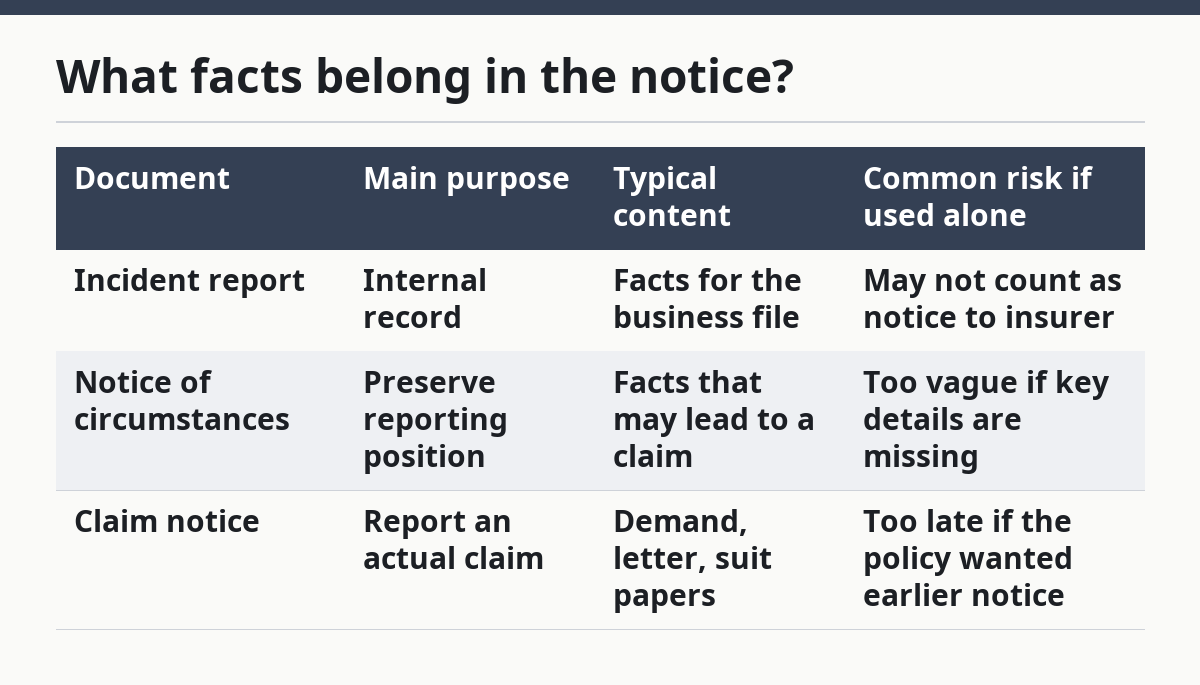
That table is the practical line: the incident report starts the paper trail, but the notice of circumstances is the step that may matter for reporting rights.
When should it be sent?
It should be sent as soon as the event looks like it may become a claim under the policy wording. That is the cleanest general rule, but the exact timing rule depends on the jurisdiction and the policy, so the wording has to be checked.
Timing is where people lose the most time. If a notice is delayed until a complaint becomes serious, the insurer may argue that the notice was not tied closely enough to the event. If the policy requires notice within a stated period after awareness, that period controls. If the policy uses a “as soon as practicable” style phrase, the question becomes whether the delay was reasonable in the circumstances.
A short internal process helps. Many businesses use a 24-hour or 1-business-day internal review step before sending notice, but that is an office rule, not a legal standard. The key point is that the review should not become a waiting period that pushes the matter past the policy’s own notice requirement.
If the facts are still developing, send the notice with what is known now and update it later if the policy permits. A later supplement is safer than no notice at all.
When should you stop and get a lawyer involved?
You should stop treating this as a routine notice task when the file starts to look disputed, large, or legally sensitive. At that point, the notice may still be part of the process, but it should be checked by a qualified lawyer.
The policy wording is unclear: If the contract does not clearly say how to give notice, the risk of a defective notice rises — get legal help before sending it.
The facts are changing fast: If the story changes after witness statements, photos, or emails come in, the notice may need careful framing — pause and review it with counsel.
There is a demand letter, threat, or draft claim: That may move the matter beyond a simple notice of circumstances — get advice on whether a different reporting step is now required.
The insurer has questioned coverage already: A coverage dispute can turn a routine notice into a contested file — have counsel review the wording before more facts are sent.
There is possible serious injury, property loss, or regulatory attention: The exposure may exceed a standard internal process — involve a lawyer and preserve records immediately.
These are not reasons to ignore the insurer. They are reasons to slow down and make sure the notice does not create a second problem while trying to solve the first.
What mistakes cause trouble?
The most common mistakes are small on paper and expensive later. They usually involve timing, content, or proof of delivery.
-
Using only an internal incident report. That can leave the insurer without formal notice, which may put reporting rights at risk. The better alternative is a separate notice sent under the policy wording.
-
Waiting for a demand letter. That can turn a pre-claim event into a late-reporting problem. The better alternative is to send notice when the facts first suggest a potential claim.
-
Writing too little. A 2-sentence note may not identify the event clearly enough. The better alternative is a factual summary with the people, place, date, and reason the matter may become a claim.
-
Writing too much legal argument. A long argument can distract from the core facts and create unnecessary disputes. The better alternative is a concise notice with attachments.
-
Sending it to the wrong place. If the policy requires notice to a named department or portal, an email to the wrong person may not count. The better alternative is to follow the delivery rule exactly and save proof.
-
Not keeping a copy. Without the exact notice and delivery record, later staff cannot prove what was sent. The better alternative is to keep the notice, attachments, and confirmation in the same file.
How do notice of circumstances and incident reports differ?
They differ because one is internal recordkeeping and the other is a policy notice that may affect later reporting rights. An incident report documents what happened inside the business. A notice of circumstances tells the insurer that the event may become a claim.
The two often start from the same facts, but they serve different jobs. An incident report may be broader, including operational fixes, supervisor comments, or safety notes. The notice should be tighter and should stick to the facts that matter to coverage and identification.
That difference matters in at least 2 ways. First, an internal report may contain language that should not be sent to the insurer without review. Second, a notice that is too casual may not satisfy the policy even if the business already wrote down the event elsewhere.
For that reason, the safer habit is to treat the incident report as the source file and the notice as the formal communication. They should be consistent, but they do not have to be identical.
What if the event is still developing?
If the event is still developing, the notice should describe the known facts and identify the risk of a future claim without guessing the ending. That approach is often the right one because the insurer needs notice of the circumstance, not a finished story.
The limit is simple: do not speculate about damages, fault, or settlement value unless those facts are known and the policy asks for them. If more facts come in later, a supplemental notice may be needed. A supplemental notice is just an update to the original notice, not a substitute for it.
One edge case is a series of linked events over several dates. In that situation, the notice should connect the dates if they are part of one continuing problem, because the insurer will need enough context to match the notice to the later claim. Another edge case is a complaint that starts informally and then hardens into a claim months later. In that case, the original notice should be kept with the later papers so the sequence is clear.
FAQ
When should i send a notice of circumstances?
Send it when the facts first show that a claim may follow, not after the claim is already fully formed. If the policy has a timing rule, that wording controls the decision. If the file is uncertain, a qualified lawyer should review the timing question before the notice goes out.
What facts belong in the notice?
The notice should identify the date, location, people involved, what happened, and why a claim might arise. It should also include any incident report number, witness names if known, and copies of key records. Keep it factual and short, because unsupported guesses can create avoidable disputes.
Does notice of circumstances preserve coverage?
It may preserve later reporting rights if the policy and the facts line up, but that depends on the jurisdiction and the policy wording. It is not a guarantee, and it is not a substitute for reading the contract carefully. A qualified lawyer should review any live coverage question.
Drafted with AI; not yet reviewed by a person.