Last updated: November 19, 2026
Quick Answer: Commercial liability underwriting and classification usually turns on the business’s actual operations, and a wrong class code can affect price, terms, and claim handling.
That process is not the same everywhere, and this guide is general information only — not legal advice; a qualified lawyer should be consulted for your jurisdiction.
The sections below explain how the file is judged, where class codes matter, and what changes the price, the terms, and the coverage. In commercial liability underwriting and classification, the key question is simple: what does the business really do?
Commercial liability underwriting is one of the core tasks behind business insurance because the underwriter has to turn a real operation into a policy decision. I write about insurance risk and policy language, and the useful part is usually not the label on the invoice — it is the class code, the activity description, and the exclusion wording that follow it. A class code can affect a policy from day one.
Key takeaways
- Classification is the hinge point. A shop, contractor, and consultant can all buy liability coverage, but the class description changes how the risk is priced and sometimes what is excluded.
- The underwriter is not just asking “what do you do?” They are asking where you operate, who touches the work, which products you handle, and which contracts you sign.
- A sloppy application can lead to a wrong class code, a surprise premium swing, or a coverage dispute after a claim.
- Special operations matter more than the business card title. Delivery work, subcontracting, hot work, and on-site service can change the risk profile fast.
- The cleanest application is the one that matches the operation on the ground, not the version of the business that sounds easiest to insure.
What commercial liability underwriting actually decides
Commercial liability underwriting decides whether the insurer will write the account, which class code fits the work, what limits and exclusions apply, and what premium tier the risk belongs in. That is the short version, and it starts with the application, not the claim.
Picture this: you’re filling out a new business application and your operation looks simple on paper, but one side job, one rented space, or one subcontracted task changes the risk. The underwriter is trying to sort that out before the policy is issued. That is where classification begins, and it is why the description of operations matters as much as the legal entity name.
The underwriter usually wants a few basic facts:
- what the business does day to day
- where the work happens
- whether there is foot traffic, product handling, or physical work
- whether any work is seasonal, mobile, or done at third-party locations
- whether the business hires subcontractors or uses temporary labor
A class code is not just a billing label. It is a shorthand used to match the business to a known risk profile, often through a rating manual or industry schedule. In many markets, the class code can affect the base premium far more than the business’s legal form does.
Here’s the catch: the same business can be classified differently depending on the jurisdiction, the insurer, and the line of coverage. A bakery that sells retail, supplies restaurants, and ships boxed goods may not be treated as one simple class everywhere, so a broker or underwriting professional should be consulted for the specific market. The class code follows the operation, not the owner’s preferred description. See the NAIC consumer resources on insurance underwriting and state rating rules for more context, and ask a licensed professional to confirm the fit in your state or country.
What the underwriter is really looking for:
- the main source of liability exposure
- the severity of a likely claim
- how often claims might happen
- whether a loss would be small and routine or large and messy
- whether the business changes hands, products, or locations during the policy term
How classification works in practice
Classification works by matching the business’s actual activities to the insurer’s approved classes, then pricing the policy from that match. That sounds neat on paper, but the real process is messy because one company can fit two or three class codes at once.
Picture this: you’re a contractor who does both installation and repair, or a retailer who also assembles products in back rooms. The application may ask for a single “main” class, but the underwriting file often needs a fuller split of revenue, payroll, or operations so the insurer can see the whole picture.
In many commercial liability programs, classification starts with the application and can continue through underwriting questions, inspection notes, and loss history. The insurer may ask for:
- class descriptions tied to payroll, sales, or revenue
- photos of the location
- contracts with customers or vendors
- certificates of insurance from subcontractors
- details on products sold, installed, or repaired
A generic article often gets this wrong by treating class codes as fixed across all insurers. They are not. One carrier may use a broad retail class, while another separates retail, light assembly, and online sales. The same operation can therefore land in different buckets depending on the market and the policy form.
The useful rule is simple: if one part of the business creates a different liability exposure, it may deserve its own classification or a split allocation. That split can matter when there is a claim, because the insurer may review whether the lost activity sat inside the insured class or outside it. Insurance Department guides and insurer underwriting manuals commonly describe this split treatment, but the exact answer should be confirmed with a professional before binding coverage.
Typical classification inputs:
- gross receipts
- payroll
- subcontractor use
- product mix
- service area
- location type, such as office, storefront, warehouse, or jobsite
Which business details change the rate the most?
The biggest rate drivers are the activity itself, the location, the scale of operations, and whether the business works on premises, off premises, or both. A legal entity name alone does very little.
Picture this: you’re comparing two businesses with the same revenue. One is an office consultant in a leased suite; the other sends workers into customer homes. Both may sell “services,” but one carries slip-and-fall and property-damage exposure in a very different way. That gap is what underwriting is paid to notice.
The most common factors that move the class and the price are:
- Work performed: office work, installation, repairs, manufacturing, retail, food handling, delivery, or professional advice
- Location exposure: storefront, office, warehouse, customer site, construction site, or remote work
- Contact with property or people: handling customer property, heavy foot traffic, minors, vulnerable populations, or busy public areas
- Products or completed operations: sold goods, installed goods, or work that can fail after the job is done
- Use of subcontractors: if others do part of the work, the underwriter checks contracts and certificates
- Claims history: prior losses, repeated patterns, or large severity claims can reshape the terms
- Jurisdiction: rules, rating methods, and policy language vary by country, state, province, or market
On the flip side, some facts matter less than business owners expect. A polished website, a catchy brand name, and the number of years the business has been open usually do not set the class code by themselves. They may help explain the operation, but they do not replace the exposure picture.
Two things that cause trouble often:
- the business grows into new work but never updates the carrier
- the application describes the “ideal” business, not the real one
That second mistake is expensive. It does not always lead to a denial, but it can give the insurer a reason to ask whether the class, premium, or coverage was written on the wrong facts.
Why class codes matter after the policy is issued
Class codes matter after issuance because they affect audits, claim handling, endorsements, and renewal terms, not just the first premium. If the class was wrong, the problem may show up later.
Picture this: you’re six months into the policy and the business has added a new service line. The policy still lists the old operation, and the renewal file repeats it because no one updated the description. That gap can show up in a premium audit or during a claim review, and it often starts with a simple question: what exactly was insured?
The main reasons class codes matter later are:
- Premium audit exposure: many commercial policies are audited against actual payroll or receipts
- Coverage matching: a claim has to fit the class and the policy wording
- Renewal pricing: repeated losses or a changed operation can alter the rating basis
- Disclosure issues: the insurer may ask whether the risk changed during the term
- Contract compliance: landlords, lenders, and customers may require a specific type of liability coverage
That is why a class code should be treated as operational data, not filing fluff. If the business has one office manager, one in-house installer, and five subcontractors, those facts belong in the underwriting file. If the business ships into another state or uses a warehouse, that belongs there too.
The honest limitation is this: there is no universal “correct” class code list for all markets. Rating manuals, carrier appetite, and local law can shift the answer. A business owner who wants a hard rule without a jurisdiction is asking for the wrong kind of certainty.
Common warning signs of a class mismatch:
- the policy says “office operations” but the business does field work
- receipts include work the application never described
- the business started handling products after policy inception
- subcontractors do the high-risk part of the job
- the renewal form copies last year’s description without checking the current work
What underwriters usually want to know before they quote
Underwriters usually want enough detail to map the operation, the contracts, and the likely loss pattern before they can quote. That usually means more than a one-line description.
Picture this: you’re trying to buy coverage for a business that looks straightforward until the application asks about tenants, delivery routes, product warranties, or after-hours work. The underwriter is not being difficult for sport. They are trying to separate ordinary premises exposure from product, professional, or completed-operations exposure.
The common questions include:
- what percentage of work is done on site versus off site
- whether the business manufactures, installs, repairs, or only resells
- whether products are imported, repackaged, or customized
- whether employees enter customer homes or commercial facilities
- whether the business uses hot processes, tools, vehicles, or hazardous materials
- whether the business signs hold-harmless or indemnity clauses
- whether any operations are seasonal or temporary
A strong submission does not hide the risky parts. It explains them. That gives the underwriter a chance to place the account with the right class and the right terms, rather than forcing a guess. ISO underwriting guidance and carrier application instructions both show that detail matters, especially when a business mixes services.
Here is the practical side:
- a detailed description can reduce the chance of a class-code mismatch
- a missing subcontractor detail can trigger follow-up questions
- a vague “general contractor” label may be too broad in one market and too narrow in another
- a retail operation with assembly work may need a split description
- a home-based office may still have non-office exposures if clients visit or goods ship out
Clarity usually helps more than spin. Underwriting hates surprises more than risk. A business that tells the truth about its operation often gets a cleaner quote than a business that tries to look simpler than it is.
The real difference between broad classes and narrow classes
Broad classes win when the business is small, stable, and easy to describe. Narrow classes win when the operation has distinct exposures that should not be lumped together.
Picture this: you’re looking at two policies. One uses a broad class that lumps several related activities into one bucket. The other splits the operation into separate activities, each with its own rating treatment. That split can raise or lower the premium, but the bigger issue is whether it matches the real work.
Broad classes are common when:
- the operation is simple
- the exposure is similar across the work
- the insurer wants an easier administration model
- the business does not have multiple distinct service lines
Narrow classes are common when:
- the business does more than one kind of work
- one part of the operation is much riskier than the rest
- revenue or payroll can be separated cleanly
- the insurer wants a more exact rate basis
The trade-off is not subtle. Broad classes are easier to manage, but they can hide risk. Narrow classes are more exact, but they require better records and better underwriting detail. If the business cannot separate receipts or payroll cleanly, the narrow structure can become a headache.
Here’s the catch: narrow does not automatically mean better. If the business is truly simple, forcing a split can create noise without improving the risk picture. That is why classification should follow operations, not pride.
What broad class users gain:
- simpler paperwork
- fewer line items
- easier renewal administration
What narrow class users gain:
- a better fit between work and rating
- less chance that one risky activity distorts the whole account
- cleaner treatment if the business expands
How claims history affects classification and underwriting
Claims history affects classification and underwriting because it tells the insurer which risk patterns are real, not theoretical. A clean loss run can help; repeated losses can change the tone of the file.
Picture this: you’re renewing coverage after a year with two customer slip-and-fall claims or one large property-damage claim. The insurer is not only looking at the amount paid. It is looking at where the losses happened, whether they match the class description, and whether the same issue could happen again.
Underwriters usually care about:
- frequency of claims
- size of claims
- whether claims repeat in the same location or activity
- whether the reported losses match the declared operations
- whether any claims were tied to subcontractors, products, or completed work
A single claim does not define the class, but a pattern does. If the business repeatedly gets claims tied to one service line, the insurer may price that line differently, require a change in controls, or decline the account at renewal in some markets.
The honest problem is that many owners read claims history as a scorecard. It is not. It is a map of where the file may break next. That is why good underwriting files describe what changed after a loss, not just what the loss was.
Useful records to keep:
- claim summaries with dates and categories
- corrective action notes
- updated safety procedures
- subcontractor agreements
- revised service descriptions
What is the biggest underwriting mistake businesses make?
The biggest underwriting mistake is describing the business as it wishes it were, not as it actually operates. That mistake can distort the class code, the premium, and the claim review.
Picture this: you’re an owner who thinks a few add-on services are too small to matter, so they stay off the application. Those small services may be the very thing that changes the exposure from office liability to field work or completed operations. Underwriting works from facts, not from the owner’s best guess about what seems material.
The most common mistakes are:
- using a generic label like “consulting” for a business that also installs equipment
- failing to mention subcontractors
- leaving out product sales
- not updating the carrier after expansion
- copying the prior year’s application without checking current operations
These mistakes matter because they can lead to the wrong class, and the wrong class can lead to the wrong premium or a dispute later. The insurer may not care that the omission was accidental if the policy was built on a different operation than the one that caused the loss.
The fix is simple, though not easy: write the application as if someone who has never seen the business must classify it from scratch. If the file would confuse a stranger, it will confuse the underwriter too.
The honest side-by-side: broad description versus precise classification
Precise classification wins for accounts with mixed operations, while broad description wins for simple businesses that truly do one thing. The winner depends on whether the business has one exposure or several.
Picture this: you’re deciding whether to keep the operation description broad or split it into separate classes. The choice changes how clean the file looks, how the rate is applied, and how much room there is for a later dispute.
| Criteria | Broad description | Precise classification | Winner for |
|---|---|---|---|
| Ease of application | Faster to write and review | Takes more detail and follow-up | Simple, stable businesses |
| Accuracy of exposure fit | Can blur different risks | Matches distinct activities more closely | Mixed-operation businesses |
| Premium precision | Less exact | Usually more exact | Accounts with separate revenue streams |
| Renewal management | Easier to repeat year to year | Needs updates when work changes | Businesses with little change |
| Claim review clarity | May invite questions if work shifts | Easier to tie to the facts on file | Claims-prone or complex accounts |
| Audit support | Harder to defend if records are thin | Better when payroll or receipts are split | Accounts with clean books |
| Growth handling | Can hide new work for a while | Forces a closer look at expansion | Growing businesses |
| Underwriter appetite | Works for low-complexity risks | Needed for specialty or layered risks | Specialty operations |
| Risk of mismatch | Higher if the business changes | Lower if the operation is documented | Fast-changing operations |
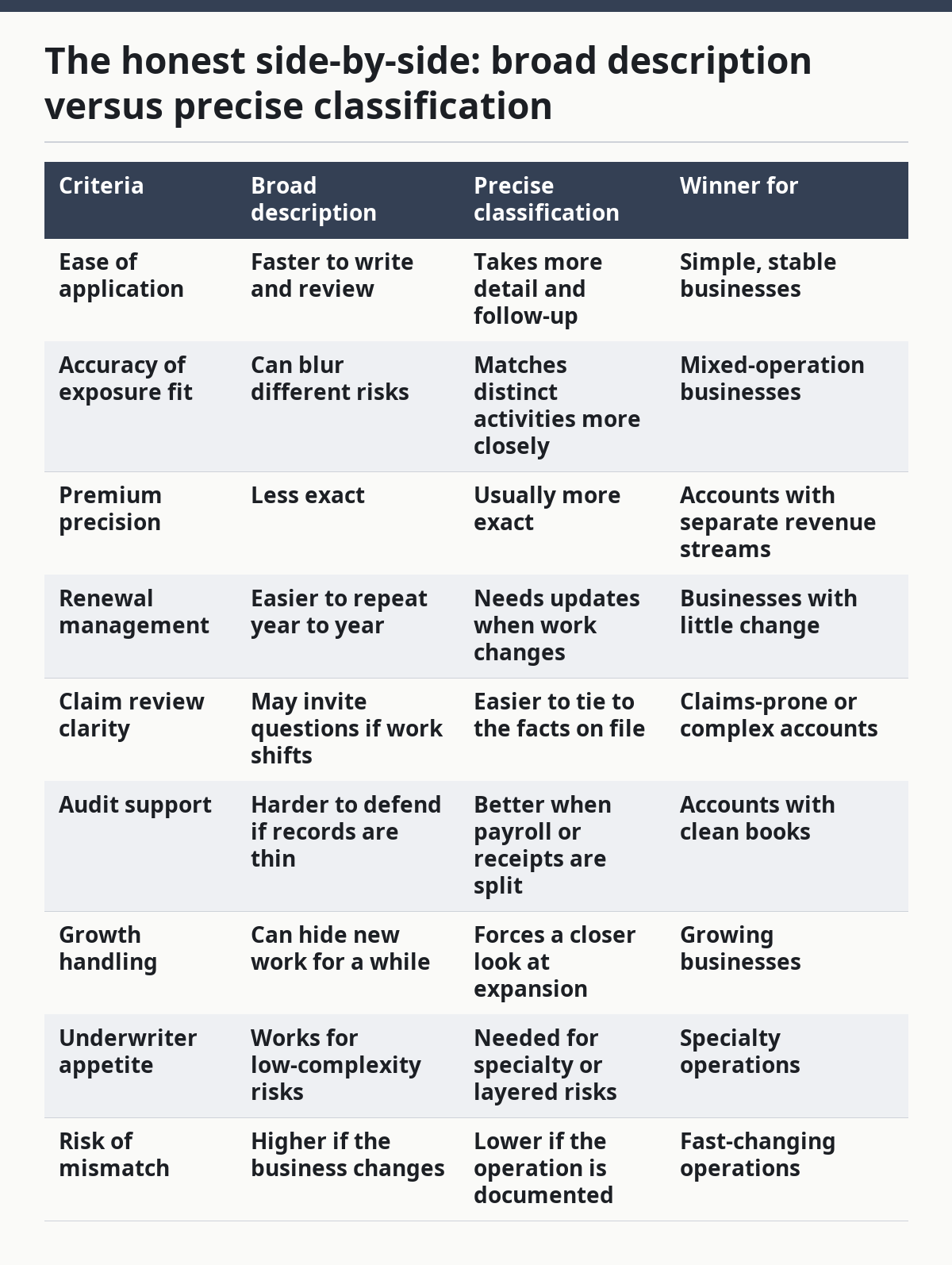
The table is not a verdict by itself. It is a warning label. If the business is doing more than one kind of work, the broad route can become a trap. If the business is truly simple, the precise route may add effort without improving the outcome.
When does classification flip the outcome?
Classification flips the outcome when the business has hidden exposures, mixed revenue, or work that belongs outside the original class. Those are the situations that change the answer.
Picture this: you’re looking at a business that started as a small service firm and then added delivery, installation, or product sales. The original class may no longer fit even though the legal entity never changed. That is the sort of growth underwriters watch closely.
The verdict flips in these cases:
- The business added field work — office-only class language may no longer fit if staff now visit customer sites.
- The business sells or installs products — completed-operations exposure may need separate treatment.
- The business uses subcontractors heavily — the underwriter may want a different description or tighter controls.
- The business expanded into a regulated or hazardous process — a simple class can become the wrong starting point.
Those cases do not mean the account cannot be written. They mean the first description is probably too thin. The right move is to reclassify the operation, not to hope the old wording survives contact with reality.
On the other hand, the verdict does not flip just because the business is bigger. A larger office-based firm may still fit the same class if the exposure stays the same. Size matters, but activity matters more.
The verdict: which approach fits which business?
Choose broad classification if the business does one simple activity, has stable operations, and keeps clean records. Choose precise classification if the business has multiple service lines, site work, product exposure, or subcontractor-heavy operations. Neither works well if the business description is vague, the records are thin, or the operation has changed without a policy update.
Picture this: you’re trying to avoid a premium shock or a claim fight later. The safest path is the one that matches the facts on the ground, not the easiest label on the form.
Here is the practical call:
- choose broad classification for a single-location office, a plain retail shop, or a stable low-complexity service business
- choose precise classification for contractors, product sellers, installers, repair shops, and businesses that blend office, field, and completed-work exposures
- reject both approaches if the operation is still changing and no one can describe it clearly yet
A bad fit is worse than a harder form. That is the whole game.
Where businesses should slow down before signing
Businesses should slow down before signing when the application uses vague labels, the operation has changed recently, or the policy is being renewed after a growth year. That is where mistakes hide.
Picture this: you’re about to sign an application that asks for a quick summary, but the last 12 months included new locations, new services, or new contract terms. A rushed answer can bake the wrong class into the file for another year.
Slow down if:
- the business has added a new service in the last policy term
- the staff now works at customer sites instead of only the office
- the company has started handling products, not just advice
- the business cannot clearly separate payroll or receipts
- the insurer is asking follow-up questions that the first draft did not answer
The useful habit is to treat the classification as living information. It should change when the work changes. A one-page description from three years ago is not a safe place to hide a new risk.
Frequently asked questions
What is commercial liability classification?
Commercial liability classification is the process of placing a business into a rating category based on what it actually does. That category helps the insurer price the risk and decide which policy language fits. Rules vary by jurisdiction and insurer, so the exact class names are not universal.
Why does the class code matter so much?
The class code matters because it can change the premium, the underwriting questions, and the way a claim is reviewed. If the business is placed in the wrong class, the policy may be priced on the wrong exposure. That is why accurate descriptions matter more than broad marketing labels.
Can one business have more than one class code?
Yes, many businesses can have more than one class code when they do more than one kind of work. A firm may have office work, field work, and product sales, and each part may need separate treatment. The exact approach depends on the insurer and the jurisdiction.
What happens if the application is wrong?
If the application is wrong, the insurer may quote the account on the wrong facts, ask for a correction, change the premium, or question coverage later. The outcome depends on the jurisdiction, the policy wording, and the nature of the mistake. A qualified lawyer should be consulted for a specific dispute.
How often should classification be reviewed?
Classification should be reviewed whenever the business changes its work, its locations, or its subcontracting pattern, and again at renewal. A yearly review is common, but a material business change should trigger a fresh look sooner. That keeps the policy description aligned with the actual operation.
Drafted with AI; not yet reviewed by a person.