Last updated: November 19, 2026
Key Takeaways
- Underwriting checks whether your liability risk fits the policy form, the price, and the coverage terms.
- The right buying process depends on how messy your exposure is, how much documentation you have, and how much negotiation your risk needs.
- The buying process usually runs in five stages: fact gathering, market submission, underwriting review, quote comparison, and binding.
- Underwriters look for exposure, controls, and consistency.
Liability insurance buying process and underwriting can stall fast if your application is incomplete, your exposures are vague, or your loss history doesn’t match the story in your forms. Quick answer: for a straightforward risk, the liability insurance buying process and underwriting review can sometimes move in a few days; complex risks can take several weeks. The right answer is to treat underwriting like a fact check, not a sales call, and to consult a qualified professional or broker for your own situation. This guide shows what underwriters look for, what to submit, and where the process usually breaks down. The topic here is the liability insurance buying process and underwriting — The Complete Guide, and I refer to it that way throughout this article.
Information only, not financial advice. Insurance terms, limits, and underwriting rules vary by country and by insurer, so a qualified adviser or broker should review your own situation. For general U.S. consumer guidance, see the NAIC and the U.S. Small Business Administration.
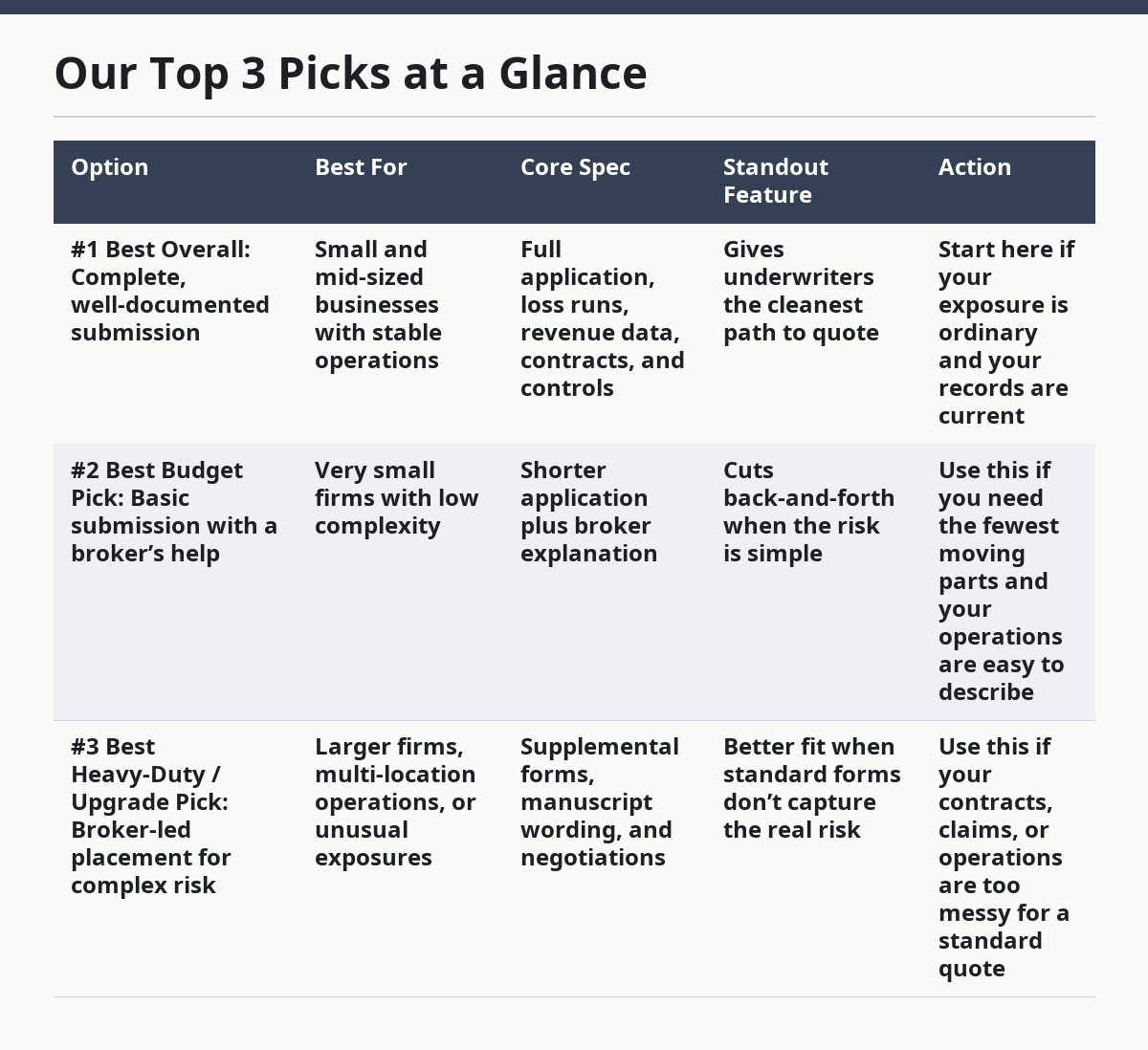
Our Top 3 Picks at a Glance
| Option | Best For | Core Spec | Standout Feature | Action |
|---|---|---|---|---|
| #1 Best Overall: Complete, well-documented submission | Small and mid-sized businesses with stable operations | Full application, loss runs, revenue data, contracts, and controls | Gives underwriters the cleanest path to quote | Start here if your exposure is ordinary and your records are current |
| #2 Best Budget Pick: Basic submission with a broker’s help | Very small firms with low complexity | Shorter application plus broker explanation | Cuts back-and-forth when the risk is simple | Use this if you need the fewest moving parts and your operations are easy to describe |
| #3 Best Heavy-Duty / Upgrade Pick: Broker-led placement for complex risk | Larger firms, multi-location operations, or unusual exposures | Supplemental forms, manuscript wording, and negotiations | Better fit when standard forms don’t capture the real risk | Use this if your contracts, claims, or operations are too messy for a standard quote |
| Product / Option | Best For | Core Spec | Standout Feature | Action |
|---|---|---|---|---|
| Complete, well-documented submission | Businesses with standard operations and tidy records | Application, loss runs, revenue, payroll, contracts, safety procedures | Fastest path to accurate underwriting | Prepare first if your risk is straightforward |
| Basic submission with broker help | Small firms with simple exposures | Short application plus broker summary | Less time spent on back-and-forth | Use when the operation is easy to explain in one page |
| Broker-led complex placement | Large, unusual, or cross-border risks | Supplemental apps, manuscript wording, layered markets | Can match risk details to insurer appetite | Use when standard forms leave important gaps |
What underwriting is actually checking
Underwriting is the insurer’s way of deciding whether your liability risk fits the policy form, the price, and the coverage terms. If your business has one storefront, a few employees, and ordinary customer traffic, the review is usually simple. If you do jobsite work, host events, use subcontractors, or sell into several states, the review gets sharper.
The underwriter is checking 4 things at once: what can go wrong, how often it can happen, how severe the claim could be, and whether your controls look real. A bakery, a roofing crew, and a software firm can all buy liability insurance, but they do not get underwritten the same way. Same label. Different risk.
The mistake most people make is treating the application like paperwork noise. It isn’t. A sloppy answer about revenue, payroll, claims, or operations can lead to a wrong quote, a later correction, or a coverage gap if the policy language does not match how you actually work. For practical guidance, consult a licensed broker or adviser and review the NAIC’s consumer resources.
Here’s the catch:
- Underwriting is not only about losses. It also looks at operations, contracts, location, training, and class codes.
- A clean loss history helps, but it does not override a risk that the insurer does not want.
- If the story in the application and the story in the contract file don’t match, the file slows down.
Quick check: If you can describe your work, your customers, and your main hazards in one accurate paragraph, you’re ready for the next step. If not, the application will show it.
What actually determines the right answer here
The right buying process depends on how messy your exposure is, how much documentation you have, and how much negotiation your risk needs. If you’re a small contractor with recent claims, then submission quality matters more than shopping ten carriers. If you’re a professional service firm with no physical work, then classification and endorsements may matter more than the base premium.
A generic article says “compare quotes.” That’s too shallow. In underwriting, comparison only helps after the facts are clean. A cheap quote that assumes the wrong class code, wrong revenue band, or wrong subcontractor exposure is not a win. It’s a future correction.
| Situation | Best Path | Why Other Options Fail |
|---|---|---|
| Stable business, standard operations | Complete application, loss runs, and broker review | Speed matters less than accuracy; rushed submissions cause rework |
| New business with little history | Strong narrative about controls, training, and contracts | No loss history means the underwriter leans harder on process and exposure detail |
| Prior claims or a near-miss pattern | Full disclosure with dates, amounts, and corrective action | Hiding claims can kill trust and distort the quote |
| Complex operations or multiple locations | Broker-led market search and manuscript review | A single standard form often misses the real risk |
| Tight budget and simple exposure | Narrow submission to the most relevant carriers | Casting a wide net can waste time and invite inconsistent quotes |
If your operation changes by season, site, or product line, then your underwriting file needs that detail. If your business is stable and narrow, the process can stay shorter and cleaner. The truth is, underwriting rewards clarity more than polish.
What this means in practice:
- List every service, product, and location.
- Match each activity to the right class description.
- Gather loss runs for the usual review period your insurer asks for; that period varies by market and policy type.
- Explain any claims, lawsuits, or incidents in plain language.
- Identify who signs contracts and what liability language you accept.
- Flag certificates, additional insured requests, and subcontractor use early.
Some readers want a rule of thumb. Here it is: the more your risk changes from job to job, the more underwriting needs written proof, not verbal reassurance.
Quick check: If you’ve got subcontractors, contracts, claims, or more than one location, you need the deeper path, not the shortest one.
How the liability insurance buying process works from start to bound policy
The buying process usually runs in five stages: fact gathering, market submission, underwriting review, quote comparison, and binding. If you skip one stage, the next one gets messier. If you rush to price before the facts are set, you usually pay for it later in corrections or exclusions. For reference, the SBA recommends documenting operations early, and the NAIC explains how policy terms can differ by insurer.
The process is less like shopping for a phone and more like getting a file approved. Underwriters want consistency. They want the numbers, the story, and the documents to line up. A broker can help translate the business, but the data still has to be real.
- Map the exposure. Write down what you do, where you do it, who you work for, and what could injure someone or damage property.
- Collect the proof. Pull your loss runs, current policy, contracts, certificates, payroll, receipts, and revenue records.
- Submit to the right market. Send the file to insurers that actually write your class of business, not every insurer on a list.
- Answer underwriting questions. Respond clearly when the insurer asks about claims, training, safety, locations, or subcontractors.
- Compare terms, not just price. Read exclusions, deductibles, defense wording, additional insured language, and any required controls.
- Bind and verify. Confirm the named insured, addresses, class codes, limits, and endorsements before the policy is issued.
A lot can go wrong in step 4. Underwriters often ask follow-up questions because one answer changes the rest of the file. If your revenue is mixed across multiple services, or your contracts shift risk back to you, they will want to know. That isn’t a punishment. It’s how they price uncertainty.
The most useful part is that you can make the process smoother by sending a complete file once instead of drip-feeding pieces over two weeks. Missing documents slow the clock more than any other issue.
Quick check: If your file is still changing every day, pause and fix the facts before chasing quotes.
What underwriters look for in a liability file
Underwriters look for exposure, controls, and consistency. If your business looks ordinary on paper, but your claims or contracts show a sharper risk, the underwriter will dig deeper. If your controls are visible and your description is tight, the file usually moves faster.
A clean file usually includes a standard application, recent loss runs, a clear description of operations, payroll or sales by class, subcontractor details, and copies of key contracts. Some insurers also ask for safety manuals, certificates of insurance, incident logs, or photos of the premises. The exact list varies by insurer and by line of business.
A generic article might stop at “show your claims history.” That’s not enough. The file needs to answer the real underwriting questions:
- What do you do?
- Who can be hurt?
- How bad can the claim get?
- Who else is involved?
- What changed after the last claim?
If you had a slip-and-fall claim, the underwriter may want to know about floor maintenance, inspection logs, and any changes to cleaning schedules. If you do professional work, they may care more about contracts, disclaimers, and errors-and-omissions overlap. Same policy family. Different pressure points.
Some applications also use classification codes and industry codes to sort the risk. Those codes matter because they influence which market sees the file and how it is priced. If the code is off, the quote can be off too.
Common file elements:
- Operations summary
- Prior carrier and effective dates
- Loss runs and claim notes
- Revenue, payroll, or sales data
- Contracts and hold-harmless language
- Property controls and site photos
- Safety training or written procedures
One honest limitation: not every underwriter wants the same depth. A simple office risk may only need a few pages. A contractor file can need a lot more. That difference is normal, not a sign that your case is “bad.”
Quick check: If your file can explain the business without contradiction, you’re in good shape. If not, expect follow-up.
How to prepare a submission that underwriters can price
A submission that underwriters can price is specific, current, and boring in the best way. If the file reads like a sales brochure, it will trigger questions. If it reads like a clean fact sheet, it usually moves faster.
Start with the obvious items: legal name, entity structure, locations, years in business, description of operations, and prior coverage. Then add the details that change the risk. For example, a service firm that enters customer homes has a different exposure than one that only works remotely. A manufacturer with a forklift has a different file than one without equipment traffic.
The truth is, underwriters do not need a novel. They need enough detail to measure the exposure. They also need the file to be consistent from page to page. If your application says “no subcontractors,” but your website and contracts say otherwise, the underwriter will ask more questions.
A strong submission usually follows this order:
- Basic business facts.
- What the business does, line by line.
- Where the work happens.
- Who does the work.
- What could go wrong.
- What you do to prevent loss.
- What happened in prior claims.
- What coverage terms you actually need.
If you use subcontractors, don’t hide that behind a generic sentence. Say whether they are insured, whether you require certificates, and whether your contracts make you responsible for their work. If you operate across state lines, say which states and which offices or jobs each state covers.
Also watch the dates. Expired loss runs, outdated payroll figures, or old addresses can slow underwriting down. Even a 12-month change in operations can matter if the risk changed materially during that time.
Quick check: If an underwriter can read your file once and know what changed, you’re close to ready.
Underwriting red flags that change the price or the answer
Underwriting red flags are not always dealbreakers, but they do change the answer. If you’ve had repeated claims, a recent ownership change, or work outside your stated class, the underwriter may tighten terms, ask for more proof, or pass on the risk. For a number-based rule of thumb, even one or two losses in a short period can trigger more scrutiny, depending on the market and line.
Here’s the catch: a red flag is not only a loss. It can be a gap between what you do and what the insurer thinks you do. A contractor using heavy equipment, a consultant handling client funds, or a retailer with event space all create different questions.
A few common red flags:
- Multiple claims in a short period
- No formal contracts with vendors or subcontractors
- Operations that changed after the last policy term
- Safety rules that exist on paper but not in practice
- Poorly explained losses
- Large customer concentration or one big venue
- Unclear responsibility for after-hours access, deliveries, or site security
If one of these applies, then the right move is not to argue the point. It is to document the controls and explain the fix. Underwriters respond better to a dated process change than to a promise.
Therefore, compare the paths:
| Red Flag | What It Means | Best Response |
|---|---|---|
| Recent claims | Higher chance of another claim or a bad pattern | Provide claim details, root cause, and corrective steps |
| Missing contracts | More legal uncertainty about who pays | Gather standard contract terms and certificate requests |
| New operations | Old policy details may no longer fit | Update the exposure description before quoting |
| Weak safety process | Loss prevention is hard to verify | Show written procedures, training, and inspections |
| Outside your class code | Risk may be misclassified | Rebuild the submission around the actual work |
A bad move here is to split the business story into pieces. Underwriters will usually find the gap. A better move is to make the file internally consistent, even if the truth is a little messy. That honesty often gives the broker a better shot at finding the right market.
Quick check: If your file has a recent claim, new service line, or missing contract terms, expect underwriting to ask for more than a simple quote.
Liability insurance buying process and underwriting for edge cases
The normal advice breaks down when the risk is unusual, the paperwork is thin, or the contract stack is heavy. If that’s your situation, then the file needs a different shape. If you try to squeeze a strange risk into a standard form, the quote may look fine while the policy fails to match the exposure.
| Situation | What changes | What to do instead |
|---|---|---|
| New business with no prior loss runs | Underwriter has less history to price | Build the file around operations, controls, owner background, and comparable activity |
| Rapid growth in the last 12 months | Prior revenue and staffing no longer fit | Update every exposure figure before marketing the risk |
| Multi-state operations | Laws, court trends, and local forms can differ | Ask for state-specific underwriting review and verify admitted versus surplus options where relevant |
| Heavy subcontractor use | Vicarious liability grows | Show contracts, COI tracking, and indemnity terms |
| Professional + bodily injury exposure | More than one coverage bucket may apply | Check whether liability, professional liability, and umbrella layers interact |
| Prior non-renewal or cancellation | Market appetite narrows | Disclose it early and focus on the reason, not the label |
If you’re in one of these edge cases, then a broker who knows the market can save time by ruling out carriers that will not fit. If the issue is contract-driven, the wording matters as much as the premium. If the issue is claims-driven, the loss narrative matters more than the headline number.
A common mistake is trying to “average out” a weird risk. That doesn’t work. Underwriters price the risk that exists, not the one you wish you had. Another mistake is hiding a difficult fact because you think it will scare off the market. That usually backfires later.
On the flip side, some edge cases still place well if the file is clean. A niche business with good controls, clear contracts, and good documentation can often get a fair review even when the exposure is unusual.
Quick check: If your business has one unusual feature that changes everything, stop using generic advice and build the file around that feature.
What happens after you get a quote
A quote is only useful if the terms match the risk you described. If the premium looks fine but the exclusions are broad, the deductible is high, or the named insured is wrong, consult a professional before treating the quote as final. The binding step is where mistakes become expensive.
Start by checking the basics:
- Exact legal entity name
- Locations and addresses
- Policy period and effective date
- Limits, deductibles, and defense treatment
- Exclusions and endorsements
- Additional insured wording if needed
- Certificate requirements and notice rules
Then compare the quote to the application. If the quote references a class code you never discussed, ask why. If the insurer added a control requirement, such as a sprinkler inspection, alarm monitoring, or subcontractor requirement, understand whether you can live with it. These are not small details. They can affect how the policy works day to day.
Do not treat every “cheap” quote as equal. A lower price can reflect a narrower scope, a higher retention, a worse claims-made trigger, or more exclusions. That may be fine for some readers and wrong for others. The point is to know which one it is before binding.
This is also where timing matters. Some carriers will hold a quote for a limited period, and rates can change at renewal. That varies by market. If your business changes before the policy incepts, tell the broker or insurer immediately.
Quick check: If the quote looks good but the wording feels fuzzy, stop and compare it line by line.
FAQ
How long does the liability insurance buying process take?
It can take a few days for a simple risk or several weeks for a complex one. The biggest delay is usually missing information, not the insurer’s clock. If the file is complete on the first pass, underwriting moves much faster.
Why does underwriting ask for so many documents?
Underwriting uses documents to match the premium and policy terms to the real exposure. A clean file helps the insurer price claims severity, legal risk, and controls. If the documents are inconsistent, the underwriter has to slow down and verify the story. For consumer guidance, the NAIC and SBA both explain why accurate records matter.
What if I have prior claims?
Prior claims do not automatically stop a quote, but they do change how the file is reviewed. The underwriter will want dates, amounts, causes, and what changed afterward. A clear explanation with corrective action is stronger than a vague apology.
Do I need a broker for liability insurance underwriting?
A broker is often useful if your risk is complex, your contracts are messy, or you need help matching the file to the right market. If the business is simple and the application is short, you may not need deep placement help, but you still need accurate disclosures.
What causes a liability quote to be declined?
A quote is often declined when the insurer does not want the class of business, the loss history is too poor, the controls are weak, or the file is incomplete. Sometimes the issue is not the business itself but the mismatch between the operations and the carrier’s appetite.
Drafted with AI; not yet reviewed by a person.