Last updated: November 19, 2026
Key Takeaways
- A claims-made policy ends new-claim protection when it ends unless reporting rights or tail coverage still apply.
- Nonrenewal usually ends protection on the expiration date unless another policy replaces it.
- Cancellation can cut coverage off before the scheduled end, leaving less time to react.
- Tail coverage keeps reporting rights open; a replacement policy may cover earlier work if the dates match.
A claims-made policy nonrenewal or cancellation can leave a coverage gap if the claim is reported after the policy ends and no tail coverage or replacement policy is in place. What happens when a claims-made policy is nonrenewed or canceled? This page shows what changes, what does not, and what to do next.
What changes the moment a claims-made policy ends?
A claims-made policy stops protecting new claims the day it ends unless the claim is still covered by the policy’s reporting rules or a tail applies. That is the short answer, and it is the part that catches people off guard.
Because the topic is what happens when a claims-made policy is nonrenewed or canceled, the key issue is the reporting window. Picture this: you are wrapping up a policy term, and the insurer sends a nonrenewal notice or a cancellation notice. The old policy may still matter for past work, but the reporting window matters now. If a claim shows up after the end date and the policy is gone, the old policy usually will not respond unless an extended reporting period or tail coverage is in force.
For example:
- The injury, error, or omission may have happened months or years ago.
- The claim still has to be made and reported in the right window.
- Once the policy ends, the clock keeps running on reporting rights, not just on the underlying work.
A claims-made policy is built around reporting during the policy term. If the claim arrives after the policy ends, you need some other layer of protection. That is where tail coverage, a replacement policy, or a continuing reporting arrangement comes in. For the policy mechanics, see the Insurance Information Institute’s overview of claims-made coverage and the IRMI explanation of claims-made policy structure.
What happens when a claims-made policy is nonrenewed?
A nonrenewal usually means the insurer will not issue a new policy term, so the protection tied to that policy stops on the expiration date unless something replaces it. The old policy does not keep covering new claims forever.
Because this is what happens when a claims-made policy is nonrenewed or canceled, the dates matter immediately. Picture this: you get a 30-day nonrenewal notice and the policy ends on a Friday. On Saturday, an unhappy client sends a demand letter about work from last year. If the policy is over and there is no tail or replacement policy with matching terms, that claim may be outside coverage.
What usually happens next:
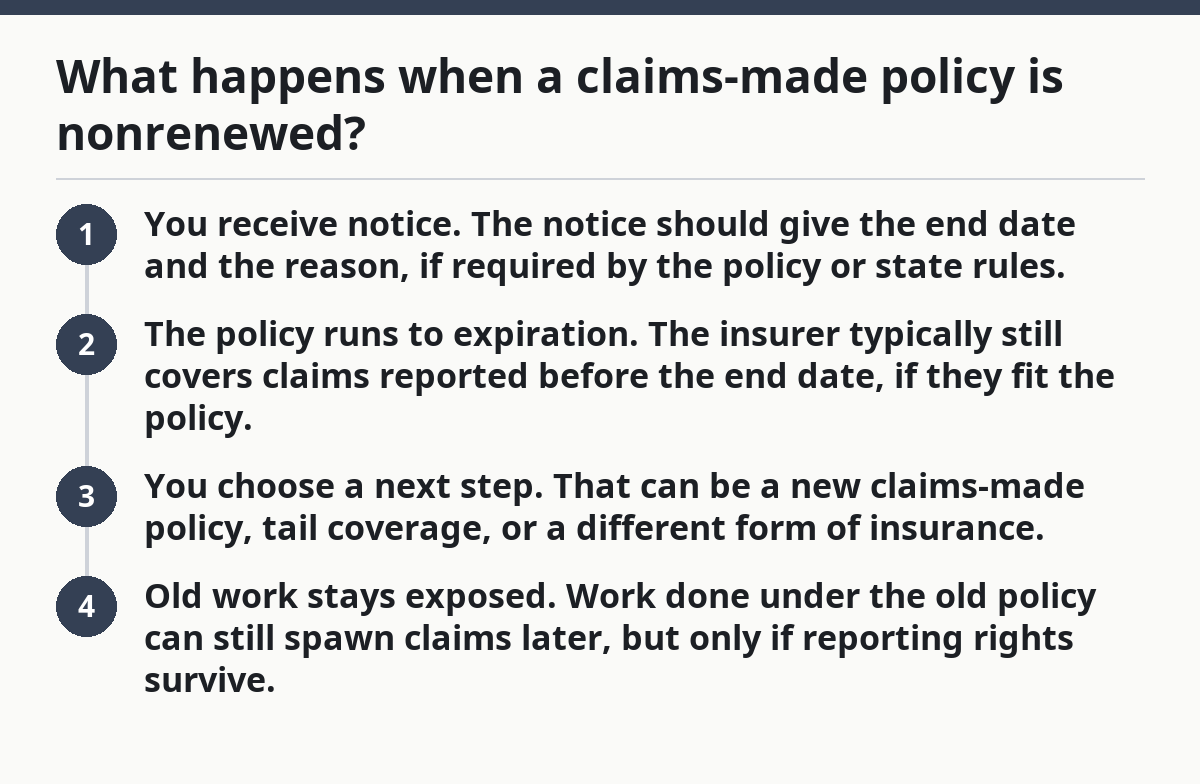
- You receive notice. The notice should give the end date and the reason, if required by the policy or state rules.
- The policy runs to expiration. The insurer typically still covers claims reported before the end date, if they fit the policy.
- You choose a next step. That can be a new claims-made policy, tail coverage, or a different form of insurance.
- Old work stays exposed. Work done under the old policy can still spawn claims later, but only if reporting rights survive.
Common mistake:
- Waiting until the last week to ask about tail coverage. That can leave you with only a short decision window and no clean backup.
A better move:
- Ask for the exact end date, the latest reporting rights, and whether a new policy will accept the old retroactive date. If the carrier will not renew, the replacement policy matters as much as the old one. See the NAIC’s consumer guidance on cancellation and nonrenewal notices and state notice rules.
What happens when a claims-made policy is canceled?
A cancellation can end the policy before its scheduled expiration, so the gap risk shows up faster and with less room to react. The policy may end immediately or on a later cancellation date listed in the notice.
Because this is still about what happens when a claims-made policy is nonrenewed or canceled, cancellation needs a faster response. Picture this: you are 6 months into a 12-month policy and the insurer cancels the contract. That is not the same as a routine nonrenewal at term end. You may lose protection for future claims far sooner, and you have fewer days to line up a new policy or secure tail coverage. If you face cancellation, consult a professional before relying on the notice alone. For background on policy termination timing, see the NAIC and the Insurance Information Institute.
The main differences are practical:
- Nonrenewal ends the policy at the term’s finish.
- Cancellation can end it midterm.
- Both can leave older work vulnerable if a claim is reported after the policy ends.
What still matters after cancellation:
- Whether the policy allows a reporting period after termination.
- Whether the policy includes or offers an extended reporting period.
- Whether the new insurer will cover prior acts under a new policy.
Two common reasons cancellation hurts more:
- A claim can surface after the contract ends, but the incident happened while the policy was active.
- The shorter timeline makes it harder to buy a new policy without a gap.
If the cancellation follows a payment issue, do not assume the old policy will behave like a normal expiration. The notice language controls. Read it line by line.
What is the practical result?
- No tail, no new policy: the old term may be closed to new claims.
- Tail in place: the old policy may still accept claims tied to the covered period.
- Replacement policy with prior acts: the new carrier may pick up earlier work, but only if the dates line up.
How do tail coverage and a replacement policy change the result?
Tail coverage keeps the reporting door open after the policy ends, while a replacement policy may cover earlier work if its dates are written right. Those are not the same thing.
Because this is what happens when a claims-made policy is nonrenewed or canceled, the choice between tail coverage and a replacement policy affects the result. Picture this: you leave one carrier and move to another. The first policy ends, but your old clients still may file claims later. If you buy tail coverage, you are paying for extra reporting time on the old policy. If you buy a replacement policy, you are starting a new contract that may include prior acts, depending on the retroactive date and terms.
Here is the useful split:
- Tail coverage extends the time to report claims tied to the old policy period.
- Replacement policy can protect future claims and sometimes old work, if the policy language allows it.
What to check before you assume you are safe:
- The exact termination date.
- Whether the old policy offers a tail option.
- Whether the new policy has a matching retroactive date.
- Whether both policies cover the same type of professional or general liability risk.
A tail is often the cleanest answer when you are leaving the business, retiring, or changing carriers and want to preserve old reporting rights. A replacement policy makes more sense when you are staying in business and can get the new policy to pick up prior acts. The dates have to line up.
One mistake costs real money:
- Buying a new policy and assuming it automatically protects the old policy period. It usually does not.
What should you do right after you get notice?
You should treat the notice as a deadline problem, not a paperwork nuisance. The goal is to protect the reporting period before the old policy shuts the door. If you are unsure, consult a professional and review the notice with the carrier or broker. For claims-made notice timing, see the Insurance Information Institute and your state insurance department’s notice rules.
Because the topic is what happens when a claims-made policy is nonrenewed or canceled, timing is the whole issue. Picture this: you have a cancellation or nonrenewal notice in hand and 2 tasks on your desk — stop the gap and preserve your reporting rights. The cleanest move is to act before the policy end date, not after.
Then use this order:
- Read the notice the same day. Find the end date, the reason for termination, and any deadlines for requesting tail coverage.
- Pull the policy declarations page. Confirm the policy type, policy period, and any reporting terms.
- Ask the carrier about tail coverage. Get the cost, the request deadline, and whether it must be elected before termination.
- Shop a replacement policy. Ask whether the new policy can keep the same retroactive date or prior-acts terms.
- Match the dates. Make sure the new policy begins when the old one ends, with no 1-day hole.
- Save the paperwork. Keep the notice, the quote, the bind confirmation, and any tail election in one file.
That sequence does two things at once:
- It reduces the chance of a gap coverage problem.
- It gives you proof of what coverage you bought and when.
If you are a business owner, broker, or risk manager, this is the moment to compare the old policy, the new policy, and any tail option side by side. The hub on commercial liability insurance policy design and terms can help frame the bigger policy structure, but this page is about the termination point and what it does to claims.
Common mistakes that leave a gap
The biggest mistakes are simple, and they are expensive because they are silent until a claim arrives. Most of them happen in the 30 days after notice.
Because this is what happens when a claims-made policy is nonrenewed or canceled, the mistakes tend to show up around the end date. Picture this: you think the policy ends cleanly, so you do nothing. Then a claim gets reported 2 months later, and the old insurer points to the end date. That is the kind of problem that only shows up when the file is already hot.
Avoid these errors:
- Assuming every old claim is still covered. It is not, if reporting rights ended.
- Ignoring the notice deadline. Tail coverage often has a firm election window.
- Leaving a one-day gap between policies. A missing day can matter on a claims-made form.
- Assuming the new carrier will cover old acts automatically. Prior acts coverage has its own date rules.
- Forgetting to document the change. Without the notice and bind papers, you may not be able to show the timeline.
Each mistake has a cost:
- Lost reporting rights.
- Denied claims.
- Disputes over which policy should respond.
What to do instead:
- Track the exact end date in a calendar.
- Ask for written confirmation of tail elections.
- Verify the retroactive date on any replacement policy.
- Keep all policy numbers and declarations pages together.
This is not the place for guesswork. A 1-page timeline is worth more than a stack of old emails.
What happens if a claim comes in after the policy ends?
A claim coming in after the policy ends may be uncovered unless it fits an old reporting right, tail coverage, or a replacement policy’s prior-acts terms. That is the rule that matters most.
Because this is what happens when a claims-made policy is nonrenewed or canceled, the post-end claim risk is the point to watch. Picture this: a claim is first made 60 days after the old policy ends. If you do not have tail coverage and the new policy does not pick up the earlier date, the old policy may not respond. The claim can be valid and still miss the coverage trigger.
The result depends on three dates:
- When the act happened.
- When the claim was first made.
- When it was reported.
On a claims-made policy, those dates have to fit the policy language. The event itself is not enough. The claim must fall inside the reporting structure the policy allows.
Here is the short version:
- Inside the reporting rules: possible coverage.
- Outside the reporting rules: likely no coverage.
- With tail coverage: more room to report after ending.
- With a replacement policy: possible protection if prior acts are included.
This is why nonrenewal and cancellation deserve immediate attention. The policy can end fast, but the claim can arrive slowly. That mismatch is where trouble starts.
What should a reader remember most?
The end of the policy is not the end of risk. It is the point where reporting rights become the whole game.
What happens if my claims-made policy is not renewed?
If your claims-made policy is not renewed, the old term usually stops covering new claims after the end date unless you buy tail coverage or a new policy takes over with matching dates. The underlying work can still create claims later, so the reporting rules matter even after the policy ends.
Do I lose coverage after cancellation?
You can lose coverage for claims reported after cancellation if no tail coverage or replacement policy protects the old period. The claim may still relate to work done while the policy was active, but that alone is not enough on a claims-made form.
Should I buy tail coverage after nonrenewal?
Tail coverage is often worth considering if you need the old policy’s reporting rights to stay open after termination. It is especially useful when you are retiring, closing a business, or cannot get a replacement policy with prior-acts protection.
Drafted with AI; not yet reviewed by a person.