Last updated: November 19, 2026
Quick Answer: the liability insurance policy structure and contract language you need to check first are the declarations page, the policy form, the endorsements, the definitions, the exclusions, and the conditions. In many cases, one endorsement page changes the result. Liability insurance policy structure and contract language also control whether a claim is defended, paid, or denied.
Liability insurance policy structure and contract language are won or lost in the wording, not the logo on the front. The structure tells you what trigger, limit, exclusion, and duty to defend actually apply. The sections below show how to read the contract so you can spot the parts that change coverage. In this guide, the topic is liability insurance policy structure and contract language — The Complete Guide.
Key Takeaways
- The declarations page is the snapshot; the policy form is the rulebook.
- A claim can be covered in one section and denied in another.
- “Occurrence” and “claims-made” are not interchangeable.
- Exclusions, endorsements, and definitions can change the result more than the premium line does.
- The duty to defend is often broader than the duty to pay a judgment.
- This is information, not financial advice; for your own situation, talk with a qualified adviser or broker.
Liability insurance policy structure and contract language are a money topic, and getting the wording wrong can cost real dollars. This is general information, not financial advice, and a qualified adviser should be consulted for your own situation, especially on legal entity names and insured status. The Insurance Information Institute explains that the policy is a contract and that coverage depends on its wording, and the National Association of Insurance Commissioners also points readers to the policy language itself.
What a liability policy is actually made of
A liability policy is built from a few named parts: the declarations page, the insuring agreement, definitions, exclusions, conditions, and endorsements. Those parts usually sit in a 20-page to 60-page contract, and each one can change the result of a claim.
Picture this: you are looking at a policy after a customer sends a demand letter. You want one thing first—does the contract promise to defend you, pay a settlement, or both? The answer lives in the structure, not the sales summary.
The declarations page lists the insured, the policy period, the limits, the premium, and sometimes a deductible or self-insured retention. The policy form carries the actual promises and limits. Endorsements then amend the form, often in a single page that can do more damage than the main contract.
If a beginner misses one thing, it is this: the “policy” is not one block of text. It is a stack of documents, and the top sheet is not the whole deal; read the declarations page, the form, and the endorsements together.
The parts you should usually check first:
- declarations page
- policy form
- endorsements
- definitions
- exclusions
- conditions
- any schedule of forms and endorsements
A common mistake is reading the summary of coverage and stopping there. That summary is not the contract. If the policy says one thing in the declarations and another in an endorsement, the endorsement usually controls.
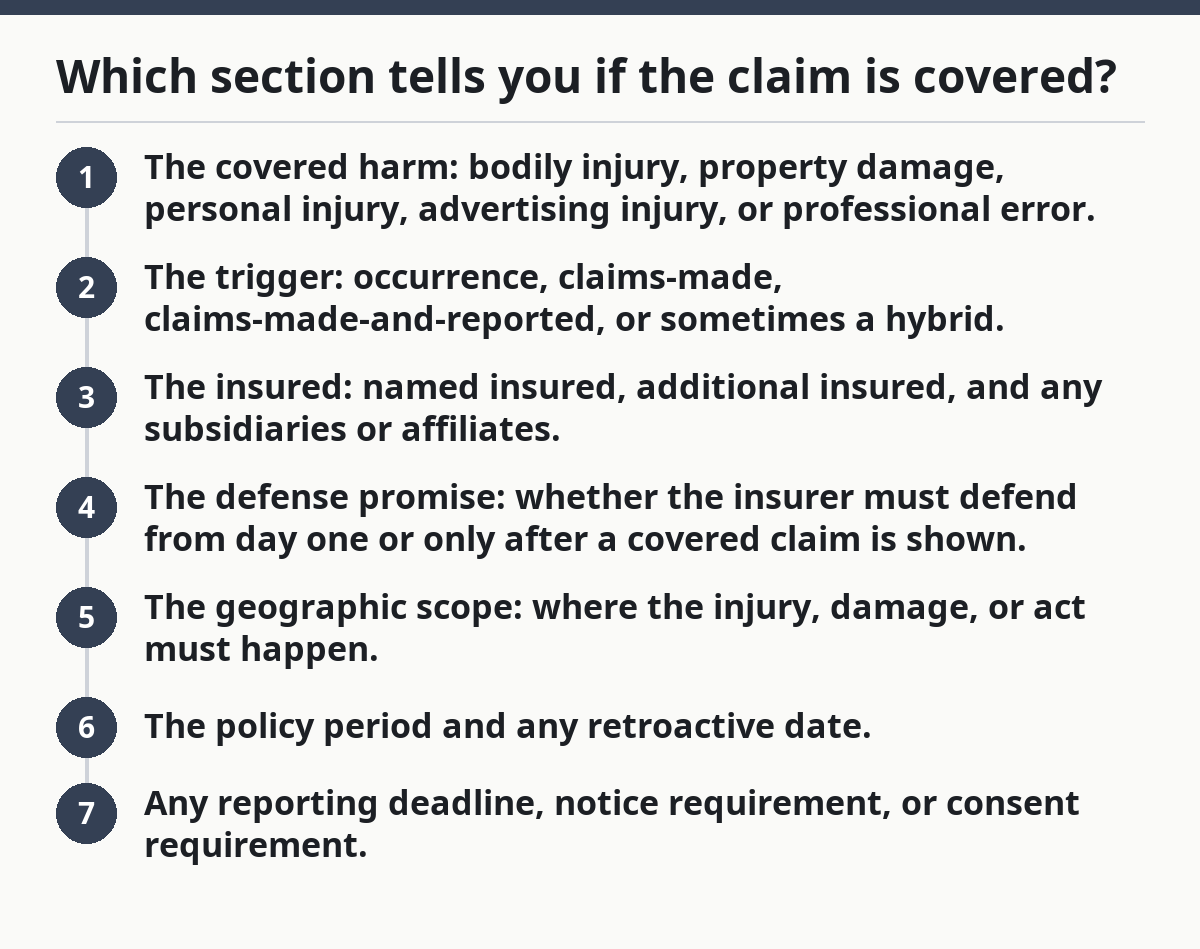
Which section tells you if the claim is covered?
The insuring agreement tells you the basic promise, and that promise is usually narrow at first glance. It says what kind of injury or damage is covered, who is insured, and what kind of claim the insurer may defend or pay.
Picture this: a complaint lands on your desk, and the facts look messy. You need to know whether the policy covers bodily injury, property damage, personal and advertising injury, professional services, or completed operations. That starts with the insuring agreement and then moves into the definitions.
Most liability forms use defined terms that do more work than plain English would. “Occurrence” often means an accident, including repeated exposure to the same harmful condition. “Claim” can mean a demand for money or a lawsuit, depending on the policy. “Suit” may require formal arbitration or a civil proceeding.
The exact trigger matters. An occurrence-based policy usually responds to injury that happens during the policy period, even if the claim comes later. A claims-made policy usually responds when the claim is first made and reported during the policy period, subject to any retroactive date and reporting rules.
That difference is not cosmetic. It changes when you must have coverage in force.
What to verify in the insuring agreement:
- The covered harm: bodily injury, property damage, personal injury, advertising injury, or professional error.
- The trigger: occurrence, claims-made, claims-made-and-reported, or sometimes a hybrid.
- The insured: named insured, additional insured, and any subsidiaries or affiliates.
- The defense promise: whether the insurer must defend from day one or only after a covered claim is shown.
- The geographic scope: where the injury, damage, or act must happen.
- The policy period and any retroactive date.
- Any reporting deadline, notice requirement, or consent requirement.
Here’s the catch: a claim can fit the insuring agreement and still be denied later by an exclusion. The structure is layered on purpose.
What do exclusions, conditions, and endorsements really do?
Exclusions remove whole categories of loss, conditions set the rules for making a claim, and endorsements rewrite the policy in targeted ways. Those three sections are where many coverage fights begin, especially on a 1-page endorsement that looks harmless.
Picture this: you have coverage language that looks broad, then you turn the page and find an exclusion for contractual liability, pollution, employment practices, or professional services. That is not a minor edit. It can wipe out the exact risk you thought you bought.
Exclusions are usually written to be broad enough to catch edge cases. Common examples include expected or intended injury, workers’ compensation, employer’s liability, pollution, and certain warranty or guarantee claims. Some policies also exclude punitive damages, fines, or mold-related losses, depending on state law and form language.
Conditions tell you what you must do. Notice provisions, cooperation clauses, no-voluntary-payments rules, other-insurance clauses, and subrogation rights all live here. If you settle on your own before the insurer agrees, you may lose reimbursement under a standard no-voluntary-payments clause.
Endorsements are attached amendments. They can add an insured, delete a form, narrow a definition, or change a limit. If an endorsement says it “modifies” the policy, that language usually means it controls over inconsistent wording in the base form.
What to read line by line:
- any exclusion that matches your business activity
- any condition with a deadline, such as notice “as soon as practicable”
- any endorsement changing an additional insured status
- any waiver of subrogation or primary-and-noncontributory language
- any manuscript endorsement, which is custom-written
- any schedule listing a retroactive date, deductible, or aggregate limit
The truth is, many policy disputes are not about whether something happened. They are about which page wins.
How do the contract words change the outcome of a claim?
The words change the outcome because liability insurance is a contract of defined triggers, not a promise to cover every bad event. A single term like “accident,” “publication,” or “professional services” can decide whether the insurer defends, reserves rights, or denies the claim.
Picture this: two policies look similar on the surface, but one says “occurrence” and the other says “claims-made and reported.” Same premium class, very different timing rules. If you miss the reporting window on the second form, the result can be denial even where the event itself happened during the right year.
Definitions work like gates. A definition can expand coverage if it is broad, or shrink it if it is tight. For example, “property damage” may include loss of use, while “personal and advertising injury” may cover libel, slander, or certain privacy claims. A “wrongful act” in an errors-and-omissions form may be much broader or narrower than a lay reader expects.
The duty to defend is another phrase to watch. In many standard forms, the insurer must defend a suit seeking covered damages, even if some allegations are outside coverage. That can make defense obligations broader than indemnity obligations, which pay settlements or judgments.
Common words that matter more than people think:
- “occurrence”
- “claim”
- “suit”
- “damages”
- “personal injury”
- “advertising injury”
- “professional services”
- “known loss”
- “prior acts”
If the policy uses a term you would not use in everyday speech, slow down. The defined meaning controls.
How do I read a liability policy step by step?
Read a liability policy in a fixed order: declarations, insuring agreement, definitions, exclusions, conditions, and endorsements. That order helps you find the moving parts faster and keeps you from trusting a summary that leaves out the fine print.
Picture this: you are trying to answer a claim question in 15 minutes, not 5 hours. You need a method that catches the big limits first, then the traps hidden in defined terms and add-on forms.
- Start with the declarations page. Verify the named insured, policy period, limits, deductible or retention, and any retroactive date. A problem is any mismatch between the legal entity on the page and the entity facing the claim.
- Identify the policy form number and edition date. Confirm that the form and all listed endorsements match the schedule. A problem is an endorsement listed on the schedule but missing from the packet.
- Find the insuring agreement. Check what harm is covered and whether the policy is occurrence-based or claims-made. A problem is a claim reported after the policy expired on a claims-made form.
- Read the definitions next. Mark every defined term that appears in the coverage grant. A problem is using ordinary meaning instead of the contract definition.
- Scan every exclusion. Match exclusions to the facts of the loss, not just the headline risk. A problem is assuming “general liability” covers professional work or pollution.
- Read the conditions. Look for notice timing, cooperation, voluntary payments, and consent-to-settle language. A problem is paying a claimant first and asking for coverage later.
- Check the endorsements one by one. See whether they add, delete, or replace wording. A problem is ignoring a one-line endorsement that deletes an entire coverage grant.
- Confirm the loss location and timing rules. Verify whether the policy needs injury to happen during the period, on the premises, or in a listed territory. A problem is a claim that occurred before the retroactive date or outside the covered territory.
Therefore, this order works on most standard forms, including commercial general liability, professional liability, and umbrella policies. It will not make a bad contract good, but it will show you where the bad part lives.
When does the standard structure stop working?
The standard structure stops working when the policy is manuscripted, layered with excess coverage, or tied to special risks like directors and officers, cyber, pollution, or construction wrap programs. In those cases, the headline form is only part of the answer.
Picture this: you see one policy number, but the loss may involve a primary policy, an excess policy, and an umbrella policy. Each layer can have its own attachment point, notice rule, and defense duty. That is a different reading exercise.
Claims-made policy with a lapsed reporting window: the claim may fall outside coverage even if the act happened years earlier — review the retroactive date and reporting rule before assuming coverage exists.
Additional insured endorsement with narrow wording: the extra insured may be covered only for vicarious liability or only for work done for a named party — compare the endorsement to the contract claim.
Umbrella policy with drop-down language: the umbrella may defend or pay only after the underlying policy is exhausted or unavailable — check whether exhaustion must be by payment, not just by verdict.
Professional services exclusion in a general liability form: the contract may exclude the very work that creates the loss — use the professional liability form instead of relying on the general form.
Prior knowledge or known-loss condition: a claim or circumstance you knew about before binding may be excluded — gather the timeline before making a notice decision.
Manuscript endorsement changing definitions: a custom endorsement can override the standard ISO-style language — read the endorsement before the base policy.
When the policy stack gets this complex, the language still matters, but the reading method has to widen. The page count can double. So can the number of traps.
What mistakes do people make with liability policy language?
People usually make five mistakes: they read the summary instead of the contract, they miss an endorsement, they confuse occurrence with claims-made, they ignore deadlines, and they assume every exclusion is obvious. Each one can change the claim outcome.
Picture this: the declarations page says one thing, the broker summary says another, and the endorsement schedule quietly rewrites the definition of insured contract. If you only read the summary, you are relying on the least binding part of the file.
- Mistake: trusting the certificate of insurance. Consequence: a certificate can show coverage that the policy does not actually grant. Correct alternative: ask for the policy form and endorsements.
- Mistake: missing a reporting deadline. Consequence: late notice can bar or narrow a claims-made claim. Correct alternative: report early and keep proof of submission.
- Mistake: assuming “defense” means “indemnity.” Consequence: the insurer may defend but still deny payment of a settlement or judgment for an excluded loss. Correct alternative: read the defense and indemnity obligations separately.
- Mistake: overlooking an exclusion in an endorsement. Consequence: the base form may look broad while the endorsement removes the coverage you need. Correct alternative: compare every endorsement to the insuring agreement.
- Mistake: treating legal entity names casually. Consequence: the wrong LLC, partnership, or parent company may be outside the named insured. Correct alternative: match the policy name to the contracting entity and consult a qualified professional if the entity structure is unclear.
A smaller mistake has a big cost: reading only the premium and limit. A $1 million limit with a narrow exclusion is not the same as $1 million of usable coverage. A broker or coverage counsel can help you confirm the practical effect.
What should you check before a claim turns into a fight?
Check the policy dates, the insured names, the trigger, the exclusions, the notice clause, and the endorsements before the insurer sends a reservation of rights letter. Early review is easier than fighting over a record after the loss has grown.
Picture this: a demand arrives today, but the conduct started two years ago and the policy changed twice since then. You need a timeline, not a guess. The answer may depend on when the injury happened, when the claim was made, and when the insurer was told.
A fast pre-claim checklist:
- exact policy period
- retroactive date, if any
- named insured and additional insured status
- type of trigger: occurrence or claims-made
- all known exclusions tied to the claim facts
- notice and consent requirements
- defense obligation and reimbursement language
- deductible, retention, or erosion wording
If the claim involves multiple policies, line them up in order: primary, umbrella, and excess. The attachment point matters, because an excess layer may not respond until the primary limit is actually used up. If the policy says “underlying insurance,” that term needs its own reading too.
The truth is, a lot of disputes start because someone waited to read the policy until after the letter arrived. That is the worst time to learn the structure; when the demand is already on the table, the structure should already be mapped.
How do policy structures differ across common liability forms?
They differ by trigger, covered harm, and the way the defense promise is written, even when the cover page looks similar. Commercial general liability, professional liability, directors and officers, and cyber policies are built for different loss patterns.
Picture this: a contractor, a consultant, and a board member all say, “I have liability coverage.” They may all be right, and still mean three different contracts with different exclusions, defense duties, and notice rules.
Commercial general liability forms often focus on bodily injury, property damage, and certain personal or advertising injury claims. Professional liability forms focus on errors, omissions, and professional services. Directors and officers policies focus on management decisions, securities issues, and corporate governance. Cyber policies often focus on data breach, network interruption, privacy claims, and incident response costs.
Each form has its own language problem. The CGL form may hinge on “occurrence” and “property damage.” The professional form may hinge on “wrongful act” and a retro date. The D&O form may hinge on “claim,” “insured person,” and “securities claim.” A cyber form may define “computer system,” “security failure,” or “privacy event.”
The main structural differences:
- CGL: broad third-party bodily injury and property damage framework
- Professional liability: act or omission tied to services
- D&O: management and governance exposures
- Cyber: data, network, and privacy exposures
- Umbrella/excess: layering and attachment rules
This is why one clean rule does not work for every liability policy. The labels are similar; the contract language is not.
FAQs
What is the most important part of a liability insurance policy?
The most important part is the combination of the insuring agreement, definitions, and exclusions. Those three sections decide whether the policy responds at all, and the declarations page only tells you the basic numbers and named parties. A policy can look generous on the face page and still exclude the loss in the body.
What is the difference between occurrence and claims-made coverage?
Occurrence coverage usually turns on when the injury or damage happens, while claims-made coverage usually turns on when the claim is first made and reported. That timing difference can change coverage even if the facts are the same. Claims-made forms also often include a retroactive date and a reporting deadline.
Why do endorsements matter so much?
Endorsements matter because they can rewrite the contract in a few lines. An endorsement can add an insured, remove a coverage grant, narrow a definition, or change a condition. In many disputes, the endorsement controls the result more than the base form does.
Is a certificate of insurance enough to prove coverage?
No, a certificate of insurance is not enough to prove coverage. It may show that a policy exists, but it does not replace the policy form, endorsements, or exclusions. If the loss matters, the actual contract documents are the ones that decide coverage.
What should I do first if I need to understand a policy for a claim?
Start with the declarations page, then check the insuring agreement, definitions, exclusions, conditions, and endorsements in that order. That sequence shows the limit, the trigger, the barriers, and the deadlines. If the claim is large or the wording is unusual, a qualified adviser should review it with you.
Drafted with AI; not yet reviewed by a person.