Last updated: November 19, 2026
Quick Answer: Completed operations coverage usually applies after work is finished and handed over, and it matters most when a claim appears later; the exact result depends on the policy wording and the facts. Completed operations coverage protects you when a liability claim shows up after the work is finished and the job has been handed over. It is the part of a liability policy that can respond to post-completion claims, not problems that arise while the work is still in progress. The sections below pin down where that line sits, what it changes, and where readers still get tripped up. For exact guidance on What completed operations coverage means in a liability policy, consult the policy and a qualified adviser.
Key Takeaways
- Completed operations coverage deals with claims tied to work that has already been finished.
- Ongoing operations covers work still being done; the two are not the same.
- The wording matters most after project handover, when a claim can surface weeks or months later.
- In construction and other contractor work, the line between active work and finished work can decide whether a claim fits at all.
- This is information, not financial advice; a qualified adviser should be consulted for your own situation.
What completed operations coverage means in a liability policy
Completed operations coverage means the policy’s liability protection for injury or property damage linked to work that is finished or treated as finished under the policy wording. If you are a contractor, that usually matters after the crew leaves the site and the project handover is done. Consult a qualified adviser if you need help applying the policy to your facts.
For example, if you have turned over a kitchen remodel, the owner has moved back in, and a loose cabinet later falls and causes damage, that is the kind of claim people mean when they ask about completed operations.
- The trigger is after completion, not during active work.
- The claim usually has to tie back to the work itself.
- The policy wording, not the job title, controls the result.
- A “finished” job can still be disputed if punch-list work, repairs, or site access remain open.
The phrase is often tied to the products-completed operations hazard, a policy bucket that groups claims from goods sold or work finished and handed over. In plain language, it is the “after you are done” part of the liability form. The catch is that “done” can be messy in real life, which is why claims handlers look closely at dates, handoff records, and what was still being touched at the site.
How does completed operations differ from ongoing operations?
Completed operations differs from ongoing operations because one deals with finished work and the other deals with work still being performed. That split is one of the main ways liability policies sort construction claims and other contractor claims.
For example, if you are framing a wall at 2 p.m. and a tool knocks over a display inside the house, that is the sort of loss tied to ongoing operations. If the wall is finished, the crew has left, and the same wall later fails, the claim moves toward completed operations.
- Ongoing operations: work is active, tools are on site, and the job has not been handed over.
- Completed operations: the work is done, the site or portion of the site is turned over, and a later loss is linked back to that work.
- The same project can contain both at once if different parts are still open.
- A claim can turn on a single detail, such as whether the owner accepted the work or whether a subcontractor returned for follow-up.
That split matters because insurers write, price, and defend those exposures differently. A generic article often says “liability covers accidents,” but that misses the real issue: the policy has to place the accident in time. If the loss happened before handover, the label may be ongoing operations. If it happened after the job was finished, completed operations is the part people look at first.
What counts as completed work?
Completed work is work that has been finished, handed over, or treated as finished under the policy language, even if minor follow-up remains. The exact line can change with the contract, the insurer’s wording, and the facts of the job. Consult a qualified adviser if the dates or scope are unclear.
For example, you finish a roof replacement on Friday, but you return Monday to fix a missed shingle. That return visit can matter. The insurer may ask whether the work was already completed on Friday or whether the job was still open because the correction was part of the same project.
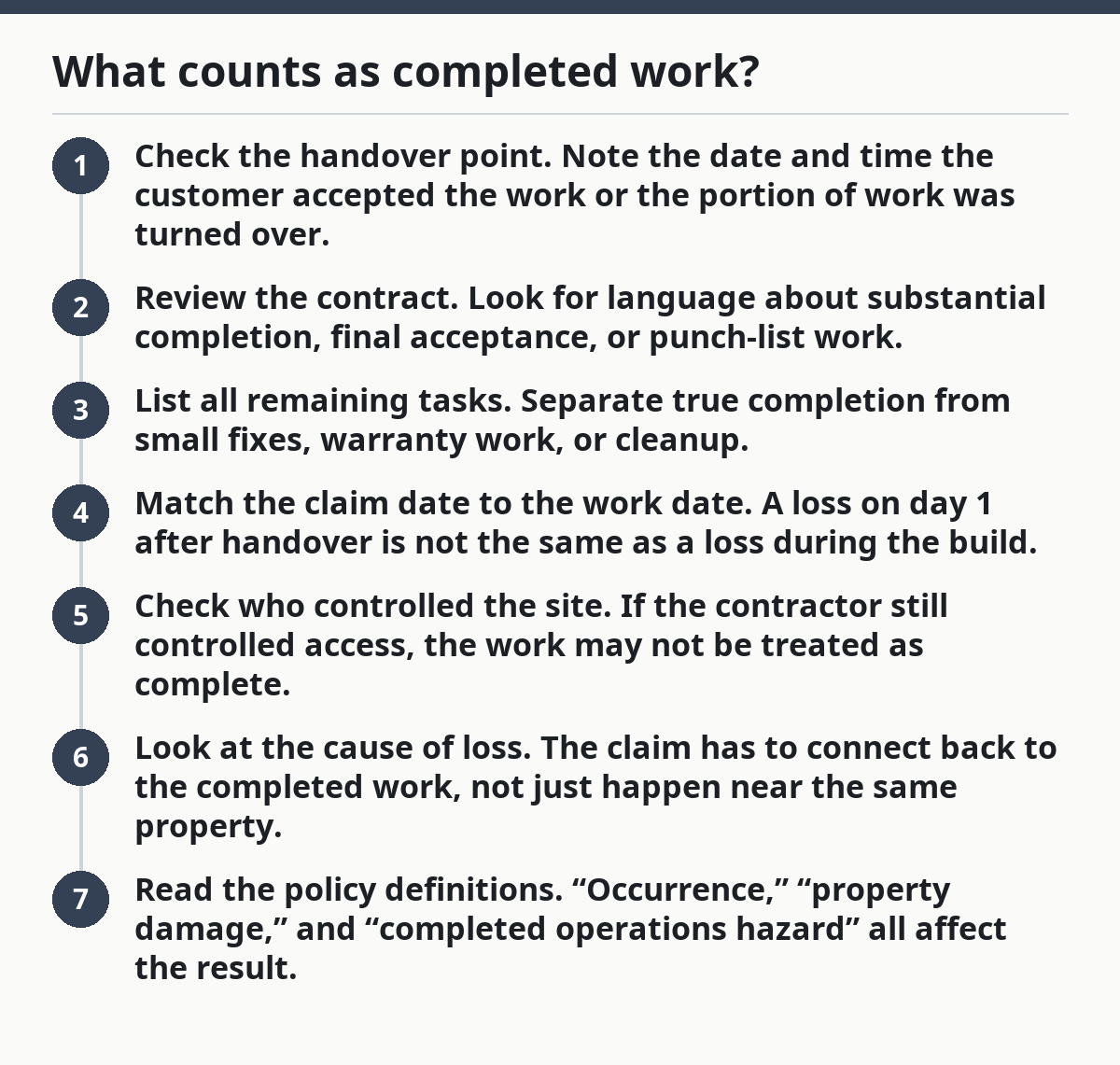
- Check the handover point. Note the date and time the customer accepted the work or the portion of work was turned over.
- Review the contract. Look for language about substantial completion, final acceptance, or punch-list work.
- List all remaining tasks. Separate true completion from small fixes, warranty work, or cleanup.
- Match the claim date to the work date. A loss on day 1 after handover is not the same as a loss during the build.
- Check who controlled the site. If the contractor still controlled access, the work may not be treated as complete.
- Look at the cause of loss. The claim has to connect back to the completed work, not just happen near the same property.
- Read the policy definitions. “Occurrence,” “property damage,” and “completed operations hazard” all affect the result.
The problem is not usually the word “finished.” It is the paperwork around it. A certificate of completion, a sign-off email, or a final invoice can help show the handover point, but none of them overrides the policy wording by themselves. If the contract says the work is complete but the policy treats certain corrections as still part of the job, the claim can still be argued.
Why completed operations coverage matters on construction claims
Completed operations coverage matters on construction claims because many losses show up after the crew is gone and the building is in use. That is when hidden defects, install errors, or weak work can turn into injury or property damage claims.
For example, if a client moves into a renovated space and weeks later a fixture breaks loose and damages a floor, the damage is no longer tied to active labor on site, so the question becomes whether the policy’s completed operations part applies.
- Construction claims often surface after project handover, not during the build.
- The claim may involve a finished component that failed later.
- The injured party may be the owner, a tenant, or a visitor who had no role in the original job.
- Even a small repair job can create a later claim if the defect is in the completed work.
This is where a lot of readers get misled by broad explanations of general liability. They hear “third-party damage” and assume the timing does not matter. It does. A cracked pipe that bursts during installation is a different exposure from a pipe that was installed, accepted, and later failed because of a hidden error. Same job family. Different policy lane.
The products-completed operations hazard is especially important when the work becomes part of a larger structure. Once the work is incorporated into a finished building, the claim can look less like a jobsite accident and more like a finished-product problem. That is why contract language, sign-off records, and repair logs are more than admin clutter. They are the map the claim examiner uses.
What people get wrong about completed operations
Completed operations gets misunderstood because people treat it like a bonus feature instead of a timing rule. That mistake can leave a reader thinking “the policy covers it” when the real issue is whether the claim fits the completed stage at all. Consult a qualified adviser if the policy wording is unclear.
For example, you may assume any claim on a finished project is automatically covered, but the policy excludes what was still in progress or what falls outside the named hazard. That is how a simple assumption turns into a denied claim.
- Mistake 1: Treating handover as a formality. Consequence: the claim may be argued as ongoing operations instead of completed operations. Correct move: keep a clear handover record.
- Mistake 2: Assuming warranty work is always part of completed operations. Consequence: later visits can muddy the completion date. Correct move: separate correction work from the original completion record.
- Mistake 3: Ignoring subcontractor timing. Consequence: a loss can involve work done by another trade at a different stage. Correct move: identify whose work was finished, and when.
- Mistake 4: Using the job label instead of the policy wording. Consequence: “repair,” “remodel,” or “install” does not decide coverage. Correct move: read the definitions in the policy form.
- Mistake 5: Forgetting the cause has to tie back to the work. Consequence: a later accident on site may not count if it is unrelated to the completed work. Correct move: trace the chain from the finished work to the alleged damage.
A generic article usually stops at “it covers claims after the work is done.” That is too thin. The harder truth is that after-completion claims are often fought over dates, scope, and whether the alleged defect belongs to the finished work or to something else on the property. That is why these claims are document-heavy and why a clean file matters.
When does completed operations coverage not fit?
Completed operations coverage does not fit when the loss belongs to active work, falls outside the completed work, or is blocked by other policy wording. That is the line readers need to see clearly.
For example, if you try to use a completed-operations label for a claim that happened while the crew was still working, or for damage unrelated to the finished project, that is the wrong tool.
Work was still being performed: the loss is tied to active labor, equipment use, or site access — look to the ongoing-operations side of the policy instead.
No handover happened: the owner never accepted the work, or the job was still open — the claim may not be treated as completed at all.
The loss is unrelated to the job: a later incident at the property does not count if it has no real link to the finished work — the claim may fall outside the hazard.
The policy wording excludes the event: some forms draw narrow lines around certain work, worksite conditions, or professional services — the exclusion can control.
The claim belongs to another policy layer: if the issue is a product sold, a design error, or something outside liability wording, completed operations may be the wrong bucket — check the form structure.
The best way to think about this is simple: completed operations is a timing-and-causation label, not a magic phrase. If either piece is weak, the fit gets shaky fast.
What wording should you look for in the policy?
You should look for the completed operations hazard, the definition of occurrence, and any language that separates it from ongoing operations. Those terms do the real work in the contract.
For example, you are reading the declarations page and the form language, trying to figure out why one claim seems to fit and another does not. The answer is in the definitions, not the marketing summary. See the commercial liability insurance policy design and terms hub for the larger policy structure.
- Find the hazard section. Look for “completed operations” or “products-completed operations hazard.”
- Read the completion definition. Check how the form treats abandonment, project handover, and final acceptance.
- Check exclusions first. An exclusion can remove an event even if it otherwise looks completed.
- Look for endorsements. A form can be modified by an endorsement, which may narrow or expand the wording.
- Note any time limits. Some claims-made forms and related wording can change how timing works.
- Match the facts to the definitions. Use the actual project dates, not a guess.
- Keep the documents together. Contract, invoice, handover note, and repair log belong in the same file.
A good result is not “the policy sounds broad.” A good result is being able to tell, from the paperwork, whether the loss belongs to completed work, ongoing work, or neither. If you cannot tell from the documents, the policy may still be fine, but the claim will be harder to place. That is a warning sign, not a verdict.
For a wider map of how liability policy language is built, the hub page on commercial liability insurance policy design and terms sits one level up from this topic.
How completed operations is handled in a claim file
Completed operations is handled by tying the loss date, the handover date, and the cause of damage to the finished work. That file review is what usually decides whether the claim is even sitting in the right bucket.
For example, a claim arrives 60 days after a remodel, and nobody can say exactly when the defect started or when the customer accepted the job. The adjuster will look for hard markers, not hunches.
- Start with the project handover date and any punch-list items.
- Add the claim date, loss date, and first notice of damage.
- Attach the scope of work so the finished part is clear.
- Separate the completed work from any later repair visits.
- Check whether the alleged damage came from the completed work itself.
- Note whether the site was still under the contractor’s control.
- Preserve photos, invoices, and written acceptance if they exist.
The point is not to “win” a claim by paperwork alone. The point is to give the policy language something concrete to attach to. If the dates line up and the work was truly finished, the completed operations bucket may be the right place. If not, forcing it there can slow the file and create a bad fit.
What counts as completed operations?
Completed operations is work that has been finished and handed over, so a later claim tied to that work may fall into that part of the policy. The exact line depends on the policy wording and the facts of the job. A final invoice alone is not always enough, and a small return visit can change the analysis.
Is completed operations part of general liability?
Completed operations is often discussed inside a liability policy, but the exact placement depends on the form and endorsements. In many policies it sits within the liability structure rather than as a separate standalone promise. The wording matters more than the label on the brochure.
When does completed operations coverage apply?
Completed operations coverage applies after the work is finished, handed over, or treated as complete under the policy language, and the claim is tied to that finished work. It does not turn on the trade alone. It turns on timing, handover, and causation, which can differ by country and by policy form.
Drafted with AI; not yet reviewed by a person.