Last updated: November 19, 2026
Commercial liability insurance contract requirements are the clauses, limits, documents, and exclusions a business policy must contain before it actually protects the risk you think it covers. This Commercial liability insurance contract requirements — The Complete Guide shows how to check those terms before a claim, a lease signing, or a project start. If the contract is missing the wrong wording, the claim can fall outside coverage even if the premium was paid on time.
Key takeaways
- The contract is only useful if it names the right insured, the right business activities, and the right date range.
- Certificates of insurance are not the policy; the policy wording controls when there is a dispute.
- Endorsements can help or hurt you, depending on whether they narrow coverage, add an insured, or impose extra duties.
- Contract requirements change with the deal: landlords, lenders, clients, and public agencies often ask for different terms.
- The hardest problems are usually not the limits themselves, but exclusions, additional insured language, and notice obligations.
- This is information, not financial advice. For your own situation, a qualified adviser, broker, or lawyer should review the wording.
Quick Answer: the fastest check is usually 3 documents — the contract, the declarations page, and the endorsement schedule. If those 3 do not line up, the coverage may not line up either.
If you are trying to sign a lease, win a contract, satisfy a lender, or make sure your own policy matches what a third party requires, the real question is: which terms must be in the policy so the paperwork and the actual coverage line up?
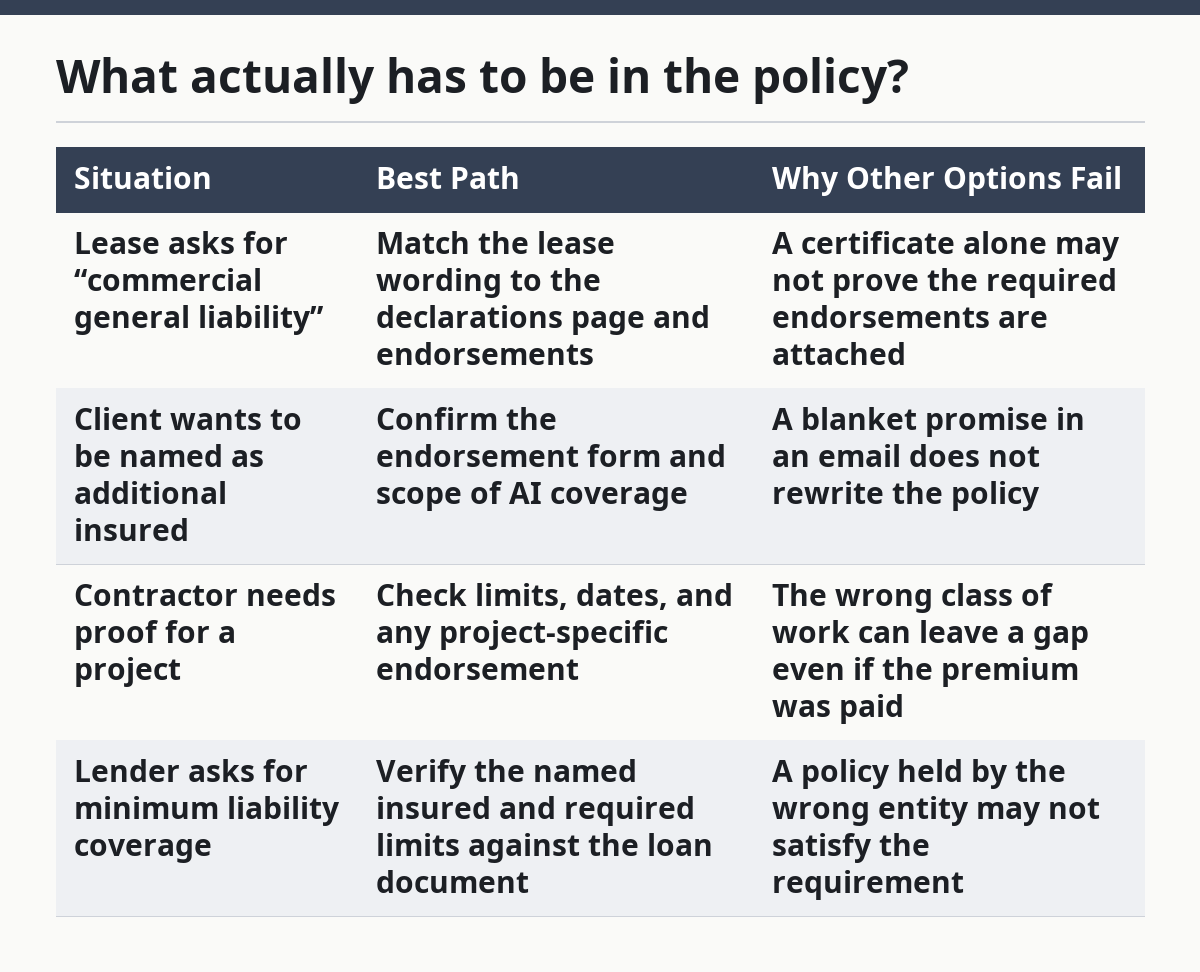
What actually has to be in the policy?
The policy has to identify the insured, state the covered business, define the policy period, describe the covered liability, and list the exclusions and endorsements that change the standard form. Without those pieces, the contract is too vague to rely on when a claim lands.
If you are comparing forms, start with the declarations page, then the body of the policy, then every endorsement. The declarations page usually shows the named insured, mailing address, policy number, effective dates, limits, and forms attached. That sounds basic, but a surprising number of disputes begin because the legal entity on the declarations page is wrong, or the location listed is not the one where the loss happened.
A standard commercial general liability form, often abbreviated CGL, usually works around the same core parts: bodily injury, property damage, personal and advertising injury, defense, and conditions. But the contract requirements are not just “have a CGL.” A lease might demand a specific additional insured endorsement, a subcontract might require primary and noncontributory wording, and a lender may want evidence of property or general liability coverage with a certain minimum limit. The policy has to match the requirement in substance, not just in name.
The other overlooked piece is the policy form itself. ISO forms are common in the United States, but country rules and local market forms differ, and outside the U.S. the structure can look very different. Even within one country, different carriers use different manuscript endorsements. If the requirement is specific, such as “waiver of subrogation,” “cross liability,” or “no exclusion for work at height,” the endorsement has to actually say it.
For details on policy language, see the Insurance Information Institute and the NAIC consumer resources. For policy form guidance, many brokers also compare wording with ISO form language and carrier endorsements.
| Situation | Best Path | Why Other Options Fail |
|---|---|---|
| Lease asks for “commercial general liability” | Match the lease wording to the declarations page and endorsements | A certificate alone may not prove the required endorsements are attached |
| Client wants to be named as additional insured | Confirm the endorsement form and scope of AI coverage | A blanket promise in an email does not rewrite the policy |
| Contractor needs proof for a project | Check limits, dates, and any project-specific endorsement | The wrong class of work can leave a gap even if the premium was paid |
| Lender asks for minimum liability coverage | Verify the named insured and required limits against the loan document | A policy held by the wrong entity may not satisfy the requirement |
Quick check: if the policy, lease, and certificate do not use the same legal names and dates, the paperwork is not aligned yet.
Which contract terms matter most when you sign a lease or client agreement?

The contract terms that matter most are the insured name, required limits, additional insured status, cancellation notice, waiver of subrogation, primary and noncontributory language, and any special exclusion tied to the work. If one of those terms is off, the deal can still close and the coverage can still fail.
If you are a tenant, contractor, consultant, or vendor, the other party usually wants risk shifted onto your policy. That is normal. The problem is that contract language often uses broad, casual wording while the policy uses narrower terms. A lease may ask for “all-risk liability coverage,” which is not a standard liability phrase, or a service contract may demand coverage for “any and all claims,” which no ordinary policy will promise. The answer is not to force the policy to mirror every sentence. The answer is to identify which clauses are actually enforceable and which ones only look impressive on paper.
The most common terms are:
- Named insured: the exact legal entity that owns the policy.
- Additional insured: a third party added by endorsement, usually for liability arising out of your work or premises.
- Primary and noncontributory: your policy responds first, without asking the other party’s policy to share the loss.
- Waiver of subrogation: the insurer gives up some right to recover from a covered party after paying a claim, if the form allows it.
- Cancellation notice: how much advance notice the carrier gives before cancelling or nonrenewing, subject to law and policy wording.
- Occurrence vs claims-made: whether coverage is triggered by when the event happened or when the claim was made and reported.
- Defense inside or outside limits: whether legal defense erodes the limit available to pay settlements or judgments.
If you are looking at a 1-year lease, a 12-month policy term usually makes the most sense operationally, but that does not solve the legal wording issue. A lease may also require a 30-day notice of cancellation even though state law or the insurer’s standard form may not promise that exact notice to the certificate holder. That is one of the biggest traps: parties write in a notice requirement that the carrier is not actually bound to give. For a contract with a strict notice clause, ask a broker or lawyer to review the policy and the local law before you rely on the wording. The NAIC consumer guidance is a useful starting point, but it is not a substitute for legal review.
Use this decision path:
- Read the contract first, not the certificate request form.
- Highlight every insurance-related clause, including exhibits and addenda.
- List each requested term as a checkable item: limit, additional insured, waiver, notice, deductibles, and exclusions.
- Match each item to the policy declarations page, then the endorsement schedule.
- Ask for revised wording if the contract asks for a promise the policy does not make.
- Keep the signed contract, policy, endorsements, and certificate in one file for the full policy term.
Quick check: if the contract says “must” but the policy only says “may,” the requirement is not met yet.
How do limits, deductibles, and self-insured retentions fit the contract?
They fit because they control how much loss you actually absorb before the insurer pays. If the agreement requires $1 million in liability coverage but the policy has a large self-insured retention or a high deductible, the nominal limit can look fine while the cashflow burden is not.
A lot of people focus on the policy limit and stop there. That is too shallow. Three different pieces can change the real protection:
- Per-occurrence limit: the most the policy pays for one covered event.
- Aggregate limit: the most the policy pays during the policy term for all covered events combined.
- Deductible or self-insured retention: the part the insured absorbs before the insurer responds, depending on the wording.
If the contract requires a minimum limit, check whether it specifies per occurrence, aggregate, or both. If it does not, the silence creates room for argument. Some contracts say “not less than $2 million each occurrence,” while others say “$2 million combined single limit.” Those are not identical promises. A combined single limit generally lumps bodily injury and property damage into one pot, while separate limits split them. The contract should be read with the policy form, not in isolation.
The deductible language matters too. A deductible is usually paid by the insured, but claims handling varies by policy. A self-insured retention often means the insured handles the defense or payment of that layer before the insurer steps in, and the wording can be stricter. If you are a small business with thin cash reserves, a large retention can turn a coverage problem into a liquidity problem even when the policy is technically in force.
This is where a generic “just increase the limit” answer fails. Higher limits can satisfy a contract request, but they do not fix a bad exclusion, a missing additional insured endorsement, or a limit that sits above a retention you cannot fund after a loss. If the contract only requires evidence of a limit, that is one path. If the contract also requires defense costs outside the limit, or no deductible on certain claims, then the details matter more than the headline number.
Use this path if the agreement names dollars but not structure:
- Identify whether the requirement is per occurrence, aggregate, or both.
- Check whether defense costs reduce the limit.
- Look at deductible and retention wording in the policy form, not the quote sheet.
- Confirm whether any required endorsement changes how the limit applies.
- Compare the contract’s dollar figure with the policy schedule and every attached endorsement.
- Flag any mismatch before signing, because retroactive fixes are harder after a claim or bid award.
Quick check: if you can pay the premium but not the retention, the policy may satisfy the contract on paper and still strain your business after a loss.
When is a certificate of insurance enough, and when is it not?

A certificate of insurance is enough only as proof that a policy exists on the date shown; it is not enough to prove the exact contract terms unless the underlying policy and endorsements also match. If the deal depends on special wording, the certificate is supporting evidence, not the contract itself.
This is one of the biggest misunderstandings in commercial liability work. A certificate usually summarizes coverages, dates, and limits. It does not rewrite the policy. If the contract requires an additional insured endorsement, the certificate may mention that status, but the endorsement controls if there is a dispute. That matters because certificates are often prepared by a broker or agent from the policy information available at the time. They are useful, but they are not magic.
If you are the party receiving the certificate, do not stop there. Ask for the actual endorsement pages and the declarations page. If the contract asks for specific wording, compare that wording against the policy form. A certificate that says “waiver of subrogation applies where required by written contract” is not the same thing as a policy endorsement that grants a blanket waiver. One is conditional and one is broader. That difference can decide whether a claim is tendered or denied.
If you are the party providing the certificate, be careful not to overstate what the policy does. A broker cannot usually create coverage by typing it onto a certificate. If the policy does not contain the requested endorsement, the certificate should not pretend otherwise. That can create a serious problem for all sides, especially after a loss.
One practical benchmark helps: if the contract has more than 2 or 3 insurance clauses, the certificate by itself is usually not enough to verify compliance. At that point, you need the actual policy documents in the file. The more tailored the requirement, the less useful the certificate alone becomes.
A short decision table:
| Situation | Best Path | Why Other Options Fail |
|---|---|---|
| Basic proof that a policy exists | Certificate may be enough initially | It does not prove the contract-specific wording |
| Lease or contract asks for AI, waiver, or notice | Review endorsements and declarations page | The certificate is only a summary |
| A claim has already happened | Pull the full policy package immediately | Gaps in wording matter more after the loss |
| The certificate says one thing and the endorsement says another | Follow the endorsement | The policy form governs over the summary |
Quick check: if someone says, “the certificate already covers it,” ask for the endorsement that actually creates the coverage.
The 3 conditions that change everything
The three conditions that change everything are the type of business activity, the legal entity that signs the contract, and the jurisdiction governing the agreement. If any one of those changes, the same policy language can produce a very different result.
If your work is low-risk office service, the usual commercial general liability structure may be enough to answer the contract. If your work includes construction, installation, product distribution, professional advice, or events with crowds, the standard wording can fall short fast. Construction adds completed operations issues. Professional advice raises errors-and-omissions questions. Product work introduces product liability and recall-adjacent exclusions. Event work can involve liquor liability, hired and non-owned auto, or premises issues tied to a temporary location.
The legal entity matters just as much. A sole proprietor, LLC, corporation, parent company, and subsidiary are not interchangeable in an insurance contract. If the contract is signed by “ABC Holdings, Inc.” but the policy names “ABC Facilities LLC,” the contract can look satisfied in spirit and fail in detail. That problem shows up often in related-company structures, franchises, and joint ventures. If the entity that performs the work is not the named insured, the policy may not respond the way the certificate suggests.
Jurisdiction is the third wild card. Insurance contract language is interpreted under local law, and rules differ on additional insured status, anti-indemnity provisions, notice, and enforceability of waiver language. Cross-border deals add another layer because policy forms, admitted carriers, compulsory insurance, and tax treatment may differ by country or state. A clause that is routine in one place may be unenforceable or commercially unrealistic in another. Because of that, consult a qualified broker or lawyer before you assume a cross-border requirement will work the same way in every market. See the OECD insurance overview and local regulatory guidance for the jurisdiction involved.
Use this order:
- Identify the exact work being done and whether it is premises, operations, products, completed operations, or professional advice.
- Confirm the legal entity signing the contract and the entity named on the policy.
- Check the governing law and venue clause in the contract.
- Compare the contract’s required endorsements with the carrier’s actual forms.
- Escalate if the work, entity, or jurisdiction changes during the policy term.
Quick check: if the work is more complex than a standard storefront or office, the answer is probably not a plain one-page certificate.
What are the edge cases where the normal advice breaks down?
The normal advice breaks down when the contract is unusual, the business structure is unusual, or the policy form is not a standard one. In those cases, the wording matters more than the label on the policy.
Here are the situations that need special handling:
-
Subcontract chains
What changes: The upstream contractor may require additional insured status, waiver of subrogation, and primary wording, all in one clause.
What to do instead: Match each requirement to an actual endorsement form, and check whether the endorsement applies only to ongoing operations or also to completed operations. A subcontractor on a 3-month job can still face a 3-year claim tail after the work is done. -
Professional services inside a larger contract
What changes: The deal may mix consulting with physical work, but the commercial general liability form often excludes professional negligence.
What to do instead: Separate the professional portion from the operational portion. If the contract expects the policy to cover advice, design, or estimation errors, the standard liability form usually will not do that. Ask a broker or lawyer to confirm whether a professional liability policy is needed. -
Certificates requested by a landlord or lender with strict notice language
What changes: The contract may demand 30 days’ prior written notice of cancellation, but the insurer may not promise that to a third party in the way the contract states.
What to do instead: Treat the notice clause as a drafting request, not as proof the carrier is bound. Verify what the policy and applicable law actually require, and get legal advice if the clause is part of a closing condition. The NAIC explains that policy terms and state rules control the actual notice duties. -
Multiple insured entities under one group
What changes: A parent, subsidiaries, and joint ventures may all touch the same deal.
What to do instead: Check which entity is named, which entities are added by endorsement, and whether the policy allows affiliated entities or joint ventures at all. A group structure can create a coverage gap even when everyone assumes “the company” is insured. -
Claims-made policies used where occurrence wording is expected
What changes: The policy depends on reporting rules and retroactive dates.
What to do instead: Confirm the retroactive date, extended reporting rights, and when the claim must be reported. A contract that only says “liability coverage” may not tell you which trigger it expects, but the trigger controls the result. -
International or cross-border work
What changes: Local compulsory coverage, admitted carrier rules, and policy language can differ sharply.
What to do instead: Treat the contract as a local-law problem as well as an insurance problem. A U.S.-style certificate may be accepted informally but not satisfy the local legal requirement. Ask local counsel to confirm the local filing, admission, or tax issue before you rely on the form.
Quick check: if your deal has subcontracting, advice, multiple entities, or cross-border work, the standard checklist is not enough by itself.
How do you check a contract requirement step by step?
You check it by reading the contract first, matching each clause to the policy, then fixing mismatches before anyone signs or starts work. If you do it in the reverse order, you end up trying to force a finished policy to fit a contract it was never written for.
Start with the exact agreement in front of you: lease, master service agreement, subcontract, vendor form, or loan covenant. Then mark every insurance clause. If the contract has an exhibit or insurance schedule, read that too. A requirement hidden in an appendix still counts.
Use this 6-step path:
- Pull the contract and highlight insurance language. Look for limits, named insured wording, additional insured status, waiver of subrogation, cancellation notice, deductibles, and any special exclusion language.
- Compare the named insured to the policy declarations page. The entity on the contract and the entity on the policy must match, or the policy must clearly cover the signing entity.
- Review the policy form and endorsements. Check the ISO form number or carrier form name, the endorsement schedule, and the effective dates.
- Match the required clauses one by one. If the contract needs primary and noncontributory wording, find the endorsement that says exactly that. If it needs completed operations, verify that the endorsement is not limited to ongoing work only.
- Check for conflicts. Look for exclusions tied to your actual activity, such as construction defects, professional services, assault and battery, pollution, cyber, auto, or employment-related claims.
- Document the result in writing. Keep the contract, declarations page, endorsements, and certificate together, and record any mismatch that needs revision.
If a mismatch appears, do not assume a certificate correction is enough. A corrected certificate can help with administration, but it does not cure a policy gap by itself. The fix may require a different endorsement, a revised contract clause, or a different policy structure. That is especially true where the contract is a condition of a lease signing, loan closing, or project award. For a fast check, keep the contract, policy, and endorsements together in one file and ask a qualified adviser to review them before the deadline.
One practical benchmark: if you cannot explain the coverage in two minutes using only the contract and endorsements, the file is not clean enough yet.
Quick check: if the answer depends on a promise that only appears in an email or certificate, you need to keep digging.
What are the most common mistakes people make?
The most common mistake is treating the certificate as the contract and ignoring the endorsements, exclusions, and entity names. That mistake is costly because the summary sheet is the weakest document in the stack.
Another common error is assuming all liability forms are interchangeable. A CGL policy does not automatically cover professional advice, employee injuries, auto use, pollution, or cyber incidents. A general liability policy can still leave major holes if the contract quietly includes those risks. People also miss the difference between occurrence and claims-made coverage. That difference is not academic; it changes when the policy responds and what reporting deadline applies. A claims-made form can be perfectly proper for the wrong deal and still leave the business exposed if the reporting window is missed.
A third mistake is accepting broad contract wording that no policy can fully satisfy. Phrases like “cover any claim arising from the work” or “insure against all losses” are often overbroad. They may need to be narrowed or clarified before the deal is signed. If the other side will not change the clause, the reader has a legal and business problem, not just an insurance one.
A fourth mistake is ignoring local law. Limits, notice rules, compulsory wording, and enforceability vary by place. A requirement that sounds standard in one market may not be standard in another. That is why the same 1-year policy can be acceptable in one country and useless for a contract in another.
The final mistake is waiting until after a loss. Once the claim is on the table, there is far less room to fix wording, negotiate an endorsement, or rewrite the contract. The time to check is before the signature page goes out or before work starts.
Quick check: if someone tells you “it’s standard,” ask standard for which form, which jurisdiction, and which exact endorsement.
FAQ
What is the most important requirement in a commercial liability policy contract?
The most important requirement is that the policy names the right insured and actually covers the activity the contract is asking about. If either one is wrong, the rest of the paperwork can look fine while the claim falls apart.
Is a certificate of insurance the same as the policy?
No, a certificate of insurance is only a summary, not the actual contract. The policy and its endorsements control if there is a dispute, and those documents can narrow or expand what the certificate seems to show.
Do all contracts require additional insured coverage?
No, but many leases, subcontracts, and vendor agreements do. If the contract asks for it, the endorsement has to exist and match the wording closely enough to cover the intended risk.
What happens if the contract asks for a 30-day cancellation notice?
That request does not automatically mean the insurer gives that notice to the third party in the exact form written in the contract. The policy, the endorsement, and local law control what notice is actually required or available. A broker, adviser, or lawyer can help confirm the wording before you rely on it.
Should I use the same policy for every contract?
Not automatically. Different contracts can ask for different limits, endorsements, and risk allocations, so the same policy may fit one deal and miss another. A qualified adviser should review the specific contract and policy wording for your situation.
Drafted with AI; not yet reviewed by a person.