Last updated: November 19, 2026
Quick Answer: In the certificate holder vs additional insured comparison, the certificate holder is usually only a document recipient, while an additional insured is added to the policy by endorsement and may gain insured status.
Key Takeaways
- A certificate holder is a document role; an additional insured is a policy status.
- A certificate holder gets proof and notice, not insured rights.
- Additional insured status can shift policy protection when contract risk transfer is required.
- The answer depends on proof, rights, and enforceability in the contract file.
A certificate of insurance can look reassuring and still leave the wrong party exposed. That happens a lot. If you are reading a certificate of insurance and wondering whether the certificate holder is protected the same way as an additional insured, the short answer is no: a certificate holder is usually just the party receiving proof of coverage, while an additional insured is a party added to the policy by an endorsement and may gain insured status under that policy.
I write on commercial insurance and contract paperwork, and this distinction matters because one line on a certificate can change who can actually make a claim. Vendor onboarding, landlord requirements, subcontractor compliance — all of them bring up the same issue. In practice, the certificate holder vs additional insured question is the difference between proof of coverage and policy rights.
The real difference between a certificate holder and an additional insured
A certificate holder is a document role; an additional insured is an insurance status. That is the cleanest way to think about it.
Named on the certificate of insurance, the certificate holder is the party receiving evidence that a policy exists. That certificate shows policy dates, carrier name, and selected coverage information. It does not amend the policy. By contrast, the additional insured is added through an endorsement and gains insured status for some covered claims, subject to the policy terms.
So the certificate holder can be a landlord, general contractor, client, or permit office and still have no direct rights under the policy. The certificate can be accurate and still leave the holder with no claim rights. An endorsement changes the policy; a certificate reports on it.
A useful mental test is this: if the policy were a building, the certificate holder is on the guest list, while the additional insured is given a key for a defined part of the building. The guest list does not open the door.
This is the distinction most people miss when they assume a certificate holder is “covered.” Usually, the certificate says what exists on the date it was issued. It usually does not grant policy rights, change exclusions, or force the insurer to treat the holder as an insured. For that, consult the endorsement language itself or a qualified professional. See the NAIC on certificates of insurance and the need to review policy wording: https://content.naic.org/cipr-topics/certificates-insurance
For a broader workflow view, the hub on commercial liability insurance certificate and contract workflow fits here, because this question usually appears during onboarding and contract review, not after a loss.
What a certificate holder actually gets
A certificate holder gets notice and documentation, not insured status. Enough for many contracting workflows. That is the right tool when the goal is to confirm that a vendor or subcontractor has active insurance on paper.
The certificate holder can see that a policy exists, who issued it, the policy term, and often the general type of coverage. In a commercial general liability context, that is often all the holder needs to decide whether a file is complete. If the contract only asks for evidence of insurance, the certificate is the document that satisfies the request.
The weakness is just as important: the certificate holder usually has no policy rights. No automatic right to defense, no direct claim position, and no power to expand coverage by reading the certificate alone. If the policy lapses the next day, the certificate does not keep it alive. If the certificate is poorly completed, the paper can look reassuring while the underlying policy still does not meet the contract.
That is why a certificate holder is the right category for administrative proof, not for risk transfer. A certificate can support a vendor file, but it is not a substitute for contract language when the real goal is shifting liability. Speed helps here, but it does not replace coverage. The trade-off is simple: fast to issue, easy to collect, limited for enforcement.
This is often a practical fit for owners, property managers, and procurement teams that need proof of coverage before work starts. When the contract language is trying to create insured status, though, it is wise to consult a professional. If the contract requires coverage for the holder’s own exposure arising out of the work, a certificate alone is not enough. The ISO certificate form itself is informational; the policy and endorsements control coverage. See ISO 2010 certificate wording and documentation practice: https://www.irmi.com/articles/expert-commentary/certificate-of-insurance
The key limitation is simple: a certificate holder is evidence that insurance may exist, not proof that the holder itself is an insured party.
What additional insured status changes
Additional insured status changes the policy relationship itself, which is why it matters when the contract is trying to transfer risk. That status is usually created by an endorsement, not by the certificate.
An additional insured is typically added so that the named insured’s policy may respond to certain claims connected to the named insured’s work. In practice, that can matter when a general contractor wants coverage under a subcontractor’s liability policy, or a landlord wants some protection tied to tenant operations. The point is not paperwork; the point is insured status.
The upside is concrete. The additional insured may have access to defense and indemnity for covered claims, but only within the endorsement’s scope and the policy’s exclusions. The policy language still controls. If the endorsement is limited to ongoing operations, completed operations may not be included. If the endorsement is narrow, the protection is narrow. A lot of contract fights happen right there.
The downside is also concrete. Additional insured status is not a blank check, and it is not the same as being a named insured. It usually does not give the same breadth of control over the policy, and it can be drafted tightly enough that the promised protection is thinner than the contract language suggests. It also depends on the endorsement form used by the carrier, which is why reading the certificate alone is a mistake.
This option is often the better fit when the contract actually needs risk transfer, not just a file copy. It suits project owners, upstream contractors, and landlords who want their own exposure tied to the other party’s operations to be addressed through the policy itself. The New York Court of Appeals has repeatedly treated endorsement wording as controlling, not the certificate alone. See the court’s insurance coverage decisions at: https://www.nycourts.gov/reporter/3dseries/2024/2024_00000.htm
It is not the best choice when the only goal is document collection. If all you need is proof that a vendor carries insurance, asking for additional insured status can create avoidable friction and extra review without changing the practical risk much. Consult a professional if the contract also asks for primary wording, notice, or waiver language.
The honest side-by-side
The answer changes once you compare the two on the terms that matter in a contract file: proof, rights, and enforceability. A certificate holder is lighter and faster; an additional insured is stronger and more specific.
| Criteria | Certificate Holder | Additional Insured | Winner for the condition |
|---|---|---|---|
| Role on the document | Receives the certificate | Added by endorsement to the policy | Additional insured, if the goal is policy protection |
| Proof of coverage | Shows that a policy exists | May also be listed on an endorsement or related paperwork | Certificate holder, for simple evidence requests |
| Insured status | No insured status by itself | Gains insured status for defined claims | Additional insured |
| Policy rights | Usually none | Some rights, limited by endorsement terms | Additional insured |
| Contract risk transfer | Weak | Stronger when properly endorsed | Additional insured |
| Ease of obtaining | Usually straightforward | Often requires review and carrier action | Certificate holder |
| Scope of protection | Informational only | Depends on endorsement wording and exclusions | Additional insured, if scope matches the contract |
| Typical use case | Vendor compliance, file tracking | GC/subcontractor, landlord/tenant, upstream risk allocation | Depends on the contract |
| Chance of false comfort | Lower, because the role is clearly administrative | Higher, if people assume the endorsement is broader than it is | Certificate holder |
| Works as a substitute for coverage | No | Sometimes, but only within the endorsement terms | Additional insured |
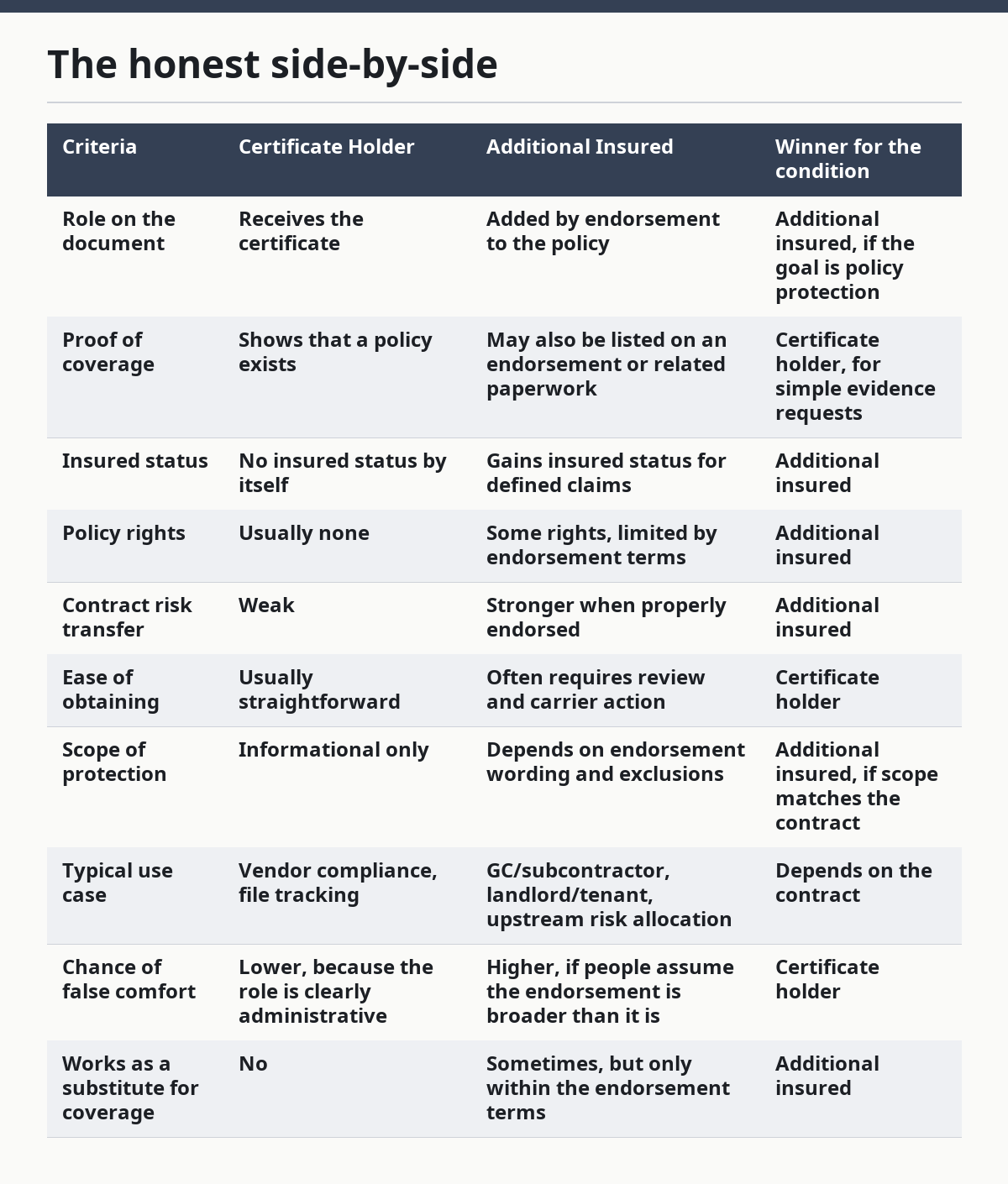
The table points to a plain answer: if the question is “Who gets real protection under the policy?” the additional insured wins. If the question is “Who receives proof that insurance exists?” the certificate holder is the document role you are actually looking for.
The trap is assuming those two questions are the same. They are not. A certificate holder can sit on a certificate without receiving any coverage benefit at all. An additional insured can have coverage rights even if the certificate itself is plain and unremarkable.
That is why a contract reviewer should treat the certificate as a checkpoint and the endorsement as the real evidence of status. The certificate is the receipt; the endorsement is the policy change. Consult counsel or an insurance broker if the endorsement language does not match the contract requirement.
When a certificate holder is enough
A certificate holder is enough when the purpose is administrative proof, not risk transfer. That is the right call for onboarding packets, vendor registries, permit files, and routine compliance checks where the contract only asks for evidence of insurance.
This is the better option when the receiving party does not need direct protection under the policy and only wants to see that the named insured carries the required coverage on the right dates. In those cases, a certificate of insurance does the job with less back-and-forth. It is easier to issue, easier to file, and usually easier to understand.
The drawback is that “enough” has a narrow meaning. A certificate holder is not protected simply because the certificate names them. If a contract clause says the other party must be an additional insured, a certificate holder designation does not satisfy that requirement. The difference matters most when there is a claim and someone tries to turn paperwork into coverage.
This use case works best when the risk is modest, the contract wording is simple, or another clause already handles indemnity and insurance in enough detail. It also works when a third party such as a city office only needs to see that a policy exists and does not need to be added to the policy itself. In New York, for example, certificates are commonly used for administrative tracking, while endorsements control the actual coverage terms. See the New York Department of Financial Services guidance: https://www.dfs.ny.gov/industry_guidance/insurance/certificates_of_insurance
The wrong move is to treat the certificate holder line as a substitute for a negotiated insurance clause. It is not a policy amendment, and it is not a defense promise.
When additional insured status is the better fit
Additional insured status is the better fit when the contract is trying to shift real liability exposure, not just collect paperwork. That is the right answer for many construction, landlord-tenant, and vendor-risk arrangements where one party wants its own exposure tied to the other party’s operations addressed in the policy.
The strength here is legal structure. An endorsement can attach the requesting party to the policy in a way a certificate cannot. That matters if the contract says the upstream party must be protected for claims arising out of the downstream party’s work. The policy endorsement is the mechanism that can make that happen.
The weakness is that the protection is only as broad as the endorsement. A party can be an additional insured and still discover that the endorsement is limited, the exclusion language is broad, or the covered operations do not match the contract. That is why reading the endorsement matters more than staring at the certificate. A certificate that says “additional insured” without the actual endorsement tells only part of the story.
This is the better fit when the other side’s operations create the risk and the contract explicitly asks for policy-backed protection. It is also the better fit when the party requesting coverage wants a real claim position instead of a document for the file. The risk-transfer goal is usually more important than speed in that setting.
It is not the right fit for simple compliance requests. If the contract does not call for insured status, pushing for additional insured wording can slow the process and create disputes over forms that add little practical value. If the purpose is only to collect proof, a certificate holder request may be enough.
The verdict: which one to choose and why
Choose certificate holder if you only need proof that a policy exists and you do not need your own insured status under the policy. Choose additional insured if the contract is meant to transfer risk and you need the endorsement to create policy rights. Neither if you think a certificate alone gives coverage you can rely on in a claim.
That is the clean rule. If you are the party collecting documents, the certificate holder line may be all you need. If you are the party trying to protect your own exposure, the endorsement is the real target. The mistake is mixing the two and assuming a document role can do an insurance role’s job.
If I had to reduce the whole issue to one sentence a contract reader can use, it would be this: a certificate holder gets evidence, an additional insured gets status. Those are not the same thing, and courts, carriers, and claim handlers do not treat them as the same thing.
For policy wording and contract review, the most useful next step is to compare the certificate, the endorsement, and the contract clause together. That is where mismatches show up.
When to rethink the choice entirely
Reconsider both labels if the contract is trying to do more than evidence or risk transfer. That happens when the clause asks for primary and noncontributory wording, a waiver of subrogation, or a specific endorsement form from a carrier. Those are separate questions, and a certificate holder versus additional insured discussion does not solve them.
A second exception is when the certificate is being used to prove something it cannot prove. A certificate can summarize coverage, but it usually cannot rewrite exclusions or create rights that are missing from the policy. If the underlying form is the wrong one, the certificate will not fix it.
A third exception is when the contract needs notice rights or defense wording that the certificate does not address. In that case, the issue is not “certificate holder or additional insured” alone; it is the exact policy language and endorsement package.
A fourth exception is when the requested protection is broader than the policy can realistically provide. If the contract demands coverage for unrelated acts, blanket protection, or terms the insurer does not offer on that form, the better answer may be to renegotiate the clause rather than force the certificate into a job it cannot do.
Those cases are why contract review beats checkbox compliance. The label on the certificate is only the beginning.
Can a certificate holder become an additional insured?
Yes, but only if the insurer issues an endorsement or other policy change that adds that party to the policy. The certificate holder line by itself does not do that. A party can appear as a certificate holder on one document and later become an additional insured through separate policy paperwork. The policy, not the certificate, controls the change.
Does additional insured status appear on the certificate?
Sometimes it does, but the certificate alone is not enough to prove the status. A certificate may show that additional insured wording was requested or issued, yet the actual endorsement is the controlling document. If the certificate and endorsement conflict, the endorsement matters more.
Which one gives actual coverage?
Additional insured status is the one that can provide actual policy protection, but only for the claims and limits the endorsement covers. A certificate holder usually gets no coverage at all from being named on the certificate. The certificate is evidence; the endorsement is the source of rights.
Drafted with AI; not yet reviewed by a person.