Last updated: November 19, 2026
Quick answer: before a liability policy is bound, the broker should verify 6 core items — the proposal, the named insured, the effective date, the limits, the endorsement requests, and the contract wording that triggered the placement. If any of those are off, the bind can create a coverage gap, a wrong certificate, or a limit that does not match the deal. This page is about What an Insurance Broker Should Check Before You Bind a Liability Policy, and the broker should consult a qualified professional for the reader’s own situation.
Key takeaways
- A bind is the last chance to catch mismatched names, dates, limits, and wording before the policy starts.
- The bind request should match the proposal, the contract, and any certificate needs line by line.
- Endorsements matter because a standard form rarely matches every deal without changes.
- The wrong effective date can leave a gap between what the client expects and what the policy actually covers.
- If the account has unusual limits or layered coverage, the broker should slow down and confirm the full structure before binding.
Who is this for?
This checklist is for a broker who already has a quoted or negotiated liability policy and is about to send the bind request. It assumes the client, the class of business, the proposed limits, and the main coverage form are already known. The job here is not to re-underwrite the account from scratch; it is to catch the mistakes that show up in the last 24 hours before binding.
This is also for a broker handling commercial general liability placement, professional liability placement, or another liability form where the terms need to line up with a contract. It is not the right step for a case that still has open underwriting questions, a disputed insured name, or a contract that demands wording the carrier has not approved. In those cases, binding first and sorting it out later can put the insured in a bad position.
A simple way to think about this page is that it covers the final verification step in the binding checklist for liability insurance. The broker is checking whether the policy that will be issued actually matches the deal the client is trying to close. One wrong digit in an effective date or one missing additional insured request can matter more than a full page of general policy language. See also our commercial general liability checklist and certificate of insurance guide.
What should be confirmed before binding coverage?
The broker should confirm that the policy the carrier is about to issue matches the proposal, the insured’s legal name, the effective date, and the contract language that drove the placement. That sounds basic, but those are the items that most often create trouble after the bind.
Start with the proposal accuracy. The proposal should show the correct named insured, business description, location, operations, limit structure, and any requested endorsements. If the bind request repeats a detail that never made it into the proposal, that is a warning sign. A bind based on a sloppy proposal can leave the insured with a policy that looks right in the email and wrong in the issued form.
Then check the effective date. The policy should start when the insured needs coverage, not when the paperwork happens to land. If there is any gap between the prior policy’s expiration and the new one’s start, that gap can become the entire problem if a claim arises in the middle.
The broker should also check the named insured details exactly as they appear on the legal entity documents. That includes the legal entity type, any trade name, and whether one company, a parent, or a subsidiary is meant to be on the policy. If the wrong entity is named, the insured may think coverage exists for the operating company when the policy names a different one.
Finally, check any certificate needs and contract requirements before the bind goes out. If a landlord, client, or customer needs specific wording, the policy should be issued in a way that can support the certificate later. A certificate cannot create coverage on its own, so the bind has to line up with the contract from the start. The Insurance Information Institute explains that a certificate is evidence of insurance, not the policy itself, and ACORD materials are commonly used for certificate forms. (Source: Insurance Information Institute / ACORD)
How should the broker check the bind request?
The broker should compare the bind request against the proposal and the contract line by line, then send only the items the carrier needs to issue the policy correctly. A good bind request is a clean instruction set, not a loose email thread.
-
Match the named insured to the legal entity. Use the exact business name, entity type, and any DBA only where it belongs. Verify against formation documents, the quote file, and the contract party name. If the policy names the wrong company, the problem is structural, not clerical.
-
Confirm the effective date and any retroactive date. Write the start date clearly and make sure it matches the intended coverage window. Verify there is no gap with the prior policy. If the dates do not line up with the transition, the bind may leave the client exposed between policies.
-
Check the coverage form and limits. Confirm the liability form, each limit, any aggregate limit, and whether the account needs a primary or excess layer. For larger accounts, excess limits can matter when the underlying policy is moved from $1M to $2M or more. If the bind request is silent on structure, the carrier may issue the wrong tower.
-
List every endorsement request the contract requires. Name the exact endorsement type, not just the business goal. Verify whether the request is for additional insured status, waiver language, primary and noncontributory wording, or another contract term. If the request is vague, the issued endorsement may not satisfy the contract.
-
Check certificate instructions. State who needs the certificate, what name they should appear under, and what wording the certificate must reflect. Verify that the certificate request matches the policy terms, not a version of the deal from an earlier draft. If the certificate asks for wording the policy cannot support, the broker needs to stop before binding.
-
Confirm underwriting facts that affect the issue. Confirm operations, locations, employee count if relevant, and any exposure that changes the class description. A wrong class description can lead to a policy that is technically bound but poorly fitted to the risk. That is a mismatch, not a small typo.
-
Review any premium or rating method language if the account is unusual. Retrospectively rated insurance is a way to set premium on large commercial accounts, and the rating formula is part of the insurance contract. If that structure is in play, the broker should confirm the wording before binding, because the pricing method itself is part of the deal. The National Council on Compensation Insurance explains retrospective rating in that same general way for workers’ compensation and large-account pricing structures. NCCI retrospective rating
-
Get final carrier confirmation in writing. Verify that the bind request was accepted and that the carrier acknowledged the key terms. If the response leaves out one of the requested items, the broker should consult a qualified insurance professional and treat that as unresolved, not as approval by silence.
A clean bind request lowers the chance of an issue later, but it does not erase the need to read the issued policy. It only makes the issued policy more likely to reflect the intended deal. See also policy wording review and liability endorsement checklist.
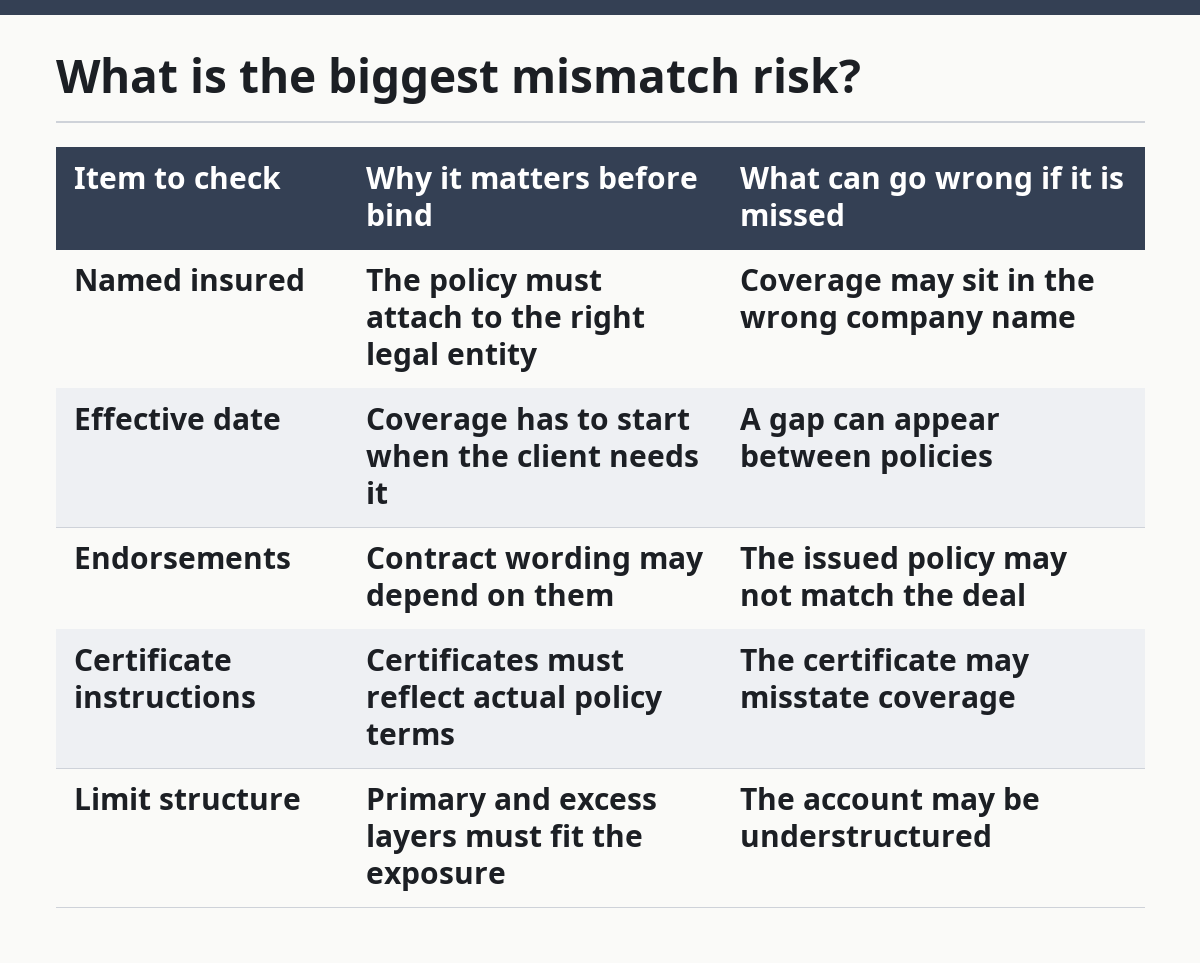
What is the biggest mismatch risk?
The biggest mismatch risk is that the client thinks the bind follows the contract, while the policy follows the carrier’s standard form. Those are often not the same thing.
This is where endorsement requests matter most. If a lease, vendor agreement, or service contract asks for wording that the standard policy does not already include, the broker has to check whether the carrier will attach the right endorsement before binding. If the carrier will not, the broker needs to know that now, not after the certificate is sent.
The same risk appears with limits. For some larger commercial accounts, an excess layer may be needed because the underlying policy does not answer the whole demand. Morrow says that for employers with hundreds of employees or benefits administration, a $2M to $5M per-claim demand is usually met with an excess layer, and the underlying policy can be moved from $1M to $2M or more. That kind of structure should be checked before bind, because the wrong limit stack changes the whole placement.
There is also a timing risk. If the effective date is wrong by even one day, the client may assume uninterrupted coverage when there is a break. That break is often not visible until there is a claim or a contract dispute. The broker should not let a rushed bind hide a date problem.
| Item to check | Why it matters before bind | What can go wrong if it is missed |
|---|---|---|
| Named insured | The policy must attach to the right legal entity | Coverage may sit in the wrong company name |
| Effective date | Coverage has to start when the client needs it | A gap can appear between policies |
| Endorsements | Contract wording may depend on them | The issued policy may not match the deal |
| Certificate instructions | Certificates must reflect actual policy terms | The certificate may misstate coverage |
| Limit structure | Primary and excess layers must fit the exposure | The account may be understructured |
When should the broker stop and get help?
The broker should stop when the bind cannot be matched cleanly to the contract, the policy structure, or the legal entity. In liability work, “close enough” can turn into a coverage dispute after a loss.
Wrong named insured on the contract and policy: This means the entity that signs the contract is not the entity being insured — do not bind until the legal names are corrected.
Endorsement wording the carrier has not approved: This means the client wants a term the policy may not support — pause and get the carrier’s written position.
Unclear effective date or gap in coverage: This means the policy may start too late — hold the bind until the date problem is fixed.
Limit request does not match the exposure: This means the placement may be too small for the deal — review whether the structure needs to change before binding.
Retrospective rating or unusual premium structure is involved: This means the rating method is part of the contract, not an afterthought — confirm the exact wording before the bind goes out.
Certificate promise goes beyond the policy: This means the certificate would say more than the policy can support — stop and narrow the instruction.
This is the point where a broker should slow down rather than hope the issue can be cleaned up later. If the placement has layered limits, unusual endorsements, or a contract that demands exact wording, a mistake at bind time can follow the policy for the whole term.
What mistakes cause the most trouble?
The most common mistakes are small on paper and expensive in the real world. A bind file with one wrong line can create work for everyone after the policy is issued.
One mistake is treating the bind request like a quick email rather than a final instruction. The consequence is a policy that reflects old wording, not the negotiated terms. The better alternative is a short checklist that matches the proposal, the contract, and the requested endorsements, and the broker should consult a qualified professional if the carrier response is incomplete.
Another mistake is assuming the certificate solves the problem. A certificate is evidence of insurance, not a replacement for the policy form. If the policy does not support the wording, the certificate will not fix that mismatch.
A third mistake is ignoring the named insured structure. If the operating company, parent, and trade name are mixed up, the insured may not be the party the client thought was protected. The safer alternative is to verify the exact legal name before the bind.
A fourth mistake is rushing the effective date. That can leave a coverage gap or create a dispute about whether the policy was in force on the right day. The better alternative is to confirm start and end dates in the bind request and in the carrier acknowledgment.
A fifth mistake is letting a contract requirement sit in a separate email thread. That breaks the chain of instructions and makes it easy to miss a needed endorsement. The better alternative is to pull contract wording into the bind file itself. See also additional insured wording and certificate wording checks.
When does the standard checklist need to change?
The standard checklist needs to change when the account has a layered program, a large excess demand, or a special premium arrangement. Those are not rare problems, but they do require more than a basic bind review.
If the account needs an excess layer, the broker should verify how the underlying and excess pieces fit together. Morrow notes that a $2M to $5M per-claim demand is usually met with an excess layer for employers with hundreds of employees or benefits administration, and that the underlying policy can be moved from $1M to $2M or more. That means the bind check has to include the whole stack, not just the first policy form.
If the account uses retrospective rating, the broker should confirm the rating formula and make sure the contract language is final. The National Council on Compensation Insurance describes retrospective rating as a method used on large commercial accounts, and the rating formula is part of the insurance contract. That makes the rating language part of the pre-bind review, not a back-office detail.
If a state-specific rating plan applies, the broker should remember that prices are based on rating plans that may vary by state, according to State Farm. That means a bind prepared for one location may not transfer cleanly to another without a fresh check.
If the client is asking for a very specific carrier financial profile, independent rating agencies can provide information on financial viability, and insurers are rated by agencies such as AM Best, according to Wikipedia. That fact belongs in the placement discussion, but the pre-bind step still has to focus on whether the issued policy terms match the request.
How does this fit into the bigger policy design process?
This checklist sits at the end of the commercial liability policy design process, after the terms have been negotiated and before the policy is locked in. It is the last place to catch a naming error, a date error, or an endorsement mismatch before those problems become issued policy language.
It is also the point where the broker translates the deal into instructions the carrier can actually execute. That is why the bind request matters so much. A good bind request is not just administrative work; it is the bridge between the placement file and the policy that the insured will rely on.
If the broker checks the proposal, the named insured, the effective date, the endorsements, the certificate needs, and the contract wording, the bind is far more likely to reflect the deal the client expects. If those items are not aligned, the right move is to stop and fix the file before the policy is bound. For related steps, see liability policy placement and commercial policy review.
What should be confirmed before binding coverage?
The broker should confirm the named insured, the effective date, the coverage limits, the endorsement list, and any contract wording that the policy must support. Those items should match the proposal and the carrier’s written acknowledgment. If one of them is unclear, the bind is not ready.
What mistakes can cause a bad bind?
A bad bind usually comes from a wrong entity name, a wrong date, a missing endorsement, or a certificate promise that the policy cannot support. The result can be a coverage gap or a policy that does not match the contract. The safer move is to stop before the carrier issues the wrong form.
What should be in the final instructions to the broker?
The final instructions should name the insured exactly, state the effective date, list the limits and any excess layer, and spell out every endorsement and certificate requirement. The instructions should also point to the contract language that drove those requests. If the carrier needs clarification, that should be answered before the bind is accepted.
Drafted with AI; not yet reviewed by a person.