Last updated: November 19, 2026
Key Takeaways
- Include the who, what, when, where, and how in order, plus the documents that support them.
- List events from the first relevant act to the last immediate response, without unexplained gaps.
- State the date, time, place, and key conditions, such as wet flooring, a blocked aisle, or active work.
- Name every relevant person only by the role they actually played.
A claim narrative for your liability insurer should give a clean, dated account of what happened, who was involved, and what documents support it. Include the facts, the timeline, the people, the loss, and the attachments—leave out guesses and blame. The sections below show what belongs in a claim narrative for your liability insurer and what does not.
What a claim narrative is for, and who should write it
A claim narrative is the written summary that helps your liability insurer understand the event in plain English; it is not the same thing as a demand letter, a lawsuit response, or a witness statement. If you are dealing with a commercial liability claim in the United States, this is general information, not legal advice, and a qualified lawyer should be consulted on the facts of your matter.
For What to Include in a Claim Narrative for Your Liability Insurer, the goal is a factual summary, not a legal brief. Picture this: you need to explain a 20-minute incident that unfolded in a store, warehouse, or job site, and the insurer needs the story without having to chase five people for the basics. The narrative should be written by the person who knows the facts best, usually the insured, a manager, or someone who coordinated the incident report.
Use it when the insurer asks for a written account, when you want to keep the record organized, or when the event has several moving parts. It works best when you already have the incident date, location, names, and any basic supporting records in hand.
- It assumes you know the core facts.
- It does not assume you have every document yet.
- It should be factual enough that another person could read it and follow the sequence.
Here’s the catch: a claim narrative is not the place to argue the case. A statement like “the other side is clearly wrong” reads like opinion, not a useful account.
What should a claim narrative include?
A claim narrative should include the who, what, when, where, and how in a tight chronology, plus the documents that back it up. That means the incident timeline, the people involved, the property or activity at issue, the immediate response, and any known loss or injury.
For What to Include in a Claim Narrative for Your Liability Insurer, the structure matters as much as the facts. Picture this: you are writing for an adjuster who did not see the event and may not know your business site, your contractor setup, or your job roles. The cleaner the structure, the less room there is for confusion.
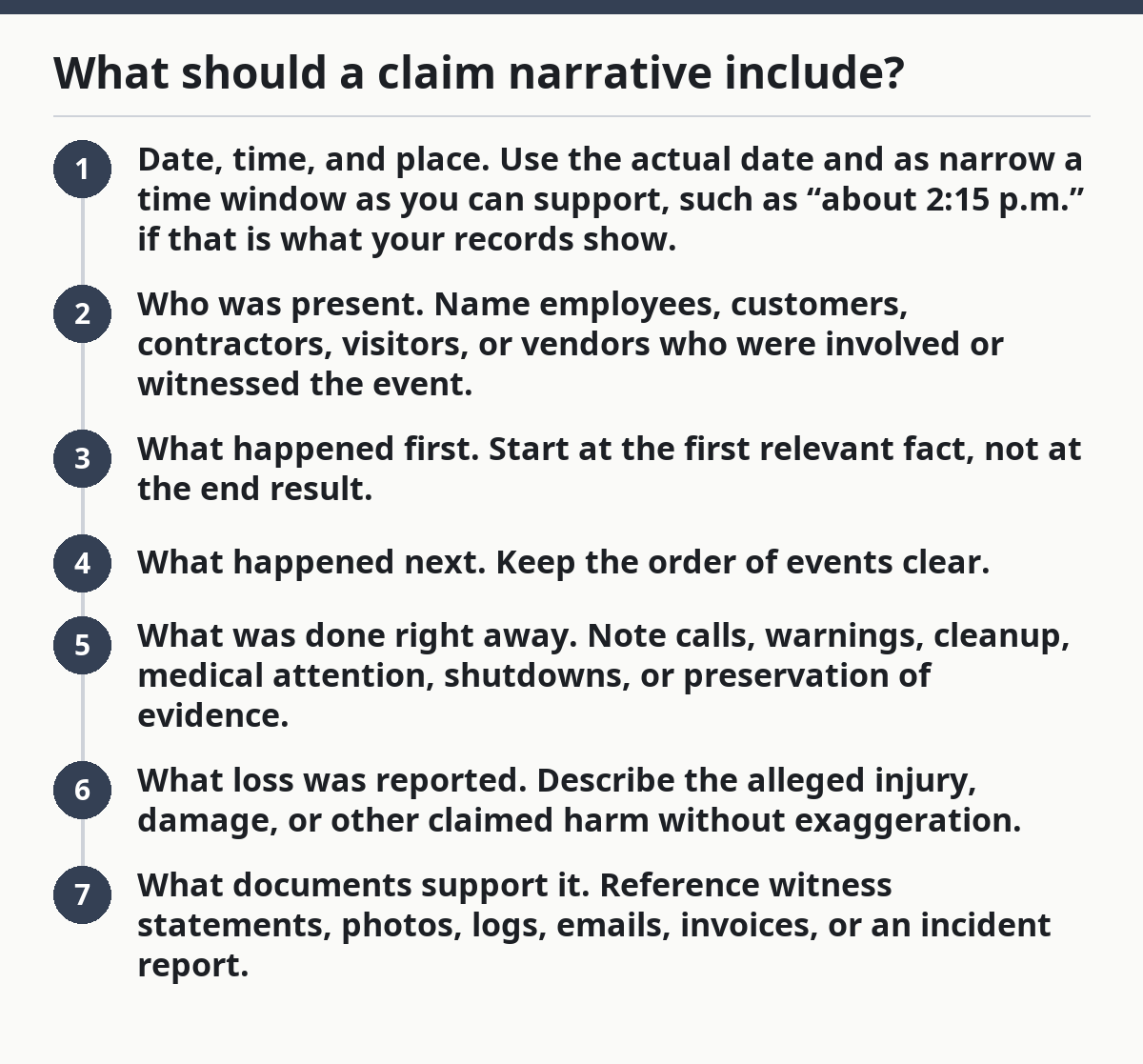
A solid narrative usually covers these points:
- Date, time, and place. Use the actual date and as narrow a time window as you can support, such as “about 2:15 p.m.” if that is what your records show.
- Who was present. Name employees, customers, contractors, visitors, or vendors who were involved or witnessed the event.
- What happened first. Start at the first relevant fact, not at the end result.
- What happened next. Keep the order of events clear.
- What was done right away. Note calls, warnings, cleanup, medical attention, shutdowns, or preservation of evidence.
- What loss was reported. Describe the alleged injury, damage, or other claimed harm without exaggeration.
- What documents support it. Reference witness statements, photos, logs, emails, invoices, or an incident report.
A short opening line often helps: “On March 4, 2026, at our warehouse loading dock, a visitor slipped near the bay door while pallets were being moved.” That kind of sentence gives the insurer the frame in one pass.
How do I write the incident timeline?
You write the incident timeline by listing the events in order, from the first relevant act to the last immediate response, with no gaps you cannot explain. The goal is a sequence the insurer can track step by step, even if the event itself took only 10 minutes.
Because the chronology is already set, the next step is to connect it to the records you have. Picture this: you have notes from a supervisor, a few photos, and an email sent the same day. The timeline should tie those pieces together so the story does not jump around.
Use this order
- Start with the setup. State the date, time, place, and the conditions that matter, such as wet flooring, a blocked aisle, or active work. Verify that the setup matches your records; a mismatch is a warning sign that the rest of the timeline may be off.
- Name the first relevant action. Say what happened immediately before the incident. Verify that this is the true starting point, not a later detail someone remembered first.
- Move through each event in order. Use short, dated or timed sentences if needed. Verify that each sentence follows the one before it; if you have to backtrack, the narrative is too tangled.
- Identify each person by role. Use names plus roles, such as “employee,” “customer,” or “delivery driver.” Verify that every person mentioned is either involved or a witness; random names weaken the record.
- Record the immediate response. Note calls to supervisors, first aid, cleanup, barrier placement, or photos taken. Verify that the response happened when you say it did; a delayed response can create credibility problems.
- State the reported harm. Describe the injury or damage as reported, not as you wish it had been reported. Verify that you are not adding diagnosis words or repair estimates unless a document already supports them.
- List the follow-up records. Mention the incident report, witness statements, photos, video, or invoices attached to the narrative. Verify that each attachment exists and matches the event date; missing exhibits make the account feel thin.
The key point is consistency, not drama. A calm, chronological account is better than a polished one. A narrative that wanders, skips times, or mixes events from different days is a problem, not a strength.
Who was involved, and what names belong in the narrative?
You should include everyone who mattered to the event, but only in the role they actually played. That usually means the person reporting the claim, the injured party or claimant, employees on site, contractors, vendors, and witnesses who saw part of the event.
Once you know who was present, the next job is to label them clearly. Picture this: an adjuster reads your draft and sees “John said it was fine” with no last name, no role, and no context. That line creates a hole where a fact should be.
Use names, titles, and functions. “Maria Lopez, store manager,” tells the reader more than “Maria.” If you do not know a surname yet, say so plainly instead of guessing. If a person is only mentioned in a rumor or an assumption, leave them out until you can verify it.
This section should also distinguish between direct observers and people who heard about the event later. A witness statement from someone who saw the incident carries a different weight than a coworker repeating what they were told. Keep that distinction clear.
If the event involves a third-party site, note the relationship to the property or work area. A subcontractor, tenant, customer, and passerby are not interchangeable labels. Each one tells the insurer something different about access, duty, and context.
What documents should I attach to the claim narrative?
You should attach the documents that support the facts in the narrative and show where the information came from. The most useful items are witness statements, photos, video stills, incident reports, repair invoices, inspection logs, and contemporaneous emails.
Because the narrative should point back to evidence, each attachment should prove one specific point. Picture this: your narrative says a spill was cleaned at 3:10 p.m., and a photo shows the wet area before cleanup. That pairing helps the insurer read the event as a documented sequence rather than a bare assertion.
Attach what actually proves a point
- Witness statements for what each person saw or heard
- Photos of the scene, damage, warning signs, or cleanup
- Video footage if your system has it
- Incident reports completed at or near the time of the event
- Maintenance or inspection logs showing the condition before the event
- Invoices or estimates if damage has already been assessed
- Emails or texts that show notice, reporting, or immediate response
Do not bury the narrative under a stack of paper. A 2-page summary with the right attachments usually helps more than a 12-page essay with no structure. The narrative should point to the documents, not replace them.
Also, do not attach items that contradict the story without explaining them. If a photo time stamp or witness account creates a mismatch, the insurer will notice. Better to flag the issue than to pretend it is not there.
Facts versus opinions: what belongs, what does not
A claim narrative should stick to facts, dates, observations, and reported statements, not conclusions about fault or motives. The word “fact” here means something you saw, recorded, or can tie to a document; “opinion” means a judgment, guess, or legal conclusion.
Because the insurer needs usable information, the safest approach is to keep the language observable. Picture this: you want to sound helpful, so you write, “The customer was careless and ignored the warning sign.” Unless you can support that with direct evidence, that line turns the narrative into an argument.
Use factual language like:
- “The floor was wet near the entrance.”
- “A yellow caution sign was placed by the aisle.”
- “The claimant said they slipped.”
- “The supervisor arrived at 2:25 p.m.”
Avoid loaded wording like:
- “clearly negligent”
- “obviously lying”
- “totally at fault”
- “an unavoidable accident”
The line between fact and opinion matters because insurers need a record they can assess. A clean factual account keeps the narrative useful even if the claim becomes disputed later. It also makes witness statements easier to compare, because the words line up with observable events instead of conclusions.
When should you stop and get help with the narrative?
You should stop drafting on your own when the narrative would require legal judgment, not just a factual summary. That line can be easy to cross in liability matters, so the safest move is to treat the narrative as a record of events, not a strategy memo.
Once the facts start touching legal judgment, the writing should pause. Picture this: the event happened near a warning label, involved a dispute over supervision, or came with a written demand. The facts may still be simple, but the stakes are not.
The claimant has made a written demand: this can change what should be said and how it is framed — get qualified legal help before finalizing the narrative.
A lawsuit has been filed: the narrative may need to fit litigation needs, not just claim intake — stop and have counsel review it.
You are unsure who saw the event: missing witnesses can lead to a one-sided record — gather the names first, or say the witness list is incomplete.
The timeline has gaps of more than a few minutes: unexplained gaps make the account look unreliable — do not guess; note the gap and what is still unknown.
The story involves disputed fault: once blame becomes contested, wording matters more — keep to observations and get advice on how to phrase the summary.
You do not know the jurisdiction’s rules: standards vary by place, and liability procedure is not universal — confirm the process with a qualified lawyer or claims professional in that jurisdiction.
The truth is, a narrative that reaches into legal conclusions can do more harm than a short one that stays factual. Leave the advocacy to the people who are licensed to do it.
What are the most common mistakes in a claim narrative?
The most common mistakes are missing facts, mixed-up chronology, and opinion-heavy language that makes the account harder to trust. Those errors do not just look sloppy; they make the insurer spend extra time sorting the record.
Once the narrative loses its sequence, the rest of the file becomes harder to read. Picture this: a reader sees three dates, two versions of the same event, and a paragraph that jumps from the incident to the repair bill and back again. That kind of draft invites questions.
- Leaving out the timeline. Consequence: the insurer cannot tell what happened first. Correct alternative: write the events in order, even if the sequence is short.
- Using blame words. Consequence: the narrative reads like an argument. Correct alternative: describe what was seen, said, or done.
- Naming people without roles. Consequence: the reader cannot tell who is a witness, employee, or claimant. Correct alternative: attach a role to every name.
- Skipping the response. Consequence: the insurer loses the immediate context. Correct alternative: note calls, cleanup, warnings, or first aid.
- Attaching unrelated papers. Consequence: the file gets bloated and harder to review. Correct alternative: attach only documents that prove a point in the narrative.
- Guessing at missing facts. Consequence: a wrong detail can undercut the entire account. Correct alternative: say “unknown” until the fact is verified.
A good narrative is not long; it is controlled. If a 1-page summary can tell the story, that is often better than stretching it to 5 pages.
How detailed should it be?
It should be detailed enough that a person who was not there can understand the event without guessing, but not so detailed that it turns into a minute-by-minute diary of irrelevant facts. A strong narrative usually fits on 1 to 3 pages, with attachments doing the heavier lifting.
That range is usually enough to cover the core facts without burying them. Picture this: you are tempted to include every conversation, every movement, and every side note because you do not want to leave anything out. That instinct is common, and it usually makes the narrative worse.
Keep the level of detail tied to the claim:
- For a simple slip, note the location, surface condition, witnesses, response, and reported injury.
- For a vehicle-related claim, note the route, impact point, visible damage, and police or incident report if one exists.
- For a property damage claim, note the source of damage, the affected area, and the immediate containment steps.
The best test is practical. If a sentence does not help the insurer understand the event, identify the people, or connect to a document, cut it.
Clarity beats volume every time. A narrative that says less, but says it cleanly, usually serves the claim better than a long story padded with guesses.
For broader context on the claims process, the hub page on commercial liability insurance claims and standard insured obligations at commercial liability insurance claims explains the bigger picture. The National Association of Insurance Commissioners also provides consumer guidance on claims handling at NAIC consumer resources, and the Insurance Information Institute offers general claims background at III.
Drafted with AI; not yet reviewed by a person.