Last updated: November 19, 2026
A commercial liability insurance application gets judged on your business operations, claims history, subcontractor use, locations, and loss controls. This guide shows what the underwriter is trying to learn, what slows the file down, and what data points usually matter most in what underwriters look for in a commercial liability insurance application.
Key takeaways
- The application is not a formality; it is the underwriter’s main map of your risk.
- Consistent answers matter as much as complete answers.
- Claims, work done away from your premises, and subcontractor use usually get extra scrutiny.
- Missing details on locations, certificates, safety rules, or prior coverage can stall the file.
- This is information, not financial advice; a qualified adviser should review your own situation.
What underwriters are really trying to decide
An underwriter is trying to answer one question: does this business fit the policy form, limits, and price assumptions the insurer is willing to use? The application is the evidence file, and fit matters more than polish.
Put simply, what underwriters look for in a commercial liability insurance application is whether the business matches the insurer’s underwriting guidelines. The application is the evidence file.
Picture this: you’re handing over a liability application and assuming the insurer mainly wants a name, address, and payroll figure. The underwriter is looking deeper — at what you do, where you do it, who does the work, and how often claims have happened before.
That’s the real test.
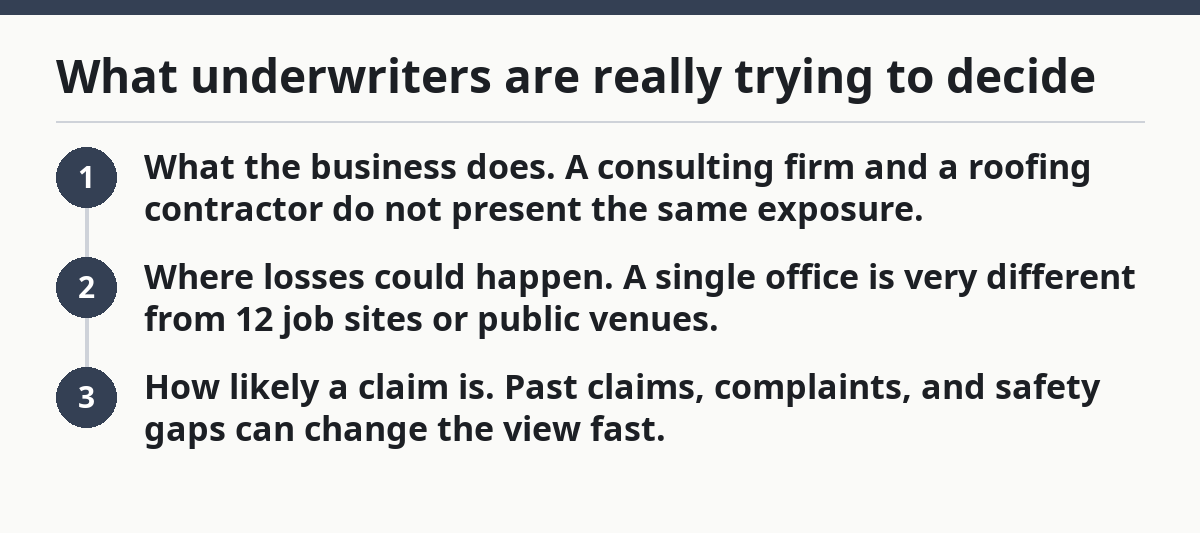
The application usually feeds decisions about three things:
- What the business does. A consulting firm and a roofing contractor do not present the same exposure.
- Where losses could happen. A single office is very different from 12 job sites or public venues.
- How likely a claim is. Past claims, complaints, and safety gaps can change the view fast.
A clean application does not force a yes. It just gives the underwriter less reason to dig for missing risk.
What underwriters ask about on a commercial liability insurance application
What underwriters look for in a commercial liability insurance application is the combination of operations, claims, locations, subcontractors, and prior insurance, because those are the fields that show where liability can attach. The form may look routine, but the details drive the decision.
Picture this: you’re filling out an application and each box seems simple on its own. The underwriter reads the whole file as one story — what you sell, who touches the work, where the public comes in, and whether the business has had losses in the last policy period or two.
Specifically, the application usually asks about:
- Business description. What the company does day to day, not just what the website says.
- Products and services. Especially if work is installed, serviced, repaired, delivered, or demonstrated.
- Locations and venues. Office, warehouse, retail space, job sites, fairs, pop-ups, client premises, or rented space.
- Employees and contractors. Who performs the work, and whether anyone is hired on a 1099 basis or similar.
- Subcontractor use. Whether outside trades do part of the job, and whether certificates of insurance are collected.
- Claims history. Losses, notices, lawsuits, and repeated customer complaints.
- Prior insurance. Limits carried before, cancellations, nonrenewals, and gaps in coverage.
- Loss controls. Training, written procedures, inspections, maintenance, and incident reporting.
A vague answer is a problem. So is a too-clever answer. If the application says “consulting” but the business also manages field crews or enters homes, the underwriter may treat that as a mismatch. Consult a licensed insurance professional or broker if the application language does not match the actual operations.
How to complete the application so the underwriter can read it
You give the underwriter a clean risk picture by matching the form to the real business, line by line, and by backing each answer with records. A little precision goes a long way.
Since the underwriter is comparing the form to the business itself, use the same wording across every page and gather the source records first.
Picture this: you’re trying to finish the application in one sitting, using memory and a few old files. That is where errors creep in. The better move is to gather the source records first, then answer the form with the same wording across every page.
- Write the business description exactly as it operates. Use 1–2 plain sentences that match invoices, contracts, and the website. Verify that the description includes the main activity and excludes side work that belongs elsewhere. A mismatch between the form and actual work is a red flag.
- List every location where liability can happen. Include offices, warehouses, stores, and off-site work zones; name each address or venue type. Verify that the list covers the full 12-month operating plan. Missing sites can lead to a wrong exposure class.
- Document all services and products tied to bodily injury or property damage. State whether work is installed, repaired, serviced, delivered, or demonstrated. Verify that the activity matches the policy language. A problem appears when the form says “sales only” but the business also installs equipment.
- Summarize claims history for the last 3 to 5 years if the form asks for it. Include claim date, type, paid amount if known, and whether the matter closed. Verify consistency with prior policy applications and loss runs. Gaps or crossed-up dates usually trigger follow-up questions.
- List subcontractors and the type of work they perform. State whether they carry their own liability coverage and whether certificates are collected before work starts. Verify that high-risk trades are not being hidden inside “miscellaneous help.” A problem appears when subcontracted work is regular but the application says “none.”
- Show your loss controls in concrete terms. Use written safety rules, incident logs, maintenance schedules, training records, or sign-in procedures. Verify that the controls actually exist and are used. Saying “we train employees” without a process leaves the underwriter guessing.
- Disclose prior insurance and any gaps. Include insurer name, effective dates, cancellations, nonrenewals, and whether the business ever went uninsured. Verify dates against old declarations pages. A missing prior policy period is a common reason for delay.
- Check every answer for internal consistency. Payroll, revenue, headcount, and subcontractor spend should point to the same story. Verify the numbers on the application, supplemental forms, and supporting documents. If one page says five employees and another says 15, expect questions.
Because the file is compared across forms, consistency matters more than style. The underwriter is not looking for a sales pitch.
A useful support packet often includes:
- certificate of insurance requests from subcontractors
- sample contracts or work orders
- loss runs from the current carrier
- safety manuals or written procedures
- a list of locations and annual operations
- prior declarations pages
What makes an application look risky, even when the business is fine
An application looks risky when the story is incomplete, inconsistent, or out of step with the business model. The problem is not always the business itself; sometimes it is the paper trail.
Picture this: you run a steady operation, but the application says “no subcontractors,” “one location,” and “no losses,” while your files show weekend job sites, multiple vendors, and an old claim. The underwriter sees the mismatch first. The operations may still be acceptable, but the file now needs work.
Watch for these warning signs:
- Claims that repeat in the same pattern. Multiple slip-and-fall losses, repeated product complaints, or the same type of damage year after year.
- Work away from your premises. Job sites, client homes, rented venues, or delivery runs usually carry more exposure than a fixed office.
- Subcontractor-heavy work. The more outside labor you use, the more the underwriter cares about contracts and certificates.
- No written controls. A business with public contact but no incident process looks less controlled.
- Unclear prior coverage. A gap, cancellation, or nonrenewal often means extra questions.
- Mismatched revenue or headcount. Numbers that do not line up across forms suggest the file needs review.
A common mistake is trying to “clean up” the story by leaving things out. That backfires. The underwriter usually finds the missing piece anyway, and now the file has a trust problem too.
When does a liability application need extra review?
A liability application needs extra review when the business does work that changes the loss pattern, the contract structure, or the venue risk. That is where standard forms stop being enough.
Since those exposures can change the file, the underwriter usually asks for more detail or a different form of proof.
Picture this: you’re looking at a line of work that seems ordinary from the outside, but it includes field operations, third-party labor, public events, or high-touch customer contact. The application can still move forward, but the underwriter will likely ask for more detail or a different form of proof.
Contract-heavy work with indemnity clauses: The business may be taking on liability by contract, not just by day-to-day operations — provide contracts and certificate wording so the exposure is visible.
Frequent subcontractor use: The risk sits partly with other firms — show vendor screening, certificates, and scope of work.
Work at client sites or public venues: Injuries and property damage can happen away from your own building — list those locations and explain controls.
Prior claims that cluster around the same hazard: A repeated pattern suggests the loss may not be isolated — expect deeper questioning about procedures and supervision.
Coverage gaps or a recent nonrenewal: The file may need a clearer explanation of why coverage lapsed — include dates and documents, not a story.
New operations or a business pivot: A fresh service line can make old application data unreliable — separate the new work from the old work in writing.
On the flip side, a business with clear processes, stable operations, and well-kept records often gets through faster. Not because it is low risk, but because it is easier to price.
For a broader look at how liability coverage choices fit into the buying process, see the hub on policy decisions and buying guidance, and review the NAIC consumer guidance on commercial liability coverage.
The mistakes that slow underwriting down
Most delays come from avoidable gaps, not from the insurer being picky. A sloppy application forces the underwriter to stop and verify basics that should have been clear.
Therefore, the review slows down when the file does not show the business model clearly.
Picture this: you submit the form and expect a quick answer. Instead, the file sits because the underwriter cannot tell whether the business has one site or five, whether subcontractors are used weekly or never, or whether a prior claim closed last month or last year. That pause is expensive in time.
Common mistakes include:
- Using marketing language instead of operations language. “Full-service solutions” tells the underwriter almost nothing. The fix is to name the actual services.
- Leaving claims history vague. “One small claim” is weak. The fix is to list the date, type, and status.
- Skipping subcontractor details. The consequence is extra follow-up and possible reclassification. The fix is to show who does what work.
- Ignoring prior insurance issues. A nonrenewal, lapse, or cancellation can matter even if the current business is sound. The fix is full disclosure.
- Submitting numbers that do not match elsewhere. Revenue, payroll, and headcount should align. The fix is to reconcile before submission.
- Failing to mention job-site or venue work. That can distort the exposure profile. The fix is to list every place the public or property can be affected.
A good application reads like a clean file folder: plain labels, matching dates, and no surprises. That is what an underwriter can work with.
What happens after the underwriter reviews the file
The underwriter usually asks follow-up questions, requests documents, or issues terms based on what the application shows and what still needs proof. The first pass is rarely the last pass.
Once the review starts, the underwriter may need extra documents before pricing the policy.
Picture this: you’ve sent the application, and now the insurer wants loss runs, a subcontractor list, or proof of safety procedures. That does not automatically mean trouble. It means the underwriter is filling gaps before making a decision.
Typical follow-up requests include:
- recent loss runs from the current carrier
- copies of contracts or service agreements
- proof of subcontractor insurance
- floor plans, site lists, or venue schedules
- written safety or quality-control procedures
- updated revenue or payroll figures
If the business is unusual, the application may need an explanation letter that sticks to facts. Short, direct, and dated is better than long and vague.
FAQ
What do underwriters ask on a liability insurance application?
They ask what the business does, where it operates, who performs the work, what claims have happened, and whether subcontractors are used. They may also ask for prior insurance details, revenue, payroll, and loss controls. The goal is to see the full exposure, not just a label for the business.
Why was my liability application delayed?
It was likely delayed because something on the form needed verification, such as claims history, prior coverage dates, subcontractor use, or a mismatch between the application and supporting documents. Underwriters often pause when the file does not clearly show the business model. Missing loss runs or unclear locations can also slow it down.
What information affects underwriting?
Business operations, claims history, venues and locations, subcontractor use, prior insurance, and loss controls all affect underwriting. The underwriter uses those details to judge how a claim might happen and how often. If the answers conflict with each other, the review usually takes longer.
Does the application need to match the website and contracts?
Yes, it should match closely enough that the business story is the same everywhere. If the website says one thing and the application says another, the underwriter may ask for clarification or change the risk view. Contracts matter too, especially when they shift liability or require certificates of insurance.
Sources
- National Association of Insurance Commissioners (NAIC), consumer guidance on commercial liability coverage: https://content.naic.org/consumer
- Insurance Information Institute (Triple-I), commercial general liability insurance overview: https://www.iii.org/article/commercial-general-liability-insurance
Drafted with AI; not yet reviewed by a person.