Last updated: November 19, 2026
Key Takeaways
- A binding checklist matches the policy’s core details before coverage starts.
- Check the insured name, dates, limits, forms, and payment terms before binding.
- Named insured, endorsements, and the effective date create the most problems.
- Compare the quote, business facts, contract terms, and final policy pages before you bind.
Commercial liability insurance should be reviewed for the effective date, named insured, limits, endorsements, payment terms, and certificate needs before you bind it. This page explains what to review before binding commercial liability insurance. This page is information only, not financial advice; for your own situation, a qualified adviser should review the policy.
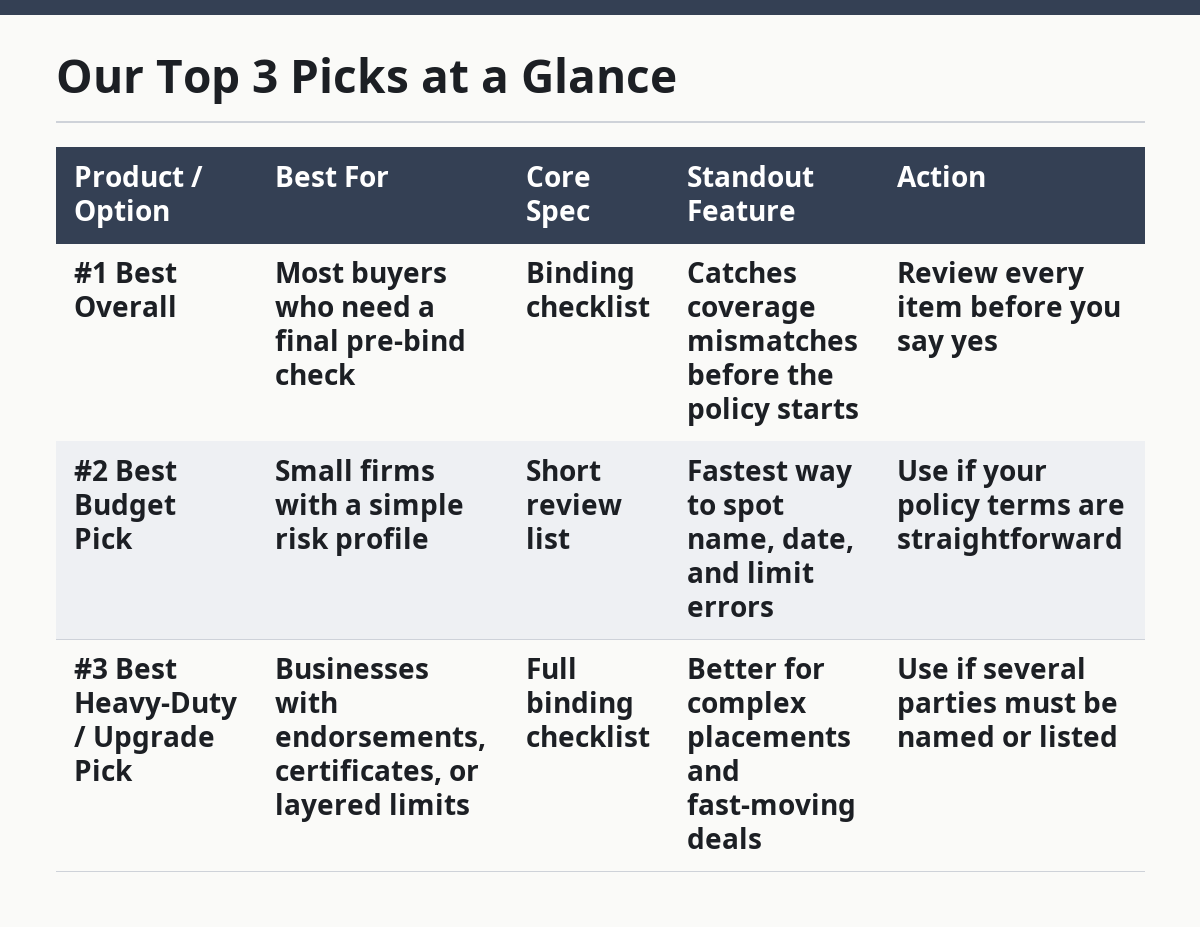
Our Top 3 Picks at a Glance
| Product / Option | Best For | Core Spec | Standout Feature | Action |
|---|---|---|---|---|
| #1 Best Overall | Most buyers who need a final pre-bind check | Binding checklist | Catches coverage mismatches before the policy starts | Review every item before you say yes |
| #2 Best Budget Pick | Small firms with a simple risk profile | Short review list | Fastest way to spot name, date, and limit errors | Use if your policy terms are straightforward |
| #3 Best Heavy-Duty / Upgrade Pick | Businesses with endorsements, certificates, or layered limits | Full binding checklist | Better for complex placements and fast-moving deals | Use if several parties must be named or listed |
| Product / Option | Best For | Core Spec | Standout Feature | Action |
|---|---|---|---|---|
| #1 Best Overall | Most buyers who need a final pre-bind check | Binding checklist | Catches coverage mismatches before the policy starts | Review every item before you say yes |
| #2 Best Budget Pick | Small firms with a simple risk profile | Short review list | Fastest way to spot name, date, and limit errors | Use if your policy terms are straightforward |
| #3 Best Heavy-Duty / Upgrade Pick | Businesses with endorsements, certificates, or layered limits | Full binding checklist | Better for complex placements and fast-moving deals | Use if several parties must be named or listed |
What does a binding checklist cover?
A binding checklist covers the exact policy details that have to match your business before coverage starts, especially the named insured, effective date, limits, endorsements, and payment method. It is the last check before binding, not a sales sheet. It often protects a 12-month policy term from avoidable errors.
Minutes before binding, the quote can look perfect and still hide a problem. One wrong entity, one missing endorsement, one date set for tomorrow instead of today — that is enough to sour the whole thing.
- Named insured: the exact legal person or entity on the policy.
- Effective date: the day coverage is meant to begin.
- Endorsement: a written change to the base policy form.
- Policy limit: the most the insurer will pay, subject to terms and exclusions.
A generic quote review misses the trap doors. A binding checklist does not. It forces you to compare the quote, application, certificates, and contract requirements line by line before the policy is locked in.
What should I check before I bind liability insurance?
Before you bind liability insurance, check the policy identity, dates, limits, forms, and payment terms. Basic? Sure. Yet the trouble usually comes from one small item nobody wanted to slow down for. A wrong certificate holder, the wrong entity name, or an exclusion tucked inside an endorsement can change the value of the policy.
You may be looking at the last carrier or broker version, and underwriting has already signed off. One chance is left to catch the mismatch. Read for fit, not for sport; you are not auditing the insurer, just checking whether the policy actually matches the business.
-
Match the named insured exactly — compare the policy to the legal name on your formation documents, not the trade name. Verify punctuation, suffixes like LLC or Inc., and any parent/subsidiary split. A mismatch can leave the wrong entity on the declaration page.
– Problem sign: the quote uses a DBA only, or the entity type is wrong. -
Check the effective date and expiration date — verify the start date, end date, and any retroactive date if one appears. Make sure the policy starts when you expect work, deliveries, or contract duties to begin. A start date that slips by even 1 day can leave a gap.
– Problem sign: the binder shows the wrong month or a delayed start. -
Review every limit — confirm each per-occurrence limit, aggregate limit, and any sublimit if it is listed. The number matters, but the structure matters too, because one limit can apply to all claims while another only applies to one claim.
– Problem sign: the quote summary and the declarations page do not show the same limit. -
Read the endorsements by title and number — endorsements are the pages that change the base form. Look for additional insured wording, waiver of subrogation, primary and noncontributory language, or a blanket endorsement that narrows coverage.
– Problem sign: the endorsement list is shorter than the contract requires. -
Check exclusions that affect your work — some policies remove specific operations, products, or professional services. Do not assume a general liability policy covers every business risk.
– Problem sign: the class of business you actually perform is mentioned in an exclusion. -
Confirm certificate needs now — if a landlord, lender, or client needs proof, verify the exact certificate holder name and any required wording before binding. A certificate proves coverage in a limited way; it does not change the policy.
– Problem sign: the party requiring the certificate is not named correctly. -
Verify payment timing and method — confirm the first premium due date, whether the policy binds only after payment, and whether installment terms apply. Some carriers will not consider the policy bound until the first payment clears.
– Problem sign: the invoice timing and bind date do not line up. -
Save the final version — keep the quote, binder, declarations page, and all endorsements in one folder. You need the final terms, not the early draft that started the process.
– Problem sign: nobody can point to the exact version approved.
When the file is clean, this step goes quickly. When something is off, it drags.
Which policy details cause the most trouble?
The named insured, endorsements, and effective date cause the most trouble because they control who is covered, what changed, and when the policy begins. Those are the spots where a policy can look fine at a glance and still miss the mark.
A tidy quote can fool you. The broker may say the file is ready to bind, but the policy may still fail your contract if the entity name is off by one word, the endorsement list is incomplete, or the certificate wording is not what the other party asked for.
- Named insured errors can leave the wrong company on the policy. That can create a coverage gap if the business operates under one entity and bills through another.
- Endorsement gaps can leave out protections a contract expects, such as an additional insured requirement.
- Date mistakes can create a gap between the old policy and the new one, especially at renewal time.
- Limit mismatches can make the policy look adequate until you compare it with a lease, vendor agreement, or customer contract.
Here is the catch: a certificate of insurance is not the policy. It is a summary document, and the actual policy language controls if there is a dispute. If the certificate says one thing and the policy says another, the policy usually wins.
So the binding review should include the declarations page and the endorsement schedule, not just the quote summary. Those pages show what was actually placed.
How do I review a quote before binding, step by step?
Review a commercial liability quote before binding by comparing the quote against the business facts, the contract demands, and the final policy pages. The order matters because the real terms show up later. That turns a sales summary into an actual coverage decision.
You may have the quote in one hand, a contract waiting in the background, and a bind deadline at the end of the day. You do not need a 40-page deep read of everything. You need a clean, fast check of the parts that can wreck the placement.
- Confirm the insured entity. Compare the named insured on the quote with your exact legal name and entity type. Verify the spelling, suffix, and any branch or subsidiary names. A mismatch means the policy may protect the wrong party.
- Match the effective date. Check the start date and make sure it lines up with your first day of operations, a lease start, or a contract start. If the policy begins later, you may have a gap even if the premium looks right.
- Check the policy limits. Verify the per-occurrence and aggregate limits, and note any sublimits for products, damage, or premises liability if they appear. If the numbers do not match the deal, the policy may not meet the contract you are trying to satisfy.
- Read the endorsements list. Look at every endorsement title and number. If a contract asks for additional insured status, waiver of subrogation, or primary wording, confirm the endorsement is actually attached and not just promised in an email.
- Review the exclusions. Scan for operations or services your business actually performs. If your line of work is carved out, the policy may be less useful than the quote suggests.
- Check certificates and other evidence needs. If a landlord, lender, or client wants a certificate, confirm the exact name and wording they require. A certificate can be prepared after binding, but the policy must support it.
- Confirm payment terms. Verify when the first premium is due, whether payment must clear before binding, and whether installments are allowed. A missed payment step can hold up the policy start.
- Save the final package. Keep the quote, binder, declarations page, endorsements, and payment receipt together. If a dispute comes later, the final file matters more than the draft file.
A good review is not a hunt for perfection. It is a check that the policy you are about to bind matches the business you actually run.
When should you stop and get help before binding?
Stop and get qualified help when the policy no longer looks like a simple renewal or a plain one-entity placement. That is especially true if your contract terms, legal entity structure, or certificate demands are more complex than the quote summary.
You are one step from binding, but the policy involves a parent company, a lease, a subcontractor agreement, or several required endorsements. That is the point where a tiny drafting slip can spill into a claim dispute later. The paper trail gets slippery fast.
The named insured is not your operating entity: the policy may insure the wrong business — pause until the entity is corrected.
The policy starts after work begins: there is a possible coverage gap — do not bind until the dates are fixed.
A contract asks for endorsements not shown on the quote: the current placement may not satisfy the contract — get the paperwork aligned first.
The limits do not match the deal: the policy may not meet the other party’s minimums — verify the structure before you bind.
The business does more than the policy class describes: the coverage may exclude part of your work — stop and confirm how the policy is written.
This is not the place to guess. The check is meant to prevent an expensive mismatch, not to patch one after the policy is live.
What mistakes do people make right before binding?
People make the same handful of mistakes right before binding, and each one has a cost. The usual pattern is speed: the file looks close enough, so the final review gets rushed. Then the error slips in.
The deal is moving, the broker is waiting, and everyone wants the policy issued today. Fair enough. But urgency is a lousy substitute for the last check.
- Using a trade name instead of the legal name — consequence: the named insured can be wrong, which may complicate a claim or contract. Correct move: verify the exact legal entity from formation records.
- Ignoring the endorsement schedule — consequence: the policy may lack the extra wording a customer or landlord expects. Correct move: read the attached endorsements, not just the quote summary.
- Assuming the certificate controls the coverage — consequence: a certificate can say one thing while the policy says another. Correct move: treat the policy forms as the controlling documents, and if the wording is unclear, consult a licensed insurance professional or attorney and review the carrier’s policy forms and filings.
- Skipping the date check — consequence: the policy may start after the work begins or after the old policy ends. Correct move: compare the start date to the real-world job date.
- Overlooking payment timing — consequence: the policy may not bind when you think it does if payment is required first. Correct move: confirm the invoice date and any binding condition tied to payment.
A short review catches these errors. A rushed one leaves them sitting in the file for the whole term.
What changes on a renewal or a multi-party deal?
A renewal or a multi-party deal needs a tighter review because the parties, dates, and endorsements are easier to miss. The standard checklist still works, but the room for error shrinks when a landlord, lender, client, or general contractor wants specific wording.
You are renewing a policy and nothing seems different except the premium and the dates. That is exactly when people miss a small update in the endorsement stack or a shift in the named insured. On renewal, the old version can lull you into skipping a real comparison.
Use the prior declarations page, the new declarations page, and every endorsement side by side. Then verify the certificate requirements again. If another party needs additional insured status or waiver wording, that requirement belongs in the file before binding, not after.
How do the final documents affect the result?
The final documents control the result because they show the policy as issued, not the policy as quoted. The declarations page, endorsement schedule, and full forms tell you what is actually in force.
A binder can bridge the gap between quote and issuance, but it is still not the full policy. The declarations page identifies the insured, dates, and limits. The endorsements show changes to the base form. The forms show the actual language that applies if a claim happens.
So the review should not stop at the sales summary. It should end with the final pages in hand, even if the deal feels routine.
What should I do if the quote and policy do not match?
If the quote and policy do not match, stop and ask for a corrected version before binding. Small differences can matter, especially if they involve the named insured, dates, limits, or required endorsements.
Compare the quote, binder, declarations page, and endorsements line by line. If one page shows a different entity name, a different start date, or a missing endorsement, that is not a detail to ignore. It is a reason to pause and fix the file.
When the mismatch affects a contract term or a certificate requirement, get the broker or carrier to confirm the correction in writing. That keeps the review tied to the actual policy language, not to an outdated draft.
Drafted with AI; not yet reviewed by a person.