Last updated: November 19, 2026
Quick Answer
Severability of interests in a liability policy usually means each insured is read separately when exclusions and conditions are applied. That separate reading matters most when more than one insured is involved in a claim.
That’s the short answer.
The sections below explain how the clause works, how it differs from cross liability, and where policy wording changes the result. This is information, not financial advice; for your own policy wording, a qualified adviser should review the contract. For general policy interpretation, see IRMI and the Insurance Information Institute.
What severability of interests means in plain English
Picture this: you’re reading a liability policy after a claim has landed, and one insured person may have caused the loss while another is being named in the same suit. The phrase How severability of interests works in a liability policy points to a person-by-person reading, not a single-block reading.
That matters because the word insured can cover more than one person or entity. The clause usually means an exclusion that points to “an insured” is tested against the particular insured who wants coverage, not automatically against all insureds together. That is the heart of the rule.
Here’s the catch: severability does not rewrite the policy into separate policies. It changes how some language is applied. If the wording says “the insured,” “any insured,” or “an insured,” those phrases can lead to different results, and the difference is often the whole fight.
- One insured’s conduct may not bar another insured’s coverage.
- The clause can matter most in exclusion disputes.
- Policy wording still controls the outcome.
How severability of interests works in a liability policy
Picture this: you’re trying to work out whether the policy protects a manager, an employee, and the company after one claim. The clause works by asking, for each insured, “Does this exclusion apply to this person, on these facts, in this claim?”
That is why policy interpretation turns on the exact words in the form. In many liability forms, the clause is paired with wording saying the insurance applies separately to each insured. That does not mean limits multiply. It means the insurer may have to analyze coverage separately for each insured before it says yes or no. The Insurance Information Institute and IRMI both describe that separate reading as a standard policy-interpretation issue.
Why severability matters in liability insurance
Picture this: you’re facing a claim where one insured may have known about a problem, but another insured did not. Severability matters because the policy may exclude coverage for the person who knew, while still leaving room for a different insured who did not participate in the same conduct.
That is especially visible in cross liability settings, where one insured sues another insured under the same policy. Without separate treatment, the policy could be read too broadly against everyone. With severability, the policy language can support a narrower reading that fits the individual insured’s position. For that reason, policyholders should compare the exclusion wording with the insuring agreement and, if needed, ask a qualified adviser to review the contract.
What severability does not do
Picture this: you’re hoping the clause will erase every exclusion just because more than one insured is listed. It won’t. Severability changes the lens, not the contract’s whole structure.
A few limits show up again and again:
- It does not create new limits for each insured unless the policy says so.
- It does not delete exclusions that are written to apply to any insured.
- It does not fix a bad endorsement or override specific policy wording.
- It does not guarantee that one insured can ignore another insured’s conduct.
How do you read the clause step by step?
Picture this: you’ve got the declarations page, the insuring agreement, and the exclusion section open in front of you. The job is to read the policy in order, then test the claim against the insured person who is actually asking for coverage.
- Identify the insured asking for coverage. Write down the exact person or entity involved, such as the company, an employee, or an additional insured. Verify whether that person fits the policy’s definition of insured. If the person is not insured under the form, severability will not help.
- Find the severability wording. Look for phrases like “this insurance applies separately to each insured” or similar language. Verify whether the form uses that clause in the main policy or only in one section. If you cannot find it, do not assume it exists; check the form or ask a qualified adviser.
- Read the exclusion words closely. Circle terms such as “the insured,” “an insured,” and “any insured.” Verify the exact phrase, because those words often control the result. If the exclusion uses “any insured,” the clause may not soften it much at all.
- Match the facts to one insured at a time. Ask whether this specific insured committed, knew, directed, ratified, or benefited from the act. Verify each fact against that person only. If the facts get blended across people, the analysis is already going off track.
- Check whether the exclusion is conduct-based or status-based. Some exclusions focus on intent, knowledge, criminal conduct, or employment status. Verify whether the exclusion turns on what the insured did or who the insured is. A status-based exclusion often leaves less room for severability.
- Test for cross liability language. If one insured is claiming against another, verify whether the form has a cross liability clause or a separate-insured provision that addresses claims among insureds. If it does not, the result may depend even more on the exact exclusion wording and a professional reading of the form.
- Look for joint liability language. Some contracts or exclusions speak in collective terms. Verify whether the policy makes one insured’s act imputed to another insured. If it does, severability may not break that link.
- Check limits and defense wording separately. Verify whether the clause changes only the liability analysis or also affects defense obligations, limits, or deductibles. A problem appears if someone assumes the clause changes all three. It usually does not.
Cross liability and severability are related, but they are not the same
Picture this: you have one policy, two insureds, and a claim where each points at the other. Cross liability answers whether insureds can be treated as if they were separate opponents under the same contract; severability answers whether the policy is read separately for each insured when exclusions and conditions are applied. For a policyholder, that distinction can decide whether a claim is analyzed one way or another, so a qualified adviser should review the exact form.
That difference matters. A policy can have one concept without fully having the other, and policy wording can narrow or expand each. In plain terms, cross liability is about who can claim against whom under the policy. Severability is about how the policy language is read for each insured.
The best way to keep them straight in most claims is:
- Cross liability = claim relationship between insureds.
- Severability = separate reading for each insured.
- One clause does not always replace the other.
What people get wrong about severability of interests
Picture this: you’re skimming a policy and assuming every insured gets a clean slate. That mistake is common, and it costs people coverage arguments later because the wording was never read carefully enough. If you are unsure, consult a qualified adviser and compare the exact exclusion wording with the policy definitions.
The usual errors are easy to spot once you know what to look for, but a professional review is still wise:
- Treating severability as blanket coverage. Consequence: someone assumes an exclusion cannot apply at all. Correct approach: read the exclusion phrase by phrase.
- Ignoring “any insured.” Consequence: the reader misses a stronger exclusion that can reach across insureds. Correct approach: flag that phrase immediately.
- Blending facts from different insureds. Consequence: one person’s knowledge gets imputed to another without checking the policy. Correct approach: separate the conduct of each insured.
- Confusing defense issues with liability issues. Consequence: the reader thinks the clause changes everything. Correct approach: test defense, duty to indemnify, and limits separately.
- Assuming an endorsement works the same as the base form. Consequence: the reader misses wording changes that override the standard clause. Correct approach: read the endorsement first if it changes the clause.
When the standard reading does not hold up
Picture this: the claim is messy, the policy has endorsements, and the exclusion language is not the usual wording. That is when a simple “separate insureds” reading can fail, or at least need careful review.
These situations need extra attention:
- The exclusion says “any insured.” That can pull in conduct by one insured and affect another insured’s claim.
- The policy has an endorsement that rewrites the severability clause. The endorsement may control over the base form.
- The claim involves fraud, intentional harm, or criminal conduct. Those exclusions often use collective wording and can defeat a separate-insured reading.
- The insureds are linked by ownership or control language. Some policies treat controlling persons differently from rank-and-file insureds.
- The dispute is about who qualifies as an insured in the first place. Severability cannot help if the person is outside the policy’s defined group.
What a good policy reading looks like
Picture this: you’re trying to make sense of a claim file without turning every sentence into a fight. A good reading is narrow, careful, and tied to the exact words on the page, not to assumptions about fairness.
A solid result usually has three marks:
- The insured is identified by name or role.
- The exclusion is tested against that insured alone.
- The phrase “an insured” or “any insured” is treated as meaningful, not decorative.
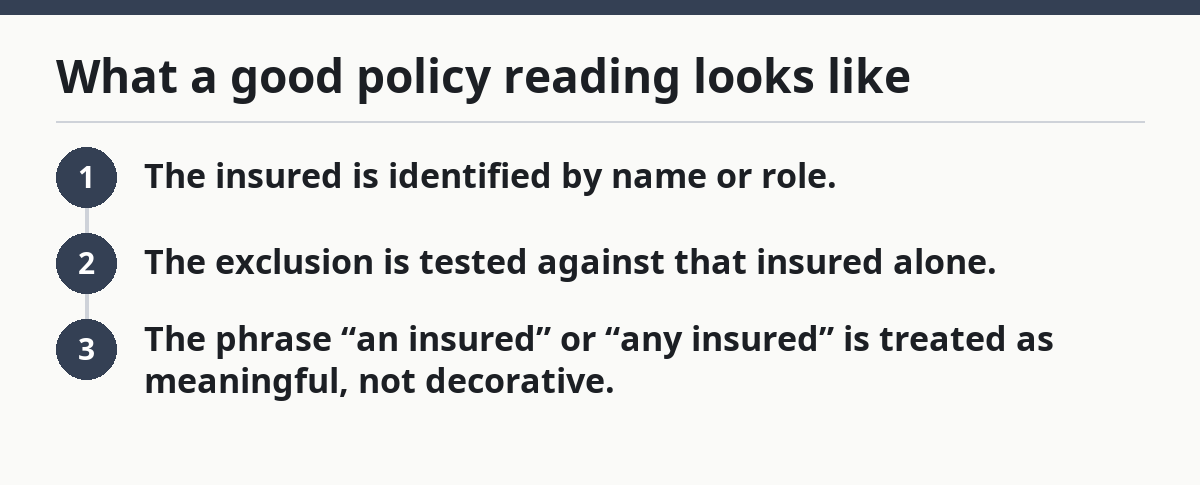
If those three things are clear, the analysis is usually on firmer ground. If they are not, the policy language needs a closer read.
Where this fits in the larger policy structure
Picture this: you are trying to understand one clause, but the policy is a whole contract with definitions, exclusions, endorsements, and conditions. Severability of interests is one piece of that structure, not the whole machine.
That is why this topic sits inside broader policy wording analysis. It belongs with definitions of insured, exclusion wording, and how liability forms treat multiple parties under one contract. If you are mapping the full contract, the hub on commercial liability insurance policy design and terms is the broader guide; this page stays with the severability question itself. For related wording issues, see cross liability clause and policy exclusions.
Key Takeaways
- Severability means the policy is read against each insured on its own facts.
- The exact exclusion wording matters more than the label on the clause.
- “Any insured” often behaves differently from “the insured.”
- Cross liability and severability overlap, but they answer different questions.
- The clause rarely changes limits; it mainly changes interpretation.
- Endorsements and special exclusions can override the simple version of the rule.
What does severability of interests mean?
Severability of interests means a liability policy is applied separately to each insured, rather than treating every insured as one unit. That separate reading can matter when an exclusion might apply to one person but not another. The exact policy wording still controls the result.
Why does severability matter in liability insurance?
It matters because a claim against one insured should not automatically erase coverage for every other insured. The clause can affect how exclusions, conditions, and conduct-based wording are read. In a multi-insured claim, that difference can change the coverage analysis in a real way.
Is severability the same as cross liability?
No. Severability is about how the policy is read for each insured; cross liability is about claims between insureds under the same policy. The two ideas often appear together, but they do different jobs. A policy may touch one more clearly than the other.
Drafted with AI; not yet reviewed by a person.