Last updated: November 19, 2026
Quick Answer: Compare two commercial liability policies line by line in 7 core steps: declarations, form, endorsements, exclusions, defense costs, limits, and insured definition. Comparing two commercial liability policies line by line means checking the policy form, endorsements, limits, exclusions, defense costs, deductible, and insured definition side by side before you trust the cheaper premium.
The cheaper quote can still be the worse policy.
The table and steps below show what to verify, what the differences mean, and where the traps hide. This guide uses the topic how to compare two commercial liability policies line by line throughout.
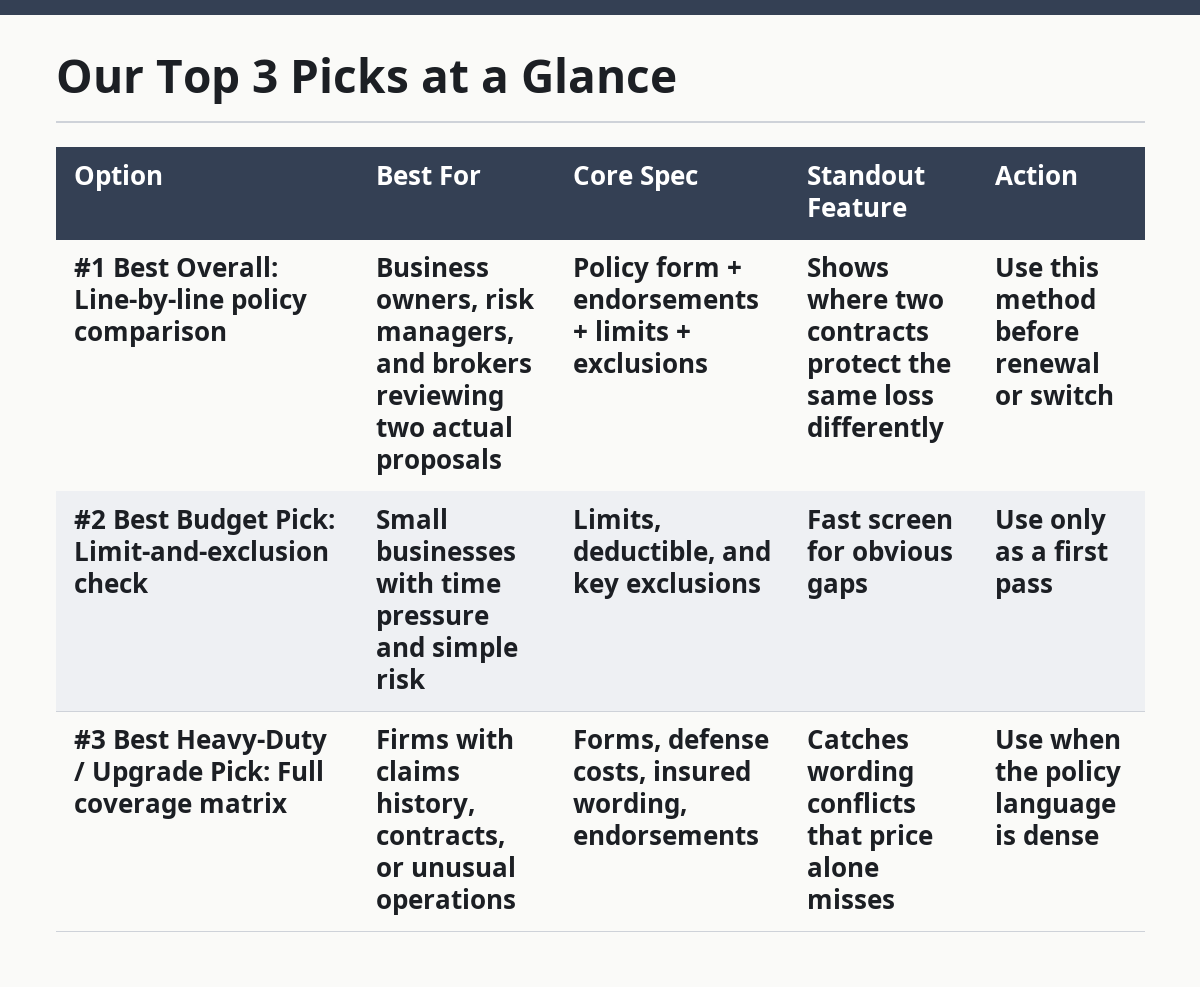
Our Top 3 Picks at a Glance
| Option | Best For | Core Spec | Standout Feature | Action |
|---|---|---|---|---|
| #1 Best Overall: Line-by-line policy comparison | Business owners, risk managers, and brokers reviewing two actual proposals | Policy form + endorsements + limits + exclusions | Shows where two contracts protect the same loss differently | Use this method before renewal or switch |
| #2 Best Budget Pick: Limit-and-exclusion check | Small businesses with time pressure and simple risk | Limits, deductible, and key exclusions | Fast screen for obvious gaps | Use only as a first pass |
| #3 Best Heavy-Duty / Upgrade Pick: Full coverage matrix | Firms with claims history, contracts, or unusual operations | Forms, defense costs, insured wording, endorsements | Catches wording conflicts that price alone misses | Use when the policy language is dense |
This article is information, not financial advice. A qualified adviser should review your own situation, because commercial liability terms and local rules vary by country and can change over time.
What should I compare first in two liability policies?
Start with the declarations page, then read the form, endorsements, exclusions, limits, and deductible in that order.
That sequence shows you the coverage shape before you get lost in fine print.
For a fast first pass, compare 6 items before anything else: named insured, policy period, form number, endorsements, limits, and deductible. If those 6 items do not line up, the policies are not equivalent.
Picture this: you have two renewals on your desk, both called “commercial general liability,” and both look similar at first glance. One is a clean 20-page form with three endorsements; the other has a stack of add-ons and a different defense clause. The first job is not to guess. It is to line up the same parts in the same order.
Use a highlighter or spreadsheet and compare these items first:
- Named insured
- Policy period
- Policy form number
- Each endorsement number and date
- Each coverage limit
- Deductible or retention
- Defense costs language
- Exclusions that apply to your work
If those items do not match, the policies are not equivalent even if the premium is close. Not even close.
How do you compare two commercial liability policies line by line?
You compare them by matching each clause against the same clause in the other policy and writing down what changes, not just whether the title looks familiar.
The goal is to find the practical effect of each difference.
Because this is a clause-level review, keep the same order in both policies. That makes the differences easier to spot and easier to explain later.
Picture this: you have the two policies open side by side on a screen, and you are moving line by line through the declarations, definitions, insuring agreement, exclusions, conditions, and endorsements. The job is mechanical, and that is good. Mechanical work finds the gaps that marketing language hides.
-
Start with the declarations page. Record the named insured, business description, policy number, dates, each coverage part, each limit, and any deductible or self-insured retention. If the business name or class code is off, the policy may not fit the risk.
A mismatch here means the rest of the policy may not respond as expected. -
Match the policy form number and edition date. A policy form is the base contract that sets the core terms. Write down the exact form number for each policy and compare the edition date, if shown.
Different editions can change the meaning of a common term. That is a problem. -
List every endorsement. An endorsement is a written change to the base policy. Compare title, number, and effective date, then note whether it adds, removes, or narrows coverage.
Missing endorsement pages, or the same endorsement title with different wording, are red flags. -
Compare the insuring agreement. This is the promise to pay covered claims. Look for the trigger words: “bodily injury,” “property damage,” “personal and advertising injury,” or other covered harms in the policy.
If the trigger is narrower in one policy, that policy can leave more claims outside coverage. -
Compare exclusions one by one. Exclusions say what is not covered. Put the same exclusion next to the other policy’s version and ask whether the wording is the same, broader, or subject to a carve-back.
A carve-back is a narrow exception inside an exclusion. If one policy has it and the other does not, the difference matters. -
Check defense costs language. See whether defense expenses reduce the limit or sit outside the limit. Also check who controls the defense, when the insurer can settle, and whether there is a duty to defend or only a duty to reimburse.
If defense costs burn down the limit, a claim can drain the policy faster. -
Compare the limit structure. Review each per-occurrence limit, aggregate limit, and any sublimit. A sublimit is a smaller cap inside a larger one.
If one policy has a $1 million aggregate but a much lower sublimit for a key exposure, that is not equal protection. -
Read the deductible or self-insured retention carefully. A deductible is usually subtracted from a covered loss; a retention often means the insured must handle the first layer before the insurer steps in.
If the wording shifts payment timing or claim handling, the cash-flow impact can be real. -
Check the insured definition. Confirm who counts as an insured: the named business, owners, employees, managers, vendors, or additional insureds where listed.
A policy that narrows who is insured can fail in a claim involving a worker, officer, or affiliate. -
Compare the conditions. Look at notice, cooperation, cancellation, other insurance, transfer of rights, and premium audit terms.
If one policy gives the insurer more room to deny for late notice or misstatement, that is a meaningful difference.
A useful comparison sheet has four columns: clause, policy A wording, policy B wording, and practical effect. If you cannot explain the practical effect in one sentence, keep reading the policy. The gap is still there.
What terms change the real value of a liability policy?
The terms that change value most are exclusions, defense costs, limits, endorsements, and the insured definition.
Those five decide whether a claim is paid, defended, delayed, or cut down.
Since those terms drive the result, compare them before you focus on the premium. A lower price does not matter if a key clause is narrower.
Picture this: two policies both show the same headline limit on page one, but one pays defense outside the limit while the other pays defense inside it. One has an endorsement adding an exclusion for subcontracted work; the other does not. On paper they look similar. In a claim, they do not.
The biggest language traps are:
- Exclusions that remove a claim category you actually face
- Endorsements that quietly narrow the base form
- Defense language that shifts attorney fees into the limit
- Insured definitions that leave out a person or entity you expected to be covered
- Sublimits that cap a specific exposure below the main limit
Here’s the catch: a single endorsement can undo a promise made in the form. The base form says one thing; the endorsement wins if the two conflict. That is why the order matters. Read the endorsement after the form, then check whether it says “this endorsement supersedes” or “subject to the following.”
For a plain-English foundation on policy design, the Insurance Information Institute and the National Association of Insurance Commissioners both publish consumer material on liability coverage structure. Use those as background, then compare your actual contract language. The Insurance Information Institute explains liability coverage basics, and the NAIC offers consumer guidance on insurance language and policy review.
Where do people make mistakes in a policy comparison?
They compare titles, not wording, and that misses the problem.
A clause name can stay the same while the coverage changes underneath.
Because the title can stay the same, the wording has to do the real work. That is where the difference lives.
Picture this: you are on a renewal call and someone says, “Nothing major changed.” That sentence is not a comparison. It is a sales line. The mistakes below are the ones that usually cost businesses time after a claim starts.
- Reading only the limits page. Consequence: two policies can look equal while one has a broad exclusion that kills the claim. Correct alternative: compare the exclusions and endorsements first.
- Ignoring defense costs. Consequence: the policy may run out faster than expected if defense shares the same limit. Correct alternative: mark whether defense erodes the limit.
- Skipping the insured definition. Consequence: a manager, owner, or affiliate may not count as an insured. Correct alternative: verify every person and entity you expect to be protected.
- Treating an endorsement as harmless because it is short. Consequence: a short endorsement can delete a major protection. Correct alternative: consult a qualified professional and read the endorsement as if it were the main contract.
- Comparing deductible amounts without the wording. Consequence: the payment timing and claim handling can differ even when the dollar figure looks similar. Correct alternative: check whether the policy uses a deductible or a retention.
- Assuming the same form edition means the same protection. Consequence: one later amendment can shift the meaning of a key term. Correct alternative: compare every form and edition date attached to the policy.
The safest habit is simple: do not trust the heading on its own. Trust the sentence under it, and if a clause affects a contract or claim, consult a qualified professional.
When should you stop comparing and get the contract reviewed?
You should stop and get qualified help when the policy language affects a contract, a claim history, a cross-border risk, or a specialized operation.
Those are the cases where a line-by-line review can still miss the legal or business effect.
Because these situations carry extra risk, a general comparison may not be enough. A lawyer, broker, or other qualified adviser can help interpret the clause.
Picture this: your policy is tied to a lease, a customer agreement, or a lender requirement, and the wording on additional insured status, waiver of subrogation, or primary and noncontributory treatment starts to matter. That is no longer a simple side-by-side check. It needs more than a general read. Consult a qualified professional before you rely on the wording.
Stop the DIY comparison when you see any of these:
- A claims-made form instead of an occurrence form: the trigger changes, and prior acts or reporting terms can matter — have the timing reviewed.
- A manuscript endorsement: custom wording can override standard language — ask for a clause review.
- Cross-border operations: territory and jurisdiction terms may not track your work locations — confirm the coverage map.
- Professional or product exposures: the base commercial liability form may not fit the risk — check whether a different policy type belongs in the stack.
- A contract demand that changes limits or endorsements: the policy may not satisfy the wording you promised elsewhere — verify the clause chain before signing.
On the flip side, if the two policies are both standard forms, the business is simple, and there are only a few endorsements, a disciplined side-by-side review is usually enough to spot the main differences. That still does not replace advice for your exact situation.
What should a good comparison result look like?
A good result is a written note that says which clauses differ, why they differ, and which business risk each difference touches.
If you cannot turn the comparison into a one-page summary, the review is still unfinished.
Since the comparison is meant to be usable, the result should be short and practical. A one-page note is often enough.
Picture this: the same two policies now sit next to a marked-up worksheet. You can point to each difference and say whether it changes who is insured, what is excluded, how defense works, or how much the insurer can pay. That is the whole point. A premium figure means little if the clause structure is unclear.
Your finished comparison should answer these questions:
- What changed in the base form?
- Which endorsements add or subtract coverage?
- Does defense sit inside or outside the limit?
- Are the deductibles or retentions truly the same?
- Do both policies define the insured the same way?
- Are there any sublimits that change the effective protection?
If the answer to any of those is “I am not sure,” the comparison is not done. That is the warning sign.
How does this compare with comparing liability quotes?
A quote comparison checks price and headline limits; a policy comparison checks the contract that will govern a claim.
Those are related, but they are not the same task.
Because the quote is only a snapshot, it can miss the language that matters later. The policy is the actual contract.
A quote can be useful in 10 minutes. A policy comparison takes longer because the wording lives in the details. You are not just asking, “What does it cost?” You are asking, “What does it actually promise?” That is why the form number, endorsement list, exclusion language, and defense clause all belong in the review.
If you are comparing multiple proposals, use the same worksheet for each one and keep the policy language in front of you, not just the broker summary. The summary can help you sort the files. It cannot replace the contract.
Key Takeaways
- Compare the form, endorsements, exclusions, limits, defense costs, deductible, and insured definition in the same order every time.
- A matching limit does not mean matching coverage.
- Endorsements can narrow the base form fast, even when the policy title stays the same.
- Defense language matters because it can change how quickly a claim burns through the limit.
- If the policy sits inside a contract, uses custom wording, or has claims-made timing issues, get the language reviewed by a qualified adviser.
What should I compare in two liability policies?
Compare the declarations page, the base form, endorsements, exclusions, limits, defense costs, deductible or retention, and the insured definition.
Those parts tell you whether two policies are really alike or only look alike on the cover page. A line-by-line check is usually the most reliable way to catch a narrow exclusion or a changed defense clause.
How do I compare liability insurance quotes?
Compare quotes by putting the policy language next to the price, not by price alone.
Check whether the form edition, endorsements, defense costs, and exclusions are the same, because those terms can change the actual protection. A cheaper quote with different wording may be a weaker fit for the same business risk.
What is the best way to compare policy language?
A clause-by-clause worksheet with four columns is a strong way to compare policy language: clause name, policy A wording, policy B wording, and practical effect.
That format makes it easier to spot changes in exclusions, sublimits, or defense terms. If the practical effect is unclear, the comparison is not complete yet.
Drafted with AI; not yet reviewed by a person.