Last updated: November 19, 2026
An extended reporting period on claims-made liability insurance gives you extra time to report a claim after the policy ends, but it does not extend the date when the wrongful act happened. If you’re trying to protect against a late claim after cancellation, nonrenewal, or termination, this is the feature that matters. What is an extended reporting period on claims-made liability insurance? It is the post-policy reporting window that can apply after a claims-made policy ends.
This article explains when it applies, what it covers, and where tail coverage fits in. It also clears up the parts people mix up most often.
This is information, not financial advice. Claims-made terms vary by policy and country, so a qualified adviser should review your situation.
Key Takeaways
- An extended reporting period lets you report certain claims later.
- It usually starts after a claims-made policy ends through nonrenewal or termination.
- It is about the reporting window, not a new policy year.
- People often call it tail coverage, but the exact label can vary by insurer.
- It can help when a claim arrives late, but it does not change every other policy term.
What is an extended reporting period on claims-made liability insurance?
An extended reporting period is a post-policy window that lets you report a claim after a claims-made policy has ended, usually for a covered event that happened while the policy was in force. That reporting window is the whole point.
Picture this: you handled work during a policy year, the policy ends in June, and a claim letter arrives in October. Without an extended reporting period, the insurer may say the report came too late. Here, the timing rule decides the claim.
- The claim must still fit the policy’s covered act or omission.
- The report must be made during the extra window.
- The policy’s other conditions still matter.
- If the loss happened outside the policy terms, the tail does not fix that.
This is why the term sits inside claims-made liability insurance rather than occurrence coverage. The policy cares about when the claim is reported, not just when the injury happened. That reporting rule is the trapdoor many readers miss.
On the flip side, an extended reporting period does not restart the policy, add new work, or create a fresh limit just because the clock is still running. It is a reporting feature, not a new season.
Why people call it tail coverage
People call an extended reporting period tail coverage because it hangs off the end of the policy and covers the tail end of claim reporting. That nickname is common in professional liability, although some insurers and forms use different labels.
Picture this: your policy is ending after 12 months, and the carrier offers an option to buy time for future claim notices tied to past work. That option is often the tail. The policy is over; the reporting window is not.
- Some forms use “extended reporting period.”
- Some people shorten it to “ERP.”
- Some markets and policies use “tail coverage” as the everyday phrase.
- The exact wording in the policy controls the result.
The name matters less than the wording. If the contract says the ERP applies only after termination or nonrenewal, then that is the limit. If it says it can be purchased only within a set time after cancellation, that deadline matters too.
Here’s the catch: not every tail works the same way. Some only allow reporting of claims from acts before the end date. Some may keep the original policy limit. Others may describe a different purchase option. The label alone does not settle it.
When does an extended reporting period matter?
An extended reporting period matters when a claim may show up after the policy has ended but the alleged act happened during the policy term. That’s the classic claims-made problem: the work is old, the complaint is new.
Picture this: a client waits months before sending a demand letter, your policy is not being renewed, and the claim arrives after the final day of coverage. If the policy includes an ERP, the late report may still be accepted.
- Nonrenewal: the insurer does not continue the policy at the end of the term.
- Termination: the policy ends early or at a stated end date.
- Claim reporting window: the time you have to notify the insurer of a claim.
- Post-policy notice: the report made after the policy ends, but during the ERP.
The timing is the key. A claim reported inside the ERP may still be denied if it falls outside the policy’s covered act, the insured person, or another condition. The ERP does not fix a bad fit.
The truth is, this feature matters most for people whose work can generate delayed complaints: consultants, professionals, directors and officers, and others whose liability may surface after the job is done. It can also matter when a business closes and no new policy will replace the old one.
How an extended reporting period works, step by step
An extended reporting period works by giving you a defined post-policy chance to notify the insurer about claims tied to the expired policy. The steps below show the usual sequence, though the exact wording and timing depend on the contract.
Picture this: your policy is ending, and you want to know what happens next before the deadline passes. You need the policy language, the end date, and the claims notice rules in the same place.
- Check the policy end date. Verify the exact termination or nonrenewal date, not a rough month. If the date is wrong, the reporting window may close before you think it does.
- Find the ERP clause. Look for the section titled extended reporting period, tail coverage, or reporting options. If there is no such clause, that is a problem.
- Read who can trigger it. Confirm whether the insured, the policyholder, or both can request it. If the contract limits the trigger, a wrong request can fail.
- Check the time limit for election. Some policies require the ERP to be chosen within a set number of days after termination. Miss that deadline and the option may disappear.
- See what claims qualify. Verify whether the ERP covers only acts that happened before the policy ended. If it covers new acts, the wording should say so plainly.
- Review the notice rule. Confirm how and where the claim must be reported, such as to a named claims address or portal. A bad delivery method can be treated as no notice, so check the policy wording and consult a professional if the delivery instructions are unclear.
- Check the limits and sublimits. Make sure the reporting extension does not change the dollar limit unless the form says it does. If you assume a larger limit, that is a problem.
- Ask what happens after a claim is reported. Verify whether the insurer still defends, investigates, or settles under the expired policy terms. If the policy is silent, you need the contract interpreted, not guessed.
A good result looks boring: the claim is reported on time, the insured work falls inside the policy terms, and the insurer confirms receipt. A bad sign is any uncertainty about the deadline, the delivery method, or whether the tail option was actually elected.
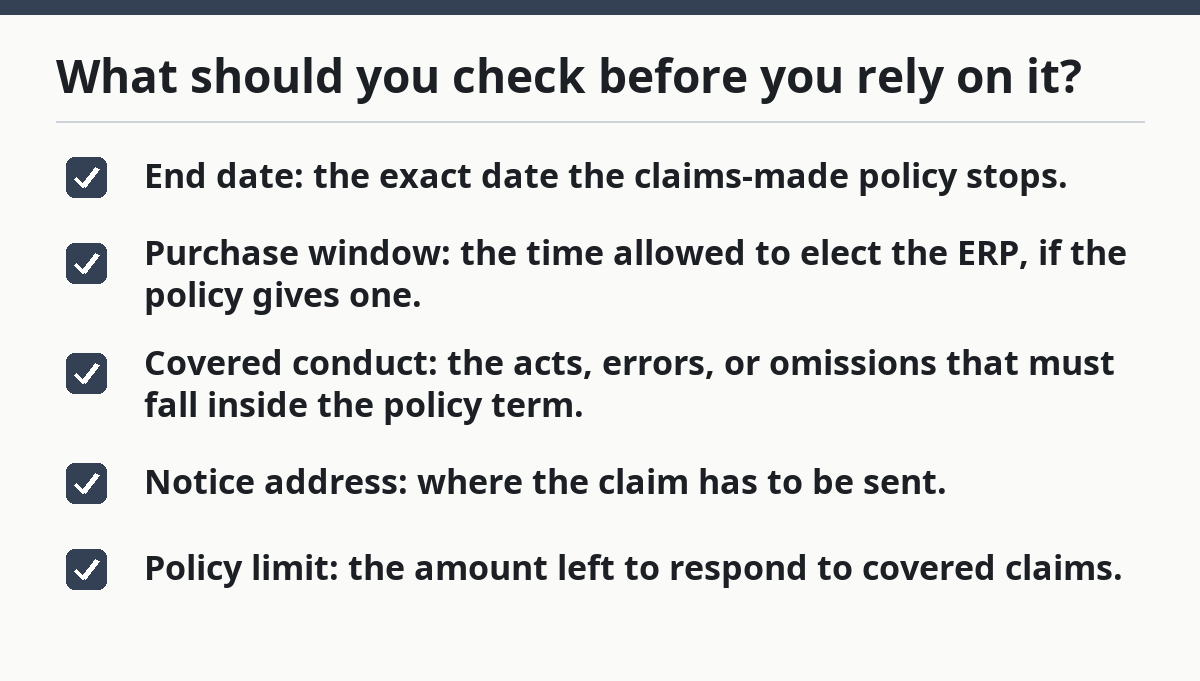
What should you check before you rely on it?
You should check the policy wording, the deadline, and the covered acts before you assume the ERP will save a late claim. Those three points usually decide the outcome more than the nickname does.
Picture this: you are holding a notice of claim and a renewal letter, and the answer depends on three pages of contract text. That is the moment to slow down.
- End date: the exact date the claims-made policy stops.
- Purchase window: the time allowed to elect the ERP, if the policy gives one.
- Covered conduct: the acts, errors, or omissions that must fall inside the policy term.
- Notice address: where the claim has to be sent.
- Policy limit: the amount left to respond to covered claims.
The hidden mistake is assuming the ERP changes the date of the underlying act. It does not. If the act is outside the policy’s covered period, the tail is usually useless. If the claim is reported late outside the ERP, the tail is also useless.
If the policy language is unclear, the safest move is to avoid guessing at the insurer’s intent and review the form, the endorsements, and the declarations page together. That is the only way to know what the reporting rule actually says.
Common mistakes people make with tail coverage
People make the same few mistakes with tail coverage because the phrase sounds simpler than the contract. Each mistake can turn into a denied claim, a gap in protection, or a missed deadline.
Picture this: the policy is ending, the inbox is full, and the client still has not complained. This is when shortcuts cause trouble.
-
Assuming the tail is automatic.
If the ERP must be elected, silence may mean no extension at all. The fix is to confirm the election rule before the policy ends. -
Missing the election deadline.
A short post-termination window can close fast. The fix is to mark the date on the calendar and send the request in the form the policy requires. -
Treating the tail like a new policy.
It is not a fresh policy term and usually does not cover new work after the original end date. The fix is to treat it as a reporting extension only, and consult a professional if you are unsure how the form applies. -
Ignoring notice instructions.
Sending a claim to the wrong place can create a notice problem. The fix is to use the exact contact method named in the policy. -
Forgetting that coverage still has limits.
The ERP usually does not erase exclusions, conditions, or the original limit structure. The fix is to read the endorsement before relying on it. -
Using one policy to explain another.
People sometimes mix up a prior policy, a renewal policy, and the tail. The fix is to keep the dates and forms separate; if two policies may apply, get qualified help to sort them out.
A claim that seems simple can turn messy fast. The wrong assumption about timing is usually the expensive one.
When does the standard rule not fit cleanly?
The standard ERP rule does not fit cleanly when the policy wording, the reporting date, or the type of insured is unusual. Those edge cases need closer reading because the normal shortcut can break.
Picture this: a business changes structure, a policy ends mid-year, or several notices arrive at once. The reporting rule can still work, but only if the form says it does.
- Policy cancellation versus expiration: some forms treat early termination differently from a full term ending.
- Business closure: the insured may need the ERP because no new policy will replace the old one.
- Multiple insureds: one party may have rights the others do not.
- Long reporting clauses: some forms allow a longer reporting period than others, but only for specific claims.
- Regulated professions: professional liability forms can use different wording from general commercial liability forms.
The right question is not “Do I have a tail?” It is “What exactly does this policy let me report, when, and by whom?” That question usually reveals the gap.
What a reader should remember before the policy ends
An extended reporting period is valuable because claims can arrive after the policy is gone, and timing can decide whether the insurer accepts them. That is the whole point of the feature.
Picture this: the coverage term is ending, the work is already done, and the only thing left is the reporting clock. If the policy includes an ERP, the extra window may protect a claim that would otherwise land too late.
The practical rule is simple: check the deadline, the notice method, and the covered work before the policy ends. If any of those are unclear, the contract needs review, not guesswork.
What is tail coverage?
Tail coverage is the common nickname for an extended reporting period. It usually means the policyholder can report certain claims after the claims-made policy ends.
The term is informal, so the policy wording controls the real answer. Some forms use the phrase directly; others describe the same idea without using the word “tail.”
Is extended reporting period the same as tail coverage?
Usually, yes, people use the terms to mean the same reporting extension. The policy language still matters more than the nickname.
Some contracts and markets use the phrases differently, so the exact endorsement or policy form decides whether the two terms match in your case.
When do I need an extended reporting period?
You need to think about an extended reporting period when a claims-made policy is ending and a claim might be reported later. That is common after nonrenewal, termination, or a business change.
The key question is timing. If the claim could be reported after the policy ends, and the policy covers the earlier act, the ERP may be the only reporting window left.
Drafted with AI; not yet reviewed by a person.