Last updated: November 19, 2026
Your landlord needs to be added as an additional insured on your commercial policy, and the additional insured endorsement is the form that makes it happen. This guide explains How to Add a Landlord as an Additional Insured on a Commercial Policy, including the wording, the certificate, and the lease steps that usually settle it.
Key takeaways
- The lease controls the ask, but the insurer controls the wording.
- A certificate of insurance is not the same thing as the endorsement.
- The landlord usually wants proof of coverage for claims tied to your use of the space, not blanket protection for everything.
- If the lease asks for wording your policy does not support, the fix is usually a broker call and an endorsement request, not a handwritten promise.
- This is information, not financial advice; rates, policy terms, and contract language vary, so a qualified adviser should review your own lease and policy.
Who this applies to, and what you need first
This applies when your commercial lease agreement says the landlord must be named as an additional insured on your general liability policy, and you already have a policy in force. You need the lease, the policy declarations page, and the name and mailing address of the landlord exactly as they appear in the contract. If the landlord also asks for primary and noncontributory wording, that matters too. Here’s the catch: those are separate contract terms, not just a line on a certificate.
Because the landlord’s request often arrives before move-in, you should treat How to Add a Landlord as an Additional Insured on a Commercial Policy as a document-matching task, not a quick checkbox. The certificate shows evidence. The endorsement changes the policy. In New York, for example, the state warns that certificates do not confer rights beyond the policy itself.
Before you ask for the change, check whether the lease requires:
- an additional insured endorsement for the landlord’s interest in the premises,
- a specific form number or ISO-style wording,
- notice if the policy cancels,
- minimum liability limits, and
- a copy of the certificate of insurance.
If the lease asks for wording that conflicts with your policy forms, that’s the point to slow down. A broker can tell you what your carrier will actually issue, and whether the policy can support the lease language without a rewrite.
How do I add a landlord as an additional insured on a commercial policy?
You add the landlord by asking your insurance broker or carrier to issue an additional insured endorsement that names the landlord exactly as the lease requires. The process usually takes a written request, a review of the lease, and then an updated certificate showing the endorsement reference. It is usually straightforward, but not always immediate.
Because the landlord’s wording can affect how a claim is handled, keep How to Add a Landlord as an Additional Insured on a Commercial Policy tied to the lease clause from the start. Picture this: you’re staring at a lease clause that says the landlord must be “additional insured on a primary and noncontributory basis.” That sentence matters because it affects how the policy responds after a claim. If the wording is off, the landlord may reject your certificate even if you already paid the premium.
- Pull the exact lease clause. Copy the insurance paragraph word for word, including any form number, notice language, and naming requirements. Verify: the landlord’s legal name, not a property manager’s trade name. Problem sign: the lease names “and/or affiliates” or a vague entity with no legal title.
- Check your current policy. Read the declarations page and endorsements to see whether additional insured coverage is already built in for tenants or whether a separate endorsement is needed. Verify: the policy period is current and the liability section is active. Problem sign: the policy only includes the landlord as a loss payee or certificate holder, which is not the same thing.
- Send a written endorsement request to the broker. Ask for the landlord to be added as an additional insured under the lease wording, and attach the lease page. Verify: the request includes the full legal name, address, and any required certificate holder line. Problem sign: the request only says “add landlord,” which leaves the carrier guessing.
- Ask for the form number. Many carriers use a scheduled endorsement or ISO-based wording such as CG 20 11 or CG 20 26, depending on the setup. Verify: the issued endorsement matches the event the lease cares about, such as ongoing operations or completed work. Problem sign: the endorsement covers only work you performed, while the lease is about the premises itself.
- Review the certificate of insurance. Make sure the certificate reflects the additional insured endorsement and lists the landlord correctly. Verify: the certificate is consistent with the endorsement and the policy dates. Problem sign: the certificate says “additional insured” but the endorsement has not actually been issued.
- Check for limits and exclusions. Confirm whether the landlord wants coverage only for liability arising out of your occupancy, and whether your policy excludes the exact activity in the space. Verify: the operations listed on the policy fit the use in the lease. Problem sign: you run a food business, but the policy excludes the slip-and-fall exposure the landlord is worried about.
- Deliver the final package. Send the landlord the certificate, the endorsement if requested, and any required notice language. Verify: all documents show the same policy number and effective dates. Problem sign: one page shows an old policy period or a misspelled legal name.
Once the carrier issues the endorsement, the landlord’s request usually becomes an admin task instead of a debate. But if the policy form cannot support the lease wording, no amount of certificate editing will fix it. For a closer look at contract language, see our page on commercial lease insurance requirements and the certificate of insurance guide.
What wording usually matters on the certificate?
The wording that usually matters is the exact name of the landlord, the policy number, the effective dates, and a clear note that the landlord is an additional insured by endorsement. A certificate of insurance is evidence, not coverage by itself. If you are unsure, a broker, agent, or attorney should confirm the lease language and the issued endorsement before you rely on the certificate alone. The New York State Department of Financial Services says certificates do not amend or extend coverage, and the Insurance Information Institute makes the same basic point.
Because How to Add a Landlord as an Additional Insured on a Commercial Policy often turns on a few lines of text, read the certificate as a snapshot, not a promise. Picture this: the landlord’s office sends a checklist with “Please provide COI naming landlord as AI.” If you only send a certificate and skip the endorsement, you may satisfy the inbox for a day and fail the lease review the next. The truth is, the certificate should mirror the policy, not replace it.
A typical request may ask for:
- the landlord’s full legal entity name,
- the property address,
- your tenant business name,
- the policy period,
- liability limits shown on the certificate, and
- the statement that the landlord is additional insured as required by written contract.
If the landlord wants extra wording such as “primary and noncontributory” or “waiver of subrogation,” do not assume your carrier will add that automatically. Those are separate policy mechanics. They may require separate endorsements, and some policies will not issue them in every situation.
One more thing: some landlords ask for the certificate holder box to show the management company. That is fine if the lease says so, but the certificate holder is not the same as the additional insured. The holder gets a copy. The additional insured gets certain policy protections, depending on the endorsement.
What can go wrong with additional insured status?
The common mistakes are usually paperwork mistakes, but the consequences are real. A landlord can reject the documents, delay move-in, or push the issue back into lease enforcement. Sometimes the tenant thinks everything is covered when the policy form says otherwise.
Because these errors show up most often at move-in or renewal, How to Add a Landlord as an Additional Insured on a Commercial Policy works best when the lease, the endorsement, and the certificate are checked together. Picture this: your broker sends a nice-looking certificate, but the endorsement never gets attached. That looks complete from a distance and wrong up close. The problem is not the font. It’s the legal effect.
Common errors and the fix:
- Using the wrong legal name. The landlord’s operating name is not always the legal insured entity. Consequence: the endorsement may not match the lease. Fix: use the exact legal entity from the lease or a W-9 if the landlord provides one.
- Treating the certificate as proof of coverage. It is not the policy. Consequence: you can hand over a document that the insurer has not backed. Fix: request the endorsement and confirm it was issued.
- Asking too late. Endorsements can take time, especially near renewal or bind date. Consequence: delayed occupancy or lease default risk. Fix: start the request as soon as the lease draft lands.
- Ignoring the policy form. Some forms cover only liability arising out of your operations, not the landlord’s broader wish list. Consequence: you think you complied, but the form is narrower than the lease. Fix: have the broker compare the lease clause to the endorsement wording.
- Forgetting renewals. The endorsement can fall off if the policy renews and nobody reissues the certificate. Consequence: stale proof at renewal time. Fix: calendar the renewal 30 to 45 days ahead.
- Adding the landlord when the lease does not require it. Some arrangements only require a certificate holder listing. Consequence: extra admin work and possible coverage confusion. Fix: read the lease, not the rumor from the prior tenant.
The best habit is simple: match the lease, then match the policy, then match the certificate. Do not reverse that order.
When the standard approach does not apply
The standard approach does not apply when the lease asks for coverage your policy cannot issue, when the landlord wants protection for something outside your operations, or when the named entity changes during the lease term. In those situations, check the lease and policy with a broker, carrier, or attorney before you rely on the paperwork.
Because the risk can change with the property structure, How to Add a Landlord as an Additional Insured on a Commercial Policy may need a fresh review at renewal or after an assignment. Picture this: the landlord wants to be added for property they own, but your business only leases a suite and the policy is written for tenant liability. That mismatch matters. A certificate can be filled out in minutes, but the endorsement has to fit the risk the insurer agreed to cover.
Stop and reassess in these situations:
- The lease names a different owner than the one on the certificate. The entity may have sold, assigned, or restructured the property. What it means: the requested additional insured may not be the right one. What to do: ask for the current legal owner name before the endorsement is issued.
- The carrier says the endorsement is not available. What it means: the policy form does not support the lease wording. What to do: ask the broker what wording can be issued, if any, and whether another policy form is needed.
- The landlord asks for broader coverage than the lease supports. What it means: the landlord wants more than the contract requires. What to do: push the request back to the lease language and compare the exact clause.
- Your business activity changed. What it means: the risk in the space no longer matches the original policy description. What to do: update the policy description before chasing the endorsement.
- The request involves several landlords or a master lease. What it means: the property structure is layered. What to do: list each entity separately if the lease requires it, and confirm each one is acceptable to the carrier.
For broader contract-risk context, this page supports the hub on commercial liability insurance risk transfer in contracts. See also our tenant insurance compliance guide and broker checklist for lease reviews.
How long it takes and what a clean result looks like
A clean result is a policy endorsement issued by the carrier, a certificate that matches it, and a landlord who accepts the paperwork without sending it back. The timeline varies by carrier and by how clean the lease language is.
Because the timing often decides whether a deal closes on schedule, How to Add a Landlord as an Additional Insured on a Commercial Policy should start as soon as the lease is drafted. Picture this: you submit the lease on Monday and get a certificate on Wednesday, then the landlord returns it on Friday because the legal name is off by one word. That is the usual failure mode. Small typo, big delay.
A clean file usually has these parts:
- the lease clause saved as a PDF or scan,
- the broker’s request for the exact endorsement,
- the issued endorsement attached to the policy file,
- a certificate with the same policy number and dates,
- the landlord’s full legal name and address,
- any renewal reminder for the next policy term.
If the landlord has a standard insurance checklist, compare it line by line with the documents before you send them. Check the name, dates, and endorsement wording first. Then check the limits and any extra wording the lease asks for. A 5-minute review can save a week of back-and-forth.
The role of your broker in the endorsement request
Your broker is the translator between the lease and the carrier, and that matters because the carrier issues the actual endorsement. If the broker gets the wording wrong, the certificate will look polished and still miss the point.
Because the broker has to match the lease to the form, How to Add a Landlord as an Additional Insured on a Commercial Policy is usually faster when the request is specific. Picture this: the lease says “landlord and its affiliates,” but the policy can only schedule one legal entity. That is where the broker has to slow the process down and get the carrier’s exact wording. Guessing here is a bad habit.
A broker should:
- read the lease clause,
- tell you what endorsement the carrier can issue,
- request the exact legal name for the landlord,
- confirm whether the endorsement covers the premises or only operations,
- check whether other required terms, like waiver of subrogation, are available.
If your broker shrugs and says the certificate is enough, that’s a warning sign. Certificates are paperwork. Endorsements are the coverage change.
What should I send to the insurer?
You should send the lease clause, the landlord’s legal name, and a written request for the additional insured endorsement. If the policy has renewal timing or a pending endorsement cutoff, include that too so the carrier can work from the right term.
Because the insurer needs exact wording, How to Add a Landlord as an Additional Insured on a Commercial Policy works best when the request is short and complete. Picture this: you’ve got one email draft and a deadline at the end of the month. A tight request helps. Vague wording causes delays.
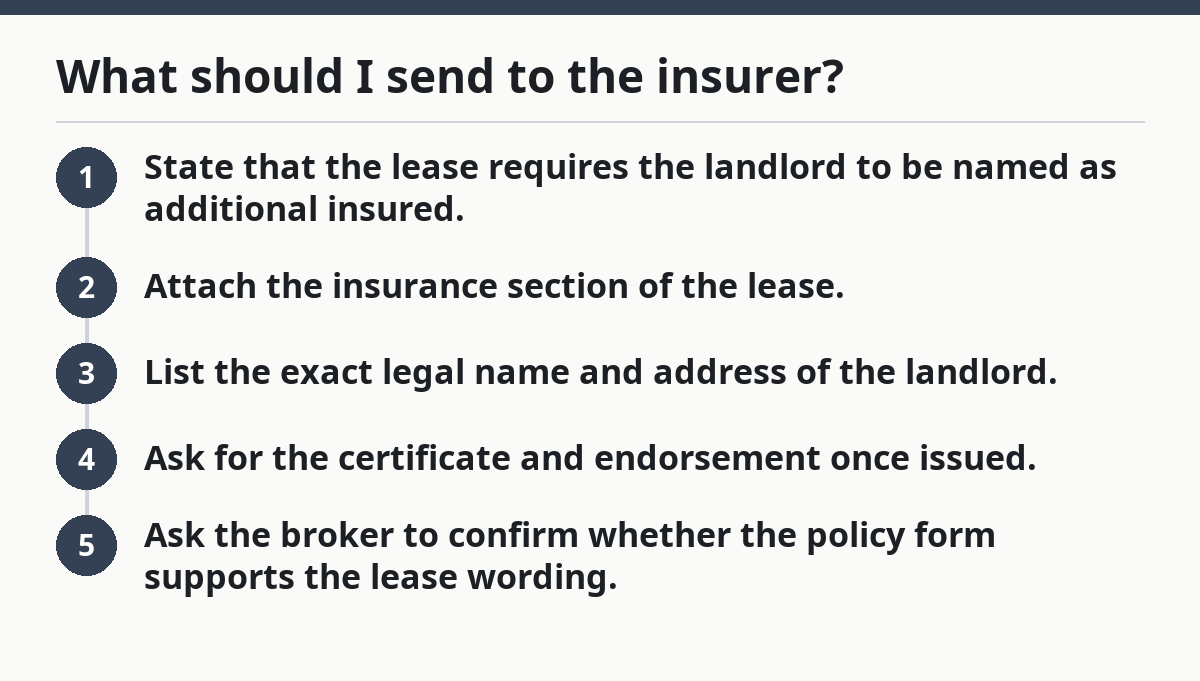
Use this request structure:
- State that the lease requires the landlord to be named as additional insured.
- Attach the insurance section of the lease.
- List the exact legal name and address of the landlord.
- Ask for the certificate and endorsement once issued.
- Ask the broker to confirm whether the policy form supports the lease wording.
If the carrier needs a manuscript endorsement or rejects the wording, ask for the reason in writing. That keeps the file clean.
Drafted with AI; not yet reviewed by a person.