Last updated: November 19, 2026
Key Takeaways
- Commercial liability insurance usually responds when your business is legally responsible for injury, property damage, or certain personal and advertising harms, with the exact policy depending on the claim.
- General liability usually responds to a customer slip-and-fall when the injury happens because of your premises, operations, or a condition you controlled.
- Professional liability usually answers claims that your service, advice, or judgment caused financial loss, not a wet-floor injury or a smashed display case.
- Product liability usually covers claims that a product you made, sold, or distributed caused bodily injury or property damage after it left your possession.
Commercial liability insurance coverage changes by risk scenario because one policy can respond to bodily injury, property damage, advertising injury, or professional mistakes while another excludes the exact loss you’re facing. The right coverage depends on the claim type, not the business label. This guide to Commercial liability insurance coverage by risk scenario — The Complete Guide helps you sort out which policy usually responds, where the exclusions bite, and what to check before a gap becomes a bill. A claim can cost far more than the premium; a slip-and-fall defense can reach thousands of dollars, and contract wording can shift the result before a loss even happens.
Who this guide is for — and what it assumes
This guide is for a business owner, manager, or bookkeeper who needs to understand commercial liability coverage before a claim, renewal, or contract signature. It assumes you already know the basics of your own operation: what you sell, where you work, who touches customer property, and whether you give advice, use vehicles, or handle data.
Because of that, the guide focuses on the mechanism, not a sales pitch. Commercial liability is not one policy with one answer. A slip on a wet floor, a bad label on a package, and a botched design job can all trigger different parts of a policy stack, and some losses won’t fit at all.
This is information, not financial advice. Coverage terms, limits, and endorsements differ by country, insurer, and policy form, so a qualified adviser or broker should check your own wording before you rely on it. The Insurance Information Institute and IRMI both stress that policy language controls the outcome.
What this guide covers
- The common claim types that hit businesses
- Which policy form usually applies
- The exclusions that most often change the result
- The situations where standard liability coverage does not fit
- The checks that prevent ugly surprises at claim time
What it does not do
- It does not tell you what to buy
- It does not price insurance
- It does not replace your policy wording
Commercial liability insurance coverage by risk scenario
Commercial liability insurance usually responds when your business is legally responsible for injury, property damage, or certain personal and advertising harms, but the exact policy depends on the scenario. If you are reading a contract, a customer is asking for proof of insurance, and you need to know whether the loss falls under general liability, professional liability, product liability, cyber, or an auto policy, this section gives the first answer.
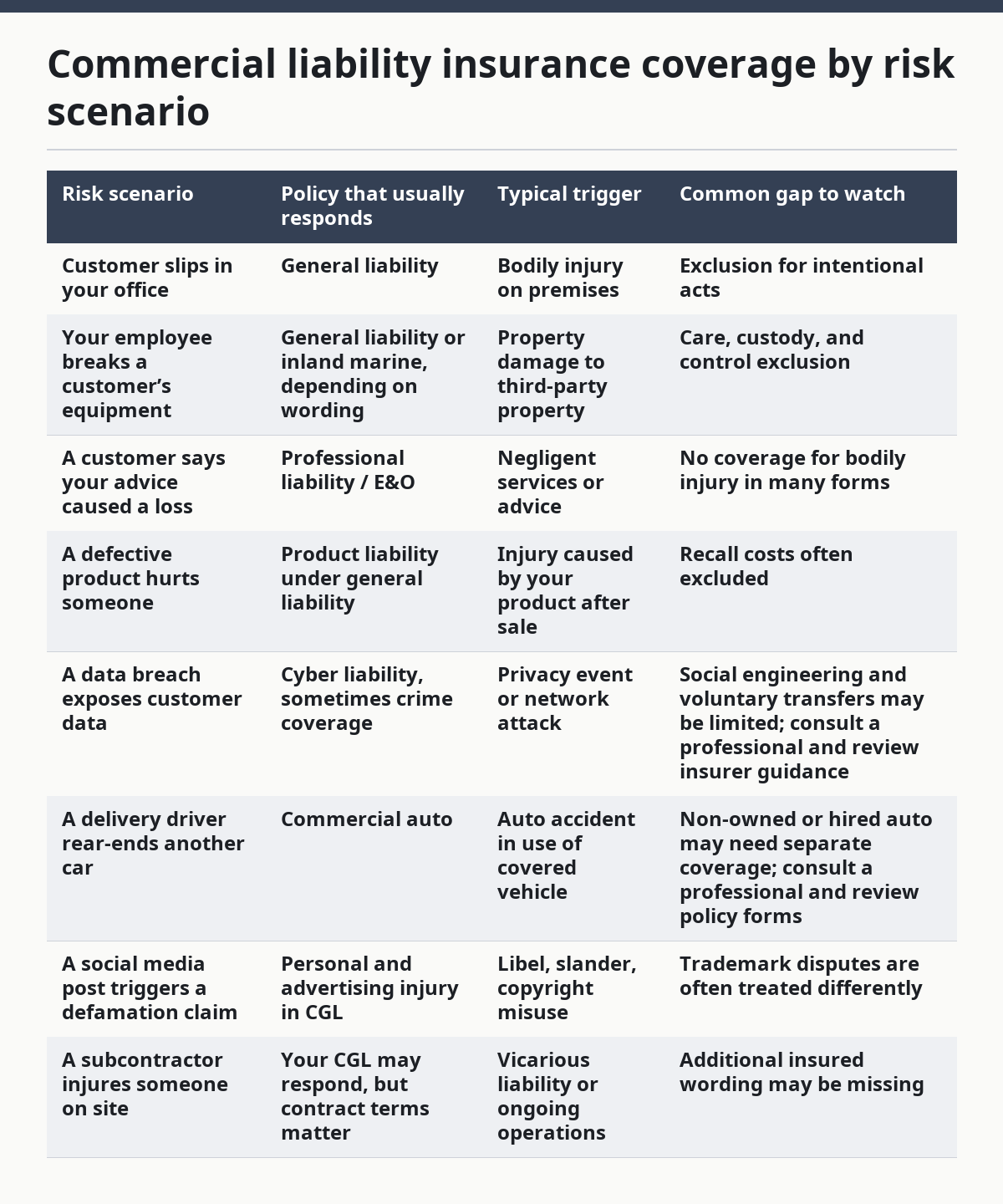
The same event can involve two policies, or none. A restaurant’s hot coffee spill is a general liability claim; a consultant’s wrong advice is usually professional liability; a delivery van crash belongs in commercial auto. The label on the business matters less than the cause of the loss.
| Risk scenario | Policy that usually responds | Typical trigger | Common gap to watch |
|---|---|---|---|
| Customer slips in your office | General liability | Bodily injury on premises | Exclusion for intentional acts |
| Your employee breaks a customer’s equipment | General liability or inland marine, depending on wording | Property damage to third-party property | Care, custody, and control exclusion |
| A customer says your advice caused a loss | Professional liability / E&O | Negligent services or advice | No coverage for bodily injury in many forms |
| A defective product hurts someone | Product liability under general liability | Injury caused by your product after sale | Recall costs often excluded |
| A data breach exposes customer data | Cyber liability, sometimes crime coverage | Privacy event or network attack | Social engineering and voluntary transfers may be limited; consult a professional and review insurer guidance |
| A delivery driver rear-ends another car | Commercial auto | Auto accident in use of covered vehicle | Non-owned or hired auto may need separate coverage; consult a professional and review policy forms |
| A social media post triggers a defamation claim | Personal and advertising injury in CGL | Libel, slander, copyright misuse | Trademark disputes are often treated differently |
| A subcontractor injures someone on site | Your CGL may respond, but contract terms matter | Vicarious liability or ongoing operations | Additional insured wording may be missing |
The core policies and what they usually do
- Commercial general liability (CGL): Often the first policy for third-party bodily injury, property damage, and personal and advertising injury.
- Professional liability / errors and omissions (E&O): Covers claims that your advice, design, or professional service caused a financial loss.
- Product liability: Usually part of or attached to CGL, focused on harm caused by goods after they leave your hands.
- Commercial auto: Covers accidents involving insured business vehicles.
- Cyber liability: Handles some data breach and network claims, though coverage varies a lot.
- Umbrella or excess liability: Adds higher limits over underlying liability policies, but it usually follows the underlying policy’s rules.
What happens if a customer slips and gets hurt?
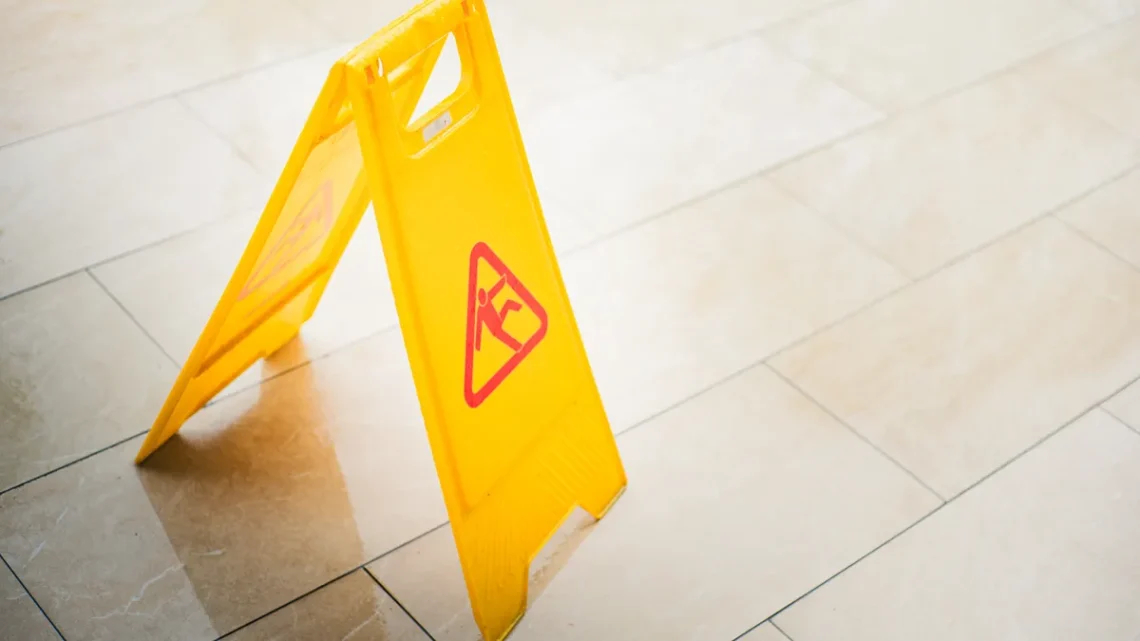
General liability usually responds to a customer slip-and-fall if the injury happened because of your premises, operations, or a condition you controlled. A customer who steps on a wet tile near the front desk, falls, and says the floor was not marked is the type of claim CGL is built to answer.
The mechanism is straightforward. The policy pays for covered claims alleging bodily injury, legal defense, settlements, and judgments, up to the limit, after deductibles or self-insured retentions if your form has them. The details matter, because a defense cost can be separate from the liability limit in some policies and inside the limit in others.
A few things can change the outcome fast. If you knowingly ignored a known hazard, the insurer may examine exclusions or contributory fault defenses. If the injured person was an employee, workers’ compensation may sit in front of liability coverage. If the injury happened during work on a customer’s site, additional insured wording and contract terms can matter a lot.
Check these points before you assume the claim fits
- Was the person a customer, vendor, contractor, or employee?
- Did the injury happen on your premises or during your operations?
- Was the hazard temporary, such as a spill, or built into the site?
- Do you have any written safety logs, photos, or incident reports?
- Does your policy exclude work at heights, pools, trampolines, or other special hazards?
Common slip-and-fall coverage surprises
- Employee injury: This usually belongs in workers’ compensation, not CGL.
- Your own property damage: Liability insurance is for third-party loss, not damage to your own building or stock.
- Known hazard ignored: Repeated warnings can create a coverage fight.
- Special venue exclusions: A bounce house, climbing wall, or pool can trigger separate underwriting rules.
What if your work is advice, design, or a professional service?
Professional liability usually answers claims that your service, advice, or judgment caused a customer’s financial loss, not a wet-floor injury or a smashed display case. A consultant misses a deadline, a designer delivers the wrong specs, or a bookkeeper files something that creates a penalty. The loss is economic, and that is the center of the claim.
That is where many owners get tripped up. A CGL policy often does not cover pure financial harm from bad advice. Professional liability exists because the legal theory is different: the customer says you failed in the service itself, not that you caused bodily injury or property damage.
The exact wording matters. Some policies cover negligence, some also cover media work, some require a claims-made form, and many use a retroactive date. A claims-made policy usually responds only if the claim is made during the policy period and the alleged wrongful act falls within the reporting window and retro date.
Watch for these wording issues
- Claims-made vs occurrence: A claims-made form can leave a gap if you let it lapse.
- Retroactive date: Work done before that date may be outside coverage.
- Professional services definition: If your task is not named or described, the insurer may dispute it.
- Bodily injury exclusion: Many E&O policies do not cover physical injury claims.
- Contracted liability: Some contracts demand broader wording than your policy provides.
Examples that often belong here
- Architect or engineer errors
- Marketing agency mistakes
- IT consulting errors
- Accounting or bookkeeping mistakes
- Insurance brokerage errors
- Real estate advisory errors
Examples that often do not
- A customer slips in the lobby
- A chair breaks and injures a visitor
- A van crash on the highway
- A defective product injures a user
Does product liability cover defective goods?
Product liability usually covers claims that a product you made, sold, or distributed caused bodily injury or property damage after it left your possession. A space heater overheats in a customer’s home, or a bottled food item is alleged to have caused harm. The claim is about the product’s condition, not the service around it.
The most useful way to think about product liability is as a part of general liability, not a totally separate universe. It matters whether you manufacture, import, brand, repackage, or simply resell. A reseller can still face a claim if it put a product into commerce under its own name or had enough control over the supply chain to be named in a lawsuit.
Here’s the catch: product liability often does not pay for recall costs, voluntary withdrawal, or the cost to fix the product itself. That is where people get blindsided. The policy may answer the injury claim, but not the warehouse pull, the customer notice campaign, or the freight bill to get the goods back.
Common product-liability checks
- Do you import from overseas?
- Do you use your own brand or private label?
- Do you include installation instructions or warnings?
- Do you sell through distributors or marketplaces?
- Do you need completed operations coverage for work after installation?
Common exclusions and limits
- Recall expenses: Often excluded or narrowly limited.
- Your own product: The policy may not pay to replace a defective item itself.
- Warranty promises: A contract warranty can create exposure the policy will not absorb.
- Batch-specific issues: A contamination event can create large loss clusters fast.
What happens after a data breach or cyber incident?
Cyber liability usually addresses some costs from a data breach, privacy event, or network attack, but it is not the same as general liability. Customer records can be exposed, an attacker can lock your files, or a vendor portal can be breached and your customers affected. You need to know whether the policy pays for forensic work, notice costs, credit monitoring, or legal defense.
The reason cyber claims are tricky is that there are usually two layers of harm. One is the direct response cost: IT forensics, breach notices, call center work, and legal review. The other is liability: claims from customers, regulators, or partners. A CGL policy may help with some privacy or advertising injury claims, but it often will not handle a modern cyber event cleanly.
Policy wording differs a lot. Some cyber forms cover ransomware, business interruption from a network outage, and third-party privacy claims. Others narrow the trigger or carve out social engineering and funds transfer fraud. If your business sends invoices by email, uses cloud storage, or handles personal information, the gap can show up fast.
Questions to ask about cyber coverage
- Does the policy cover ransomware and extortion?
- Are voluntary transfers covered if an employee was tricked?
- Does it include business interruption from a network outage?
- Are privacy fines or penalties covered where law allows?
- Does it respond if a vendor causes the breach?
Things a generic liability policy often misses
- Data restoration
- Breach notification
- Credit monitoring
- Crisis communication
- Computer system repair
What if the claim involves a vehicle?
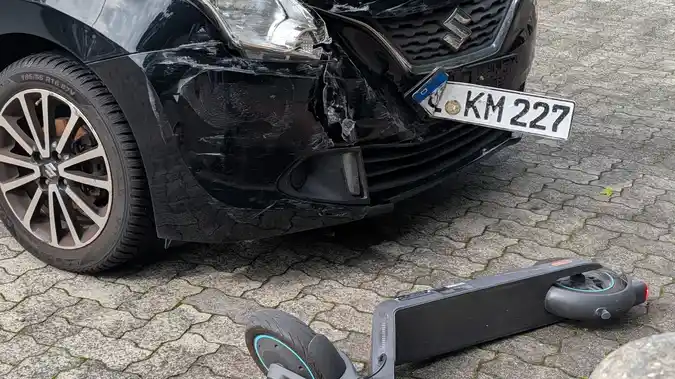
Commercial auto usually responds when a business vehicle causes injury or property damage in a crash, while general liability often steps back. A sales rep rear-ends another car, a delivery van clips a mailbox, or an employee uses a truck for work and damages someone else’s property. That is classic auto territory.
The policy form matters here because not every business vehicle is scheduled the same way. Owned autos, hired autos, and non-owned autos can each need different treatment; consult a professional and review the policy wording. If an employee uses a personal car for errands, the business may face exposure from non-owned auto liability even if the employee’s own policy is primary for that vehicle.
The tricky part is ownership and use. A cargo van, a box truck, and a rented trailer do not all flow through the same clause. If the policy only lists owned autos and the loss involves a rented vehicle, there may be a gap. If a contractor uses its own truck, the contract may demand proof of insurance before work starts.
Verify these items
- Are the vehicles owned, hired, borrowed, or leased?
- Are employees using personal cars for company errands?
- Does the policy include non-owned and hired auto liability?
- Is cargo coverage needed for goods in transit?
- Are drivers and uses listed correctly on the declarations page?
Common auto coverage traps
- Personal auto assumed to be enough: It often is not for business use.
- Hired vehicle gap: A rented van can be outside a standard schedule.
- Trailer confusion: Trailers can be treated differently from powered vehicles; consult a professional and review the policy wording.
- Driver list mismatch: Named-driver rules can create a claim dispute.
What if a contract asks for an additional insured?
Additional insured status usually gives another party some protection under your liability policy, but it does not create unlimited coverage. A landlord, general contractor, or venue may say you must name them as an additional insured before you can work. That request is common, but the wording on the certificate and endorsement is what controls.
A certificate of insurance is not the same as coverage. It is a summary, not the policy. The endorsement is what changes the contract. If the endorsement only covers ongoing operations, it may not protect the other party for completed work. If it is limited to liability caused by your acts, it may not help with the other party’s own negligence.
This is where many business owners get burned. They assume a certificate proves the deal, then discover the endorsement is narrower than the contract. The names have to match, the policy period has to be live, and the required wording has to appear in the actual endorsement form.
Check the endorsement, not just the certificate
- Is the other party named correctly?
- Does the endorsement cover ongoing operations, completed operations, or both?
- Is the request broader than the policy form allows?
- Does the contract require primary and noncontributory wording?
- Is there a waiver of subrogation requirement?
Common contract pitfalls
- The contract asks for coverage the policy does not provide or provides only in a narrower form
- The endorsement is limited to work done at a specific site
- The certificate was issued, but the endorsement was never added
- The time window for completed operations is too short for the contract
When standard liability coverage does not apply
Standard liability coverage does not fit when the loss is really about your own property, a guaranteed result, or a specialized professional exposure. You want one policy to fix every problem, but the loss is a contract dispute, a payroll error, a patent claim, or a flood. That is not a CGL problem.
The line is simple once you see it. Liability insurance is about what your business owes others because of injury, damage, or defined harm. It is not a maintenance plan for your own assets, and it is not a warranty on performance. If the claim is about poor financial performance without a covered wrongful act, the policy can still say no.
Stop and reassess if the situation is one of these
- Your own property is damaged: This is usually first-party property coverage, not liability.
- A worker is injured on the job: Workers’ compensation usually sits first.
- The loss is pure contract breach: Many liability policies exclude it.
- The issue is a known defect in your product: Recall and remediation may not be covered.
- The claim is about a patent, trademark, or copyright fight: Some parts may be excluded or narrowly defined.
- A payment was sent because someone was tricked: Crime coverage or cyber crime may be the better fit.
What to do instead
- Read the declarations, endorsements, and exclusions together
- Match the claim to the trigger, not the business type
- Confirm whether the loss is injury, property damage, economic loss, or statutory damage
- Ask a qualified adviser to compare the policy form to the contract or claim letter
The mistakes businesses make with liability coverage
Businesses usually make the same six mistakes, and the cost is a denied claim, an uncovered defense, or a contract breach. The premium may look fine, the certificate may be issued, and the owner may think the policy does the rest. Then the loss arrives and the wording says otherwise.
The biggest mistake is buying by business category instead of by hazard. A coffee shop, a tutoring company, and a web design firm can all need very different mixes of coverage even if they look small on paper. The second mistake is assuming general liability covers everything with a bad outcome.
The most common errors
- Using the wrong policy type: A services claim goes to E&O, not CGL. The result is a denial or a defense fight. The fix is to map each service line to the correct policy.
- Ignoring exclusions: Pollution, professional services, employment practices, and auto claims can be carved out. The result is a gap where the loss was expected to fit. The fix is to read the exclusions page first.
- Relying on the certificate alone: A certificate can be incomplete or outdated. The result is false confidence. The fix is to verify the endorsement and effective dates.
- Forgetting hired or non-owned exposures: Employees driving personal cars can create liability. The result is uncovered auto exposure. The fix is to ask specifically about hired and non-owned auto.
- Missing completed operations: Work that looks fine today can cause damage months later. The result is a post-job claim with the wrong policy period or no coverage. The fix is to check completed operations wording.
- Letting a claims-made policy lapse: A late claim can fall outside the reporting window. The result is no response at all. The fix is to manage retro dates and tail coverage carefully.
A quick reading order for any policy
- Declarations page
- Insuring agreement
- Definitions
- Exclusions
- Conditions
- Endorsements
How do you read the policy without getting lost?
You read it by matching one claim to one trigger, then checking exclusions and endorsements in that order. A 40-page form, a claim letter, and maybe a contract clause do not need to be read like a novel. The goal is to find the sentence that changes the claim.
Start with the declarations page, because that tells you the named insured, policy period, limits, and form number. Then read the insuring agreement to see what the insurer promises to pay. After that, scan exclusions for the words that remove coverage, such as professional services, pollution, auto, employer’s liability, or expected injury. Finally, check endorsements, because they can rewrite almost anything.
This reading method matters because a lot of disputes are not about the main promise. They are about a small endorsement that narrowed coverage, or a definition that moved a claim out of the policy. If the claim is large, or the contract is strict, a qualified adviser should compare the policy form against the risk before you rely on it. IRMI and the National Association of Insurance Commissioners both point readers to the policy wording as the controlling source.
The shortest useful checklist
- Match the claim type to the coverage part
- Check whether the policy is claims-made or occurrence
- Read the exclusions that fit your work
- Look for endorsements that narrow or expand coverage
- Confirm whether defense costs erode the limit
FAQ
Does general liability cover professional mistakes?
No, not usually. General liability is built for bodily injury, property damage, and certain personal and advertising harms, while professional mistakes usually fall under professional liability or E&O. If the loss is a pure financial loss from advice, design, or service work, the CGL form often does not respond.
Is a certificate of insurance enough proof of coverage?
No, a certificate is not enough by itself. It is only a summary, and the endorsement and policy wording control the actual coverage. If a landlord or contractor needs specific wording, the certificate should be checked against the live policy documents.
Does product liability cover a recall?
Not automatically. Product liability often covers injury or property damage caused by the product, but recall costs, voluntary withdrawal, and fixing the product itself are commonly excluded or limited. The exact answer depends on the policy form and any product recall endorsement.
Do I need commercial auto if employees use their own cars?
Often yes, if those cars are used for business tasks. The employee’s personal auto policy may not fully protect the business, and non-owned auto liability can come into play. A policy review should confirm how hired and non-owned vehicles are handled.
What’s the biggest coverage gap for small businesses?
The biggest gap is usually assuming one liability policy covers every kind of loss. It doesn’t. A small business can face separate exposures for premises injury, advice errors, vehicles, products, cyber events, and contract wording, and each one can land in a different part of the insurance stack.
Drafted with AI; not yet reviewed by a person.