
Last updated: November 19, 2026
Quick answer: an endorsement stacking issue in commercial liability insurance happens when 2 or more endorsements affect the same part of coverage, and their wording does not line up cleanly. The problem is not the endorsement itself; it is the overlap, conflict, or order of application between forms, especially when one endorsement narrows coverage and another seems to restore it, change it, or move it in a different direction. This article explains the topic in plain English, and a qualified adviser should be consulted for your own policy and situation.
Key takeaways
- An endorsement stacking issue is a wording problem, not a math problem.
- The conflict usually shows up when 2 forms touch the same exclusion, definition, limit, or condition.
- Order matters because policy wording, endorsement wording, and manuscript endorsement language can point in different directions.
- The main risk is a wrong reading of which form controls if the policy is silent or the forms are dated poorly.
- A clean review starts with the declarations page, then every attached endorsement, then the conflict rules in the policy itself.
What does endorsement stacking mean?
Therefore, endorsement stacking means more than one endorsement is operating on the same policy term, and the combined effect is unclear. In commercial liability insurance, that can happen with standard form endorsements, company-specific forms, and a manuscript endorsement, which is a custom-written change made for one insured or one risk.
The issue is common because endorsements do not sit in isolation. A policy may have a base form, one endorsement that adds a definition, another that removes an exclusion, and a third that changes who is an insured. If the policy wording says one thing and the endorsement says another, the reader has to decide which language governs and whether both forms can be read together at all.
For example, a generic article often misses the real point: stacking is not just “two endorsements at once.” It is the practical problem of policy interpretation when multiple forms overlap on the same 2-page or 10-page section of the contract. That is why the exact wording matters more than the label on the form.
For a plain-English guide to the parts around this topic, the broader commercial liability insurance endorsements and policy changes material on this site covers the surrounding ground. This page stays on the narrower question: what stacking means when forms collide.
Why does it happen in a liability policy?
Because commercial liability policies are built in layers, endorsement stacking happens when the base policy gives the starting rule, then 1 or more endorsements change specific parts of that rule. When those changes are written at different times, by different drafters, or for different underwriting reasons, the language can overlap.
A common pattern is simple enough to spot on paper. One endorsement may say an exclusion applies to “bodily injury” in one section, while another endorsement changes the definition of “insured contract” or adds an exception in a different section. If both forms touch the same loss scenario, the question becomes whether the second form modifies the first, leaves it intact, or creates a contradiction that needs conflict resolution.
This is also where manuscript endorsement language matters. A manuscript endorsement can be very specific, but specificity does not automatically make it controlling. If the policy has 3 separate conflict rules, or if an endorsement says it applies “subject to” other forms, those words can change the result.
Legal interpretation is not guesswork, but it is also not a simple count of forms. Courts and adjusters usually look at the actual wording, the structure of the policy, and any clause that tells them how to reconcile inconsistent provisions. A basic contract principle from Cornell Law School’s Legal Information Institute explains that contract terms are read in context, not in isolation: https://www.law.cornell.edu/wex/contract
Which endorsement controls if wording differs?
Ultimately, the controlling endorsement is the one the policy language says controls, or the one that clearly and specifically overrides the other language. If the policy does not say that directly, the answer comes from the internal hierarchy of the forms and ordinary rules of interpretation, not from the form number alone.
That is where people can make a mistake: they assume the newest endorsement always wins. That is sometimes true in practice, but not because “newer is better.” It is true only if the policy says the latest form applies, or if the later wording clearly replaces earlier wording on the same subject. If the answer is unclear, a professional should review the policy before anyone treats the newest form as decisive.
Here is a simple comparison of the usual conflict patterns:
| Situation | What the reader sees | What usually matters most |
|---|---|---|
| Two endorsements address different topics | One changes limits, the other changes a definition | No real conflict if both can operate together |
| Two endorsements change the same clause | One expands coverage, one narrows it | Specific wording and any order-of-application rule |
| Base policy conflicts with an endorsement | The policy says one thing, the endorsement says another | The endorsement if it clearly modifies the base form |
| Two manuscript endorsements conflict | Two custom forms point in different directions | Exact language, dates, and any stated hierarchy |
| One form says “subject to” another | A cross-reference appears in the wording | The referenced form often controls that point |
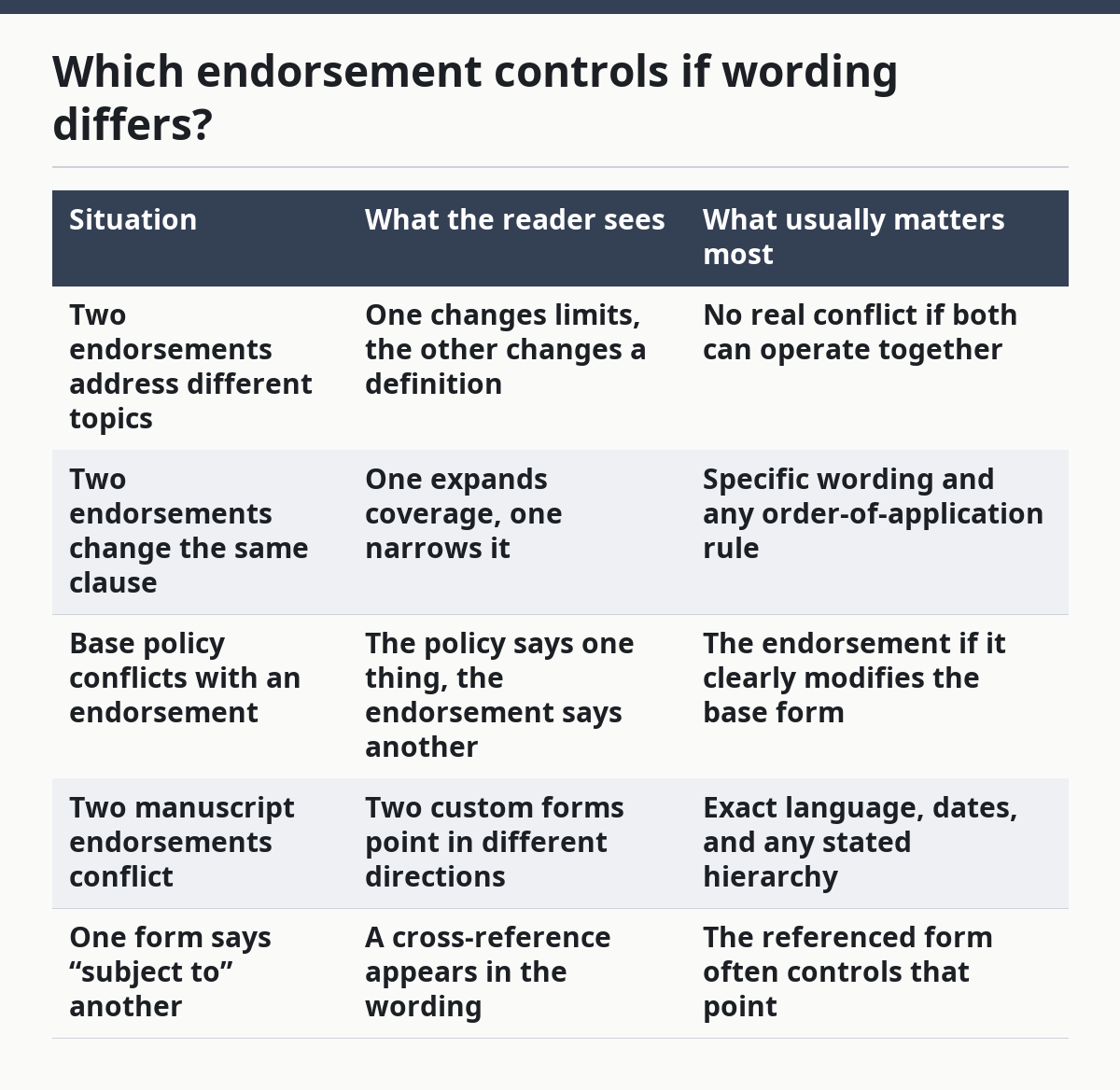
A policy that includes a conflict clause may give the answer in 1 paragraph. A policy that does not can still be read, but the analysis becomes more exacting. In a liability dispute, the difference between “adds” and “replaces” can matter in a single sentence.
How do you spot an endorsement stacking issue?
Because endorsement stacking issue analysis turns on overlap, contradiction, and missing priority language, the fastest way is to trace every form that touches the same exclusion, definition, insured status, or condition, then check whether the words can live together without strain.
Start with the declarations page and list every endorsement attached to the policy. Then read the endorsement titles, not just the titles, and compare the exact clauses they change. A label like “amendment” or “supplementary” does not tell you whether the form narrows coverage, broadens it, or does both in different places.
Look for these signs in the wording:
- one form says “except as otherwise provided”;
- another says “in lieu of”;
- one changes a defined term, then another uses that same term in a different way;
- the same exclusion appears twice with different exceptions;
- a manuscript endorsement refers to a prior form by number, then changes the same section again.
If the policy is 1 clean chain of changes, the forms can usually be read together. If the chain breaks, or if 2 forms point in different directions on the same issue, the policy has a stacking problem that needs careful interpretation.
What should be checked first?
Therefore, the first check is the exact policy wording, because the policy itself often tells you how to handle later forms. That means the declarations page, the endorsement schedule, the full text of each endorsement, and any clause that says how conflicts are resolved.
A practical review usually follows 7 steps:
- List every attached form. Write down each endorsement number and title from the declarations page. Verify that the list matches the pages actually attached to the policy. If a form is referenced but missing, that is a red flag.
- Mark the subject matter of each form. Note whether the endorsement changes exclusions, definitions, conditions, limits, or who qualifies as an insured. Verify that no 2 forms are changing the same clause without explanation. If 2 forms hit the same clause, the risk of conflict rises fast.
- Check the order of application language. Look for words like “subject to,” “notwithstanding,” or “in the event of conflict.” Verify whether the policy says 1 form overrides another. If the policy is silent, the problem gets harder, not easier.
- Read the changed clause in full, not line by line. Compare the base policy text with the endorsement text as a single unit. Verify whether the endorsement adds an exception, removes a sentence, or rewrites the whole section. If only 1 phrase is quoted, the meaning can be missed.
- Check for manuscript language. Identify any endorsement that was custom drafted for the insured. Verify whether it names the policy form it modifies and whether it says it replaces prior wording. If it is custom language with no hierarchy clause, the reading can be disputed.
- Test the same loss scenario against both forms. Use 1 hypothetical claim and ask what each endorsement does to that loss. Verify whether both forms can be true at the same time. If not, you have a conflict, not just a clarification.
- Look for cross-references and date clues. Note whether 1 form refers to another form by title, revision date, or endorsement number. Verify which version came first and whether the later one actually changes the earlier one. If the dates are unclear, the sequence may be contested.
A good result is not “this looks fine.” A good result is a clear reading of which form changes what, and why the combined wording still makes sense. If the answer depends on guessing intent, the policy still needs attention.
When does the standard reading not work?
Nevertheless, the standard reading does not work when the forms cannot be reconciled from the page itself. In those cases, the reader needs a more careful policy interpretation, because the usual “read the endorsement with the policy” approach stops producing a clean answer.
Strong warning signs include these:
Two endorsements rewrite the same sentence differently: this means the policy may contain a direct conflict, not just a layered change — the loss should be reviewed against both forms side by side.
A manuscript endorsement says nothing about priority: this means the custom wording may not clearly replace earlier language — check whether the policy has a conflict clause before assuming it controls.
The policy references a form that is not attached: this means the record is incomplete — request the missing page or the reading may be unreliable.
The endorsement schedule and the endorsement text disagree: this means the policy papers are inconsistent — the inconsistency can affect the interpretation of a claim.
The same clause is changed more than once: this means the policy may have stacked changes on 1 issue — read the most specific wording first, then the conflict rule.
These situations do not always mean the policy is wrong, but they do mean the clean, ordinary reading may fail. When that happens, the question becomes not “what does the title suggest?” but “what does the actual language say, and in what order?”
For a general background source on reading contract language as a whole, the National Association of Insurance Commissioners is a standard reference point for consumer-facing insurance terms: https://content.naic.org/consumer. However, policy disputes still turn on the wording in the policy itself. If a conflict could affect a claim, a qualified adviser should review the documents before any decision is made.
What mistakes do people make with stacked endorsements?
The most common mistake is reading each endorsement as if it exists alone. That can lead to the wrong answer, because a form that looks broad on its own may be limited by another form on the same 5-page policy packet.
Another mistake is treating the newest form as automatically superior. A later date helps only if the policy or the wording makes that priority clear, and a qualified professional should review the forms if that is unclear. Without that language, the later form may still need to be read alongside the earlier one.
A third mistake is skipping the exact words that change the rule. “Adds,” “replaces,” “amends,” and “subject to” are not decoration; they are the machinery of the contract. Missing 1 phrase can change the result of a claim analysis.
A fourth mistake is focusing on the endorsement title instead of the text. A title can sound broad or narrow, but titles are not the contract. The body of the endorsement does the real work.
A fifth mistake is assuming a conflict will always be resolved in favor of coverage. That is not a safe assumption, and it is not a rule that can be applied across all countries or all policies. Policy wording, local law, and the facts of the loss can all matter.
The correct alternative is slower but safer: compare the changed clauses, identify the controlling language, and note any unresolved conflict. If the result is still unclear after 1 careful read, the policy likely needs a qualified review rather than a quick guess.
FAQ
Can two endorsements conflict?
Yes. Two endorsements can conflict when both change the same policy term but point in different directions. The conflict may be direct, such as 1 form broadening a definition while another narrows it, or indirect, such as 1 form adding an exception that the other does not mention.
Which endorsement controls if wording differs?
The controlling endorsement is usually the one the policy says controls, or the one with the clearest and most specific language on that point. If the policy does not provide a hierarchy, the answer depends on the full wording, the order of the forms, and any conflict clause in the policy package.
How do you spot an endorsement conflict?
Read the declarations page, list every attached endorsement, and compare the exact words that change the same clause. A conflict often shows up when 2 forms alter the same exclusion, definition, or condition in different ways. If the forms cannot both be true at once, the policy has a stacking issue that needs careful interpretation.
Drafted with AI; not yet reviewed by a person.


